
On Sunday, August 17, 2025, Israel confirmed that its military had carried out a targeted strike against energy infrastructure in Yemen, escalating tensions in the region already rattled by the ongoing Israel-Hamas war. According to the Israeli Defense Forces (IDF), the strike hit the Haziz power plant, located south of the Yemeni capital Sanaa, an area controlled by the Huthi movement (also known as Ansar Allah).
Israeli officials described the site as a critical hub for the Huthis’ operational network, alleging it played a role in supporting the group’s missile and drone campaign against Israel. The IDF characterized the strike as part of its strategy to “reduce the ability of the Huthi terrorist regime to threaten Israel and destabilize regional security.”
What Happened on the Ground
The strike reportedly caused loud explosions that were heard across parts of Sanaa. Local residents described seeing plumes of smoke rising from the plant area, followed by power disruptions in nearby neighborhoods. Al-Masirah TV, the Huthi-run broadcaster, acknowledged the attack and confirmed that the Haziz plant was hit, though it emphasized that no casualties had been reported.
Footage shared on social media appeared to show fire trucks and emergency crews attempting to put out flames at the facility. Independent local sources indicated that several generators were knocked offline, but the plant was not completely destroyed. This partial damage has nonetheless raised concerns about the impact on Yemen’s already fragile electricity supply, particularly in Sanaa and surrounding provinces that rely on limited infrastructure.
Why Israel Targeted Yemen’s Huthis
Israel has repeatedly accused the Iran-backed Huthi movement of escalating attacks since the outbreak of the Gaza war in October 2023. The Huthis, who control large parts of northern Yemen including Sanaa, have launched dozens of missiles and drones toward Israeli territory, framing these actions as a show of solidarity with Palestinians.
Although most of these projectiles have been intercepted by Israel’s Iron Dome and Arrow defense systems, the constant barrage has pressured Israel to retaliate. The strike on the Haziz power plant marks one of Israel’s deepest military operations inside Yemen since the conflict began, signaling a more aggressive military posture toward the group.
In addition to targeting Israel directly, the Huthis have attacked commercial shipping in the Red Sea and the Gulf of Aden. Initially, their operations focused on vessels they alleged were linked to Israel, but by early 2024, they had expanded to strike U.S. and U.K.-connected ships as well. These attacks prompted joint U.S.-British military operations aimed at securing one of the world’s most vital maritime routes.
The Ceasefire That Never Truly Held
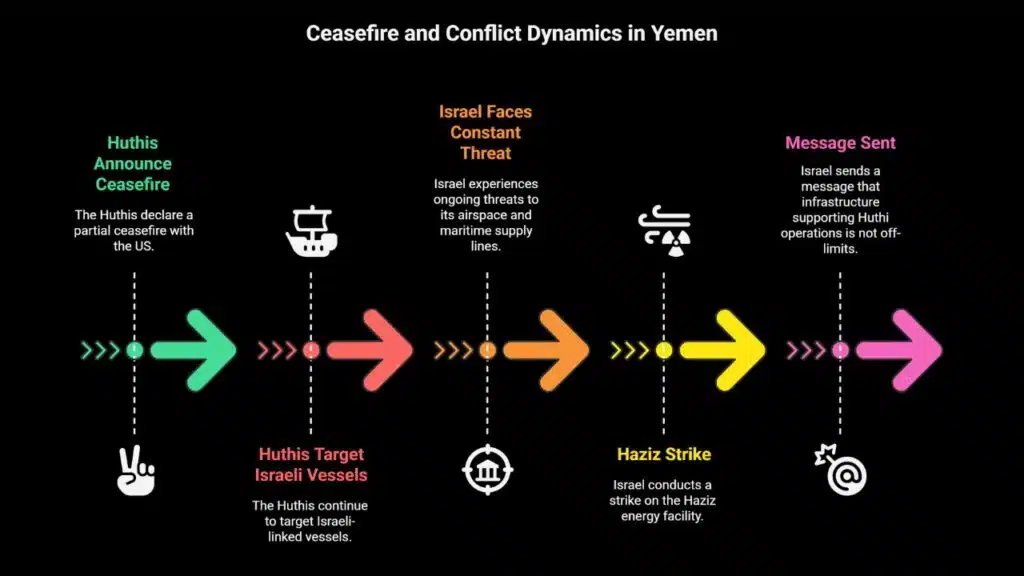
In May 2025, the Huthis announced a partial ceasefire with the United States, but they explicitly declared they would continue to target Israeli-linked vessels. This position has left Israel under constant threat in both its airspace and maritime supply lines.
The Haziz strike demonstrates Israel’s willingness to go beyond defense and directly degrade the Huthis’ capacity. Analysts argue that by targeting an energy facility, Israel is sending a broader message: that any infrastructure perceived to sustain Huthi operations will not be off-limits.
Broader Regional Implications
The attack risks further widening the conflict beyond Gaza. Iran, which provides financial, military, and logistical support to the Huthis, has repeatedly warned that Israel’s “regional aggression” could trigger broader retaliation. Tehran may see the Sanaa strike as another justification to deepen its own proxy strategy across the Middle East, potentially drawing in Lebanon’s Hezbollah and militias in Iraq and Syria.
Meanwhile, Arab League officials and international observers have expressed concern about the strike’s impact on Yemen’s humanitarian crisis. Already, Yemen faces widespread food insecurity, limited fuel imports, and intermittent electricity. Damaging energy infrastructure in Sanaa could worsen living conditions for civilians who are not directly part of the conflict.
The Red Sea Shipping Threat
The Huthis’ naval operations in the Red Sea and Gulf of Aden remain a central concern for global trade. Roughly 12% of global commerce passes through these waters, including oil shipments from the Gulf states to Europe. Disruptions caused by Huthi attacks in late 2023 and 2024 forced some shipping companies to reroute vessels around Africa’s Cape of Good Hope, significantly raising costs and delivery times.
By striking a strategic facility inside Yemen, Israel is aiming to weaken the group’s logistical backbone and send a signal that it will not tolerate continued maritime threats. However, security analysts caution that the Huthis, with Iran’s backing, are unlikely to be deterred entirely. Instead, the strike may prompt retaliatory escalation at sea.
As of now, no fatalities have been reported from the strike, but the political and strategic consequences are expected to unfold over the coming weeks. With Israel vowing to maintain a zero-tolerance stance, further military actions remain likely if the Huthis continue their attacks.
Observers warn that unless diplomatic mediation—possibly through Oman, the United Nations, or regional backchannels—manages to de-escalate tensions, the Middle East could face a prolonged multi-front conflict.
For Israel, the latest strike underscores its expanded military reach and readiness to take action across the region. For the Huthis, it reinforces their narrative of standing up against Israel and its allies. For ordinary Yemenis, it raises fears that the already dire humanitarian situation could worsen, as critical infrastructure becomes a target in a war that increasingly stretches far beyond Gaza.
The Information is Collected from France 24 and MSN.