U.S. President Donald Trump has unveiled a sweeping plan to impose a 50% tariff on goods imported from Brazil, a move that significantly raises tensions between the two countries and revives concerns over global trade instability. The announcement, made through a public letter posted on social media, marks a dramatic escalation from the previously proposed 10% tariff and adds a new layer of geopolitical tension between Washington and Brasília.
This tariff threat is not just part of a general trade policy initiative but is rooted in political and digital disputes, reflecting a wider clash of ideologies, digital sovereignty, and foreign policy direction between Trump and Brazilian President Luiz Inácio Lula da Silva.
Trump Accuses Brazil of Unfair Trade and Political Hostility
In his letter, Trump claimed that Brazil has been engaging in actions that undermine U.S. interests, particularly by targeting American tech companies and allegedly suppressing freedom of expression. He accused the Lula administration of launching what he considers aggressive regulatory and judicial actions against U.S.-based digital platforms.
Among the issues raised is the Brazilian Supreme Court’s recent decision that social media platforms can be held legally responsible for the content their users post. This has significant implications for companies like Elon Musk’s X (formerly Twitter), Meta (Facebook, Instagram), Google (YouTube), and Trump’s own platform, Truth Social, which have been in legal conflict with Brazilian authorities over compliance with misinformation regulations.
Trump tied this digital regulatory issue to broader themes of freedom of speech, alleging that Brazil’s judiciary has been used as a tool to silence political opposition and foreign platforms. He stated that these developments violate what he sees as core American democratic values.
Brazil’s Legal Pressure on U.S. Tech Firms
The Brazilian courts have recently ordered several U.S.-based social media companies to suspend or remove content and user accounts accused of spreading false information related to the 2022 Brazilian presidential election. The action sparked international controversy, especially after Brazil briefly suspended access to Musk’s platform X due to its refusal to comply with court orders.
The rulings come in the context of Brazil’s push to regulate digital misinformation, especially after the country experienced a wave of online disinformation campaigns surrounding its presidential election in 2022. Brazilian lawmakers and judges argue these steps are essential to preserve democratic processes and public safety.
However, Trump and some global observers view these decisions as politically motivated, particularly since they affect content critical of President Lula’s government or sympathetic to former President Jair Bolsonaro.
Trump’s Continued Support for Jair Bolsonaro
Trump used the letter as an opportunity to defend Bolsonaro, who is currently facing legal proceedings in Brazil for allegedly attempting to overturn the results of the 2022 election. Bolsonaro is accused of encouraging or coordinating with supporters who violently stormed government buildings in Brasília in January 2023.
Bolsonaro was not in the country at the time—he had traveled to the United States before the unrest erupted—and he has consistently denied involvement. Brazilian prosecutors, however, allege that his rhetoric and refusal to accept the election results helped incite the violence.
Trump, who has faced similar accusations in relation to the January 6, 2021, Capitol riot in the U.S., drew parallels between his legal troubles and those of Bolsonaro. He claimed both were victims of politically motivated prosecutions by left-wing governments aiming to suppress opposition figures.
In his public messages, Trump portrayed Bolsonaro as a respected leader and dismissed the Brazilian legal process as biased and illegitimate, calling the proceedings against him internationally embarrassing.
Lula Fires Back, Warns of Retaliation
President Lula da Silva responded swiftly and firmly. He warned that any increase in tariffs on Brazilian exports to the U.S. would be met with reciprocal trade measures. Lula rejected what he views as Trump’s attempts to meddle in Brazil’s domestic judicial affairs and accused the former U.S. leader of overstepping diplomatic norms.
Brazil’s government insists that all prosecutions, including those against Bolsonaro, are being conducted through due legal process and are not politically driven. Lula also emphasized Brazil’s sovereign right to uphold judicial independence and regulate social media platforms within its jurisdiction.
He suggested that Trump’s comments reflect an outdated worldview where powerful nations dictate terms to others, asserting that the global order has changed and Brazil will not tolerate external interference.
Broader Tariff Plan Targets 22 Countries
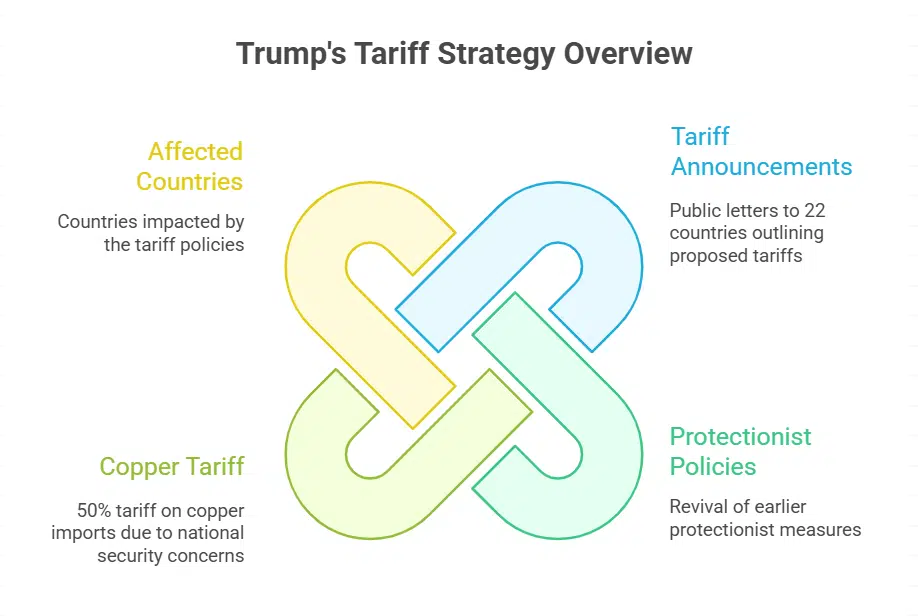
Trump’s warning to Brazil is part of a larger wave of tariff announcements. Over the past week, he has issued 22 public letters to countries across Asia, Africa, and Latin America, including Japan, South Korea, Sri Lanka, and others. These letters outline proposed tariffs on a wide range of imported goods, which Trump says will go into effect on August 1, 2025, should he return to office.
These measures appear to revive earlier protectionist policies that Trump had introduced during his first term and floated again in April 2025, only to put them on hold after strong backlash from global markets and trade partners.
Trump also confirmed that a 50% tariff on copper imports will be enacted on August 1, citing national security concerns. Copper is a critical component in U.S. industries such as electric vehicles, defense systems, and renewable energy infrastructure. Brazil, being a significant exporter of copper, is directly affected by this policy as well.
Section 301 Investigation Threatens Further Sanctions
In addition to the tariff, Trump indicated that he would instruct the Office of the U.S. Trade Representative (USTR) to initiate a Section 301 investigation into Brazil’s digital policies. This tool, part of the U.S. Trade Act of 1974, allows the United States to investigate and retaliate against foreign trade practices considered unfair or discriminatory.
A Section 301 probe into Brazil’s digital policies could pave the way for even broader tariffs, particularly on industries linked to data governance, AI, cloud computing, and online commerce. The use of this mechanism adds a layer of legal legitimacy and shows Trump’s intent to frame his actions within established trade law frameworks, rather than relying solely on executive power.
Trump previously used Section 301 during his presidency to justify tariffs against China and other nations, often triggering retaliatory actions and disrupting global supply chains.
U.S.-Brazil Trade: An Uneven Relationship
Unlike many other nations where the U.S. runs large trade deficits, the U.S. enjoyed a trade surplus with Brazil in 2024, exporting more goods and services to the country than it imported. This makes the proposed tariff increase all the more unusual, as such moves are typically reserved for countries where the U.S. feels economically disadvantaged.
Major U.S. exports to Brazil include aircraft, machinery, chemicals, and medical equipment, while Brazilian exports to the U.S. consist largely of iron ore, coffee, soybeans, and energy products. Analysts suggest that a tariff war could negatively impact both economies, disrupting supply chains and increasing consumer prices.
Trump Targets BRICS, Calls Group “Anti-American”
Further intensifying tensions, Trump also criticized the BRICS summit, which was held in Rio de Janeiro and included Brazil, Russia, India, China, and South Africa. The group aims to build stronger economic and political cooperation among developing nations and reduce dependency on Western-dominated financial institutions like the IMF and World Bank.
Trump labeled BRICS as hostile to American interests and announced that goods from these nations would face an additional 10% import tariff. This could further isolate the U.S. from emerging economies and lead BRICS members to deepen trade relationships with China or the European Union instead.
The summit focused on de-dollarization, creating alternative trade routes, and establishing digital financial infrastructure that bypasses Western oversight—all of which Trump views as undermining U.S. global influence.
Global Reactions and Strategic Implications
The global business community and international trade organizations have expressed concern over Trump’s proposed actions. Economists warn that these tariffs could trigger retaliatory measures, slow economic recovery, and strain bilateral relations with multiple nations, including Brazil.
Diplomatic experts also point out that using trade policy as a tool to intervene in foreign judicial matters—such as Bolsonaro’s trial—could be seen as violating norms of state sovereignty and judicial independence.
Brazil’s role as a leading economy in Latin America and a founding BRICS member adds strategic weight to this standoff. If tensions continue to escalate, it could affect broader regional dynamics, including energy exports, agricultural trade, and digital governance frameworks.
Trump’s 50% tariff threat against Brazil represents more than just a trade dispute—it is part of a broader ideological and political confrontation. By linking trade, tech policy, and political loyalty into one sweeping package, Trump has not only reignited global tariff fears but also redefined how foreign policy, economic nationalism, and digital governance intersect in 2025.
As the U.S. moves closer to its next presidential election, the world is watching closely to see how Trump’s proposed economic agenda might reshape global alliances and strain the rules-based international trade system.