

Meta is intensifying its efforts to become a dominant force in artificial intelligence. CEO Mark Zuckerberg is leading a bold, high-stakes campaign to recruit the best AI minds in the industry, offering unprecedented compensation packages and positioning Meta as a future leader in artificial general intelligence (AGI). This move signals the company’s strategic shift from its struggling metaverse investments to the booming and competitive AI sector.
Meta’s Multi-Billion Dollar Investment in Superintelligence
To jumpstart its vision of building superintelligent AI, Meta recently made a significant move by acquiring a nearly 50% stake in Scale AI, a startup known for supplying high-quality, labeled training data for AI models. This deal, reportedly worth around $14 to $15 billion, values Scale AI at approximately $29 billion—making it one of the largest private investments in the tech space this year.
As part of the agreement, Scale AI’s founder and CEO, Alexandr Wang, has joined Meta to lead its newly established superintelligence team. Wang is bringing along a group of top researchers and engineers, integrating Scale’s data infrastructure directly into Meta’s AI ecosystem. His leadership is expected to play a crucial role in guiding Meta’s strategy in data handling, model training, and long-term research efforts.
Record-Breaking Compensation Offers to Lure Talent
In a move rarely seen in the tech world, Meta is offering up to $100 million in total compensation—including hefty signing bonuses—to attract top-tier AI talent from competing labs like OpenAI and Google DeepMind. These offers include not only financial incentives but also the opportunity to work closely with Zuckerberg himself at Meta’s headquarters, adding an element of executive access and prestige.
Despite the lucrative offers, Meta has faced resistance from some of the industry’s most prominent researchers. Notably, its attempts to recruit individuals from OpenAI and DeepMind have largely been unsuccessful so far. Researchers such as OpenAI’s Noam Brown and Google DeepMind’s Koray Kavukcuoglu have reportedly declined the offers, choosing to stay with their current organizations. This indicates that, for many in the AI community, company mission, values, and innovation culture often outweigh even extraordinary financial incentives.
OpenAI Pushes Back: Culture Over Compensation
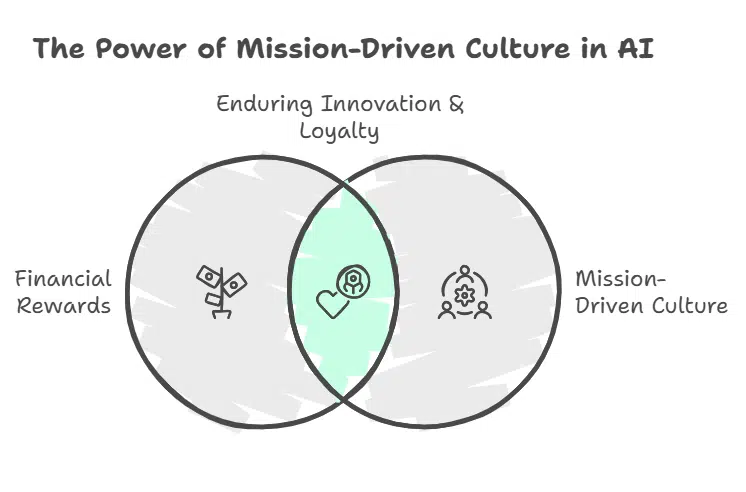
OpenAI, Meta’s key rival in the AGI race, has acknowledged Meta’s aggressive recruitment campaign but emphasized that its own team remains largely intact. OpenAI leadership believes that its mission-driven culture, focused on achieving AGI responsibly and ethically, is a key reason why its top researchers have remained loyal despite Meta’s offers.
The belief at OpenAI is that financial rewards alone cannot foster true innovation or commitment. Instead, building groundbreaking AI requires a collaborative culture where researchers feel aligned with a meaningful long-term mission. The stability of OpenAI’s team suggests that it has successfully cultivated such an environment, which may give it an edge in the long run.
Meta’s AI Challenges and Missed Opportunities
While Meta has made progress in AI with its LLaMA (Large Language Model Meta AI) family, it continues to lag behind competitors in releasing truly groundbreaking models. The company has faced internal delays and performance limitations with its AI systems, which some reports suggest have failed to meet the expected benchmarks.
Adding to its challenges, Google has reportedly cut ties with Scale AI after Meta’s investment, citing competitive conflicts. Since Scale AI was a key supplier of data services for Google’s AI models, this move may complicate Meta’s ability to collaborate across the industry in the future.
Moreover, despite heavy investments in infrastructure, including the development of custom AI chips and in-house data centers, Meta still faces questions about the scalability, efficiency, and originality of its AI efforts.
Meta vs OpenAI: Different Paths to the Future
Meta’s strategy focuses on rapid expansion, massive spending, and infrastructure scaling. The company believes that assembling a team of elite researchers with top-tier tools and vast computing resources will accelerate its path to superintelligence.
On the other hand, OpenAI continues to follow a more research-focused, cautious trajectory. Instead of aggressive expansion, it prioritizes ethics, alignment, and long-term safety of AGI systems. OpenAI’s steady, innovation-led growth model contrasts sharply with Meta’s fast-paced, investment-heavy approach.
This divergence in approach also highlights a broader question in the AI industry: Can money alone buy progress? Or is sustained innovation better achieved through careful planning, principled research, and culture-building?
New AI-Powered Social Platforms: The Next Frontier
Beyond AI research, both Meta and OpenAI are exploring how AI can transform consumer experiences, particularly in the realm of social media.
Meta recently launched the Meta AI assistant, integrated into its apps like WhatsApp, Instagram, and Facebook. The assistant provides AI-powered responses and tools, but it has received mixed reactions. Some users have reported confusion, especially with issues related to data sharing and privacy. Instances of personal AI chats being shared publicly have raised concerns about user trust and platform reliability.
Meanwhile, OpenAI is developing a separate, experimental AI-powered social media application. The app is designed to offer highly personalized content feeds based on user preferences, as opposed to the traditional algorithmic feeds that prioritize engagement and ad revenue. This new model, if successful, could disrupt the way social content is distributed and consumed.
While it’s still early to predict which model will dominate, both companies clearly see AI-powered personalization as a transformative opportunity. This shared vision further intensifies their rivalry—not just over AI research, but also over control of the next generation of digital experiences.
The Talent War Is Far From Over
Meta’s lavish spending and aggressive recruitment mark only the beginning of what is shaping up to be a long-term talent war in AI. As AGI becomes the industry’s holy grail, the fight for top minds, cutting-edge infrastructure, and proprietary datasets is likely to intensify.
Other players, including Anthropic, xAI, and Google DeepMind, are also scaling up their teams and research budgets. With billions of dollars in investments and increasing governmental interest in national AI strategies, the global AI landscape is becoming more complex, competitive, and consequential.
Meta may have succeeded in attracting some high-profile hires, but its ultimate challenge lies in converting its massive investments into breakthrough results. Meanwhile, OpenAI’s confidence in its culture and mission remains a strong defensive wall against external poaching.
The battle between Meta and OpenAI over AI supremacy is more than a corporate rivalry—it’s a clash of philosophies. Meta is betting on scale, capital, and high-stakes recruitment. OpenAI is doubling down on focus, culture, and purpose-driven research.
While Meta’s $100 million offers make headlines, it’s the innovation, values, and long-term vision that will determine who truly leads the next era of artificial intelligence. In the months to come, as new models roll out and new platforms emerge, the world will be watching to see which strategy delivers real intelligence—and real impact.





















