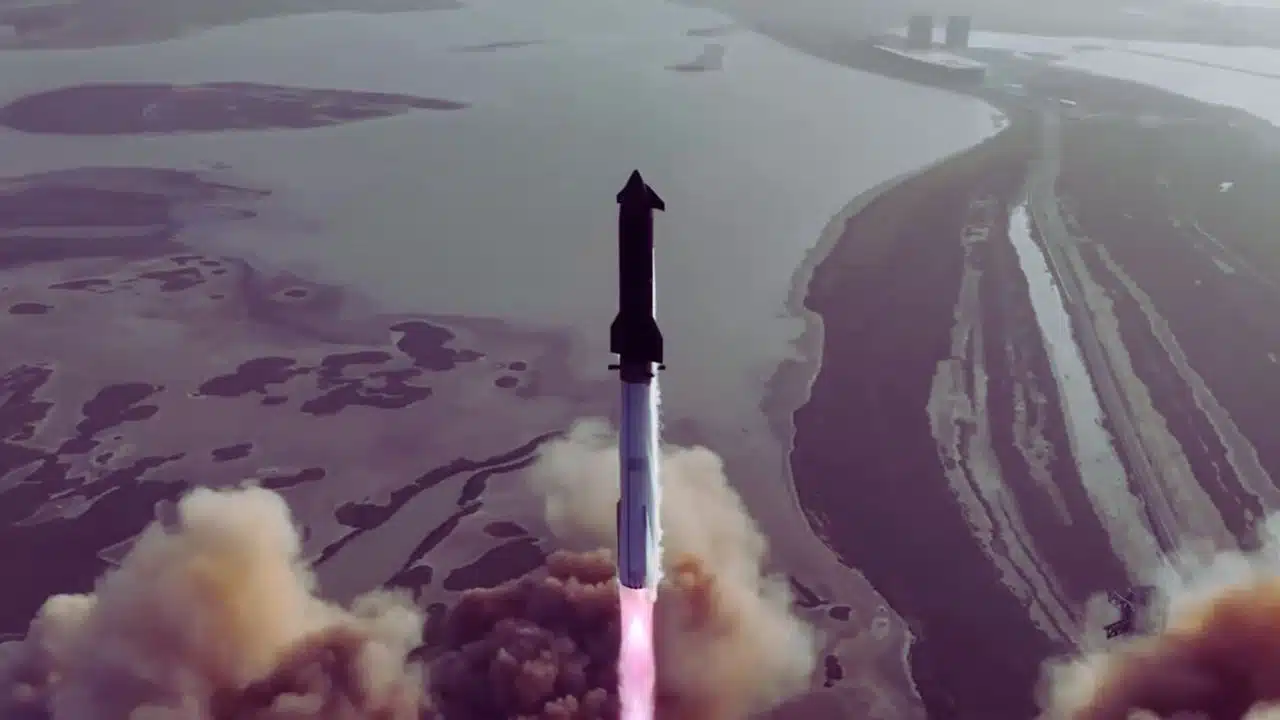
On Tuesday evening, May 27, 2025, Elon Musk’s ambitious mega rocket, Starship, took off from the company’s Boca Chica launch facility in Texas for its ninth test flight. Although the launch itself proceeded as scheduled and marked some technical milestones, the mission ultimately ended in failure, highlighting ongoing challenges for the world’s most powerful launch vehicle.
Starship’s Ambition: The Largest Rocket Ever Built
SpaceX’s Starship is designed to revolutionize space travel. Standing nearly 400 feet tall, the two-stage rocket consists of the Super Heavy booster as its lower stage and the Starship upper vehicle, which is intended to carry cargo—and eventually humans—to destinations such as the Moon and Mars.
The system is intended to be fully reusable, a key part of SpaceX’s vision for sustainable spaceflight. Tuesday’s test aimed to demonstrate progress toward this goal, with key objectives including:
-
A successful stage separation.
-
A full orbit or near-orbit flight of Starship.
-
Controlled reentry and water landing attempts.
-
Deployment of dummy satellites via an onboard bay door.
Launch Details: From Lift-Off to Breakdown
At launch, the Super Heavy booster fired all 33 Raptor engines, generating over 16 million pounds of thrust—making it the most powerful rocket ever launched. After successfully lifting the Starship upper stage to space and separating, the booster was expected to attempt a controlled splashdown in the Gulf of Mexico.
The Starship upper stage then ignited its six vacuum Raptor engines to begin a planned suborbital journey. However, about 45 minutes into the flight, mission control noted a critical issue: a propellant leak caused a loss of pressure in one of the main tanks. This failure disrupted attitude control, leading the spacecraft to spiral uncontrollably.
Although SpaceX announcers remained hopeful for a water landing, telemetry was lost shortly thereafter, and the company later confirmed that the vehicle disintegrated upon reentry over the Indian Ocean, far from U.S. airspace.
Satellite Deployment Failure: Bay Door Didn’t Open
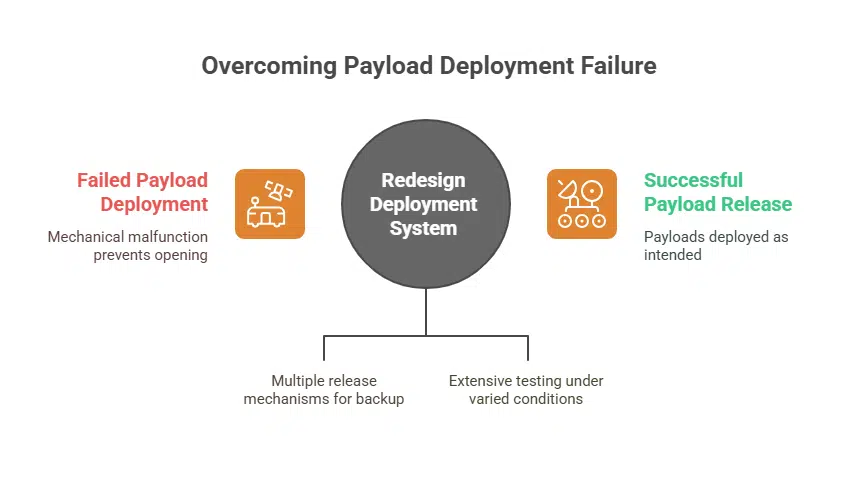
Another mission goal was to deploy dummy satellite payloads during flight using an automated bay door. However, SpaceX confirmed that the door failed to open due to a mechanical malfunction. As a result, none of the planned test payloads were released, and one of the mission’s key data-gathering goals was unfulfilled.
This marks a significant failure, as the payload deployment system is a critical component for future commercial satellite launches and deep-space missions.
A Pattern of Explosions: Starship’s Troubled History
This isn’t the first time Starship has encountered trouble during testing. In fact, the past several test flights have ended in similar fiery failures:
-
Flight 7 (January 2025): An engine bay fire caused by a propellant leak led to Starship’s explosion over the Turks and Caicos Islands, scattering debris across the Caribbean.
-
Flight 8 (March 2025): A hardware failure above one of the six engines triggered an onboard fire, causing the spacecraft to break apart mid-flight.
-
Flight 9 (Current test): A propellant leak disrupted tank pressure and attitude control, leading to the spacecraft’s uncontrolled spin and eventual disintegration during reentry.
Despite these repeated failures, SpaceX insists each test flight contributes valuable data for refining design, performance, and safety.
Environmental Impact: Ongoing Scrutiny and Violations
SpaceX’s operations at Starbase in Boca Chica, Texas, have come under increasing scrutiny from both environmental groups and federal regulators. Located near state parks and wildlife refuges, the launch site has been criticized for its impact on local ecosystems, including the destruction of endangered shorebird nests.
According to records from the Environmental Protection Agency (EPA) and the Texas Commission on Environmental Quality (TCEQ), SpaceX has violated the Clean Water Act multiple times by discharging tens of thousands of gallons of wastewater into the surrounding environment. In September 2024, the company was fined $150,000 for these violations.
Environmental groups also continue to file lawsuits over permits issued to SpaceX. One recent suit alleges that the TCEQ issued improper discharge permits, endangering protected wetlands and violating federal environmental laws.
What Went Wrong This Time?
Following the flight, SpaceX issued a statement clarifying the nature of the failure:
“The upper stage of Starship experienced a propellant leak, which led to a pressure loss in the main tank. This resulted in a loss of attitude control, which prevented the spacecraft from performing a controlled reentry and splashdown.”
Interestingly, the company also emphasized that this failure was different from those in previous flights, indicating a new, previously undetected technical issue. The root cause of the leak is under investigation, but early speculation suggests it could be tied to internal tank vibration or structural fatigue under prolonged engine burns.
Elon Musk and SpaceX Respond
Elon Musk has remained optimistic despite public criticism and the string of failures. In a post on X (formerly Twitter), Musk said:
“Each test flight gives us enormous data. We’re learning fast. Expect Starship 10 to be better in every way.”
SpaceX maintains that failure is part of the development philosophy, especially when dealing with such a massive and complex engineering system. Engineers believe these tests are necessary to work out issues before carrying humans or large payloads.
What’s Next for Starship?
Despite the setback, SpaceX is pushing forward. The next flight, Flight 10, is already being prepared and may occur as early as August 2025, pending regulatory approval and hardware updates.
Key focus areas for the upcoming flight include:
-
Strengthening the fuel tank systems.
-
Reworking the satellite deployment mechanism.
-
Improving engine insulation to prevent onboard fires.
-
Enhancing redundancy in control systems to better manage loss-of-function scenarios.
The long-term goal remains clear: enable regular flights to the Moon, Mars, and beyond. Starship is central to both NASA’s Artemis Program and SpaceX’s own Mars colonization plans.
The May 27 Starship test highlights both the potential and peril of cutting-edge aerospace innovation. While SpaceX has made historic strides in reusability and payload capacity, the company must now address a series of complex technical and environmental hurdles.
For now, the dream of interplanetary travel remains alive—but grounded. Each launch brings us closer, even if the journey is paved with fire, failure, and learning.