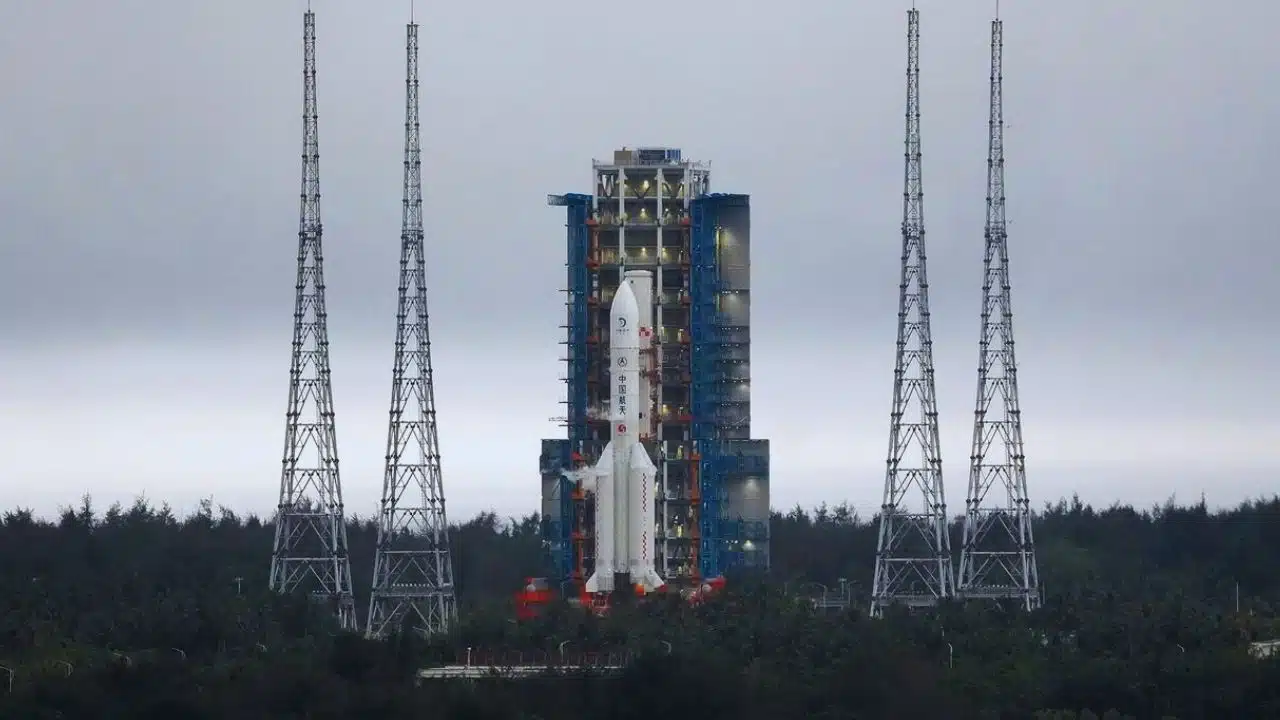
China has made a historic achievement by landing its Chang’e-6 craft on the far side of the moon. This success not only elevates China’s status in the global space race but also highlights the country’s technological advancements and ambitious goals in space exploration. This landmark event occurred at 6:23 a.m. Beijing time (2223 GMT), as confirmed by the China National Space Administration (CNSA).
Chang’e-6: A Landmark Achievement
The Chang’e-6 mission stands out as the first human sampling and return mission from the far side of the moon. This mission is significant for several reasons, primarily due to the numerous engineering innovations it involves. The CNSA stated, “The Chang’e-6 mission is the first human sampling and return mission from the far side of the moon. It involves many engineering innovations, high risks, and great difficulty.” The payloads carried by the Chang’e-6 lander are expected to function as planned, performing essential scientific exploration missions that will contribute valuable data to our understanding of the moon’s composition and history.
Strategic Importance of the Far Side of the Moon
Landing on the far side of the moon is a significant achievement because this region has never been reached by any country before. The far side of the moon, which perpetually faces away from the Earth, poses unique challenges for communication and navigation. This orientation complicates missions to this part of the moon, making China’s successful landing a testament to their technological prowess and strategic planning. The ability to conduct missions in this remote and challenging environment signifies a major technological breakthrough and highlights China’s growing capabilities in space exploration.
Mission Details and Future Prospects
The Chang’e-6 probe landed nearly a month after it was launched by a Chinese Long March-5 rocket from the Wenchang Space Launch Center on the southern island of Hainan. This launch is part of a broader strategy by China to advance its space exploration capabilities and establish a strong presence in lunar research. The successful landing of the Chang’e-6 craft is a crucial step in China’s long-term goals of exploiting lunar minerals, which are considered vital for sustaining long-term astronaut missions and establishing permanent moon bases.
The Chang’e-6 mission not only reinforces China’s commitment to lunar exploration but also positions the country as a key player in the ongoing international efforts to explore and utilize the moon’s resources. These resources are seen as crucial for the future of space exploration, as they can support extended missions and the development of lunar bases that will serve as launch points for further space exploration.
Scientific Goals and Innovations
The scientific goals of the Chang’e-6 mission are ambitious and multifaceted. The payloads carried by the Chang’e-6 lander will perform a variety of scientific tasks, including the collection and analysis of lunar samples. These samples will provide valuable insights into the geological history of the moon and enhance our understanding of its composition. The mission also aims to study the moon’s environment and the effects of its unique conditions on scientific instruments and human operations. This information will be critical for planning future missions and ensuring the safety and success of astronauts and equipment on the moon.
The engineering innovations required for this mission are significant. The Chang’e-6 lander is equipped with advanced technology designed to operate in the harsh and challenging environment of the far side of the moon. This includes communication systems capable of transmitting data over long distances and through obstacles, as well as scientific instruments capable of performing complex analyses in situ. These innovations represent a significant advancement in space technology and demonstrate China’s growing capabilities in this field.
China’s Role in the Global Space Race
China’s successful Chang’e-6 mission underscores its advancing capabilities in space exploration. As countries like the United States and others also strive to harness lunar resources, this achievement places China at the forefront of the global push to explore and utilize the moon. The mission’s success is a testament to China’s innovative engineering and commitment to scientific discovery. It also highlights the country’s strategic vision for the future of space exploration, which includes not only lunar missions but also plans for Mars exploration and other deep space missions.
China’s achievements in space exploration have broader implications for the international space community. The successful landing of the Chang’e-6 craft demonstrates the potential for international collaboration and competition in space exploration. As more countries and private companies become involved in space missions, the exchange of knowledge, technology, and resources will be crucial for advancing our collective understanding of space and achieving common goals.
China’s successful Chang’e-6 mission is a major milestone in the country’s space exploration efforts. The mission’s achievements in engineering, science, and strategic planning demonstrate China’s growing capabilities and ambitions in space. As the global race to explore and utilize lunar resources continues, China’s accomplishments will play a crucial role in shaping the future of space exploration. This mission not only advances our understanding of the moon but also sets the stage for future missions and the continued development of space technology.
The Information is Collected from Space and Science.