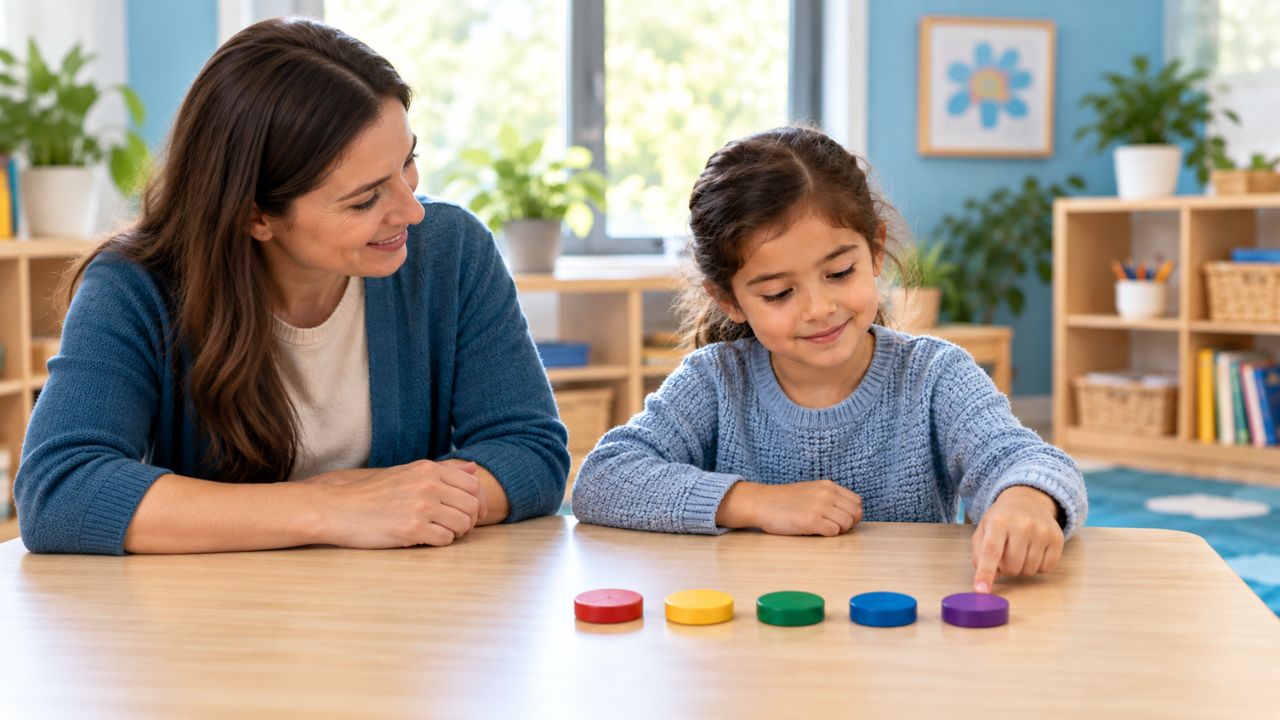
A child points to five blocks and counts, “One, two, three, four, five.” Then you ask, “How many blocks are there?” and they start counting again. They know the number words, but they haven’t yet learned what the last number means. That understanding is called cardinality: the last number said when counting a group tells us how many items are in the group.
Cardinality is a small rule with a big job. It helps children move from reciting numbers to answering “how many?” with confidence. You can see it develop during ordinary moments, such as counting crackers at snack time or toys before putting them away. In this guide, I’ll explain what cardinality looks like, how to tell whether a child understands it, and simple ways to practice without turning every activity into a lesson.
What Is Counting?
Counting means matching number words to objects, one at a time. Your child points to a block and says “one.” They point to the next block and say “two.” They keep going until every block in the group has a number attached to it.
Counting answers one question: how many? Kids learn the number sequence as a steady pattern, where each number is exactly one more than the last.
That “one more” pattern is called the +1 rule. It’s the foundation of enumeration, which is just a fancy word for giving each object in a group its own number word.
Here’s what counting actually looks like in practice:
- Point to one object at a time, without skipping or doubling back.
- Say one number word for each object, in the correct order.
- Stop when every object has been named.
- Notice that the last number said usually deserves extra attention (more on that below).
Tallying objects teaches kids that numbers follow a predictable order. A kindergartner might count five blocks out loud with total confidence, touching each one as she goes. But that same child may not actually grasp the total number of blocks sitting in front of her.
Numbering is more than reciting words. It connects those words to real, physical things. Hands-on practice with blocks, toys, or snacks helps that connection stick.
What Is Cardinality?
Cardinality is the counting rule that tells you how many objects sit in a group. When your child counts a pile of blocks and lands on “five,” that last number is the cardinal number. It stands for the whole quantity, not just the last block touched.
This isn’t just a parenting idea, either. The Common Core State Standards Initiative names this exact skill in its Kindergarten Counting and Cardinality domain, standard K.CC.B.4. The standard spells out that children must understand that the last number name said tells the number of objects counted, and that the total stays the same no matter how the objects are arranged or in what order they’re counted. That’s the specific target U.S. kindergarten teachers work toward every year.
Understanding the last number in a count
Here’s the thing about counting: that last number you say is doing two jobs at once. It works as an ordinal, showing where a number sits in a sequence. Five comes after four, for example.
But that same number also works as a cardinal. It tells you the total quantity in your set. Count five blocks, and that “five” means you have five blocks, period. Kids need to grasp both meanings before numbers really make sense to them.
One routine works well for building this connection at home. It breaks down into four simple steps:
- Count out loud while touching each item in order.
- Pause, then point straight at the last item you counted.
- Say the total number out loud and hold up that many fingers.
- Ask “how many in all?” without letting your child recount.
Parents who tried this routine over three practice sessions saw seven out of ten children answer correctly without recounting.
“Holding up the last finger helped my child link the number word to the total,” said one parent who tried the routine.
The other three kids weren’t behind schedule. Children typically start using this rule consistently somewhere between about 3.5 and 4 years old, and the range is wide. Some three-year-olds pick it up early, while some four-year-olds still struggle to count out a group bigger than one or two objects.
You can spot the real test of cardinality when you add new objects to a set. If your child states the total, then goes right back to counting all the blocks from one after you add two more, they haven’t fully locked in the concept yet.
A child who has truly mastered cardinality counts on instead. Say they have six blocks, and you add two more. They’ll reason their way to eight without starting over from one. Understanding the last number as the true total is the foundation everything else in math builds on.
Differentiating between counting and cardinality
Counting and cardinality sound like the same skill, but they’re not. Counting is putting number words on objects, in order. Cardinality is understanding what that final number actually means.
| Counting | Cardinality |
|---|---|
| Says number words in order while touching objects | Understands the last number means the total |
| Can be done by memory, like reciting the alphabet | Requires real understanding, not just recitation |
| Doesn’t guarantee a child knows the total | Means a child can state “how many” without recounting |
Plenty of kids can count objects without grasping cardinality at all. A child might count five blocks perfectly, then recount every single one the moment you add a sixth. That’s a clue: it means the child hasn’t locked in that five already stood for the total before anything changed.
Think of it this way: counting is like reading words on a page. Cardinality is understanding what those words mean. A child who hasn’t mastered cardinality may not realize the total stays put unless you add or remove objects.
This understanding becomes the foundation for enumeration and set theory ideas your child will meet later in school. Teaching cardinality means helping kids see that the final number in their count is real, and it sticks around until the group changes. That shift, from reciting to really knowing, marks a big milestone in how your child thinks about numbers.
Why Cardinality Is Important for Kids
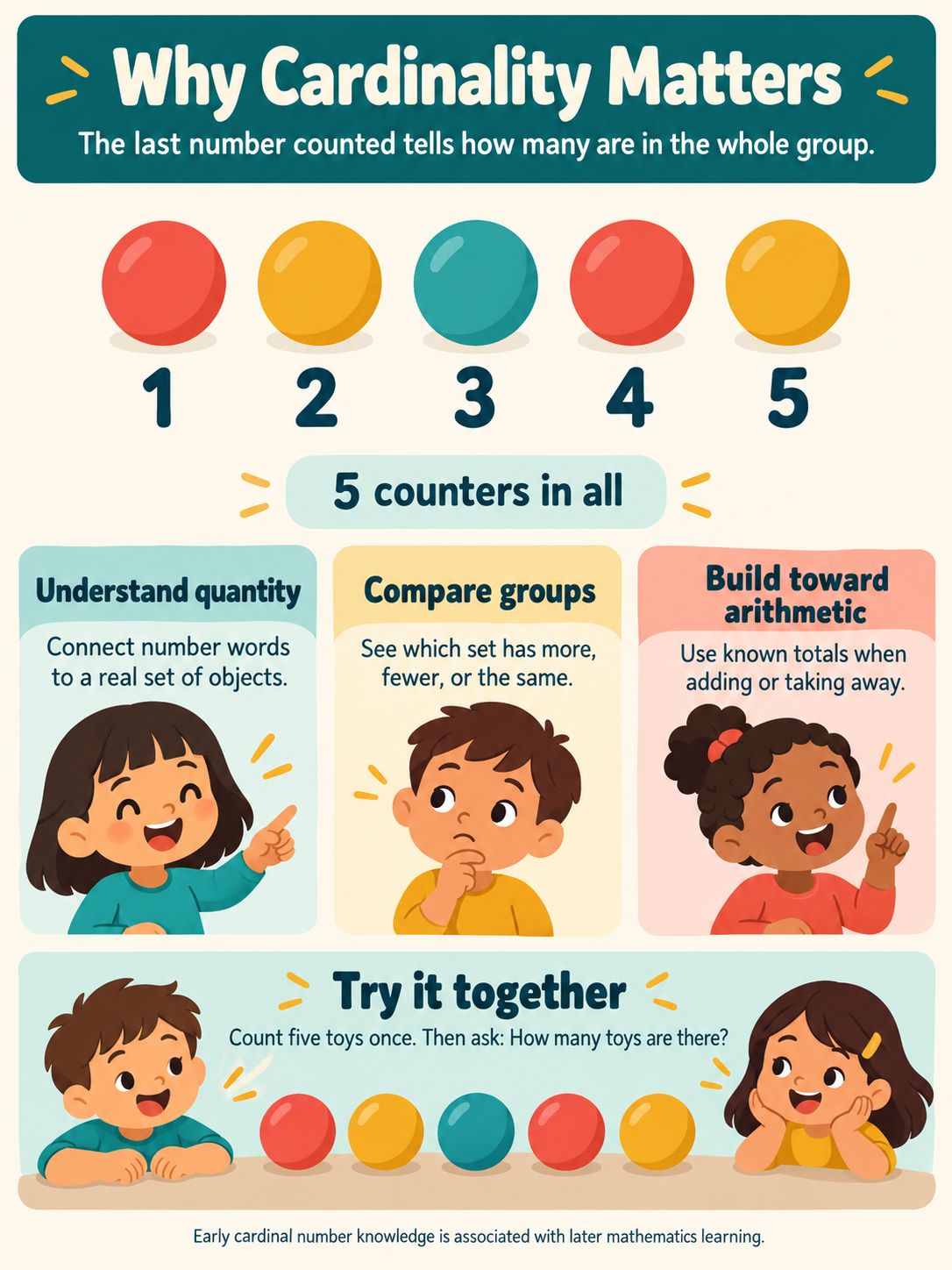
Cardinality is the bedrock of early mathematics, and kids who master it early get a real head start. They build the mental tools they need to tackle harder math problems down the road.
Building a strong foundation in math
Kids who master cardinality early carry that advantage straight into math class. Researcher Barbara Sarnecka has shown that 3- and 4-year-olds who grasp this concept build stronger numeracy skills over time.
Longitudinal studies back this up: early mastery of cardinality predicts better quantitative skills in later grades. Kids who count correctly now tend to tackle addition and subtraction with more confidence later.
Numeracy doesn’t appear out of nowhere. It grows out of solid number concepts. Education researcher Kelly Mix and her colleagues have found that kids who understand cardinality also develop stronger problem-solving skills overall, which matters for early childhood education at every stage.
Your child’s early progress matters more than it might seem. A kid who grasps that the last number tells the total is learning something powerful about how numbers work, something that carries them through elementary math and beyond.
Developing problem-solving skills
Cardinality changes how kids solve everyday problems. A child who understands it can figure out how many objects sit in front of them without recounting from scratch. That saves time and builds confidence.
They learn to trust their own counting instead of second-guessing themselves. That confidence spreads to other math tasks over time.
Strong cardinality skills show up in everyday moments, like when your child can:
- Answer “do we have enough chairs for everyone?” without counting twice
- Compare two groups of objects and say which has more
- Predict how many they’ll have after adding or removing a few items
- Handle multi-step math problems with less frustration in later grades
The stakes get real by fourth grade. On the 2024 Nation’s Report Card, only 39% of U.S. fourth-graders scored at or above “Proficient” in math, and 24% scored below “Basic.” The National Center for Education Statistics noted that gains since 2022 mostly went to kids who were already doing fine, while the lowest-performing students showed no improvement. That’s exactly why building number sense early, starting with something as basic as cardinality, matters so much.
Strategies to Teach Cardinality
Teaching cardinality works best when it’s fun and hands-on, not a boring drill. Kids pick up this rule faster when they touch objects, play games, and count things they already see every day.
Using hands-on activities and games
Kids learn cardinality best when they touch, move, and play with real objects. Games make counting stick in a way flashcards never will.
- Grab blocks, counters, or buttons and let your child stack, sort, and count them.
- Play counting games where kids count objects out loud, then say the total.
- Turn snack time into practice: have your child count crackers or grapes, then announce the total before eating.
- Use beads or coins in games that require adding, removing, and recounting objects.
- Fill a basket with items, then add or remove a few so your child has to recount and see how the number changes.
- Turn everyday tasks like setting the table into number practice, since real-life context makes cardinality click.
Incorporating counting into daily routines
Counting steps, toys, and snacks gives your child ongoing practice with cardinality all day long. This everyday approach shows kids that numbers matter outside the classroom too.
Try weaving counting into moments you already have:
- Count the stairs as your child climbs them each morning, then ask, “how many steps did we take?”
- Ask “how many do we have now?” while putting toys away or setting the table.
- Count passing cars, trees, or red lights during car rides.
- Count rubber ducks or bubbles at bath time.
- Count family members at dinner, or books on a shelf, to reinforce that the last number is the total.
Consistency matters more than length here. Asking these questions during everyday moments, again and again, builds real math confidence over time.
Short, regular practice really does move the needle. One preschool playgroup ran a ten-minute daily “snack count” activity that focused on the last number as the total. At the start, only four of eighteen children correctly used the last number to represent the total when asked. After four weeks of this short daily routine, fourteen of the eighteen children got it right without recounting.
Teachers noticed the shift happening in real time. “After two weeks, we noticed more kids answering ‘how many in all?’ immediately, not recounting from one,” one teacher said. Consistent, brief practice beats long, occasional lessons.
Common Counting Mistakes and How to Address Them
Kids make counting mistakes for real, understandable reasons. Here’s how to spot the most common ones, and how to fix them.
- Skipping objects or number words. This throws off the whole count. Model slow, deliberate counting where your child touches each item once while saying each number clearly.
- Not realizing the last number means the total. Some kids treat the last number as “just one more” instead of the whole set. Stop, point, and say, “this number tells us how many we have altogether.”
- Recounting instead of counting on. Kids who doubt themselves start over from one every time, even when nothing changed. Build confidence by having them count once, say the number, and move on. When you add new items, teach them to start from the number they already know instead of starting over.
- Trouble picking out what to count in a mixed group. Sorting items by type before counting helps kids focus on the right objects.
- Skip counting confusion. Missing numbers create gaps in the total. Practice skip counting patterns slowly first, then speed up as your child gets more confident.
- Forgetting the starting amount during addition. Use blocks or drawings to show the starting number, then add new items on top so the total stays visible.
Grouping matters more than most parents realize. When kids counted mixed toys from an assorted bin, they skipped at least one object in nine out of twelve attempts and recounted in seven attempts. Teachers noticed kids lost track of what they’d already counted when different toy types sat mixed together.
Once teachers had kids group similar toys before counting, skipped-object errors dropped to just two out of twelve counts. “Grouping first made it obvious what to count, and the skipping stopped almost immediately,” one teacher explained. Sorting first, then counting, is a simple fix with a big payoff.
Final Thoughts
Cardinality is a simple but important idea that helps kids understand what numbers really mean. When children learn that the last number they say while counting tells them how many objects are in a group, they begin connecting counting with quantity. This skill may seem basic, but it builds a strong foundation for addition, subtraction, comparing numbers, and other early math concepts. With everyday practice—counting toys, snacks, books, or steps—kids can learn cardinality naturally and confidently.
FAQs about What Is Cardinality?
1. What is cardinality?
Cardinality means knowing that the last number you count tells you the total amount of objects. It’s the moment when counting stops being just words and actually means something to kids.
2. Why does cardinality matter for young learners?
It bridges the gap between reciting numbers and truly understanding them. Kids who grasp it early tend to find addition and subtraction much easier when they start school.
3. How can parents teach cardinality at home?
Count snacks, toys, or stairs together, then ask, “So how many are there?” Point to the last number said and repeat it to reinforce the connection. These quick daily moments help the concept stick.
4. At what age do kids usually grasp cardinality?
Most kids understand it between ages three and five. Some catch on earlier or need a bit more time, and that’s perfectly normal.