

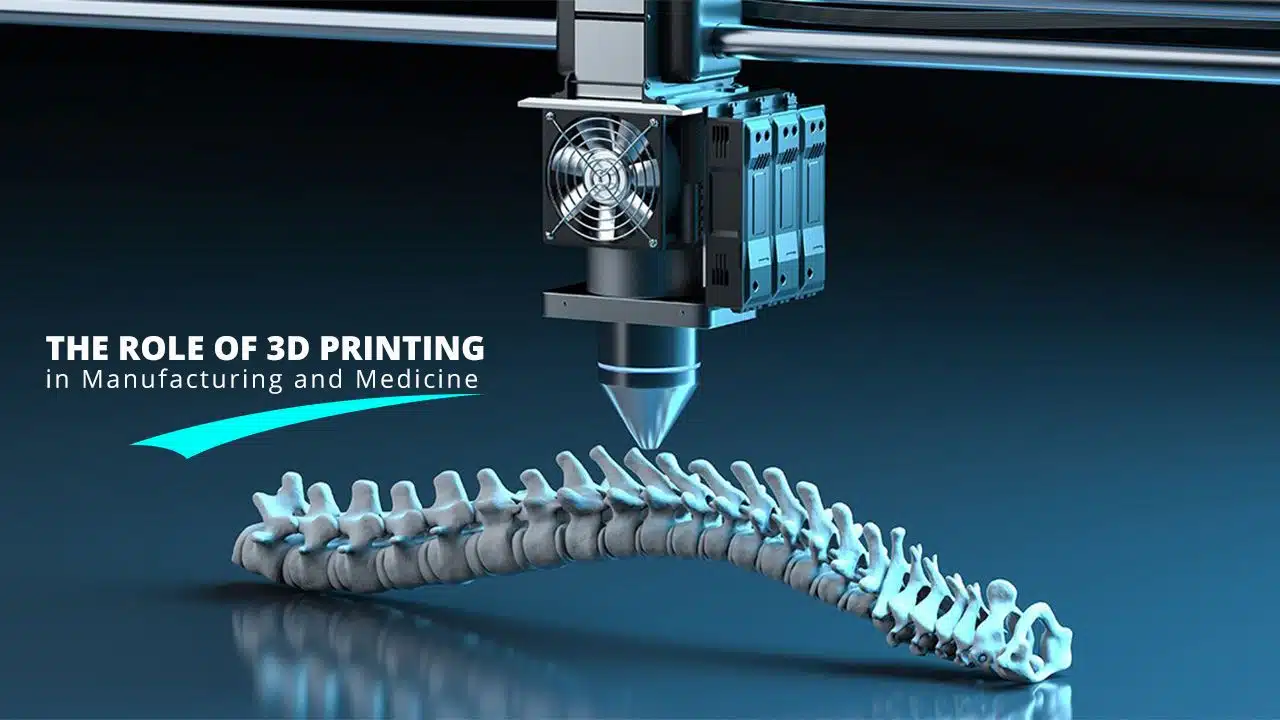
Imagine a world where you can print a new kidney for a transplant patient, create a custom-fit prosthetic limb in hours, or manufacture complex machine parts with a button. This isn’t science fiction – it’s the rapidly evolving reality of 3D printing. Also known as additive manufacturing, 3D printing is revolutionizing how we create objects, from tiny medical implants to massive industrial components. It’s a technology bridging the gap between digital designs and physical reality, layer by meticulously.
In recent years, 3D printing has moved far beyond its initial applications in rapid prototyping. Today, it’s reshaping entire industries, particularly in manufacturing and medicine. This transformative technology is changing what we can make and how we make it – offering unprecedented levels of customization, reducing waste, and opening up new possibilities in design and functionality.
As we delve into the world of 3D printing, we’ll explore how this groundbreaking technology is revolutionizing production lines, enhancing medical treatments, and pushing the boundaries of what’s possible in both fields.
3D printing leaves an indelible mark on our world, from factories to operating rooms, one layer at a time. Let’s embark on a journey to understand this remarkable technology’s present and future impact.
What is 3D Printing?
At its core, 3D printing is creating three-dimensional objects from digital files. Unlike traditional manufacturing methods that often involve cutting away material (subtractive manufacturing), 3D printing builds objects by adding material layer by layer – hence the term “additive manufacturing.”
The process begins with a 3D digital model, typically created using Computer-Aided Design (CAD) software or 3D scanning. This model is then sliced into hundreds or thousands of horizontal layers by specialized software. The 3D printer reads this file and creates the object, one layer at a time.
There are several 3D printing technologies, each with its strengths:
- Fused Deposition Modeling (FDM): Melts and extrudes plastic filament, building the object layer by layer.
- Stereolithography (SLA): Uses a laser to cure and solidify liquid resin.
- Selective Laser Sintering (SLS): Uses a laser to sinter powdered material, often nylon or metal.
- Digital Light Processing (DLP): Similar to SLA, but uses a digital light projector screen.
- Electron Beam Melting (EBM): Melts metal powder layer by layer with an electron beam in a high vacuum.
Materials used in 3D printing have expanded significantly and now include various plastics, metals, ceramics, and even biological materials.
3D Printing in Manufacturing
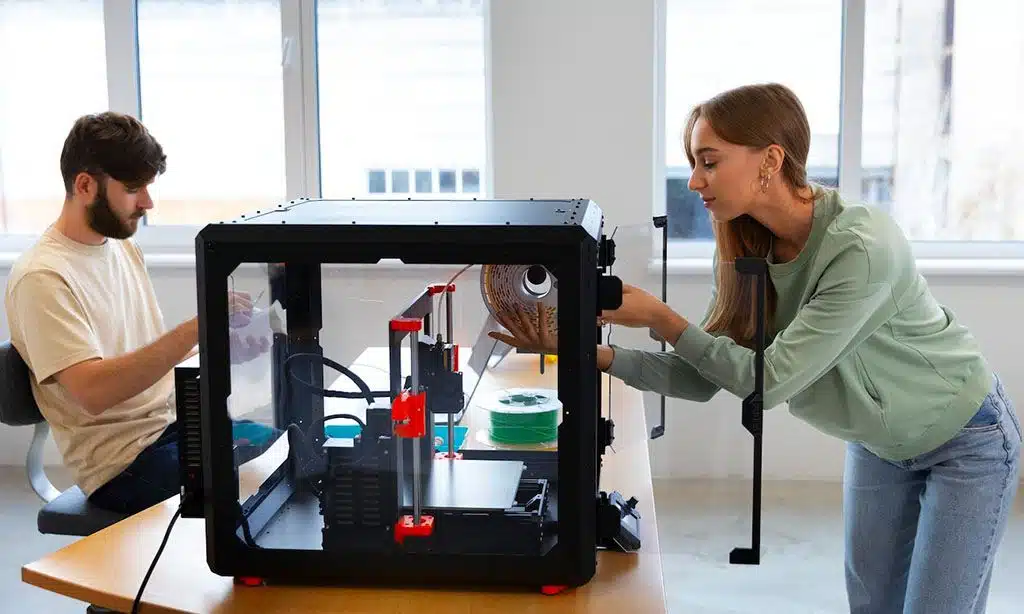
The impact of 3D printing on manufacturing has been profound, offering new ways to design, prototype, and produce goods. Let’s explore some critical areas in more depth:
Rapid Prototyping
Rapid prototyping was one of the first widespread applications of 3D printing in manufacturing. It allows companies to quickly create physical prototypes of new product designs, significantly speeding up the product development cycle.
Benefits of rapid prototyping with 3D printing include:
- Faster iteration: Changes can be made to the digital model, and a new prototype can be printed in hours, not weeks.
- Cost-effective: Eliminates the need for expensive molds or tooling for prototype creation.
- Risk reduction: Design flaws can be identified and corrected early in development.
- Improved communication: Physical prototypes enhance understanding among design teams and stakeholders.
For example, Ford Motor Company uses 3D printing extensively in its product development process. They can now 3D print a prototype engine in four days and $3,000, compared to four months and $500,000 using traditional methods.
Custom Production
3D printing excels at producing customized, one-off, or small-batch items. This capability is transforming several industries:
- Aerospace: Companies like Boeing and Airbus use 3D printing to create custom brackets, ducts, and other lighter and more efficient components than traditional parts.
- Automotive: Local Motors 3D printed the entire body of their Strati car in just 44 hours.
- Fashion: Companies like Adidas use 3D printing for custom shoe soles, while others explore 3D-printed clothing.
- Jewelry: Custom jewelry designs can be 3D printed in wax and cast in precious metals.
On-Demand Manufacturing
3D printing enables a shift from “make-to-stock” to “make-to-order” manufacturing. This has several advantages:
- Reduced inventory costs: Parts can be printed as needed, reducing warehousing expenses.
- Decreased obsolescence: Digital designs can be stored indefinitely and printed on demand.
- Localized production: Items can be produced closer to the point of use, reducing shipping costs and time.
For instance, the U.S. Marine Corps has experimented with mobile 3D printing labs to produce spare parts in the field, reducing the need for extensive supply chains.
Complex Geometries
With traditional manufacturing methods, 3D printing can create complex shapes that are difficult or impossible to produce. This opens up new possibilities in design and functionality:
- Lattice structures: 3D printing can create internal lattice structures that reduce weight while maintaining strength.
- Consolidated parts: Complex assemblies can often be redesigned as a single 3D printed part, reducing assembly time and potential points of failure.
- Biomimicry: Designs inspired by nature, often too complex for traditional manufacturing, can be realized through 3D printing.
General Electric’s 3D-printed fuel nozzle for jet engines is a prime example. The 3D printed version, which combines 20 parts into one, is 25% lighter and five times more durable than the traditional version.
Reduced Waste
Traditional subtractive manufacturing often results in significant material waste. 3D printing, as an additive process, typically uses only the material needed for the part itself. This can lead to:
- Material savings: Especially significant for expensive materials like titanium in aerospace applications.
- Energy efficiency: Less energy is often required to 3D print a part than traditional methods.
- Sustainability: Reduced waste contributes to more sustainable manufacturing practices.
A study by the U.S. Department of Energy’s Oak Ridge National Laboratory found that 3D printing can reduce material costs by up to 90% compared to traditional manufacturing methods.
3D Printing in Medicine
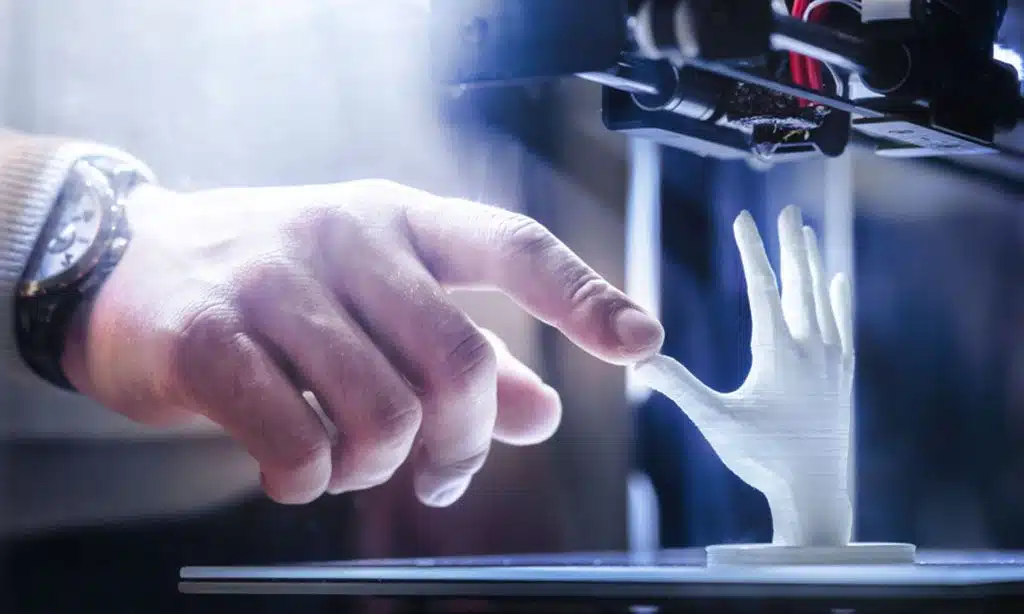
The medical field has embraced 3D printing technology, leading to significant advancements in patient care, medical education, and research. Let’s delve deeper into some critical applications:
Custom Prosthetics and Orthotics
3D printing has revolutionized the production of prosthetic limbs and orthotic devices:
- Perfect fit: 3D scanning of the patient’s anatomy ensures a precise, comfortable fit.
- Rapid production: Prosthetics can often be produced in days rather than weeks.
- Cost-effective: 3D printed prosthetics can be significantly cheaper, especially beneficial for children who quickly outgrow them.
- Customization: Prosthetics can be easily customized for specific activities or aesthetic preferences.
For example, UK-based Open Bionics has developed 3D-printed bionic arms for children themed after popular superheroes. These not only function well but also help boost the confidence of young users.
Surgical Planning and Training
3D-printed anatomical models are increasingly used in surgical planning and medical training:
- Complex surgeries: Surgeons can practice on exact replicas of a patient’s anatomy before the actual surgery.
- Patient education: 3D models help patients better understand their condition and planned procedures.
- Medical training: Students can practice procedures on realistic 3D printed organs without risk to patients.
In 2020, Lucile Packard Children’s Hospital Stanford surgeons used a 3D-printed model to plan a complex surgery separating conjoined twins, contributing to the operation’s success.
Dental Applications
The dental industry has been an early and enthusiastic adopter of 3D printing:
- Clear aligners: Companies like Invisalign use 3D printing to create custom clear braces.
- Crowns and bridges: Can be 3D printed for a precise fit, often in a single dental visit.
- Dental models: These are used for treatment planning and creating traditional dental appliances.
The global 3D printing market in dentistry was valued at $2.5 billion in 2021 and is expected to reach $10 billion by 2030.
Bioprinting
Perhaps the most exciting and challenging application of 3D printing in medicine is bioprinting – the process of printing living tissues and organs:
- Tissue engineering: Scientists can print living cell structures for drug testing or disease modeling.
- Organ printing: While still in the early stages, researchers are working towards printing functional organs for transplantation.
- Skin grafts: 3D bioprinted skin is being developed for burn victims and cosmetic testing.
In 2019, researchers at Tel Aviv University successfully 3D printed a small heart complete with cells, blood vessels, ventricles, and chambers – a significant step towards printed organ transplants.
Custom Implants
3D printing allows for the creation of patient-specific implants:
- Cranial implants: Custom skull plates can be printed to match a patient’s anatomy.
- Joint replacements: 3D-printed hip and knee implants can be tailored to a patient’s unique bone structure.
- Spinal implants: Custom spinal cages can be printed to fit precisely between vertebrae.
A study published in the Journal of Cranio-Maxillofacial Surgery found that 3D-printed custom implants led to better outcomes and reduced surgery time compared to traditional implants.
Drug Delivery Devices
3D printing is opening new possibilities in drug delivery:
- Personalized dosing: Pills can be 3D printed with precise doses tailored to individual patients.
- Complex release profiles: Multi-drug pills with different release timings can be created.
- Novel geometries: Unique shapes can be printed for specific drug release characteristics.
In 2015, the FDA approved the first 3D-printed drug, Spritam, used to treat epilepsy. Its porous 3D-printed structure dissolves more quickly than traditional pills.
Challenges and Limitations
While 3D printing offers numerous benefits, it also faces several challenges:
- Speed: Traditional manufacturing methods are often faster for large-scale production.
- Materials: While the range of printable materials is expanding, it’s still limited compared to traditional manufacturing.
- Size constraints: Most 3D printers have limitations on the size of objects they can produce.
- Regulatory hurdles: 3D printed devices must meet strict regulatory requirements in medicine, which can slow adoption.
- Cost: For some applications, 3D printing remains more expensive than traditional methods, especially for large production runs.
- Quality control: Ensuring consistent quality across 3D printed parts can be challenging, particularly for critical components.
- Post-processing: Many 3D printed parts require additional finishing steps, adding time and cost to the process.
- Intellectual property issues: 3D printable designs can be easily shared, raising concerns about design theft and counterfeiting.
Future Outlook
Despite these challenges, the future of 3D printing in manufacturing and medicine looks promising. Here are some developments we might see:
- Faster printing: New technologies like Continuous Liquid Interface Production (CLIP) promise to speed up printing dramatically.
- New materials: Researchers are developing new printable materials, including multi-material printing capabilities.
- Larger scale: Companies like Big Rep and Voxeljet are creating ever-larger 3D printers for industrial applications.
- Bioprinting advancements: We may see the first 3D-printed organs for transplantation within the next decade.
- 4D printing: This emerging technology involves 3D printed objects that can change shape or self-assemble over time when exposed to certain stimuli.
- Integration with other technologies: 3D printing may be combined with artificial intelligence and the Internet of Things for more advanced manufacturing processes.
- Sustainability: 3D printing could play a significant role in the circular economy, with increased use of recycled materials and localized production reducing transportation emissions.
Takeaways
As we’ve explored, 3D printing is not just a technological novelty – it’s a transformative force reshaping the landscapes of manufacturing and medicine. This layer-by-layer revolution is changing how we conceptualize, design, and create from the factory floor to the operating room.
In manufacturing, 3D printing is breaking down barriers between imagination and reality. It’s enabling designs once thought impossible, slashing prototype development times, and opening new avenues for customization. As technology evolves, we may see a shift towards more distributed, on-demand manufacturing models that could reshape global supply chains.
In medicine, 3D printing is changing lives. Custom prosthetics are bringing new hope and capabilities to patients. Surgeons perform complex procedures with greater confidence thanks to 3D-printed anatomical models. And while 3D-printed organs for transplant aren’t a reality, the rapid progress in bioprinting suggests this once-futuristic idea may not be far off.
Yet, as with any transformative technology, 3D printing also brings challenges. Questions of regulation, quality control, intellectual property, and the societal impacts of such a flexible manufacturing technology will need to be addressed as 3D printing becomes more ubiquitous.





















