


In the commercial trucking industry, safety and compliance are non-negotiable. Before putting any driver on the road, it’s crucial to verify their violation history and driving record. Many companies turn to a truck driver recruiter to find reliable drivers quickly. In such a case, the question arises: when a driver is sourced through a recruiting agency, who holds the responsibility for background checks – the recruiting agency or the transport company?
This article explores the roles of each party and clarifies where the legal responsibility lies when companies hire a driver.
The Role of a Recruitment Agency
A recruiting agency helps find potential candidates for trucking companies facing hiring challenges. Their main tasks include:
- Sourcing potential candidates through advertising, job boards, and outreach.
- Conducting initial qualification screenings.
- Coordinating interviews and documentation.
Many CDL recruiter jobs focus on volume hiring and sourcing – not full DOT compliance. Unless the agency is explicitly contracted to handle full DOT compliance, they are not legally responsible for checking violation histories. Recruiters help you find drivers, but the safety vetting must be completed by the carrier. In most cases, their responsibility ends once the candidate is submitted for consideration.
Misconceptions About the Job of a CDL Recruiter
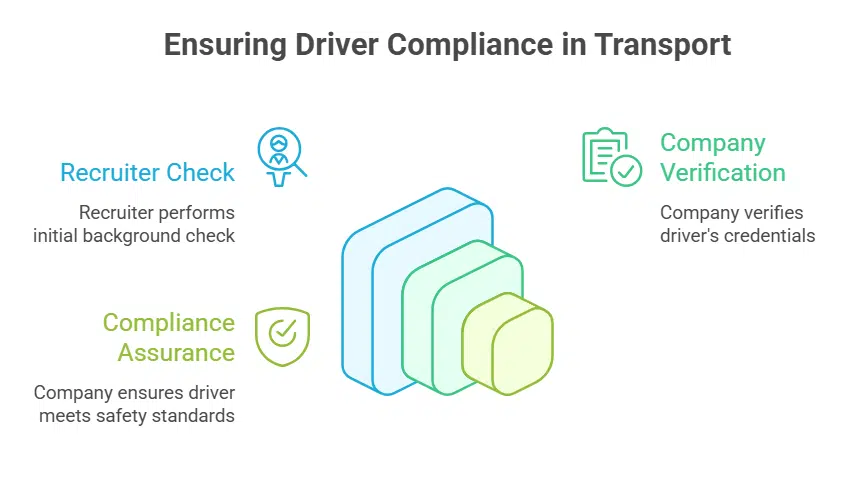
Why can’t transport companies rely solely on recruiters? FMCSA regulations make it clear: employers (i.e., transport companies) are the ones responsible for ensuring that every CDL A driver they employ meets the necessary safety standards. Even if a recruiter for truck drivers says they’ve checked a driver’s background, transport companies should always verify it themselves.
If a driver is hired and later found to have a suspended license or a history of violations, the transport company – not the recruiter – will face the consequences. FMCSA doesn’t recognize third-party recruiters as legally accountable for compliance.
Responsibilities of the Transport Company
As we have already found out, it is the transport company – not the agency – that bears full responsibility for ensuring that the driver they hire is eligible, qualified, and compliant with federal and state safety regulations.
When companies hire a CDL driver, they must:
- Obtain the driver’s Motor Vehicle Record (MVR) from all states where the license was held during the past three years.
- Run a query through the FMCSA Drug & Alcohol Clearinghouse.
- Investigate past employment and accident history with prior carriers.
Failing to conduct these checks can result in fines, lawsuits, and serious safety risks. No matter how the driver is found, whether through a truck driver recruitment agency or internal HR teams, the transport company must take ownership of this compliance.
How Transport Companies Can Manage Risk While Using Recruiters
Truck recruiters and carriers can work together effectively – if expectations are clearly defined. To ensure legal compliance while benefiting from faster hiring, transport companies should:
- Use recruiters to identify qualified leads – but always verify driver records internally.
- Require documented processes if any compliance checks are delegated.
- Maintain internal hiring standards regardless of recruiter involvement.
- Keep communication open with the recruitment agency to avoid missed steps.
This way, you gain the efficiency of a recruiting agency without risking DOT violations.
Using a driver recruiting agency can be a smart way to fill open positions faster – but it doesn’t remove your legal responsibility. The transport company is always the one held accountable for checking a CDL A driver’s violation history.
Companies that use driver recruiters should clearly outline in their contracts who is responsible for each part of the driver screening process. This ensures compliance and protects both parties in case of disputes or legal reviews.
























