

Give yourself two weeks to write a five-page proposal, and the project will inevitably consume all fourteen days. You will spend the first week researching unnecessary background details, the next few days outlining and second-guessing your structure, and the final 24 hours frantically typing under self-induced stress.
Give yourself 48 hours to complete that exact same proposal, and you will finish it in 48 hours. The final document will usually match or exceed the quality of the two-week attempt because the restricted timeframe forces immediate focus, eliminating distraction and overthinking.
If you have ever asked yourself what is Parkinson’s Law and why your schedule constantly expands to fill your calendar, the answer comes down to a basic behavioral trap: work expands to fill the time allotted for its completion.
What Is Parkinson’s Law?
Imagine your parents tell you that you have all day to put three toys back into your toy box.
Because you have all day, you will probably take forever. You might pick up one truck, roll around on the floor, stare at the ceiling, play with a sock, and slowly drop the last toy into the box right before bedtime.
Now imagine your parents tell you: “You have two minutes to put away those three toys, and then we go get ice cream!”
You will zoom across the room and throw those toys into the box in ten seconds flat.
That is Parkinson’s Law! It means that a task will stretch out to fill whatever time you give it.
If you give a tiny job a giant chunk of time, your brain acts like it’s a huge project. But if you give that same job a tiny time limit, your brain stays focused and gets it done super fast.
Where the Concept Actually Came From
The principle originates from a 1955 essay published in The Economist by British naval historian Cyril Northcote Parkinson. Rather than studying individual daily habits, Parkinson was examining the ballooning administrative costs inside the British Civil Service and Royal Navy.
He noticed a striking trend. Even as the total size of the navy’s active fleet shrank significantly following World War I, the number of bureaucrats managing the navy grew by over five percent every year. The volume of actual naval work had decreased, yet the administrative staff kept expanding.
Parkinson realized that administrative systems naturally generate internal tasks to justify their existence. Officials split duties among subordinates, created new reporting structures, and generated paperwork for one another. The available time and budget dictated how much work was produced, completely disconnected from the actual baseline requirements of the job. Over time, productivity experts recognized that this institutional bloat applies just as directly to individual professionals managing their own weekly schedules.
Why Simple Tasks Inflate into Full-Day Projects
To understand what is Parkinson’s Law doing to your daily schedule, look at how an average workday unfolds when deadlines are distant. Several distinct mental habits cause simple assignments to stretch across days or weeks:
Perfectionism and Scope Creep
When a task lacks a tight turnaround time, your brain assumes the work must be complex enough to fill the assigned window. You begin over-polishing slides, running endless extra background checks, or rewriting introductory paragraphs ten times over. This extra polish rarely adds commercial value, but it consumes every spare hour you give it.
The Absence of Real Urgency
Without an impending deadline, tasks linger in your subconscious without generating action. You check email, reorganize file folders, read industry news, or refine to-do lists while delaying the actual execution. The real labor still gets shoved into a brief burst right before the due date—meaning you experience days of background anxiety for an assignment that only required two hours of active focus.
Unnecessary Process Layers
Generous timelines invite unnecessary operational steps. Teams schedule extra alignment meetings, draft elaborate outline documents, and build multi-stage approval loops simply because the schedule permits them. The project expands to match the timeline rather than the timeline being built to fit the work.
Corporate Culture and the Trap of Open-Ended Schedules
This expansion pattern is visible across almost every modern office environment:
The 60-Minute Default Meeting: Digital calendar apps set meetings to 30 or 60 minutes by default. A quick alignment conversation that should take eight minutes almost always stretches to fill the full hour because participants feel compelled to keep talking until the scheduled block ends.
Software Development Scope Creep: When product managers hand development teams generous delivery windows, software builds routinely pick up unnecessary features, extra code refactoring, and edge-case debates that delay the core launch.
Agency Campaign Briefs: Marketing teams operating under two-month client timelines frequently waste weeks debating brand nuances. When forced to launch an ad campaign in four days, the output is often punchier and more direct because decision-making happens rapidly out of necessity.
How to Turn Tight Boundaries Into Higher Output
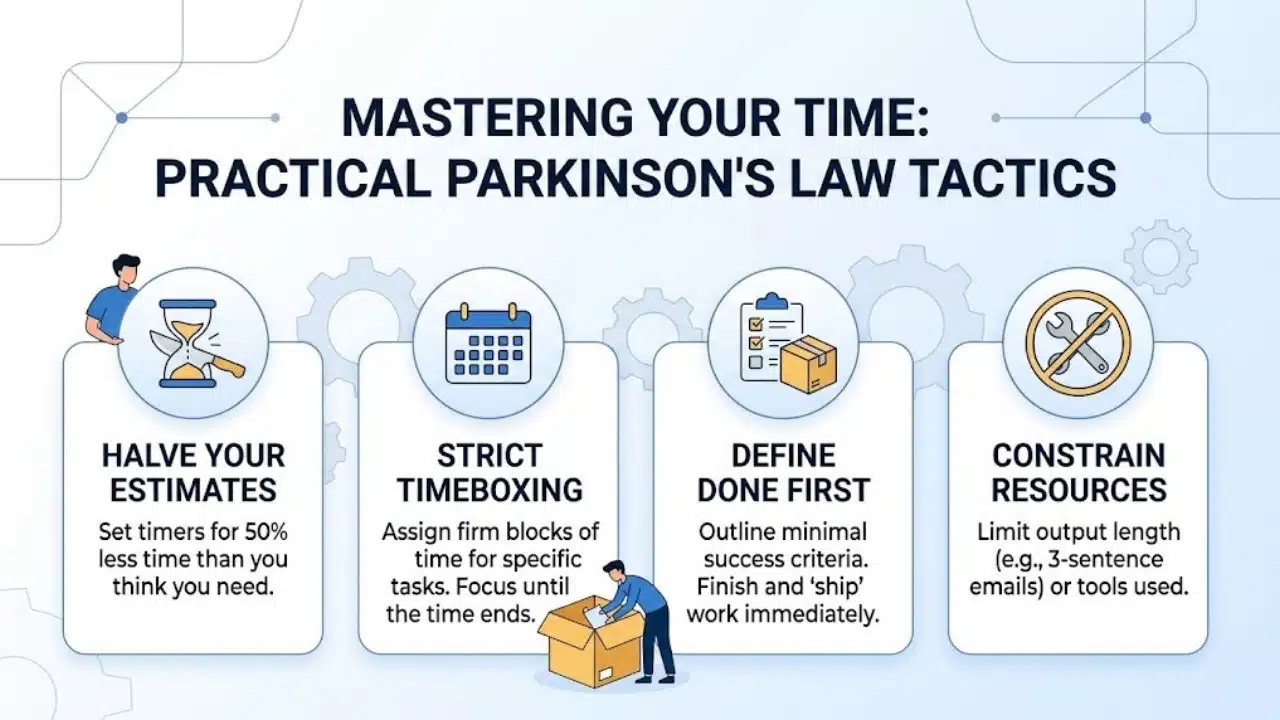
Learning how to leverage what is Parkinson’s Law offers an immediate edge in managing personal output. Instead of letting open deadlines dictate your pace, you can intentionally restrict your time and tools to force clarity and rapid execution.
1. Halve Your Initial Time Estimates
When planning an assignment, write down your realistic estimate for completion, then immediately cut that number in half. If you think drafting an email update will take an hour, give yourself 30 minutes. Setting a strict countdown timer creates a mild, healthy pressure that shuts off outside distractions and stops you from over-analyzing minor details.
2. Strict Timeboxing Over Endless Lists
To-do lists without time constraints invite task expansion. Replace open-ended lists with calendar timeboxing. Block out explicit windows for specific outcomes—such as 10:00 AM to 10:45 AM for drafting a client brief. When the clock hits 10:45 AM, stop working on that document and move to your next scheduled item, regardless of whether it feels 100% finished.
3. Define “Done” Before You Start
Perfectionism thrives when performance criteria are vague. Before typing your first sentence or opening a spreadsheet, explicitly write out the minimum criteria required for the deliverable to succeed. Once those specific parameters are hit, send or publish the work immediately to prevent low-value polishing.
4. Constrain Your Output Formats
Restricting resources forces brevity and speed. Tell yourself you will answer every non-critical email in three sentences or fewer. Limit internal slide decks to five slides total. Restricting your medium prevents unnecessary detail from creeping into your work.
Balancing Speed Without Sacrificing Standards
Shrinking your working windows is an effective tool, but applying artificial constraints requires judgment. There is a clear line between eliminating operational fluff and rushing complex work.
If you cut deadlines too aggressively on high-stakes projects, quality suffers, technical errors slip through, and team members burn out. Parkinson’s Law is not an excuse to rush complex financial audits, medical research, or foundational software architecture.
The goal is to eliminate passive buffer time—the hours lost to procrastination, overthinking, and unnecessary process—while preserving the focus required for deep work. Strategic thinking and creative breakthroughs need uninterrupted focus blocks, but those blocks should still have definitive start and end points.
Taking Control of Your Weekly Calendar
Time is naturally flexible; it contracts or expands based on the boundaries you enforce around your day.
By setting aggressive micro-deadlines, enforcing timeboxes on your calendar, and defining clear completion criteria upfront, you regain control over your workload. Stop giving basic tasks endless room to stretch. Set tight constraints, focus on core execution, and let explicit boundaries drive your productivity.