

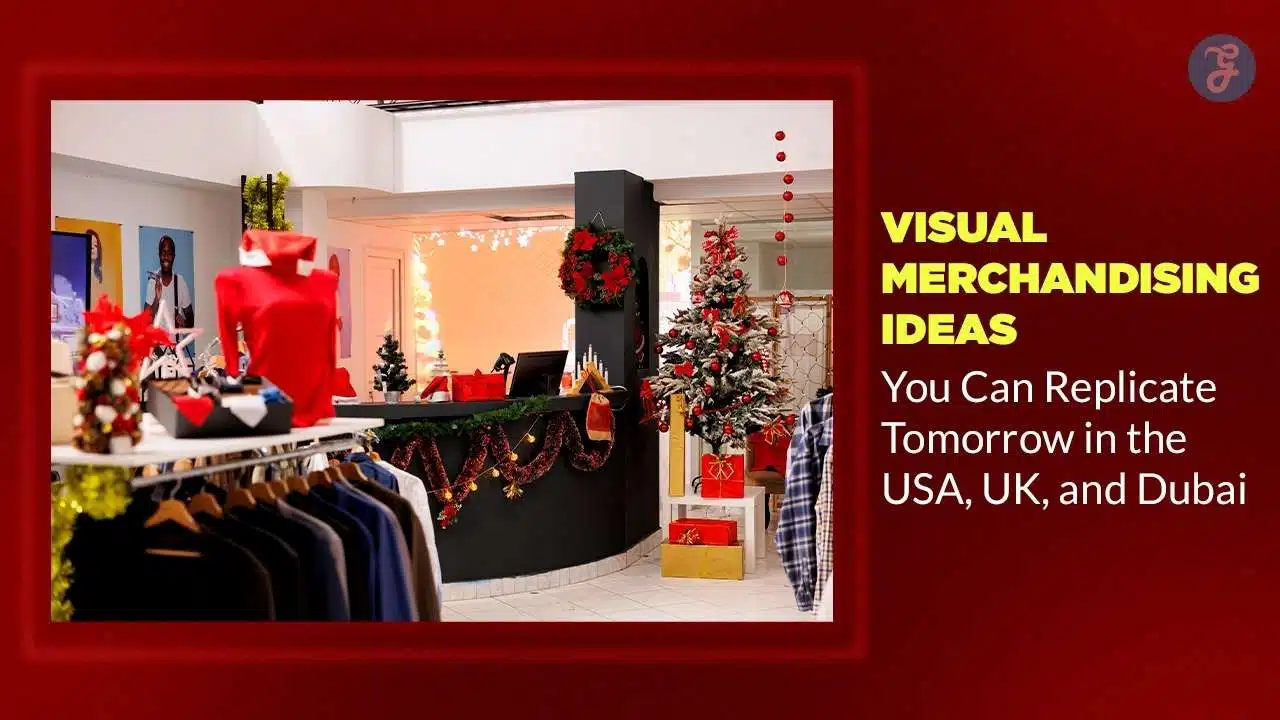
The global retail landscape is shifting faster than a seasonal window display, and staying ahead of the latest Visual Merchandising Trends is no longer just about aesthetics—it is about survival. As we look toward 2026, the days of “stack ’em high, watch ’em fly” are officially over. Whether you are a boutique owner in London’s Shoreditch, managing a flagship in Dubai Mall, or running a pop-up in New York, the new rule is simple: your store must be a destination, not just a depot.
In this guide, we will explore 14 actionable, data-backed strategies you can implement immediately. We will dissect how the “Quiet Luxury” of the UK, the “Phygital” efficiency of the USA, and the sensory immersion of Dubai are converging to create the ultimate retail experience.
Key Takeaways: The 2026 Retail Playbook
If you only remember four things from this guide, make them these. This is your cheat sheet for the future of physical retail:
-
Silence is the New Loud: The “Quiet Luxury” trend is here to stay. Replace clutter and stark white lights with warm “latte” tones, negative space, and single “Hero” focal points.
-
Phygital is Non-Negotiable: Your customers live on their phones. Meet them there by integrating QR storytelling, “Endless Aisle” tablets, and designated UGC (User Generated Content) zones.
-
Engage the Senses: E-commerce cannot offer touch or smell. Leverage this by unboxing products for tactile “Try-Me” stations and using subtle “Scent Scaping” to increase dwell time.
-
Measure What Matters: A pretty display is useless if it doesn’t sell. Move beyond vanity metrics and start tracking Zone Conversion Rates and Dwell Time to prove your ROI.
The Psychology of the New Shopper
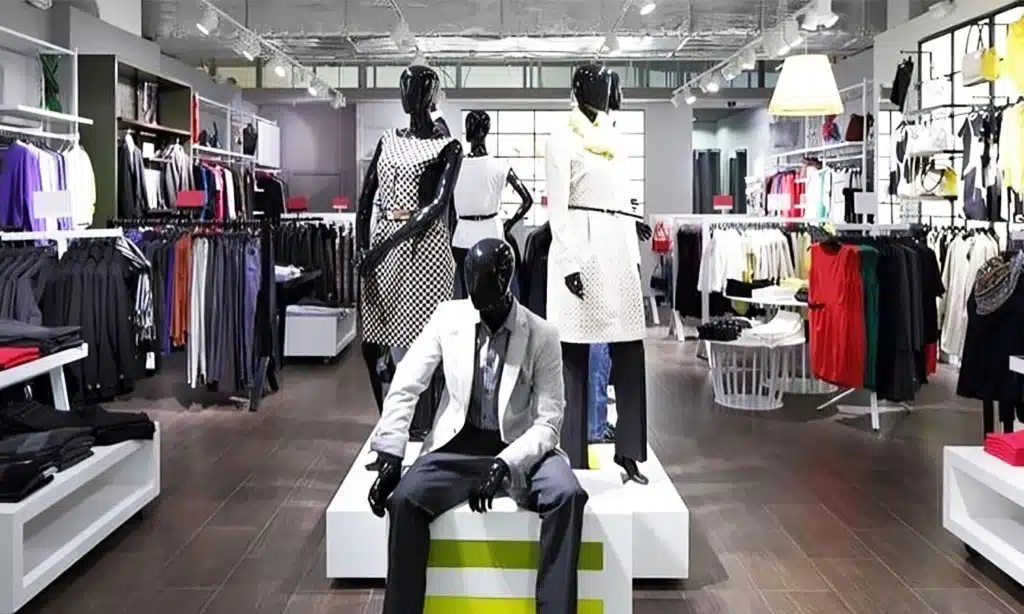
Before we dive into the specific ideas, we must understand why these changes are happening. The 2026 shopper is tired of visual noise. They are seeking clarity, connection, and efficiency.
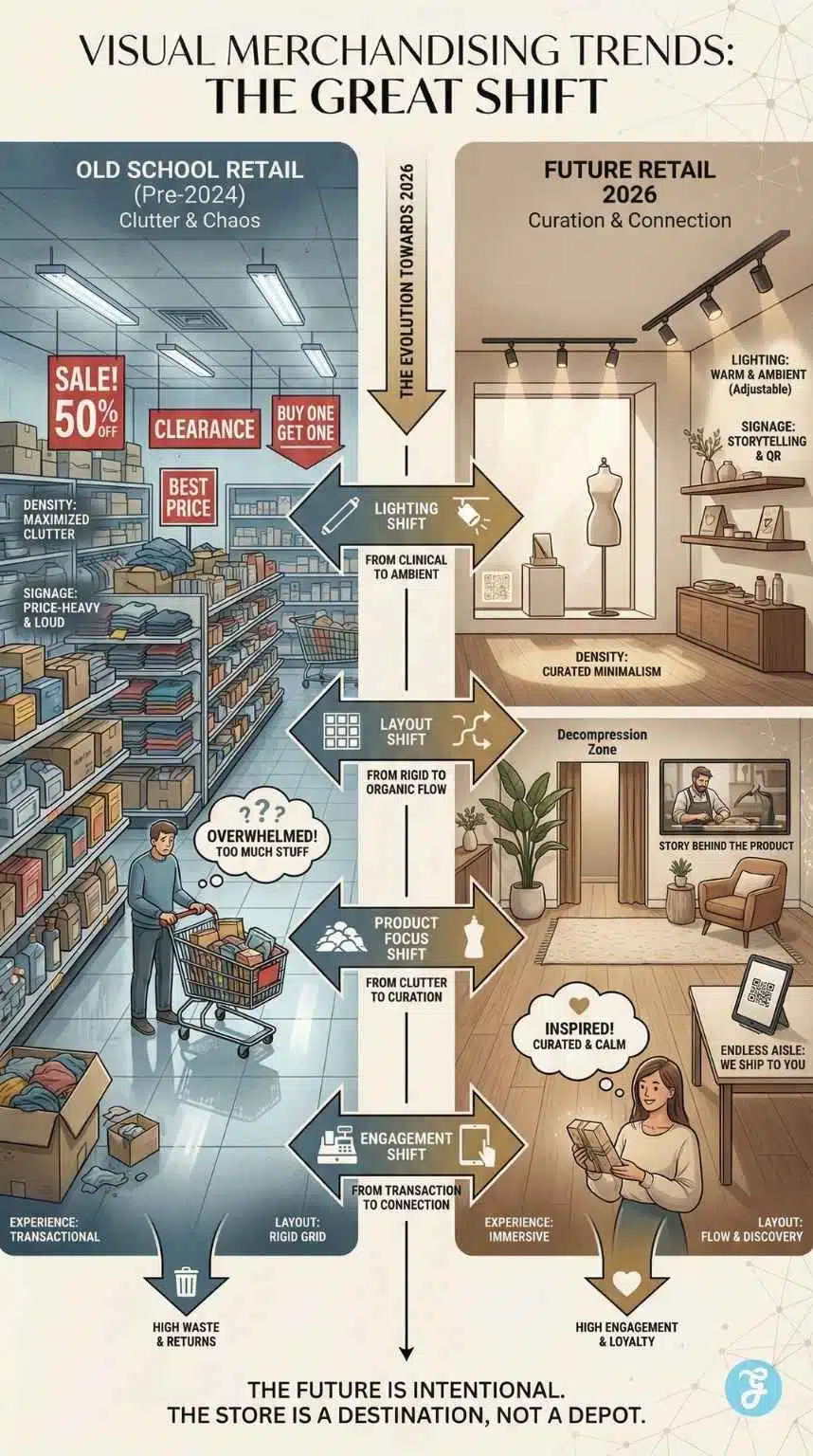
Google’s latest search data reveals a spike in terms like “calm shopping experience” and “curated retail.” This signals a move away from clutter toward intentionality. Your visual merchandising trends strategy needs to pivot from “showing everything” to “showing the right thing.”
| Old School Retail (Pre-2024) | Future Retail (2026 Outlook) |
| Goal: Maximize product density per square foot. | Goal: Maximize engagement per square foot. |
| Lighting: Uniform, bright, clinical fluorescent. | Lighting: Dynamic, warm, moody, and focal. |
| Signage: “Sale,” “Discount,” and price-heavy. | Signage: Storytelling, QR codes, and values-based. |
| Layout: Grid systems for efficiency. | Layout: Loop and “decompression” zones for discovery. |
The Global Blueprint: Converging Styles for 2026
Understanding the shopper’s mindset is only the foundation. The real challenge lies in translation: how do you turn a psychological need for “calm” or “connection” into physical fixtures, lighting, and layout?
To master the Visual Merchandising Trends of the future, we cannot look at just one market. We are witnessing a “Great Convergence” in retail. The successful store of 2026 is a hybrid entity—it must possess the frictionless efficiency of the American market, the curated “soul” and sustainability of the British high street, and the immersive hospitality of Dubai’s luxury sector.
In the past, these were separate retail philosophies. Today, they are the baseline requirements. A boutique in Manchester now needs the digital savvy of New York to survive; a department store in Chicago needs the sensory magic of the Middle East to retain footfall.
In the sections below, we will dismantle these silos. We have curated the best-in-class strategies from each region to help you build a store that is not just seen, but felt. It begins with the most immediate signal your store sends: its visual language.
The Aesthetic Shift: “Quiet Luxury” & Warmth
(Primary Influence: UK & Europe)
The “Quiet Luxury” trend has bled from high fashion into interior design and is now dominating retail spaces. This aesthetic prioritizes quality materials and neutral palettes over loud branding.
1. The “Earth Tone” Palette Switch
In the UK, high-street retailers are abandoning stark white walls for “latte” tones—warm walnuts, soft beiges, and taupes. White was once seen as modern; now, it feels sterile and cheap.
-
The Strategy: Replace your bright white table covers, risers, or backdrops with linen or kraft paper in warm beige or soft brown.
-
Why It Works: Warm tones lower the customer’s heart rate, encouraging them to browse longer. It instantly elevates the perceived value of products, especially in jewelry, skincare, and apparel.
2. Minimalist “Hero” Windows
Influenced by the confident minimalism of brands like Aesop and Zara, this trend is about the “Power of One.
-
The Strategy: Instead of cramming 20 items into your window display, choose one hero product. Place a single mannequin or product pedestal in the dead center, surrounded by negative space.
-
Semantic Insight: This technique utilizes the concept of Focal Point merchandising. By removing visual clutter, you reduce cognitive load, making the decision to enter the store easier for the passerby.
3. Vertical “Power Walls”
With retail real estate prices skyrocketing in cities like London and New York, the floor is expensive, but the walls are free.
-
The Strategy: Build up. Use floating shelves or stacking crates to create a floor-to-ceiling display of a single product category (e.g., a wall of colorful socks or organized spices).
-
Execution Tip: Ensure the top shelves are well-lit. Products placed above eye level generally sell poorly unless they are part of a massive, cohesive visual block that draws the eye upward.
4. The “Decompression Zone” Entrance
This is a critical, often ignored rule of human behavior known as the “invariant right.” When a customer enters a store, they need 5–10 steps to adjust to the lighting and vibe.
-
The Strategy: Clear the first 5 feet of your store entrance. Do not place products here—shoppers will physically brush past them without seeing them.
-
Actionable Step: Move your “New Arrivals” table 6 feet back. Use the entrance solely for atmosphere—a rug, a plant, or a welcome sign.
Tech & “Phygital” Integration
(Primary Influence: USA & Dubai)
“Phygital” retail—the blending of physical and digital worlds—is no longer a buzzword; it is a baseline expectation. In the USA, this is driven by efficiency. In Dubai, it is driven by spectacle.
5. QR Code Storytelling
Customers in 2026 want “specs” and “stories” without necessarily waiting for a sales associate.
-
The Strategy: Print small, elegant cards with a QR code next to your top 3 best-selling items. Link this not to a checkout page, but to a 30-second video of the product in use, its origin story, or a stylist tip.
-
SEO & Data Benefit: You can track how many people scan these codes, giving you hard data on which in-store displays are generating interest—a metric known as “Offline-to-Online Attribution.”
6. The “Instagram/TikTok” Corner
In Dubai’s mall culture, if a store isn’t “grammable,” it doesn’t exist. This trend is now essential for US experiential retail as well.
-
The Strategy: Dedicate one dead corner of the store to a “selfie moment.” It doesn’t need to be expensive. A large mirror with a ring light, a neon sign with a catchy phrase, or a floral wall is enough.
-
The Payoff: This generates User-Generated Content (UGC). Every selfie taken is free advertising for your store.
7. Digital “Endless Aisle”
Nothing kills a sale faster than “We don’t have your size.”
-
The Strategy: Bridge the gap between your limited physical stock and your full online inventory. Place a tablet or a clearly visible sign that says, “Don’t see your size? We ship free to your home.”
-
The Shift: This turns your physical store into a showroom (zero inventory risk) rather than just a warehouse.
Lighting is the silent salesman. In 2026, we are seeing a move toward “variable temperature” lighting.
-
The Strategy: Use cool, crisp lighting (4000K-5000K) for high-energy zones like tech or activewear to make colors pop. Use warm, dim lighting (2700K-3000K) for fitting rooms and lounge areas to flatter skin tones.
-
Actionable Step: Aim spotlights only at the products you want to sell this week. Leave the aisles slightly dimmer to create contrast and drama. Shadows are just as important as light.
Experience & Sensory Engineering
(Universal Application)
E-commerce has speed, but physical stores have senses. To compete with Amazon, you must offer what a screen cannot: touch, smell, and immersion.
9. Cross-Merchandising “Bundles”
Traditional retail groups items by category (e.g., all shirts together). The modern trend is to group by lifestyle.
-
The Strategy: Create a “Date Night” table. Place a shirt, a matching accessory, a cologne, and a gift bag all in one spot.
-
The Metric: This strategy is designed to increase Average Transaction Value (ATV). You aren’t just selling a shirt; you’re selling a solution to a problem (“What do I wear tonight?”).
10. Scent Scaping
Dubai retailers are masters of this, often using Oud or Bakhoor in luxury spaces. However, the science applies everywhere.
-
The Strategy: Introduce a subtle signature scent near the entrance.
-
Citrus/Mint: Increases energy (good for sports/tech).
-
Vanilla/Cedar: Increases comfort and dwell time (good for home/bookstores).
-
-
Warning: Subtlety is key. If a customer can smell it from the street, it’s too strong.
11. The “Tactile” Table
The barrier to buying online is the inability to touch. Your store must lean into this advantage.
-
The Strategy: Unbox one unit of your most popular boxed item. Create a “Try Me” station. Let customers feel the weight of the device, the texture of the fabric, or the smell of the soap.
-
Psychology: The “Endowment Effect” states that once a customer holds a product, they psychologically feel a sense of ownership, making them much more likely to buy.
12. Micro-Seasonal Updates
Waiting for “Christmas” or “Summer” is too slow. The modern consumer lives in micro-moments.
-
The Strategy: Rename a display table based on the immediate weather or local event.
-
Is it raining? Build a “Rainy Day Essentials” display (books, tea, cozy socks) by the door.
-
Local football game? Create a “Game Day Ready” snack and gear display.
-
-
Agility: This requires no new stock, just a reorganization of existing items to match the customer’s current mindset.
Sustainability & Localization
(Primary Influence: UK & Dubai)
Trust is the currency of 2026. Customers in the UK are demanding sustainability, while customers in Dubai and global tourist hubs demand local relevance.
13. “Upcycled” Prop Styling
In the UK, plastic acrylic stands are increasingly viewed as “tacky” and environmentally irresponsible.
-
The Strategy: Use natural materials for risers and props.
-
Instead of acrylic: Use stacks of vintage books, reclaimed wooden crates, or stone tiles from a hardware store.
-
Instead of vinyl banners: Use fabric scrolls or chalkboard art.
-
-
The Message: This signals that your brand is conscious, thoughtful, and premium.
14. Localized Cultural Nods
Global brands often fail because they look the same in New York as they do in Dubai.
-
The Strategy: Look at your local community calendar. Is there a local festival, a marathon, or a religious holiday? Create a small window decal or display acknowledging it.
-
The Result: It builds immediate community trust. A global brand that acts locally wins the heart of the consumer.
The Science: Neuro-Merchandising (The “Why” It Works)
(Advanced Strategy)
In 2026, the best visual merchandisers are part artist, part neuroscientist. Understanding how the human brain processes visual information can double your conversion rates.
The “Zeigarnik Effect” (Curiosity Gaps)
Psychology tells us that the human brain hates incomplete stories.
-
The Strategy: Don’t show the full outfit on the mannequin. Leave the jacket unbuttoned to reveal a hint of the lining, or place a half-opened gift box on the table.
-
The Result: This creates a “curiosity gap.” The customer effectively has to walk over to “close the loop” and see the hidden detail.
Visual Priming & Mirror Neurons
We are wired to mimic what we see. This is why “lifestyle” displays work better than static shelves.
-
The Strategy: Don’t just stack coffee mugs. Place a mug on a small side table next to an open book and reading glasses.
-
The Science: When a customer sees this, their “mirror neurons” fire. They don’t just see a mug; they subconsciously simulate the feeling of drinking coffee while reading. You are selling the feeling, not the ceramic.
The Business: Measuring Your VM ROI
(Data-Driven Retail)
A pretty store is vanity; a profitable store is sanity. In 2026, you must prove that your visual merchandising changes are actually driving revenue. Here are the three metrics that matter.
| Metric | What It Is | How to Measure It |
| Zone Conversion Rate | The % of people who walk into a specific zone and actually buy something. | Use simple heat-mapping cameras (like Prism or Aislelabs) or manual tally counts for 1 hour/day. |
| Dwell Time | How long does a customer stand in front of a display? | If dwell time is high (>2 mins) but sales are low, your price or stock is the issue, not the display. |
| Sales Per Linear Foot | Total sales of a shelf/length of the shelf. | Calculate this before and after you move products to a “Power Wall.” If the number drops, move it back. |
Implementation Guide: How to Start Tomorrow
You do not need to overhaul your entire store overnight. Visual merchandising is an iterative process. Use this checklist to prioritize your actions.
| Priority | Action Item | Estimated Time | Semantic Goal |
| High | Clear the “Decompression Zone” (Entrance) | 15 Mins | Improve Traffic Flow |
| High | Create one “Hero” Window Display | 1 Hour | Increase Footfall |
| Medium | Set up a “Tactile” Try-Me Station | 30 Mins | Increase Conversion |
| Medium | Print QR Codes for Top 3 Items | 1 Hour | Digital Integration |
| Low | Source “Upcycled” Props (Wood/Stone) | Weekend | Brand Equity |
Frequently Asked Questions (FAQs)
1. What is the single biggest visual merchandising trend for 2026?
The biggest shift is the move toward “Hyper-Curated Warmth.” The era of industrial, cold, warehouse-style retail is fading. In 2026, successful stores are mimicking the feel of a high-end home or a hospitality lounge. Think walnut wood, soft textiles, warm lighting (3000K), and drastically reduced inventory on the floor. The goal is to make the customer feel comfort, which psychologically lowers their guard and encourages spending.
2. How can I improve my store’s visual merchandising with zero budget?
You don’t need money; you need discipline. Start with The Purge. Remove 30% of the merchandise from your floor. Clutter creates cognitive overload, which kills sales. Next, adjust your existing lighting. Turn off general overhead fluorescents if possible and aim your adjustable spotlights only at your key products. Creating shadows and pools of light costs nothing but immediately adds drama and focus.
3. What exactly is “Phygital” retail, and is it relevant for small shops?
“Phygital” is simply the bridge between the Physical and Digital worlds. It is absolutely relevant for small shops because it extends your limited square footage. For a small boutique, “Phygital” means having a QR code next to a handmade vase that links to a video of the artist making it. It adds value and story without you needing to hire more staff to explain it.
4. How often should I update my window displays and visual layout?
Think in two timelines: Macro and Micro.
-
Macro (Windows): Change these every 4–6 weeks or with major seasons. Windows are your billboard; if they get stale, people stop looking.
-
Micro (In-Store Tables): Update these every 2 weeks. Rotate your “Front-of-House” tables based on immediate local events, weather, or new arrivals. Regular customers need to see something “new” every time they walk in, even if it’s just existing stock rearranged.
5. Does “Scent Scaping” actually affect sales, or is it a gimmick?
It is scientifically proven, not a gimmick. Research shows that the right ambient scent can increase dwell time (how long a shopper stays) by up to 40%. The key is congruence. If you sell rugged outdoor gear, a scent of cedar and pine reinforces the brand identity. If you sell luxury linens, a scent of lavender or fresh cotton triggers a “clean” association. If the scent matches the visual expectation, the brain processes the brand as “trustworthy.”
Bottom Line: Retail is Detail
The Visual Merchandising Trends for 2026 are not about spending millions on renovation; they are about empathy. They are about understanding that your customer is human, busy, and seeking connection.
By adopting the warmth of the “Quiet Luxury” aesthetic, the efficiency of “Phygital” tools, and the immersion of sensory design, you turn your store into a living entity. The goal is no longer just to sell a product; it is to sell a memory.
Your Next Step: Do not try to do all 14 ideas at once. Pick one section from this article—perhaps the “Decompression Zone” or the “Hero Window”—and change it before you open your doors tomorrow. Observe the customer reaction. If they stop, look, and linger, you have won.
Remember: Good visual merchandising isn’t about filling space; it’s about managing attention.





















