Have you ever bitten into a grocery store strawberry in January that looked perfect but tasted like… well, absolutely nothing? You’re not the only one. The average meal in the US travels about 1,500 miles from farm to plate, losing flavor and nutrients with every hour it spends on a truck. That’s why city planners and foodies alike are looking up—literally.
Vertical farming is changing the game by using 98% less water and 99% less land than traditional fields, allowing fresh crops to grow right inside concrete jungles. But is it just a buzzword, or can it actually feed a city? In this guide, we’ll walk through exactly how it works, the real pros and cons (including the energy bills), and how you can even start a mini-farm in your own living room.
Ready to see how we can grow salads in the sky? Let’s get into it.
What is Vertical Farming?
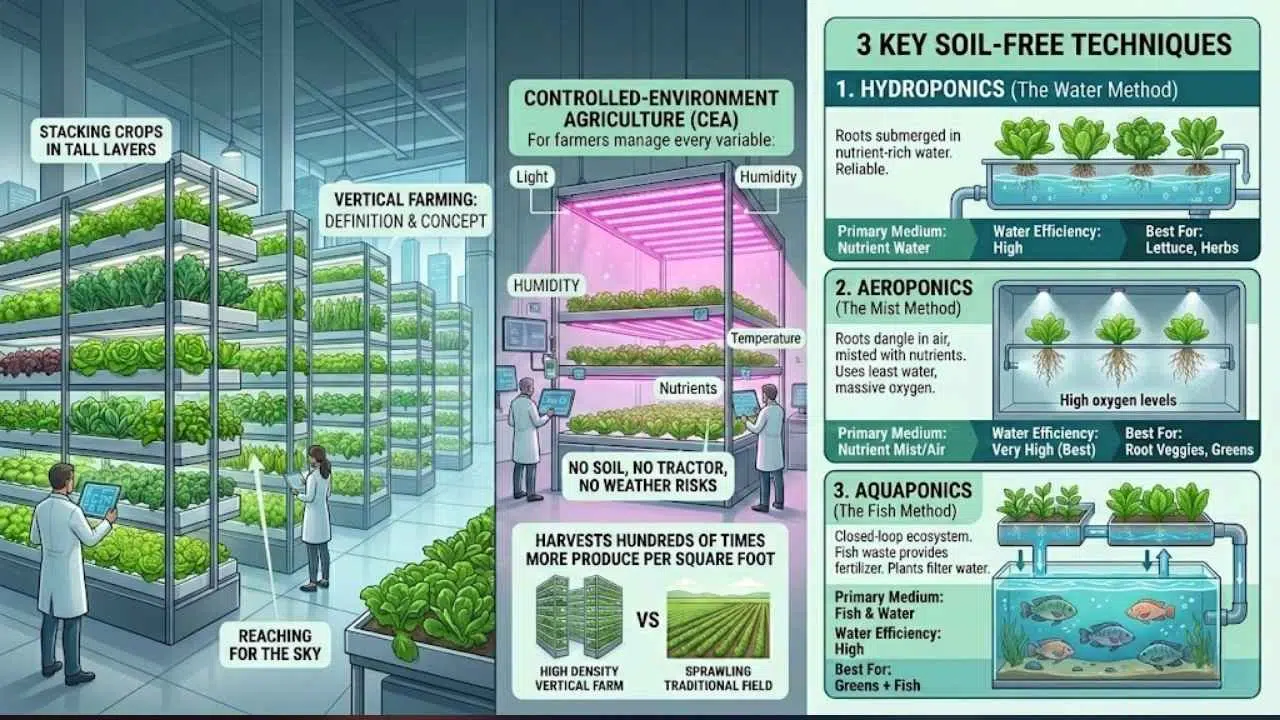
At its simplest, vertical farming is exactly what it sounds like: stacking crops in tall layers, often indoors, reaching for the sky instead of spreading out over acres of land. It’s a fresh approach that flips traditional gardening on its head—literally turning warehouses and skyscrapers into food factories.
Definition and concept
Imagine a library, but instead of books, the shelves are packed with basil, lettuce, and kale. That is the core of vertical farming. Farmers use controlled-environment agriculture (CEA) technology to manage every single variable: light, humidity, temperature, and nutrients. There is no soil, no tractor, and definitely no praying for rain.
LED lights stand in for sunshine, creating a “pinkhouse” glow that allows plants to photosynthesize 24/7. This style of urban agriculture is a precision game. By removing the unpredictability of weather, these farms can harvest hundreds of times more produce per square foot than a traditional farm.
Key techniques: Hydroponics, Aeroponics, and Aquaponics
Modern vertical farming relies on three main soil-free systems. Understanding the difference is key to knowing how your food is grown or choosing a system for your own home.
- Hydroponics (The Water Method): This is the most common technique. Plants sit with their roots submerged in nutrient-rich water. It is reliable and widely used by big players like 80 Acres Farms to grow leafy greens.
- Aeroponics (The Mist Method): Instead of sitting in water, plant roots dangle in the air and are misted with nutrients every few minutes. It was popularized by NASA research. The benefit? It uses even less water than hydroponics and delivers massive amounts of oxygen to the roots for faster growth.
- Aquaponics (The Fish Method): This creates a closed-loop ecosystem. Fish live in tanks connected to the plant beds. The fish waste provides organic fertilizer for the plants, and the plants filter the water before it returns to the fish. It’s the closest thing to a natural cycle you can get indoors.
| Feature | Hydroponics | Aeroponics | Aquaponics |
|---|---|---|---|
| Primary Medium | Nutrient Water | Nutrient Mist/Air | Fish & Water |
| Water Efficiency | High | Very High (Best) | High |
| Best For | Lettuce, Herbs | Root Veggies, Greens | Greens + Fish |
The Rise of Vertical Farming
Skyscrapers are growing lettuce, not just housing offices. City skylines now blend glass with greens. But this isn’t just about aesthetics; it’s a response to a fragile food supply chain.
Transition from concept to reality
For years, vertical farming was just a theory championed by professors like Dickson Despommier. Today, it is a commercial reality driven by the need to shorten the supply chain. Traditional agriculture is struggling with drought and soil degradation, while “food miles” continue to skyrocket.
By moving farms into the city, we cut the travel time from days to hours. For example, Plenty, a major vertical farming company, recently opened a massive indoor farm in Richmond, Virginia, specifically to grow strawberries for Driscoll’s. This partnership means Northeast consumers can get peak-season berries in the dead of winter, grown just a short drive away rather than trucked from California or Mexico.
Adoption in major cities
New York, Chicago, and Singapore have become hotspots for this technology. Old meatpacking plants and abandoned warehouses are finding second lives as high-tech farms. In the Midwest, 80 Acres Farms has partnered with Kroger to supply over 1,000 stores with robot-harvested greens.
This shift allows city dwellers to enjoy produce that was harvested hours ago, not weeks ago. The “local food” movement is no longer limited to summer farmers’ markets; it’s becoming a year-round aisle in the supermarket. When you see a package of “indoor grown” spinach, you are looking at a product that likely used zero pesticides and didn’t sit on a highway for three days.
Benefits of Vertical Farming
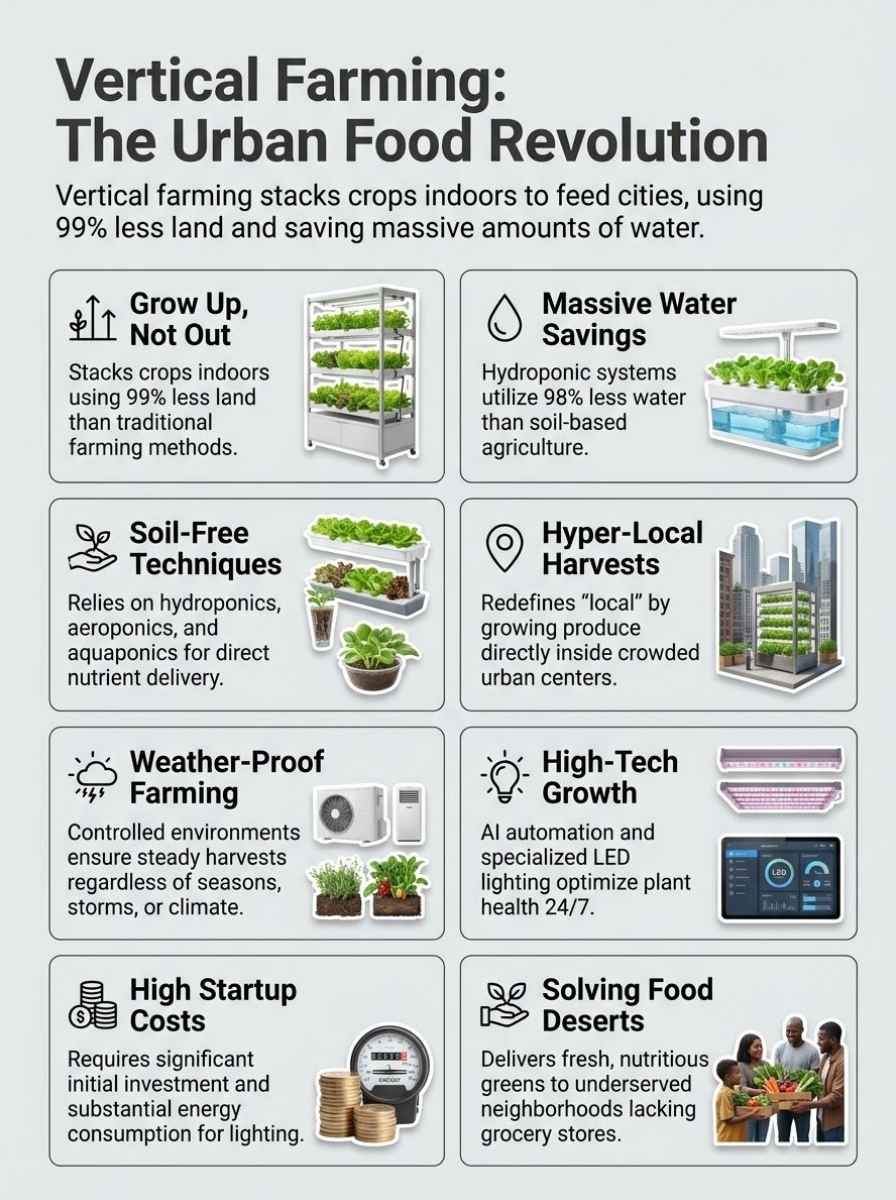
Fresh lettuce, herbs, and strawberries can now grow inside city buildings. That sounds cool, but what is the actual payoff? The data shows massive efficiency gains.
Efficient use of space in urban areas
Vertical farming turns empty city pockets into production powerhouses. Because crops are stacked, the yield per acre is astronomical compared to traditional methods. Some estimates suggest a vertical farm can produce 50 to 100 times more food per square foot than a flat field.
This density allows agriculture to squeeze into tight spaces—basements, shipping containers, and rooftops. In expensive cities like San Francisco or New York, this ability to “grow up” is the only way farming makes financial sense.
Reduced water usage and waste
The most stunning stat in vertical farming is water efficiency. Hydroponic and aeroponic systems use up to 95% less water than traditional soil farming. Since the water is recirculated in a closed loop, the only water “lost” is what the plants actually drink.
“In traditional farming, runoff is a huge issue—water carries fertilizers into local rivers. In a vertical farm, there is zero runoff. Every drop is accounted for.”
This makes vertical farming a critical solution for drought-prone regions like the American West, where water rights are becoming a battleground.
Year-round crop production
Farmers can grow crops every month of the year with vertical farming. There are no seasons indoors. A vertical farm in Boston can produce the same perfect basil in February as it does in July. This consistency is a dream for grocery stores and restaurants that rely on steady supplies.
It also means food security. When a hurricane wipes out crops in Florida or a freeze hits California, indoor farms keep humming along, unaffected.
Challenges Facing Vertical Farming
While the benefits are exciting, we have to be real about the hurdles. It’s not all smooth sailing, and the industry has faced some serious “reality checks” recently.
High initial setup costs
Building a vertical farm takes a massive investment up front. You aren’t just buying seeds; you are building a life-support system. Costs can range from $110 to over $160 per square foot just to get started. That means a decent-sized commercial facility costs millions before selling a single leaf.
This high barrier to entry has led to volatility. High-profile companies like Bowery Farming, once a darling of the industry, ceased operations in 2024 due to financial struggles. It serves as a stark reminder that while the technology works, the business model is still being perfected.
Energy consumption and sustainability concerns
This is the “elephant in the room.” While vertical farms save water and land, they are energy hogs. Replacing the sun with LED lights requires a lot of electricity.
Data shows that growing lettuce in a vertical farm can require 150 to 350 kWh of energy per kilogram, compared to just 1-5 kWh for outdoor farming. Unless that electricity comes from renewable sources like wind or solar, a vertical farm might actually have a higher carbon footprint than a traditional farm trucking food across the country.
The “Insider” Tip for Consumers
If you are buying vertical-farmed produce for sustainability reasons, check the brand’s website. Look for farms that explicitly state they are powered by renewable energy. If they run on coal-powered grid electricity, you might be trading water savings for carbon emissions.
Innovations Driving Vertical Farming
From smart computers to bright, energy-saving lights, new gadgets are helping solve the energy problem and making farms smarter.
Artificial intelligence and automation
Artificial intelligence (AI) now runs the show in many top-tier farms. Smart sensors track water pH, humidity, and light levels every second. Companies like Gardyn have even brought this tech to the home market with AI assistants like “Kelby” that watch your home plants through cameras and tell you exactly when to add water or harvest.
In commercial farms, computer vision systems can detect a yellowing leaf on a strawberry plant before a human ever could, adjusting the nutrient mix instantly to fix the problem.
LED lighting advancements
The lights are getting better, too. Modern “spectrum tuning” allows farmers to give plants exactly the light wavelengths they need for flavor or crunch, without wasting energy on the rest of the spectrum. This has improved efficiency significantly, helping to bring those high energy bills down over time.
The Future of Urban Agriculture
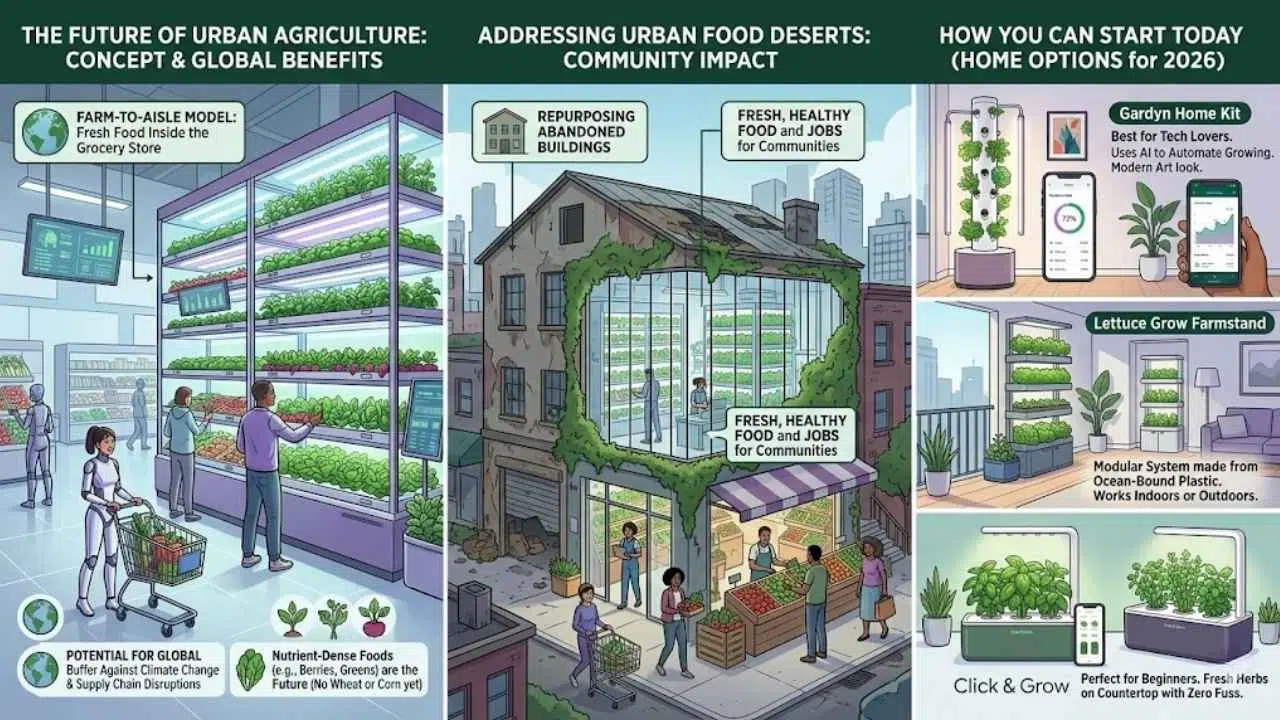
Urban farming could become the backbone of city life, bringing fresh food closer to home. We are moving toward a “farm-to-aisle” model where the farm might be inside the grocery store.
Potential for global food security
As cities grow, feeding them becomes harder. Vertical farming offers a buffer against climate change and supply chain disruptions. While we won’t be growing wheat or corn indoors anytime soon (the economics don’t work yet), for nutrient-dense foods like berries and greens, it is the future.
Role in addressing urban food deserts
One of the most promising aspects is placing these farms in “food deserts”—urban areas where fresh produce is hard to find. By repurposing abandoned buildings in these neighborhoods, vertical farms can bring fresh, healthy food and jobs to the communities that need them most.
How You Can Start Today (Home Options)
You don’t need a warehouse to get started. Home vertical gardening systems have exploded in popularity. Here are a few top-rated options for 2026:
- Gardyn Home Kit: Best for tech lovers. It uses AI to automate the growing process and looks like a piece of modern art.
- Lettuce Grow Farmstand: A modular system made from ocean-bound plastic that works great indoors or outdoors.
- Click & Grow: Perfect for beginners who just want fresh herbs on their countertop with zero fuss.
Final Thoughts
Vertical farming isn’t just a sci-fi dream; it’s a real solution growing in a city near you right now. It stacks crops high to save water, protect our land, and put the freshest possible food on your plate.
Sure, the energy bills are high, and the industry is still finding its footing, but the ability to grow a perfect strawberry in a snowstorm is a game-changer. Whether you pick up a box of “indoor grown” greens at Kroger or set up a Lettuce Grow tower in your kitchen, you are part of this food revolution.
So next time you’re in the produce aisle, check the label. You might just find your dinner was grown right down the street.