

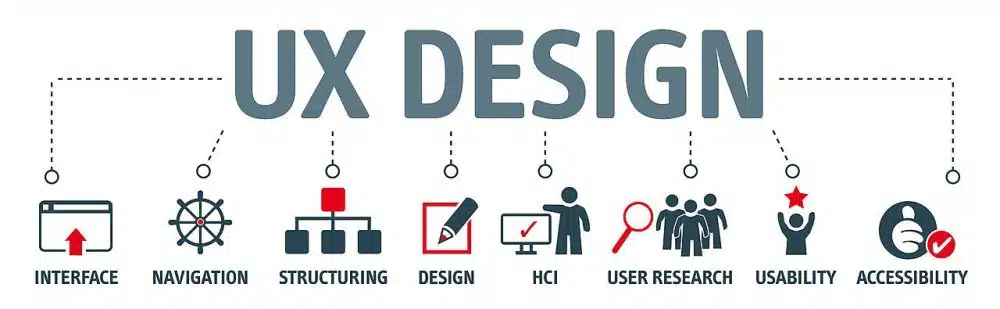
Technology has been a major part of our day-to-day lives and as users, we are instantly drawn to products and services that make our lives easier. We as users expect nothing short of perfection irrespective of whether we interact with a business offline or online.
This is where the user experience jumps in. it is one of the most multidisciplinary, and fascinating fields. The products and services that we use daily are shaped by user experience and are quite influential in the success or failure of a brand or business.
Let us get to know more about what user experience is.
In simpler terms, user experience refers to any interaction that a user has with a product or service. Every element is considered by the UX design that helps to shape the experience, how the users feel about it, how easy it is for the users to accomplish the tasks of their choice.
This can range from how a physical product feels in your hand, to how simple the checkout process is when you are buying something online. The main objective is to offer easy, relevant, efficient, and all-around pleasant experiences to the user.
The designers of user experience combine product development, market research, and design to create a picture-perfect user experience for services, products, and processes.
Let us now take a good look as to what is the difference between UX and UI?
A user interface design is not the same as the user experience. In general terms, user interface refers to the actual interface of a product, a visual design of the screens that a user navigates through when they are using a mobile app, or the buttons they click on when browsing a website. If you are looking for a UX design firm, you can take help from Google.
User interface and user experience go side by side and the design of the product interface has a significant impact on the overall experience of the user. Though the notable thing is, that UX design is everywhere, a supermarket’s layout, a vehicle’s ergonomics, and even the usability of a mobile application.
The term user experience was coined in the early 90s but the concept of user experience has been around for much longer. Now that we have mentioned it, let us take a look at the history of user experience design.
The earliest origins of user experience can be traced as far back as 4000 BC in ancient Chinese philosophy and are focused on arranging your surroundings in a user-friendly way. In the late 19th century, brilliant minds like Frederick Winslow Taylor and Henry Ford started integrating basic experiences design principles into their production processes. Those two were on a mission to make human labor more efficient.
For centuries now, people have been trying to optimize their surroundings to attain maximum user comfort. Nowadays, the term UX design includes strong connotations, that are often referred to as websites, apps, software, and technology.
UX Sydney has been one of the most popular designing sectors in the world. The job of a designer is to make everyday products, technology, and services as user-friendly and easy to access as well. The thinking process when it comes to design can be separated into four different stages;
- Inspiration
- Iteration
- Exposition
- Conceptualization
The inspiration period is where the designer seeks to understand and observe. To do this, they have to conduct extensive research and analyze their competitors to fully understand the challenge or problem that they have to solve.
Apart from the design-specific programs, the designers also use certain project management tools and use communication to keep track of their work at all times.
Here we have mentioned the kind of projects that the UX designers work on.
- Website, software, and app design
- Voice design
- Virtual reality and augmented reality
- Service design
These are some of the notable projects that a user experience designer works on.
In a nutshell, designing a world-class user experience is the key to making sure that the customer is satisfied which helps in building brand loyalty from a business point of view. The user will only return to the business only when the product or service is hassle-free and enjoyable.





















