

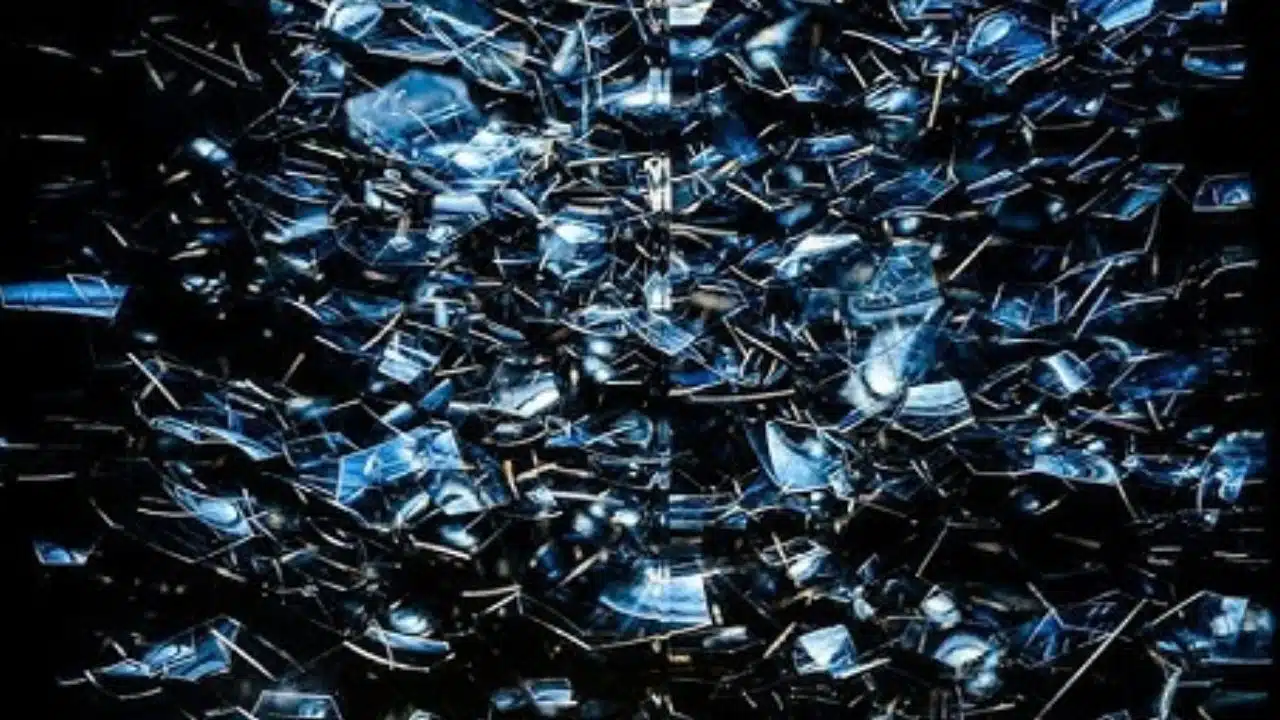
A French physicist has derived a simple mathematical law that predicts how almost any object will shatter, from dropped wine glasses to exploding bubbles. The work, published in Physical Review Letters, offers a unifying explanation for a messy everyday phenomenon that has puzzled scientists for decades.
Breakthrough from Marseille Lab
The new framework comes from Emmanuel Villermaux of Aix-Marseille University and the University Institute of France, who set out to understand why fragment sizes follow similar patterns no matter what is breaking. Earlier experiments had already hinted that if you count fragments by size and plot them on a graph, the curve looks remarkably similar for shattered glass, broken ceramics, and other brittle materials.
Instead of tracking every individual crack in a plate or window, Villermaux approached fragmentation statistically, asking which overall outcome is most likely when something breaks apart. That perspective allowed him to look past the microscopic details and search for a deeper rule that applies across many different materials and impact scenarios.
A Law Built on “Maximal Randomness”
At the heart of the new law is a principle Villermaux calls “maximal randomness,” the idea that when an object shatters, nature favors the most chaotic and irregular breakup that is still physically possible. In practice, that means highly uneven fragments are far more likely than neat, symmetrical pieces such as a vase splitting into four identical chunks.
However, pure chaos is not enough, because any realistic breakage must still obey basic physical limits. To capture this, Villermaux combines maximal randomness with a conservation rule his team previously identified, which restricts how the overall distribution of fragment sizes can vary during the breakup.
From Simple Equation to Predictable Fragments
By linking those two ideas, the research derives a compact mathematical equation that predicts how many fragments of each size an object will produce when it shatters. When this formula is compared with decades of experimental data—from smashed glass plates to fractured ceramic tubes and even debris in ocean waves—it reproduces the same characteristic distribution scientists have repeatedly observed.
To put the law to a direct test, Villermaux designed an experiment crushing individual sugar cubes, then used the model to forecast the resulting fragment sizes based on the cube’s three‑dimensional shape. The measured pieces closely matched those predictions, strengthening the case that the law captures something genuinely universal about how cohesive objects fail.
From Bottles to Bubbles
One striking feature of the work is how far it stretches beyond familiar brittle solids like glass and porcelain. The same statistical law describes fragmentation in liquid drops and bursting bubbles, suggesting that the underlying principles operate across very different physical systems.
Because the law focuses on fragment distributions rather than specific crack paths, it helps explain why wildly different materials and breakage setups can yield similar scaling patterns in fragment sizes. Researchers say this broad applicability points to a fundamental principle of breakup dynamics rather than a quirk of any one material.
Real-World Applications and Limits
Physicists and engineers see potential applications wherever fragmentation matters, from designing safer car windows and more robust construction materials to understanding rockfalls, mining blasts, and industrial crushing processes. A better predictive handle on fragment sizes could also aid in fields such as planetary science, where collisions and breakups shape everything from asteroid belts to planetary rings.
The law is not universal in a literal sense: it works best for violent, disordered shattering events, such as a glass tumbler hitting the floor, and performs less well for very soft materials that deform rather than crack or for highly regular breakups controlled by surface tension. Even so, outside experts describe the analysis as remarkably general and say it can be adapted when extra constraints—such as partial crack “healing” in some plastics—come into play.





















