
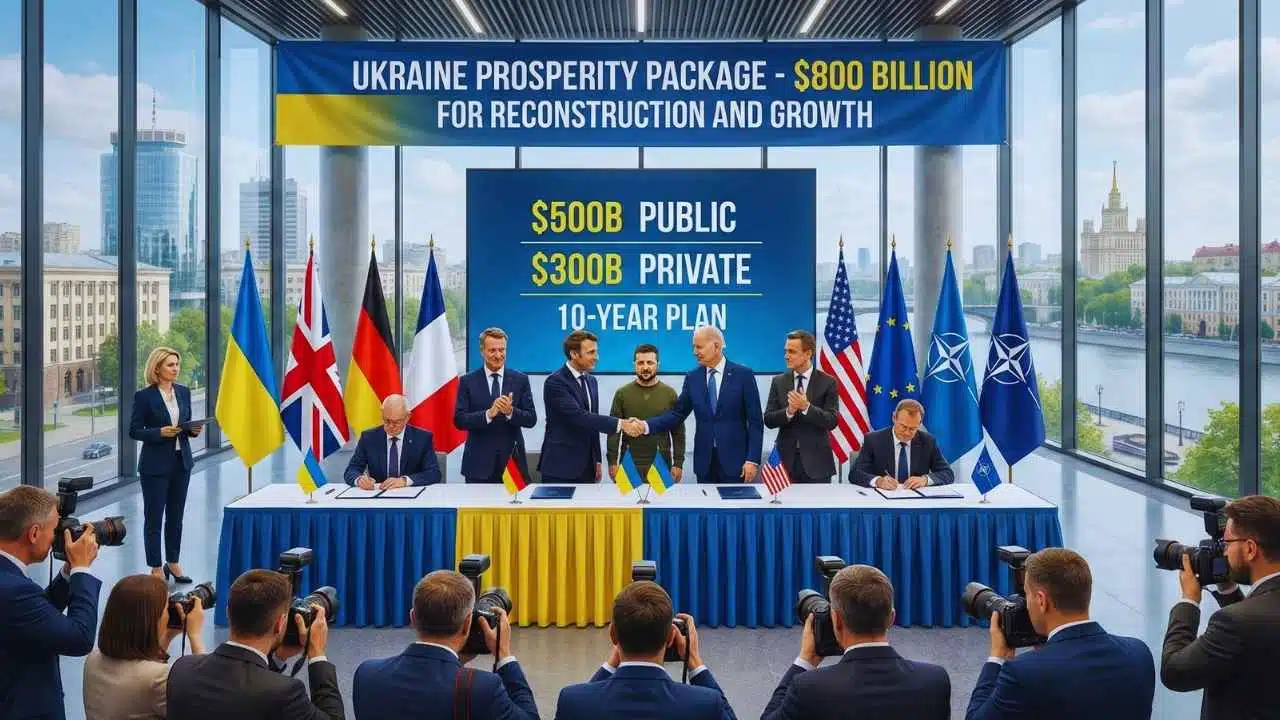
Ukraine and key partners are debating an $800 billion reconstruction plan inside a 20-point peace framework, tying funding to security guarantees, EU steps, and oversight, as fighting continues into early 2026.
The Ukraine 800 Billion Reconstruction Plan is emerging as a central bargaining point in ongoing peace discussions, as Kyiv argues that any settlement must include not only security terms but also a large, organized financing plan to rebuild homes, roads, power systems, schools, and the wider economy.
The proposal is being discussed alongside a draft peace framework that includes commitments on sovereignty and non-aggression, security guarantees, and a political path designed to anchor Ukraine’s long-term stability. Ukraine’s leadership is pushing the message that reconstruction is not an “after the war” issue. It is part of what could make peace durable, because it shapes whether people return, businesses restart, and public services function.
How The Ukraine 800 Billion Reconstruction Plan Fits Into Peace Talks?
The draft framework under discussion links the economic track directly to the security track. Ukraine’s position is that investment will not scale without credible protection against renewed attacks, and that donors will not commit at the highest levels without enforceable standards and a clear strategy.
A major component is the push for NATO-style security guarantees, even if formal membership is not immediately resolved. Ukraine has also argued that its defense capacity must remain strong enough to deter future aggression, including maintaining a large standing force.
At the same time, the framework ties Ukraine’s long-term stability to deeper European integration. It outlines a concept of Ukraine joining the European Union on a defined timeline and expanding access to European markets sooner, with reforms and governance conditions built into funding flows.
The peace framework also includes sensitive unresolved items that remain major political obstacles. These include disputes over territory and arrangements around critical infrastructure, including the Zaporizhzhia nuclear power plant, which has been a persistent point of international concern due to safety risks and control issues.
To show how the reconstruction plan aligns with the wider negotiation track, the table below summarizes the main themes without treating any element as finalized.
| Theme In The Draft Talks | What It Seeks To Achieve | Why It Matters For Reconstruction |
| Security Guarantees | Reduce the risk of renewed invasion or major escalation | Lowers investor risk and borrowing costs |
| EU Path And Market Integration | Lock reforms into a clear political destination | Supports trade, investment, and legal alignment |
| Reconstruction Funds And Oversight | Mobilize large-scale capital with accountability | Helps donors justify long-term commitments |
| Humanitarian Measures | Address prisoners, displaced people, and urgent needs | Supports population return and workforce recovery |
| Disputed Issues | Resolve territory and critical asset control | Influences where and how rebuilding can occur |
Even supporters of a large funding package acknowledge a practical issue. A headline figure is not the same as spendable money. Turning “$800 billion” into rebuilding projects requires project pipelines, procurement capacity, anti-corruption safeguards, and mechanisms that can keep money moving even during political disagreements.
What The Damage And Needs Data Shows?
International assessments already place Ukraine’s recovery needs at an extraordinary scale. A joint damage and needs review covering the period from February 2022 through the end of 2024 estimated that Ukraine’s reconstruction and recovery needs total $524 billion over the next decade. That figure reflects documented damage and projected requirements across sectors, and it is often treated as the most detailed baseline for planning.
The same assessment also highlights the gap between need and available funding. Even when budgets allocate large sums to urgent priorities, a significant shortfall remains, which is one reason Ukraine is trying to build a multi-year, multi-part funding plan rather than relying on ad hoc packages.
The sector breakdown below shows why the rebuilding bill climbs quickly. Housing repairs alone represent a massive share, and infrastructure rebuilding spans transport corridors, bridges, logistics nodes, and public facilities.
| Sector | Estimated Long-Term Need | What Drives Cost |
| Housing | $84B | Destroyed and damaged homes, rebuilding for displaced people |
| Transport | $78B | Roads, bridges, rail lines, logistics infrastructure |
| Energy And Mining | $68B | Power generation, grids, substations, fuel infrastructure |
| Commerce And Industry | $64B | Factories, warehouses, equipment, supply chains |
| Agriculture | $55B | Land impacts, machinery losses, storage, export routes |
These numbers also help explain why Ukraine is discussing an $800 billion ambition. A reconstruction figure can rise above a strict “repairs only” baseline if it includes modernization, stronger energy resilience, and expanded economic capacity, not just restoring what existed before the war.
Another detail that matters for readers is timing. Damage estimates cover a ten-year horizon, but many costs arrive immediately. Ukraine’s recovery planning has included near-term spending categories such as housing repairs, energy restoration, transport, water systems, demining, and civil protection. That means financing must address both urgent repairs and long projects, often at the same time.
Where The Money Could Come From?
No single country or institution can cover a package measured in hundreds of billions. The Ukraine 800 Billion Reconstruction Plan, as discussed, implies a blended approach that combines public grants, low-interest loans, guarantees, and private capital.
A realistic funding architecture typically involves four pillars: direct budget support, investment finance, risk insurance or guarantees, and targeted humanitarian programs. Without guarantees, private investment tends to stay limited, especially while security threats persist.
Here are the main funding channels currently shaping Ukraine’s financing landscape.
| Funding Channel | What It Can Pay For | Strength | Key Limitation |
| EU Multi-Year Support | Budget stability, reform-linked spending, investment tools | Predictable multi-year framework | Needs political unity among members |
| G7 Loan Structures | Large upfront support tied to defined repayment flows | Speed and scale | Depends on stable legal mechanisms |
| Multilateral Development Banks | Infrastructure loans, sector programs, procurement systems | Long maturities and technical capacity | Can be slower for urgent needs |
| Private Capital And PPPs | Energy, logistics, industrial recovery, housing finance | Potential scale beyond taxpayers | Requires credible risk reduction |
One of the most important multi-year structures is the EU’s Ukraine Facility, designed to provide up to €50 billion in support for 2024–2027. The model combines grants and loans and is linked to reforms and modernization priorities, creating a framework that can support stability and longer-term investment planning.
A second major track is the G7’s Extraordinary Revenue Acceleration (ERA) initiative, a loan approach backed by proceeds generated from immobilized Russian sovereign assets. Under this design, the funding arrives now, while repayment is tied to the “windfall profits” earned on frozen assets rather than relying entirely on annual taxpayer appropriations.
The United States disbursed $20 billion as part of the ERA approach in late 2024, and the European Commission announced early disbursement of its contribution in 2025. These flows are significant not only for the money involved, but for the precedent they set: using profits tied to frozen assets to finance support for Ukraine.
The EU has also transferred several tranches derived from interest earnings on immobilized Russian central bank assets. These are not seizures of the underlying principal. Instead, they use the profits generated by those assets while the principal remains frozen. The first transfer was about €1.5 billion in July 2024, followed by €2.1 billion in April 2025, and another €1.6 billion tranche announced in August 2025.
This approach remains politically and legally sensitive. Some governments support going further, including full confiscation of assets, while others warn of legal risk, retaliation, and impacts on trust in financial jurisdictions. For now, the “profits only” model is one of the key compromises used to generate funding without immediately crossing the legal threshold of confiscation.
What Could Block Or Delay A Plan Of This Size?
The biggest obstacle is security risk. Investors and insurers price war risk into every project. Even when donors provide grants, large infrastructure rebuilding still needs contractors, supply chains, and financing terms that reflect the reality on the ground.
A second obstacle is governance capacity. Reconstruction at this scale requires transparent project selection, competitive procurement, anti-corruption enforcement, and public reporting that can withstand scrutiny. Donors want accountability, while Ukraine wants speed. Managing both at once is difficult, especially during wartime conditions.
A third obstacle is coordination. Large plans often fail when funding is fragmented across many programs that do not align with each other. Ukraine and partners have pushed for clearer “project pipelines” so that financing can be matched to ready-to-build priorities, rather than being trapped in planning cycles.
There is also a geographic and planning challenge. Rebuilding is not equally feasible everywhere while the war continues and territorial questions remain unresolved. That can push more spending toward resilience projects that deliver benefits even under uncertainty, such as decentralized power systems, modular housing solutions, rapid bridge repairs, and strengthened civil protection.
Finally, there is donor politics. Even supportive governments face budget pressure, election cycles, and debates about burden-sharing. That reality is one reason Ukraine is emphasizing mechanisms that can unlock private capital and use structured repayment flows, rather than relying only on annual grant pledges.
The Ukraine 800 Billion Reconstruction Plan is not simply a big number attached to postwar rebuilding. It is being framed as part of the peace logic itself, meant to show how Ukraine could stabilize, reform, and recover if security terms and financing structures move together.
What happens next will likely involve more technical work on how funds would be governed, how projects would be prioritized, and how risk would be reduced enough to attract investment at scale. Even if a final peace framework remains uncertain, the reconstruction track is already shaping diplomatic discussions because Ukraine’s rebuilding needs are immediate, measurable, and growing with time.