

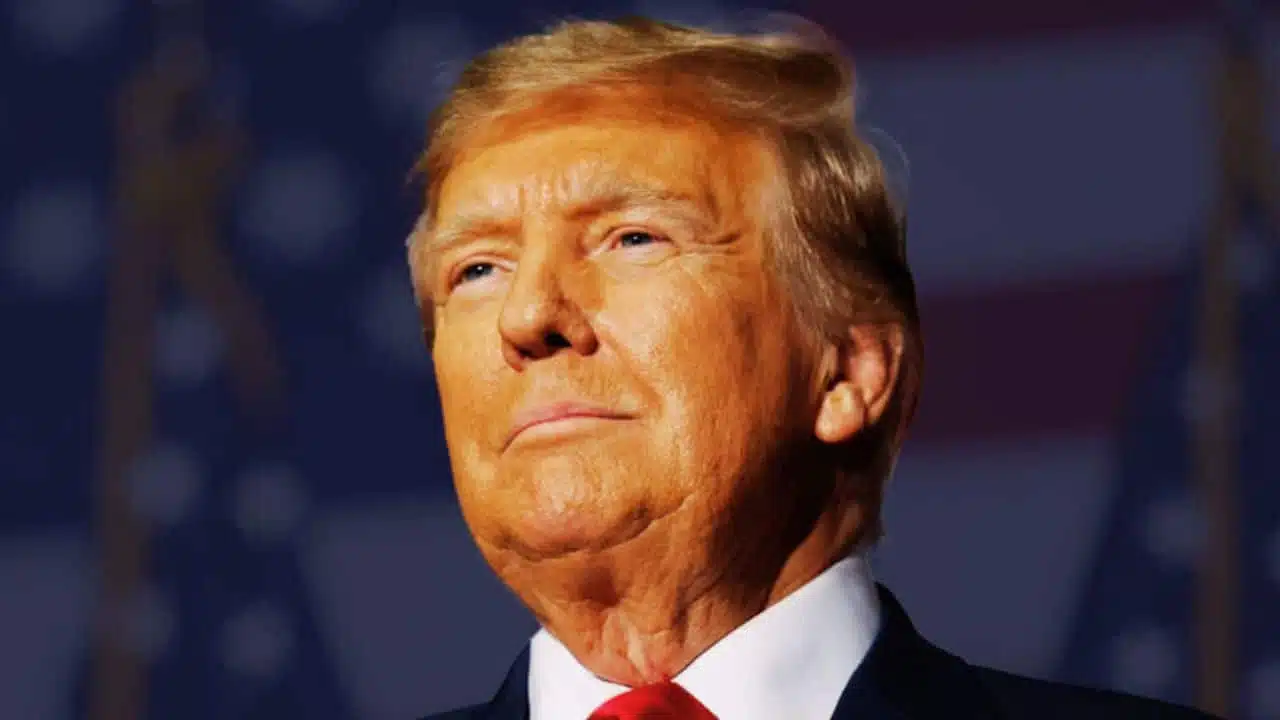
On Monday, August 25, 2025, President Donald Trump signed a new executive order addressing the burning of the American flag, a form of political protest that the U.S. Supreme Court has repeatedly ruled is protected under the First Amendment.
The order does not directly criminalize flag burning nationwide, as doing so would violate established constitutional precedent. Instead, it directs Attorney General Pam Bondi and the Department of Justice to prioritize enforcement in cases where acts of “flag desecration” intersect with other violations of law. This could include situations involving property damage, violent conduct, illegal discrimination, or violations of state and local restrictions such as bans on open burning.
The text of the order pledges to “restore respect and sanctity to the American flag” and allows federal agencies to refer cases to state or local authorities for prosecution if other violations are identified. It also encourages the Justice Department to litigate in order to test the scope of First Amendment exceptions in such cases.
Trump’s Longstanding Position on Flag Burning
President Trump has long argued that desecrating the American flag should carry harsh penalties. During the signing, he reiterated his view that burning the flag should result in a one-year jail sentence without parole. He first raised this position in the mid-2010s and has repeated it at campaign rallies and in television interviews.
In 2024, following protests in Washington, D.C. where demonstrators burned the U.S. flag outside the Capitol during Israeli Prime Minister Benjamin Netanyahu’s speech to Congress, Trump again called for mandatory jail terms. That same year, Sen. Josh Hawley (R-Mo.) introduced legislation seeking tougher penalties for those who burned flags while committing federal offenses, though it has not advanced in Congress.
Historical and Legal Context
Flag burning has been at the center of U.S. free speech debates for decades. In the landmark 1989 case Texas v. Johnson, the Supreme Court ruled 5–4 that burning the American flag is protected symbolic speech under the First Amendment. The Court reaffirmed that ruling in 1990, when it struck down a congressional law attempting to ban flag desecration.
Justice William Brennan, writing for the majority in Texas v. Johnson, declared that government cannot prohibit an expression simply because society finds it offensive. Even conservative Justice Antonin Scalia, whom Trump has praised as one of the greatest justices, acknowledged in 2012 that while he personally opposed flag burning, the First Amendment protects it—particularly as a form of dissent against government authority.
Immediate Fallout: A Protest Near the White House
Hours after Trump signed the executive order, video circulated online showing a man who identified himself as an Army veteran burning a U.S. flag in Lafayette Park, directly across from the White House. The act was described as a protest against the order itself.
U.S. Park Police confirmed that they arrested the man at around 6:30 p.m. for violating fire safety regulations, noting that open flames are prohibited in Lafayette Park. Officers extinguished the blaze before taking him into custody. Authorities have not released the man’s name, pending formal charges.
Critics Raise First Amendment Concerns
Civil liberties groups were quick to condemn the executive order. Bob Corn-Revere, chief counsel for the Foundation for Individual Rights and Expression (FIRE), warned that the president cannot rewrite constitutional protections through executive action. He emphasized that unpopular speech is precisely what the First Amendment was designed to protect, and that criminalizing symbolic protests like flag burning could open the door to broader restrictions on dissent.
Other advocacy groups echoed similar concerns, warning that the order may be used to intimidate protesters or chill political expression, even if actual prosecutions remain limited by constitutional precedent.
The Broader Debate Over Patriotism and Protest
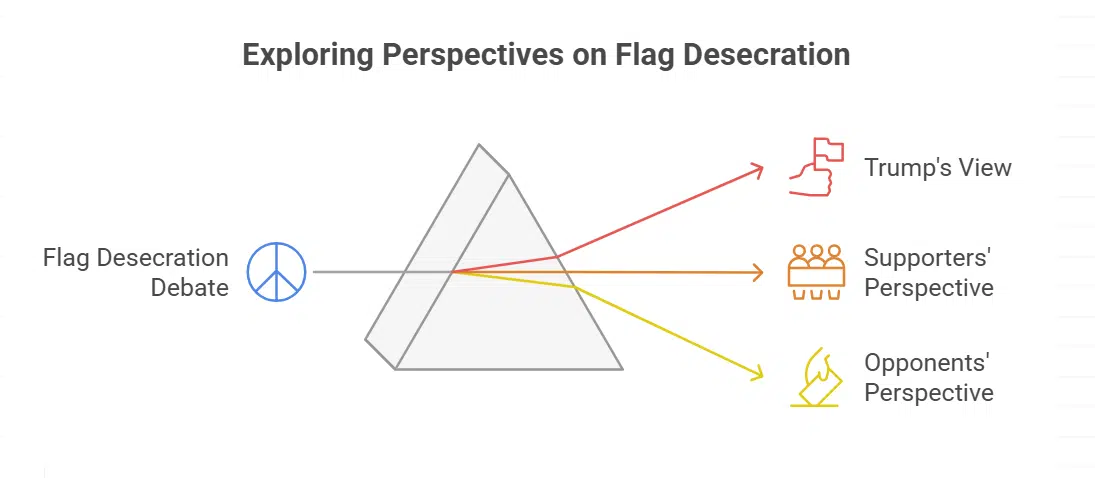
Trump has repeatedly framed flag desecration as an attack on American values, arguing that harsher penalties are necessary to defend the symbol of national unity. Supporters of the order believe it will discourage acts of protest they view as disrespectful to the military and to veterans.
Opponents argue that patriotism cannot be legislated and that true respect for the flag lies in protecting the freedoms it represents. They warn that prosecuting individuals for expressive conduct undermines the very democratic principles the flag symbolizes.
What Happens Next?
Although the executive order gives federal agencies direction, its enforcement will be constrained by existing Supreme Court rulings. The Department of Justice may attempt to pursue cases where flag burning overlaps with other criminal activity, but any attempt to prosecute someone solely for burning the flag will likely be struck down in court.
Legal experts predict that the order could trigger new constitutional challenges, potentially returning the flag-burning issue to the Supreme Court for the first time in over 30 years. Whether the Court would revisit its earlier rulings is uncertain, especially given its current conservative majority.
Key Facts at a Glance
| Aspect | Details |
|---|---|
| Date Signed | August 25, 2025 |
| Target | Burning of the American flag as a form of protest |
| Executive Order Scope | Does not criminalize flag burning outright; enforces only when other laws apply |
| Trump’s Stance | Advocates for mandatory one-year jail term for anyone burning the flag |
| Legal Precedent | Supreme Court rulings (1989, 1990) protect flag burning as free speech |
| Recent Protest | Army veteran arrested for burning flag near White House hours after signing |
| Criticism | Civil liberties groups warn order violates First Amendment principles |
| Potential Impact | May trigger new constitutional challenges; uncertain legal enforceability |
Trump’s executive order represents the latest chapter in America’s decades-long struggle to balance patriotism and protest, symbolism and free speech. While the order itself is limited in scope and unlikely to withstand broad constitutional challenges, it signals the administration’s determination to push the legal boundaries around flag desecration.
For critics, the move is a political gesture that risks undermining civil liberties. For supporters, it is a stand for national pride. As the debate reignites, the courts will likely remain the ultimate arbiter of whether symbolic acts of protest involving the U.S. flag remain protected under the First Amendment.





















