

The much-anticipated meeting between U.S. President Donald Trump and Russian President Vladimir Putin in Anchorage, Alaska, ended without a ceasefire agreement for Ukraine. The two leaders met for nearly three hours behind closed doors at Joint Base Elmendorf-Richardson, one of America’s largest military installations. When they finally appeared before cameras, they read short prepared statements and left without engaging with reporters.
The summit had been framed in advance as a possible turning point in the Ukraine war. Yet it closed with little more than vague assurances of “progress” and a promise to keep talking. No framework for halting the fighting was produced, and no timeline was set for follow-up negotiations.
Why Anchorage Was Chosen
The decision to meet in Alaska carried symbolic weight. Anchorage sits at the intersection of the U.S. Arctic frontier and Russia’s eastern reach, separated only by the Bering Strait. The base has deep Cold War significance and today remains a hub for Arctic and Indo-Pacific operations. Choosing this location allowed for tight security and projected an image of American strength. For Russian officials, the symbolism of gathering in what was once “Russian America” before its 19th-century sale to the U.S. was not lost.
A Blow to Trump’s Deal-Maker Reputation
The lack of a breakthrough undermines the carefully cultivated image of Trump as a natural dealmaker. In the run-up to the summit, he publicly downplayed the chances of failure, insisting that only a small margin existed for talks collapsing without results. Yet he left Alaska with no concrete deliverables, an outcome that dents both his domestic standing and his credibility abroad.
Trump had entered the meeting under pressure from allies and critics alike. European governments were concerned he might make unilateral concessions to Russia. Ukrainian officials feared an agreement struck without their presence could legitimize territorial losses. Neither fear came true, but the absence of any substance still paints the gathering as a failure of diplomacy.
For the American president, the optics were difficult. The press event that followed was dominated by Putin’s lengthy remarks, while Trump stood silent. Reporters expected to probe next steps, but the leaders abruptly walked off stage. In Washington, commentators quickly noted the contrast with traditional White House press conferences, where U.S. presidents typically take the lead.
Putin Gains the Spotlight
While no ceasefire was agreed, Putin gained something valuable from the Alaska summit: visibility and legitimacy. For nearly a full day he was treated as a respected guest on American soil, complete with a red-carpet welcome. Sharing a stage with the president of the United States in front of the global media allowed him to project strength at home and present himself as an indispensable actor on the world stage.
This was particularly notable given Russia’s isolation from much of the West since the full-scale invasion of Ukraine began. By meeting in Anchorage, Putin secured global attention without conceding anything on the battlefield. Analysts suggested that in the short term, he benefited more from the optics than Trump.
Ukraine’s Reaction: Relief Mixed With Concern
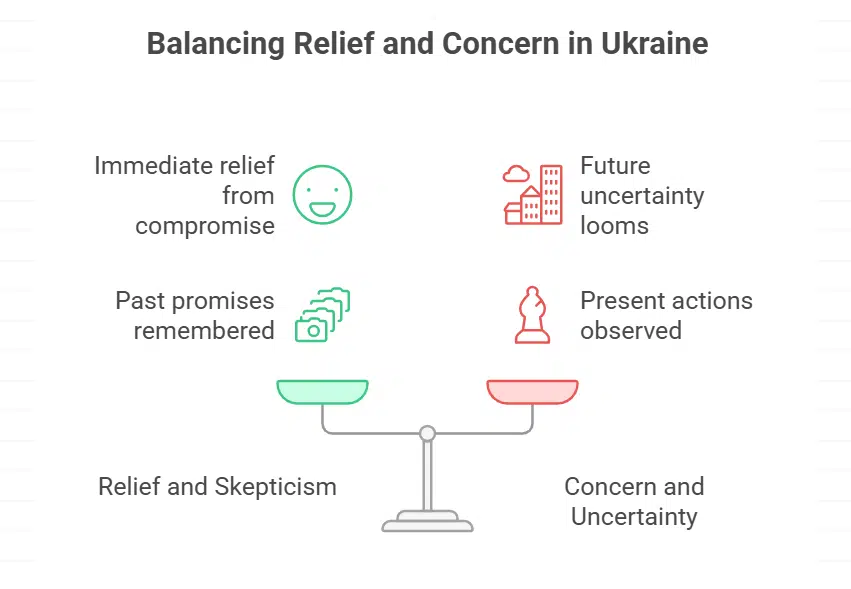
In Kyiv, the reaction was cautious. Ukrainian leaders and citizens expressed relief that no agreement was announced that might have cost the country more territory. Past experiences with Russian promises left Ukrainians skeptical of any deal struck behind closed doors. Many feared a rushed compromise could have frozen the conflict on Russia’s terms.
Still, the absence of progress is not seen as a victory either. For ordinary Ukrainians, the outcome confirms that Moscow remains committed to its original objectives. Putin again emphasized the so-called “root causes” of the conflict, a phrase widely understood to mean his desire to weaken or dismantle Ukraine’s independence. More than three years of Western pressure have not shifted that stance.
The concern now is what comes next. Russian strikes continue, Western deadlines have passed without consequence, and sanctions threats often remain unfulfilled. Ukrainians worry that Putin interprets these mixed signals as permission to carry on the assault with little fear of punishment.
Key Differences Remain Unresolved
At the heart of the stalemate are fundamental disagreements. The United States wants Russia to halt its offensive and agree to a monitored ceasefire. Russia continues to demand recognition of its territorial claims and security guarantees that would weaken Ukraine’s sovereignty. With Ukraine excluded from the Anchorage summit, there was no chance to bridge these gaps.
Diplomatic veterans note that any viable ceasefire would require Kyiv’s consent, detailed verification mechanisms, and a credible enforcement system. None of these elements emerged from the Alaska talks.
Domestic and International Fallout
For Trump, the immediate challenge is managing the narrative at home. He had portrayed himself as a leader uniquely capable of ending the war. Returning from Alaska empty-handed undermines that claim. Political opponents are already describing the summit as a wasted opportunity and a foreign policy embarrassment.
Internationally, allies are likely to breathe a sigh of relief that no unilateral concession was made. But they will also question whether the United States is prepared to impose consequences on Moscow for refusing to compromise. Trump has repeatedly threatened new sanctions, yet in a later television interview, he pushed any decision weeks into the future. That hesitation could embolden Russia and frustrate European partners eager for stronger action.
For Putin, the summit reinforced his ability to command attention without making concessions. The coverage at home is likely to highlight his endurance on the global stage and his ability to meet the American president as an equal. For Ukrainians, this outcome is troubling, as it signals that Western pressure alone has not forced Russia to reconsider its war aims.
What Happens Next
The road ahead remains uncertain. No date was set for a follow-up summit. Putin suggested future talks could occur in Moscow, but there was no firm commitment. Without Ukraine’s involvement, any new round of negotiations would face the same limitations as Anchorage.
Attention now shifts to whether the United States follows through on its threats of sanctions and whether European governments adjust their own strategies. Meanwhile, on the battlefield, Russian operations continue, and Ukraine braces for more attacks.
Diplomatic experts stress that the absence of progress in Anchorage does not close the door on future talks, but it underlines how difficult it will be to secure even a temporary ceasefire. Until Ukraine is fully included and enforcement mechanisms are agreed, meetings between Washington and Moscow alone are unlikely to change the trajectory of the war.
The Trump–Putin summit in Alaska will be remembered less for achievements and more for what did not happen. No ceasefire was announced, no framework for peace was established, and no timetable for progress was set. For Putin, it was an opportunity to showcase Russia’s resilience and his own standing. For Trump, it was a reminder that high-stakes diplomacy without preparation or clear commitments risks yielding little more than photo opportunities.
For Ukraine, the meeting’s failure to deliver change offers short-term relief but long-term anxiety. The war continues, and so does the uncertainty about when — or if — real negotiations will begin.