

In June 2025, protests erupted across Los Angeles after a series of controversial immigration raids carried out by federal agencies. Demonstrators accused the Trump administration of targeting immigrant communities unfairly, while federal officials argued they were simply enforcing immigration law.
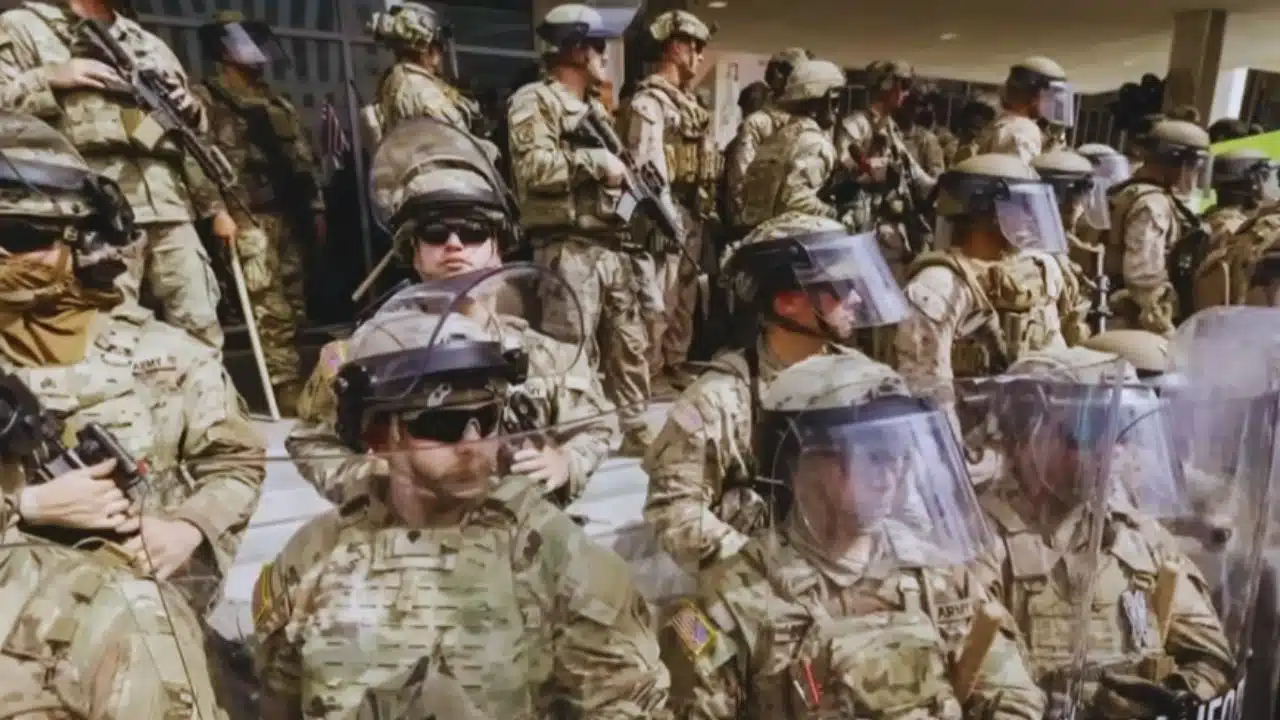
As the protests grew, President Donald Trump ordered thousands of National Guard troops and several hundred Marines to be deployed in the city. According to the White House, the troops were needed to control what they described as rising violence and to ensure that federal property and personnel were protected.
California leaders, however, pushed back strongly. Governor Gavin Newsom and state officials said California’s own police forces and highway patrol units were fully capable of handling the situation. They accused Trump of overstepping his authority by bypassing the governor and directly sending military forces into Los Angeles.
The Legal Challenge: California vs. Trump Administration
Governor Newsom, along with California’s attorney general, filed a lawsuit arguing that Trump’s actions violated the Posse Comitatus Act, a law passed in 1878 that limits the federal government’s ability to use the military in domestic law enforcement.
The Posse Comitatus Act was designed to prevent the military from being used as a policing force inside the United States, except in rare cases where Congress authorizes it or when the Insurrection Act is invoked. In this case, Trump did not invoke the Insurrection Act, and Congress gave no authorization for the deployment.
California’s lawsuit stated that troops were performing police-style duties such as:
- Setting up perimeters around protest zones
- Creating traffic blockades
- Conducting crowd control and riot management
- Supporting immigration raids
These actions, according to the state, crossed the line from “support” into direct enforcement of civilian law — exactly what the Posse Comitatus Act forbids.
The Court’s Decision: A Landmark Ruling in San Francisco
On September 2, 2025, U.S. District Judge Charles Breyer, sitting in San Francisco, delivered a major ruling. He agreed with California’s arguments and declared that Trump’s use of the National Guard in Los Angeles was illegal.
Judge Breyer wrote that there was no rebellion, insurrection, or failure of local law enforcement in Los Angeles. Without those conditions, the President had no legal authority to bypass the state’s governor and federalize troops for policing roles.
The judge’s order emphasized that soldiers had engaged in prohibited activities, including:
- Arrests and apprehensions
- Crowd and riot control
- Traffic enforcement
- Searches and seizures
- Evidence collection and interrogations
He warned that allowing such actions could set a dangerous precedent of creating what he described as “a national police force with the President as its chief.”
Reactions from the White House and California Leaders
White House Response
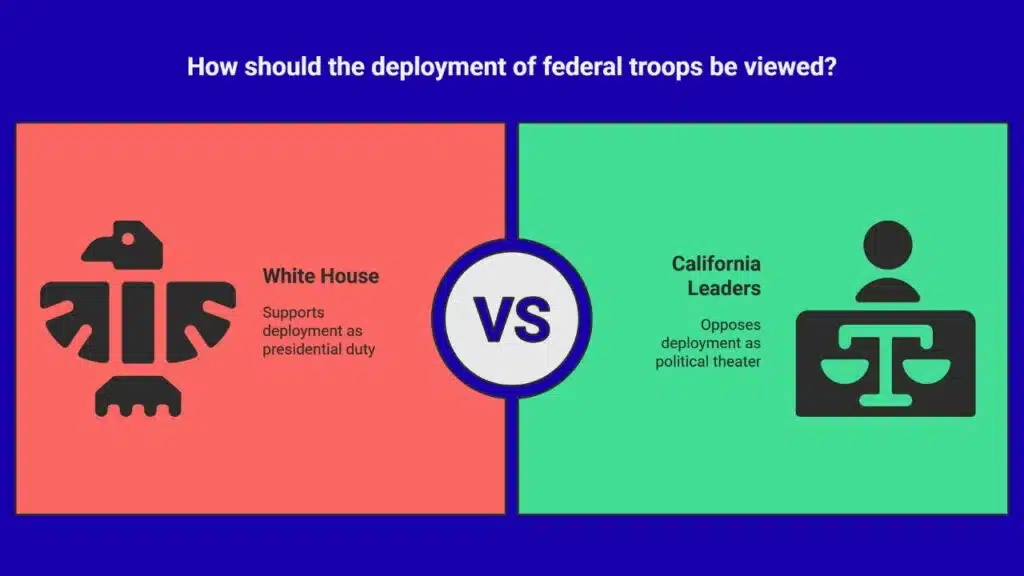
The ruling was met with immediate criticism from the Trump administration. White House spokeswoman Anna Kelly called Judge Breyer a “rogue judge,” claiming he was interfering with the president’s constitutional duty to protect American cities.
Kelly argued that Trump acted within his rights as Commander-in-Chief to deploy troops when he believed local leaders had failed. She also signaled that the administration would appeal the decision to higher courts, insisting that “this will not be the final say on the issue.”
California’s Reaction
Governor Gavin Newsom hailed the decision as a victory for democracy and the U.S. Constitution. In his statement, he said the court had reinforced the principle that the federal government cannot impose military control on states without proper legal grounds.
California Attorney General Rob Bonta echoed this sentiment, describing the deployment as “political theater” meant to project strength rather than solve problems. He emphasized that California law enforcement had been fully in control and did not need military intervention.
Trump’s Response: Defiance and Threats of More Deployments
President Trump, speaking at the White House after the ruling, dismissed the judge’s concerns. He argued that the National Guard had saved Los Angeles from chaos and even claimed that without the deployment, the 2028 Olympic Games scheduled for the city might have been cancelled due to instability.
Trump also criticized Governor Newsom, calling him “weak” and warning that federal troops might need to return if unrest resurfaced. He further suggested that similar deployments could happen in Chicago and other cities soon, saying: “We’re going in. I didn’t say when, but we’re going in.”
Wider Implications: What This Means for Other U.S. Cities
Although Judge Breyer’s ruling applies specifically to California, it sets a legal precedent that could affect Trump’s plans in other states.
The president has previously hinted at sending troops to cities such as Chicago, New York, and Baltimore, citing crime and immigration enforcement concerns. Now, those deployments could face immediate lawsuits, with Breyer’s ruling serving as a guide for other judges.
This decision also underscores the long-running tension between federal power and state authority. Governors traditionally control their state’s National Guard units unless the president lawfully federalizes them. The ruling reinforced that state consent cannot simply be ignored.
The Legal Framework: Posse Comitatus Act vs. Insurrection Act
- Posse Comitatus Act (1878): Prevents federal troops from acting as domestic law enforcement unless explicitly authorized by Congress. It is a safeguard against military overreach into civilian affairs.
- Insurrection Act (1807): Allows the president to use military forces during times of rebellion, insurrection, or when states cannot enforce the law themselves. Historically, it has been invoked during crises such as the Civil War and the Civil Rights Movement.
Because Trump did not invoke the Insurrection Act, his use of troops in Los Angeles had no legal cover, leaving it vulnerable to challenge under the Posse Comitatus Act.
What Comes Next: Appeals and Future Legal Battles
Judge Breyer’s order will formally take effect on September 12, 2025, unless blocked by an appellate court. The Trump administration has already indicated plans to appeal to the Ninth Circuit Court of Appeals, which has ruled in Trump’s favor on a related National Guard case earlier this year.
Legal experts say the case could eventually reach the U.S. Supreme Court, where it would raise fundamental questions about the limits of presidential authority in deploying military forces domestically.
A Turning Point in U.S. Civil-Military Relations
This ruling marks one of the most significant legal checks on presidential power in recent years. It reaffirms the delicate balance between federal authority and state sovereignty, especially when it comes to using the military inside U.S. borders.
While Trump remains defiant, promising more troop deployments if necessary, California leaders are celebrating what they see as a restoration of constitutional order. The legal battle, however, is far from over — and its outcome could reshape how the U.S. government handles protests, immigration enforcement, and domestic security for years to come.
The Information is collected from BBC and NBC News.






















