

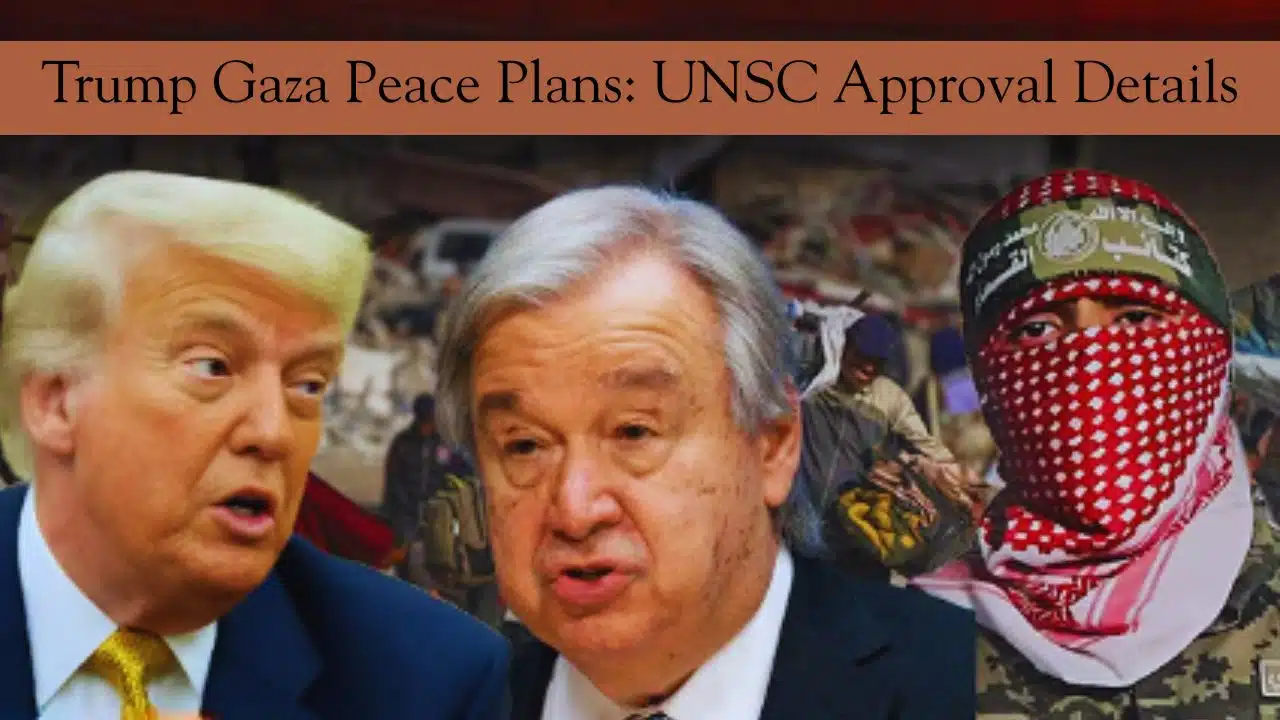
The United Nations Security Council took a major step on Monday by approving a U.S.-drafted resolution that fully endorses President Donald Trump’s comprehensive 20-point peace plan for Gaza, providing it with a strong international mandate after more than two years of devastating conflict. This decision, captured in Resolution 2802 (2025), passed with 13 votes in favor from council members, including the United Kingdom, France, and several non-permanent members, and no vetoes from any of the five permanent powers. Russia and China chose to abstain, citing concerns over the plan’s details and potential biases, but their decision not to block it allowed the resolution to move forward without obstruction.
The approval comes at a critical juncture, building directly on the fragile ceasefire that took effect on October 10, 2025, which was initiated through an exchange of hostages and detainees between Hamas and Israel, marking the first significant de-escalation since the war’s outbreak. This ceasefire, while holding for now, remains vulnerable to breakdowns, as evidenced by sporadic incidents along the borders, and the resolution aims to solidify it by introducing structured international involvement to prevent a return to full-scale hostilities.
The plan itself, first announced by Trump on September 29, 2025, outlines a multi-phase approach to transform Gaza from a war-torn enclave into a stable, demilitarized region capable of supporting economic recovery and eventual Palestinian self-governance. Trump’s initiative draws on his administration’s long-standing emphasis on deal-making in the Middle East, incorporating elements like security guarantees for Israel and humanitarian aid corridors for Palestinians, while addressing the root causes of the conflict such as arms proliferation and governance vacuums.
The UN’s endorsement elevates this proposal from a unilateral U.S. effort to a binding framework under Chapter VII of the UN Charter, meaning member states are obligated to support its implementation, including through financial and logistical contributions. This legal backing is particularly significant given the scale of destruction in Gaza, where entire neighborhoods have been reduced to rubble, infrastructure like hospitals and schools lies in ruins, and over 90% of the population has faced displacement at some point during the fighting. By formalizing the plan, the resolution signals a collective international commitment to ending the cycle of violence that has persisted for decades, though experts note that success will depend on cooperation from all regional stakeholders.
Core Components of the 20-Point Plan
At the heart of Trump’s peace plan is a detailed roadmap divided into four phases, starting with immediate stabilization and progressing toward long-term reconstruction and political reforms. The first phase, already partially underway since the October ceasefire, focuses on humanitarian access and basic security measures, including the release of remaining hostages held by Hamas—estimated at around 100 individuals—and the withdrawal of Israeli forces from key urban areas in northern Gaza. Subsequent phases introduce governance reforms, economic incentives, and diplomatic normalization between Israel and Arab states, with points dedicated to issues like water resource sharing, border delineations, and anti-corruption measures in Palestinian institutions.
The plan’s 20 points cover a wide spectrum: from Point 1, which calls for an immediate halt to rocket fire from Gaza into Israel, to Point 20, envisioning a confederation model where Gaza integrates economically with the West Bank under a reformed Palestinian Authority. This holistic design reflects input from U.S. negotiators who consulted with Israeli officials, Egyptian mediators, and even some Gulf states, aiming to create incentives for compliance, such as U.S. security aid packages for Israel and investment funds for Palestinian development.
One of the resolution’s most innovative elements is the authorization for a Board of Peace (BoP), a new transitional body headquartered in a neutral location like Geneva or Amman, which Trump is slated to chair personally during its initial years. The BoP would serve as the central coordinating authority, overseeing everything from aid distribution to political dialogues, and it includes representatives from the U.S., Israel, the Palestinian Authority, Egypt, and select Arab nations to ensure balanced input. This board would manage a World Bank-supported trust fund, projected to raise billions in pledges from donor countries, targeting Gaza’s reconstruction needs estimated at over $50 billion.
Funds would prioritize clearing unexploded ordnance— with reports indicating more than 100,000 such devices scattered across the territory—rebuilding power grids, and constructing desalination plants to address chronic water shortages. The trust fund’s structure emphasizes transparency, with independent audits to prevent mismanagement, drawing lessons from past reconstruction efforts in post-conflict zones like Iraq and Afghanistan. By embedding economic recovery into the security framework, the plan seeks to create jobs and reduce the appeal of militant groups, fostering a virtuous cycle where stability enables prosperity.
Launching the International Stabilization Force
A cornerstone of the resolution is the creation of the International Stabilization Force (ISF), a multinational peacekeeping mission designed to deploy rapidly to Gaza under a unified command structure approved by the Board of Peace. The ISF, authorized for an initial two-year mandate with options for extension, would consist of up to 20,000 troops and support personnel, drawn from contributing nations that have already signaled interest, including Egypt for border security expertise, the United Arab Emirates and Qatar for regional legitimacy, the United Kingdom and France for logistical capabilities, and potentially Turkey, Pakistan, Australia, and Jordan to broaden international buy-in. Deployment would begin in phases: first, a vanguard unit to secure the Rafah crossing with Egypt, followed by teams to patrol northern borders with Israel and establish safe zones in central Gaza for aid convoys. The force’s rules of engagement allow for defensive actions against threats, including the neutralization of armed militants, but stress proportionality to avoid alienating civilians.
The ISF’s primary tasks include overseeing the demilitarization of Gaza, a process that involves mapping and destroying underground tunnels—over 500 kilometers of which have been identified—dismantling rocket launch sites, and confiscating heavy weaponry from non-state actors. This would extend to a mandatory decommissioning program where groups like Hamas must surrender arms stockpiles, verified through on-site inspections and satellite monitoring coordinated with U.S. Central Command. To fill the resulting security vacuum, the resolution mandates the training of a new Palestinian National Police Force, numbering around 15,000 officers, who would undergo vetting by international observers to exclude affiliations with militant organizations.
Training camps, potentially based in Egypt or the West Bank, would focus on community policing, counter-terrorism tactics, and human rights standards, with the goal of transitioning full control to this force within 18 months. U.S. Ambassador Mike Waltz highlighted these efforts during the council debate, stating that the ISF would “stabilize the security environment, support the demilitarization of Gaza, dismantle terrorist infrastructure, decommission weapons, and maintain the safety of Palestinian civilians,” while coordinating closely with Israeli and Egyptian forces to respect sovereignty concerns. He described the ceasefire as a “fragile first step,” underscoring the need for swift ISF deployment to build confidence among all parties.
Complementing the ISF is the Civil-Military Coordination Center, already operational since mid-October 2025 under the leadership of U.S. General Brad Cooper, which facilitates daily interactions between international actors, aid agencies, and local authorities. This center has already enabled the delivery of over 500 truckloads of supplies weekly, including food, medicine, and shelter materials, through secured corridors, demonstrating the practical groundwork for the larger mission.
Hamas’s Strong Rejection and Concerns
Despite the international momentum, Hamas has outright rejected the resolution and the underlying peace plan, framing it as an infringement on Palestinian sovereignty and a tool to perpetuate Israeli dominance. In a detailed statement released on Telegram shortly after the vote, Hamas spokesperson Sami Abu Zuhri declared that the proposal “imposes an international guardianship mechanism on the Gaza Strip, which our people and their factions reject in its entirety.” The group specifically criticized the ISF’s disarmament mandate, arguing that it “strips the force of its neutrality and turns it into a party to the conflict in favor of the occupation,” effectively siding with Israel against legitimate resistance.
This position echoes Hamas’s earlier responses to Trump’s September announcement, where they conditionally offered to release hostages and transfer administrative control to independent Palestinian technocrats but insisted on retaining defensive capabilities and veto power over any external forces. Internal Hamas deliberations, as reported by regional mediators, reveal divisions: hardliners view the plan as a non-starter, while pragmatists worry about isolation if they remain the sole holdouts amid growing Arab support for the initiative.
Hamas’s objections center on several unaddressed issues, including the lack of explicit commitments to Palestinian statehood, the right of return for refugees, or lifting the blockade on Gaza’s economy. They argue that the plan sidesteps core grievances from the Oslo Accords era, such as settlement expansions in the West Bank, and imposes timelines that favor rapid demilitarization without reciprocal Israeli concessions like halting military operations. The group’s Telegram channels have amplified these views through videos and infographics, rallying supporters by portraying the ISF as an “occupation army in disguise.
This rejection could complicate implementation, as Hamas controls significant territory and resources in Gaza, potentially leading to guerrilla-style resistance or aid disruptions if not managed carefully. Reuters, citing sources close to the talks, noted that Hamas has urged allies like Iran and Hezbollah to condemn the resolution publicly, though no coordinated military response has materialized yet.
Historical Context and Human Impact
The resolution’s passage occurs against the backdrop of the war ignited by Hamas’s October 7, 2023, attack on southern Israel, a meticulously planned assault involving thousands of rockets and ground incursions that killed approximately 1,200 people, mostly civilians, and resulted in the abduction of over 250 hostages. Israel’s retaliatory offensive, involving airstrikes, ground invasions, and a tightened siege, has led to profound devastation, with the Hamas-run Gaza health ministry reporting more than 69,000 Palestinian deaths, including a disproportionate number of women and children, and widespread injuries exceeding 150,000.
Independent verifiers, such as the UN Office for the Coordination of Humanitarian Affairs, have corroborated much of this toll, highlighting famine risks, disease outbreaks in overcrowded shelters, and the collapse of basic services like electricity and sanitation. The conflict has displaced nearly 2 million residents multiple times, turning Gaza into what aid groups describe as “the world’s largest open-air prison turned graveyard,” with long-term psychological trauma affecting generations.
This latest development represents a potential turning point, as the plan addresses immediate humanitarian needs while laying groundwork for political resolution. However, its success hinges on navigating entrenched distrust: for Palestinians, it must deliver tangible justice; for Israelis, unyielding security.
Global Reactions and Path Forward
Reactions to the resolution have been mixed but largely supportive among Western and Arab states. Israeli Prime Minister Benjamin Netanyahu praised it as a “victory for peace through strength,” though he expressed reservations about Turkish participation in the ISF, citing Ankara’s ties to Hamas. The Palestinian Authority, led by President Mahmoud Abbas, has welcomed the initiative at the highest levels, seeing it as an opportunity to reclaim governance in Gaza from Hamas, with Algerian Ambassador Amar Bendjama noting broad backing from Arab and Muslim countries during the council session.
Russia’s Ambassador Vasily Nebenzya explained the abstention by criticizing the plan’s opacity, warning that it hands “complete control” to undefined entities without clear modalities, potentially exacerbating divisions. U.S. officials, including Ambassador Waltz, hailed the vote as “charting a new course” for the region, promising that a stable Gaza would enhance security for Israel and prosperity for Palestinians alike.
Looking ahead, the next steps involve rapid ISF mobilization, with a joint task force—already monitoring the ceasefire since October—expanding operations to include weapons collection sites and reconstruction assessments. International donors are convening in December 2025 to pledge funds, while diplomatic channels work to coax Hamas toward conditional acceptance. If implemented effectively, this could mark the end of a dark chapter, but ongoing challenges like enforcement and inclusivity will test the international community’s resolve.





















