

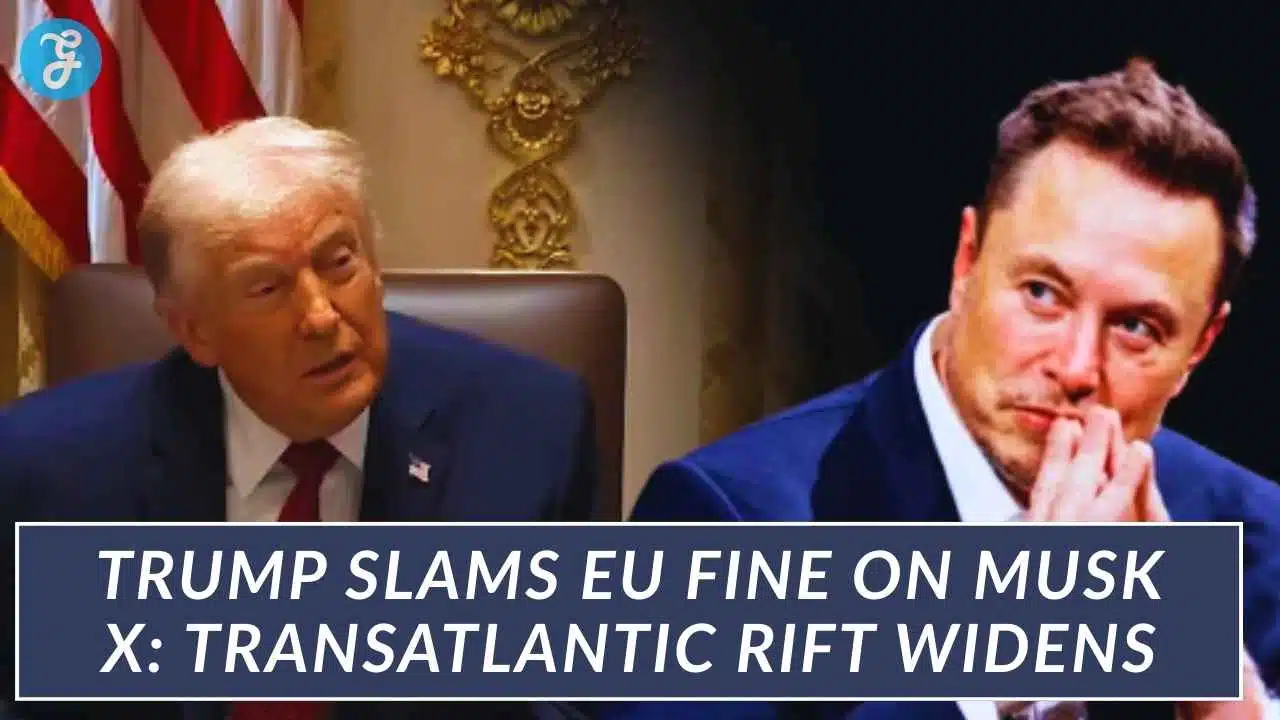
President Donald Trump, speaking to reporters at the White House on Monday, December 8, 2025, strongly denounced the European Union’s imposition of a hefty €120 million ($140 million) fine on Elon Musk’s social media platform X, labeling the penalty as “a nasty one” and expressing deep concern that “Europe is going in some bad directions.” Trump voiced genuine puzzlement over the underlying rationale for the fine, which EU regulators had announced on Friday, December 5, under the bloc’s relatively new Digital Services Act (DSA), questioning openly, “I don’t see how they can do that.
” He further revealed that Musk had not contacted him seeking any assistance or intervention on the issue, yet Donald Trump issued a pointed caution to European leaders, advising that “Europe has to be very careful” in pursuing such regulatory measures against prominent American tech firms. This public rebuke from the U.S. president underscores growing frictions between Washington and Brussels over digital regulation, trade practices, and broader geopolitical alignments, amplifying perceptions of a widening transatlantic divide.
First DSA Penalty Sparks Transatlantic Tensions
The €120 million fine represents a landmark moment, marking the European Commission’s very first non-compliance enforcement action under the Digital Services Act, a comprehensive regulation that took full effect in 2024 to govern online platforms and curb illicit content, disinformation, and deceptive practices across the 27-nation bloc. After an exhaustive two-year investigation involving multiple warnings and compliance audits dating back to early 2023, regulators pinpointed three core violations by X: first, the “deceptive design” of its paid blue checkmark verification system, where users paying for the premium badge—introduced after Musk’s 2022 acquisition—could misleadingly appear as officially verified accounts, heightening risks of scams, impersonation, and consumer harm without rigorous authenticity checks; second, persistent shortcomings in the transparency of X’s public advertising repository, which failed to provide essential details such as ad content specifics, targeted topics, and the identities of advertisers and payers, while also imposing unnecessary technical barriers to access; and third, systematic blocking of independent researchers from vital public data repositories essential for studying systemic risks like election interference, hate speech proliferation, and algorithmic biases.
The fine’s breakdown, as detailed by senior EU officials, assigns €45 million specifically to the blue checkmark deception that eroded user trust, €35 million to the ad transparency failures that obscured political and commercial influences, and €40 million to the data access restrictions that impeded academic and societal oversight of platform operations. Executive Vice-President for Technology Sovereignty Henna Virkkunen articulated the EU’s firm stance, declaring that “deceiving users with blue checkmarks, obscuring information on ads, and shutting out researchers have no place online in the EU,” positioning the penalty as a critical step toward enforcing accountability and protecting over 450 million European users’ rights in the digital marketplace. The decision immediately provoked a fierce backlash from Trump administration heavyweights, with Secretary of State Marco Rubio framing it as “an attack on all American tech platforms and the American people by foreign governments,” Vice President JD Vance deriding the EU’s justifications as outright “garbage,” and Federal Communications Commission Chairman Brendan Carr arguing that the fine exemplified Europe punishing a “successful U.S. tech company for being a successful U.S. tech company,” rather than addressing legitimate harms.
Elon Musk himself fired back aggressively on his platform, posting a blunt “Bullshit” directly under the Commission’s official announcement, and escalating further by proposing that the EU should be “abolished” to allow individual nations to reclaim sovereignty over tech policies; in a retaliatory move over the weekend, X terminated the European Commission’s longstanding advertising account, accusing regulators of exploiting a purported system loophole for undue advantages, even as the Commission clarified it had refrained from purchasing any ads on X since 2023 amid ongoing tensions.
Broader Strategic Rift
Trump’s sharp criticism arrives against the backdrop of his administration’s freshly unveiled National Security Strategy, released in late November 2025, which delivers stark warnings about Europe’s precarious trajectory, highlighting the “prospect of civilizational erasure” driven by unchecked mass migration policies, plummeting birthrates, and cultural identity dilution that could render the continent “unrecognizable” within two decades. The comprehensive 50-page document meticulously outlines how these demographic shifts—exacerbated by resource strains, rising crime rates linked to integration failures, and fraying social cohesion in nations from Sweden to France—pose existential threats not only to European stability but also to the reliability of traditional U.S. allies in NATO and beyond, prompting Washington to actively “cultivate resistance to Europe’s current path within European nations” through support for populist movements and policy reforms.
It calls for recalibrating transatlantic ties by enforcing greater burden-sharing, such as pushing NATO members toward a 5% GDP defense spending target via mechanisms like the Hague Commitment, while critiquing elite-driven migration agendas that prioritize open borders over national security and economic sustainability. In response, EU regulators have staunchly defended the DSA fine as a proportionate, rules-based measure that applies uniformly to all very large online platforms—regardless of American, European, or other nationality—insisting it targets specific transparency lapses rather than engaging in censorship or protectionism.
Virkkunen reiterated that the action “has nothing to do with censorship” but centers on upholding core DSA obligations for user protection and systemic risk mitigation, requiring X to deliver detailed compliance improvement plans within 60 to 90 days, with the specter of escalating penalties, including potential platform bans or fines up to 6% of global annual revenue, looming if violations persist. This episode highlights deepening U.S.-EU clashes over tech sovereignty, with American officials viewing DSA enforcement as extraterritorial overreach akin to digital protectionism, while Brussels sees it as essential for a level playing field amid dominance by U.S. giants like X, Meta, and Google; ongoing disputes could ripple into trade negotiations, data privacy pacts, and alliance dynamics as both sides navigate an increasingly polarized global tech landscape.





















