

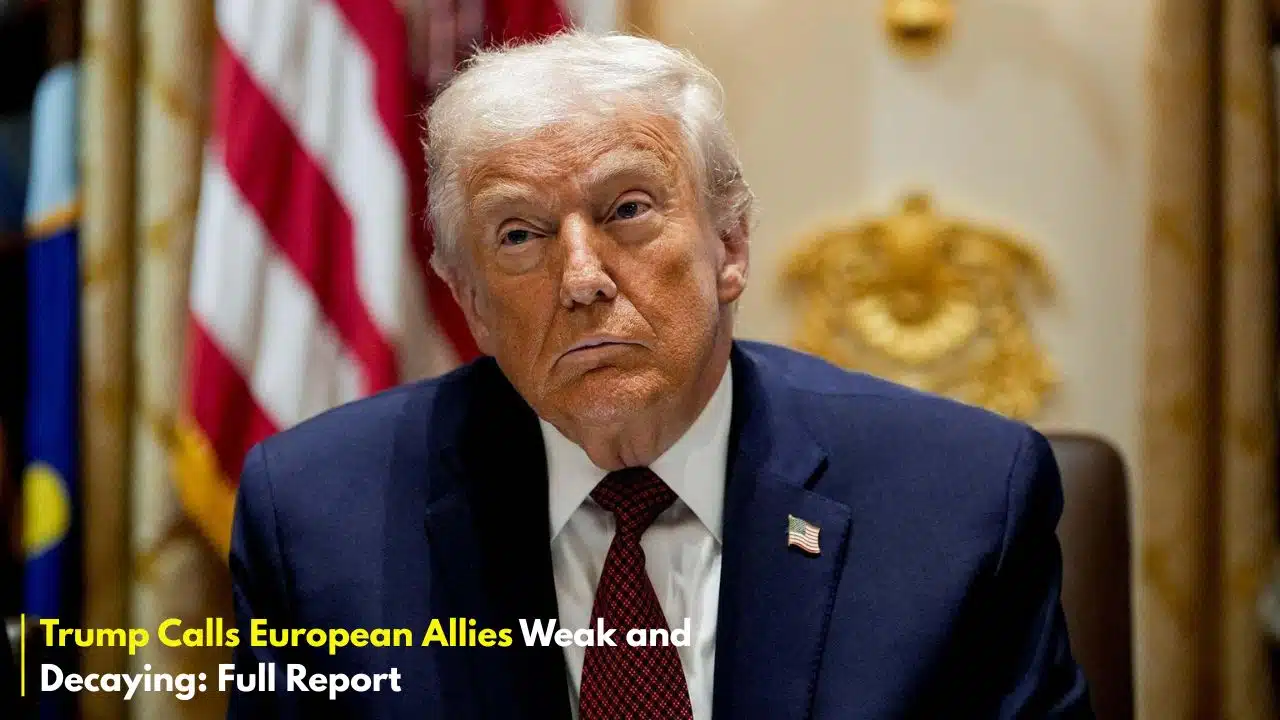
Former U.S. President Donald Trump has once again ignited international controversy after labeling several of America’s longstanding European allies as “weak” and “decaying.” The remarks, reportedly made during a campaign rally and later reinforced in a televised interview, have triggered a wave of diplomatic unease across European capitals and rekindled questions about the future of transatlantic cooperation if Trump returns to the White House.
A Familiar Rhetoric With New Intensity
Trump’s criticism of Europe is not new. During his first term (2017–2021), he frequently accused NATO members of failing to meet defense spending commitments and argued that the U.S. carried an unfair financial burden in defending the continent. However, his latest comments appear even more direct and inflammatory.
Referring to European nations as “decaying powers” that “have lost their will to fight,” Trump claimed that Western Europe’s political and economic decline was “self-inflicted” due to what he described as “bureaucratic socialism, open borders, and dependence on American protection.”
At a campaign event in Iowa, Trump declared, “Europe is falling apart. They are weak, they are decaying, and they expect the United States to save them every time. That’s not leadership — that’s dependency.”
The statement drew immediate attention from international media and leadership circles across the Atlantic. Analysts see it as another effort by Trump to define his foreign policy stance as nationalist and transactional — framing alliances as business deals rather than shared commitments.
European Leaders React with Concern
The reaction from Europe was swift and pointed. Top officials from the European Union and NATO expressed concern over Trump’s rhetoric, warning that such remarks could damage trust at a time when unity between the U.S. and Europe remains critical amid rising global instability.
European Commission President Ursula von der Leyen responded subtly but firmly, saying, “The transatlantic partnership has been the cornerstone of security and prosperity for decades. It is not weakness to stand together. It is wisdom.”
German Chancellor Olaf Scholz, whose government has been under domestic pressure to increase defense spending, called Trump’s comments “unhelpful and counterproductive.” Scholz added, “Partnership is built on respect, not insults. Europe is evolving and adapting — not decaying.”
French President Emmanuel Macron, often outspoken in defending Europe’s strategic independence, seized the opportunity to promote his long-held vision of “European sovereignty.” In a statement from the Élysée Palace, Macron emphasized that Europe must “learn to rely on itself” and “prepare for any scenario where the transatlantic relationship is weakened.”
NATO Officials Try to Contain Fallout
Within NATO, officials sought to play down the comments while reaffirming the alliance’s unity. NATO Secretary-General Jens Stoltenberg stated that the strength of the alliance lies in mutual commitments rather than rhetoric. “All allies contribute in different ways,” Stoltenberg said, “and together, we are stronger and safer. That has never changed.”
Behind the scenes, however, several diplomats expressed frustration that Trump’s words risk undermining morale at a time when NATO is trying to maintain cohesion in the face of Russian aggression and global uncertainty.
One senior European diplomat, speaking anonymously, told Editorialge News, “Every time Trump attacks NATO or calls Europe ‘weak,’ it sends a signal to Moscow and Beijing that Western unity can be questioned. That is dangerous.”
U.S. Allies Fear “America First” Foreign Policy 2.0
Trump’s remarks also revive memories of his administration’s contentious approach to foreign relations. During his presidency, he repeatedly criticized NATO’s Article 5 — the principle that an attack on one member is an attack on all — and once reportedly considered withdrawing from the alliance altogether.
If reelected, many analysts expect Trump to pursue a foreign policy even more isolationist than before. His vision of “America First 2.0” could entail reduced military commitments abroad, reevaluated trade agreements, and a more unilateral approach to global crises.
Dr. Fiona Hill, a former senior director for European affairs on the National Security Council, said in a television interview that Trump’s new rhetoric “goes beyond budget complaints — it’s ideological.” She added, “He seems to truly believe that the U.S. should disengage from Europe and Asia unless there is a very clear and immediate benefit for America.”
Historical Context: Trump’s Tense Relationship with Europe
Tensions between Trump and European leaders have existed for years. From his skepticism of climate accords to his trade tariffs on European steel and aluminum, Trump consistently portrayed the European Union as both an economic competitor and a political burden.
Throughout his presidency, he clashed with Angela Merkel over refugee policy, criticized NATO’s eastern expansion cost-sharing, and openly supported Brexit, celebrating Britain’s departure from the EU as a “beautiful thing.”
In this sense, his recent remarks fit a pattern — using Europe as a rhetorical foil to strengthen his domestic political narrative. Within his campaign, positioning himself as the “defender of American taxpayers against freeloading allies” resonates strongly with segments of his base who question the value of foreign alliances.
European Economic Stagnation: Facts and Perceptions
Trump’s “decaying” label, while provocative, taps into real anxieties about Europe’s economic performance. The European Union has struggled with slow growth, energy dependency, and demographic decline over the past decade.
-
Economic slowdown: Europe’s GDP growth has lagged behind that of the U.S. and Asia-Pacific economies, driven by high energy prices, regulatory complexity, and weak productivity.
-
Defense spending gaps: A number of NATO nations still fall short of the 2% of GDP defense target, though investment has increased since Russia’s 2022 invasion of Ukraine.
-
Population decline: Several countries, including Italy and Germany, are facing shrinking workforces, raising concerns about long-term vitality.
However, critics of Trump argue that his narrative ignores Europe’s resilience and capacity for innovation. The EU remains the world’s second-largest economic bloc, a leader in green energy and digital regulation, and a dominant player in global trade.
Transatlantic Security at a Crossroads
Trump’s remarks also arrive at a strategic turning point for Western defense. The war in Ukraine has reminded Europe of its dependence on U.S. military assets, but it has also catalyzed renewed efforts toward self-reliance.
NATO’s expansion to include Finland and Sweden underscores Europe’s strategic awakening, while the EU’s own defense initiatives — including the European Defence Fund and Permanent Structured Cooperation (PESCO) — signal moves toward collective capability development.
Still, the gulf between ambition and implementation remains wide. Despite new commitments, Europe’s military readiness is uneven, and procurement inefficiencies persist. For this reason, European analysts fear that another Trump presidency could accelerate plans for autonomy but also expose vulnerabilities before they are resolved.
Analysts: “Testing the Alliance Before It’s Needed Most”
Geostrategic experts note that Trump’s language may have ripple effects that extend beyond elections. “Allies look for predictability, and Trump thrives on disruption,” said Professor Karen Donfried of Harvard’s Kennedy School. “If European leaders start to doubt U.S. reliability, they will hedge — not necessarily with Russia or China, but through alternative partnerships and independent deterrence structures.”
Others suggest that Trump’s confrontational messaging is intentional. According to conservative commentator Dana Loesch, “Trump’s point is not to destroy NATO — it’s to make it stronger by forcing Europe to pay up. The problem is his language, not his objective.”
European Public Opinion: A Divided Response
Public reaction within Europe has been mixed. In Germany and France, opinion polls reveal declining trust in American leadership when Trump dominates headlines. In Poland, Romania, and the Baltic states, however, public opinion remains more favorable to Trump’s tough stance against NATO free-riding — as long as it does not lead to U.S. withdrawal.
An IPSOS survey conducted shortly after his comments found that 58% of Europeans view Trump as a “destabilizing force,” while only 21% believe his approach could “reinvigorate” transatlantic relations by demanding accountability.
The Biden Camp Responds
From Washington, the Biden administration moved quickly to reassure allies. Secretary of State Antony Blinken reiterated the U.S. commitment to NATO and described Europe as “America’s indispensable partner.” He added, “Our alliances amplify American strength — they don’t reduce it.”
A spokesperson for the Biden campaign criticized Trump’s remarks as “reckless and dangerous,” arguing that “insulting allies weakens America, emboldens adversaries, and undermines decades of U.S. leadership.”
Meanwhile, Republican lawmakers offered differing views. Senator Lindsey Graham downplayed the controversy, saying, “Trump’s style is brash, but his message on burden-sharing is valid.” Others, including Senator Mitt Romney, criticized the comments as “shortsighted and harmful to U.S. security interests.”
The Future of NATO Without Consensus
If Trump returns to office, NATO could face unprecedented internal strain. His potential administration might demand immediate financial reforms, new burden-sharing agreements, or conditional military support — all of which could test the alliance’s fabric.
European defense planners already discuss contingency scenarios. One senior EU official told the Financial Times, “We are preparing for the possibility that we’ll need to defend Europe on European terms. We hope for partnership, but we must plan for autonomy.”
That sentiment echoes a larger shift: Europe’s realization that its security can no longer depend solely on American goodwill.
Trump’s Broader Global Strategy
Beyond Europe, Trump’s renewed “America First” tone fits a broader blueprint of reduced multilateral commitments. His campaign promises include renegotiating trade agreements, reasserting tariffs on foreign imports, curtailing U.S. aid abroad, and reassessing relations with China and Russia under new terms.
In this vision, the United States would act less as the “leader of the free world” and more as a “sovereign superpower” pursuing narrowly defined national interests. For supporters, this signals realism; for critics, it marks an inward retreat.
A Diplomatic Balancing Act for the EU
Faced with an unpredictable U.S. partner, EU policymakers are walking a fine line between preparing for strategic autonomy and preserving transatlantic unity. Initiatives such as deeper defense integration, joint procurement, and cybersecurity cooperation aim to fortify Europe’s resilience.
However, building a truly independent European defense system could take decades and trillions of euros — resources that are not easily mobilized amid debt pressures and domestic political divides.
Some analysts suggest that Trump’s provocations might paradoxically accelerate Europe’s cohesion. “If nothing else, Trump is forcing the EU to confront strategic dependency,” noted Sophie Meunier, a senior fellow at Princeton University. “That could be the shock Europe needs.”
Global Implications of a Fractured West
The implications of Trump’s “weak and decaying” comments extend far beyond diplomatic etiquette. In Moscow and Beijing, leaders are likely to interpret the statements as evidence of Western fragmentation.
Russian state media outlets quickly amplified Trump’s remarks, portraying them as proof that “America has lost faith in Europe.” Chinese commentators on state-affiliated networks echoed similar narratives, claiming that “Washington sees the EU as a subordinate in decline.”
Such narratives serve the interests of authoritarian powers by undermining Western confidence and unity — precisely what NATO and the EU are trying to counter through collective messaging.
Domestic Political Motives Behind Trump’s Rhetoric
Domestically, Trump’s tough talk plays well with voters skeptical of foreign entanglements. His campaign continues to exploit the populist narrative that American resources should serve U.S. citizens first, not global institutions.
Pollsters suggest that such positions resonate strongly in swing states like Pennsylvania, Michigan, and Wisconsin, where economic discontent overlaps with anti-globalist sentiment.
By targeting Europe, Trump effectively draws a contrast between his vision of self-sufficiency and the Biden administration’s emphasis on alliances and international cooperation.
Europe’s Path Forward: Resilience Through Unity
Despite the rhetorical storm, European officials insist that Trump’s provocations will not derail the continent’s commitment to cooperation. EU foreign policy chief Josep Borrell summed up the sentiment succinctly: “We have faced crises before — financial, migration, pandemic, war — and each time, Europe has emerged stronger.”
In practical terms, European governments are doubling down on joint projects, from renewable energy and technology investments to expanded defense capabilities. Whether this renewed commitment can translate into actionable independence remains to be seen.
Conclusion: A Transatlantic Relationship Tested but Enduring
Donald Trump’s labeling of Europe as “weak” and “decaying” is more than just an insult — it is a test of the resilience of Western unity in an era of shifting power dynamics. The comments have reopened old wounds within the transatlantic relationship, yet they also highlight enduring questions about sovereignty, dependence, and strategic ambition.
As Europe cautiously prepares for possible political shifts in the United States, one truth remains: the fates of the U.S. and Europe are still deeply intertwined, however turbulent the rhetoric may become. Whether that relationship will evolve through cooperation or confrontation depends not only on who occupies the White House but also on how Europe chooses to define its own future.





















