


The year 2026 marks a turning point where climate tech is the primary engine of the global economy. As fusion energy shifts from laboratory dreams to strategic roadmaps and AI-driven energy demand reshapes our power grids, the individuals steering these technologies have become the most critical voices of our time. To be one of the top climate tech influencers 2026, one must bridge the gap between deep science and industrial scalability.
How We Chose Our Top 10 List?
Identifying “influence” in the fast-moving 2026 landscape requires looking beyond social media following. We analyzed technical deployment milestones, capital under management, and policy-shaping impact.
We applied the following weightings to our selection process:
| Criteria | Weighting | Focus Area |
| Technical Scalability | 40% | Proven ability to move technology from pilot to industrial scale |
| Capital Influence | 30% | Direct control or influence over climate-aligned investment flows |
| Policy & Public Impact | 30% | Ability to shift global regulations or consumer behavior |
Here are The 10 Top Climate Tech Influencers in 2026
The following ten individuals represent the most significant leadership across the diverse sectors of the 2026 climate economy.
1. Alastair Child
As the Chief Sustainability Officer at Mars, Alastair Child has redefined how multinational corporations handle Scope 3 emissions. In 2026, he was named the #1 sustainability leader for successfully embedding regenerative agriculture into one of the world’s largest supply chains. His “accountability-first” model has become the blueprint for other Fortune 500 companies.
Special Features:
-
Leads global strategy for a 100% net-zero value chain.
-
Pioneer in large-scale corporate regenerative agriculture investment.
-
Focuses on measurable impact over high-level boardroom discussions.
Things to Consider:
-
His influence is largely corporate-focused, which can be slower than startup agility.
-
Success is heavily dependent on the cooperation of millions of independent farmers.
-
Primarily operates within the consumer goods sector.
Best for: Corporate leaders seeking a roadmap for supply chain decarbonization.
2. Juliann Edwards
Juliann Edwards is a central figure in the 2026 nuclear renaissance. As a leader at The Nuclear Company, she has championed the deployment of Small Modular Reactors (SMRs) as the “missing piece” of the clean energy puzzle. Her work bridges the gap between high-tech energy solutions and public-sector energy policy.
Special Features:
-
Managing a multi-billion dollar portfolio of clean energy deployment.
-
Leading advocate for gender equity through “U.S. Women in Nuclear.”
-
Key voice in reshaping public perception of modern nuclear safety.
Things to Consider:
-
Nuclear projects face long regulatory timelines regardless of technical readiness.
-
SMR technology is still in the early stages of mass manufacturing.
-
Her voice is often at the center of polarized energy debates.
Best for: Energy policymakers and investors focused on 24/7 carbon-free base load power.
3. Andreas Aepli
As CFO of Climeworks, Andreas Aepli has transitioned Direct Air Capture (DAC) from a scientific experiment to a bankable asset class. In 2026, he has led the company to deliver over 50,000 tons of verified carbon removal credits to major buyers like Stripe and Microsoft, proving that carbon removal is a viable commercial industry.
Special Features:
-
Architect of the first commercial-scale “carbon removal portfolios.”
-
Expertise in making deep-tech projects attractive to conservative capital.
-
Leads the most visible and trusted brand in the DAC space.
Things to Consider:
-
Carbon removal credits remain expensive ($600-$800/ton) in 2026.
-
The technology requires vast amounts of clean energy to operate at scale.
-
Face competition from lower-cost, nature-based offsets.
Best for: Sustainability officers looking for high-permanence carbon removal solutions.
4. Tyler Norris
Formerly a Duke University researcher, Tyler Norris recently joined Google’s advanced energy team. He is the leading voice on the “AI Energy Crisis,” having published seminal research on how data centers can modulate demand to support, rather than strain, the electric grid. His work is essential for the 2026 transition to AI-first economies.
Special Features:
-
Bridging the gap between AI growth and power grid stability.
-
Influencing how “Big Tech” spends hundreds of billions on clean energy.
-
Expert in electricity market design and load integration.
Things to Consider:
-
His move to Google may limit his “independent” academic voice.
-
Solutions require deep cooperation between tech giants and local utilities.
-
Focus is primarily on the U.S. power sector.
Best for: Tech founders and utility executives navigating the energy demands of AI.
5. Jessica Bailey
Jessica Bailey is the pioneer of C-PACE (Commercial Property Assessed Clean Energy) financing. In 2026, her leadership at Nuveen Green Capital has unlocked over $3.3 billion in upgrades for building decarbonization. She has successfully turned “green buildings” into a mainstream financial product for real estate investors.
Special Features:
-
Creator of the scalable financial model for city-wide resilience.
-
Operates at the intersection of public policy and private markets.
-
Focuses on “inclusive climate solutions” that benefit building occupants.
Things to Consider:
-
C-PACE adoption varies significantly by state and local jurisdiction.
-
Commercial real estate market volatility can impact funding availability.
-
Primarily focused on the “built environment” rather than energy generation.
Best for: Real estate developers and city planners looking to finance energy upgrades.
6. Eamon Jubbawy
As the founder of Isometric, Eamon Jubbawy is the “referee” of the carbon removal market. In 2026, Isometric has become the most trusted registry for high-quality carbon removals, providing the radical transparency needed to restore faith in carbon markets after the offset scandals of previous years.
Special Features:
-
Developed the gold-standard protocol for carbon removal verification.
-
Built a digital-first platform for real-time impact monitoring.
-
Essential for preventing “greenwashing” in corporate reporting.
Things to Consider:
-
His platform’s success depends on industry-wide adoption of his standards.
-
The registry market is becoming increasingly crowded with competitors.
-
Focus is on “engineered” removals rather than traditional forestry.
Best for: Investors and buyers who need high-confidence verification of climate impact.
7. Ayana Elizabeth Johnson
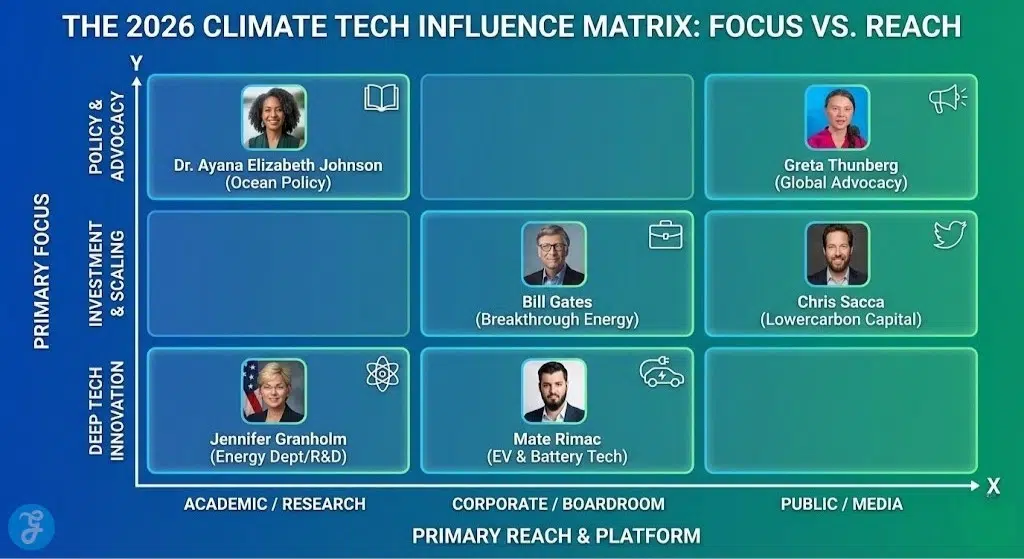
Dr. Ayana Elizabeth Johnson remains the leading communicator in the climate movement. In 2026, her work through “Urbanoceanlab” and her best-selling books focus on the “politics of abundance”—the idea that climate solutions can create a better, wealthier, and more equitable world, rather than one of sacrifice.
Special Features:
-
Expert at merging science, policy, and human psychology.
-
Co-founder of the “All We Can Save” project, empowering female leadership.
-
High influence on the “determined optimism” shift in climate communication.
Things to Consider:
-
Her work is more high-level and cultural than technical or operational.
-
Influence is strongest among activists and policymakers rather than engineers.
-
Often focuses on coastal and ocean-specific climate issues.
Best for: Leaders seeking to inspire their teams and the public with a positive climate vision.
8. Jorgo Chatzimarkakis
As the CEO of Hydrogen Europe, Jorgo Chatzimarkakis is the architect of the “Hydrogen Backbone” in 2026. He has been instrumental in coordinating cross-border policy to ensure that green hydrogen becomes a viable replacement for fossil fuels in heavy industry and long-haul shipping.
Special Features:
-
Leading the push for European hydrogen energy independence.
-
Expert in navigating the complex regulatory frameworks of the EU.
-
Connecting hydrogen producers with industrial “off-takers” like steel and shipping.
Things to Consider:
-
The “Green Hydrogen” economy relies heavily on government subsidies in 2026.
-
Infrastructure (pipelines and storage) is lagging behind production capacity.
-
Hydrogen remains a “polarizing” solution in some environmental circles.
Best for: Heavy industry executives looking to decarbonize manufacturing and logistics.
9. Greg Jackson
Greg Jackson, founder of Octopus Energy, has turned a utility company into a global technology powerhouse. In 2026, Octopus’s “Kraken” platform is being used by utilities worldwide to manage millions of smart devices, heat pumps, and EVs, making the grid smarter and more responsive in real-time.
Special Features:
-
Creator of the most successful consumer-facing energy tech brand.
-
Focuses on using AI and IoT to lower energy bills for households.
-
Successfully exporting UK energy technology to global markets.
Things to Consider:
-
Expanding a utility model globally involves significant regulatory friction.
-
Success depends on high consumer adoption of “smart” home devices.
-
The brand is heavily centered around Jackson’s personal leadership style.
Best for: Consumer-tech startups and utility leaders focused on “demand-side” management.
10. Greta Thunberg
While many 2026 voices focus on “how” to transition, Greta Thunberg remains the most influential voice on “why” and “how fast.” Her role has evolved into a global accountability officer, consistently pointing out the gaps between corporate net-zero pledges and actual scientific requirements.
Special Features:
-
Unrivaled ability to mobilize global youth and public opinion.
-
Consistent focus on “Climate Justice” and the Global South.
-
The ultimate “greenwashing” detector for the 2026 corporate world.
Things to Consider:
-
Her influence is often confrontational, which can alienate some corporate partners.
-
Does not offer specific “technical” or “financial” solutions.
-
Influence is primarily at the moral and policy level.
Best for: Organizations that need a reality check on their long-term climate ethics.
Climate Tech Market Overview 2026
The 2026 market is characterized by a “Profit-First” sustainability model. The speculative “ESG bubble” has been replaced by a focus on technologies that slash costs for CFOs while meeting net-zero targets. Key growth areas include Direct Air Capture (DAC), Small Modular Reactors (SMRs), and AI-optimized grid management.
| Voice | Domain | Organization | 2026 Impact Focus |
| Alastair Child | Supply Chain | Mars Inc. | Regenerative agriculture at scale |
| Juliann Edwards | Nuclear Energy | The Nuclear Company | SMR deployment & gender equity |
| Andreas Aepli | Carbon Removal | Climeworks | Commercializing 50,000+ tons of DAC |
| Tyler Norris | AI & Power | Decarbonizing AI data center demand | |
| Jessica Bailey | Green Finance | Nuveen Green Capital | Building decarb via C-PACE |
How Should You Choose The Best Option For You
Determining which climate tech voice to follow depends on your specific role in the 2026 energy transition:
-
For Investors: Look to Andreas Aepli or Jessica Bailey for insights into bankable, scalable assets.
-
For Corporate Leaders: Follow Alastair Child or Eamon Jubbawy to ensure your supply chain and carbon credits are beyond reproach.
-
For Engineers & Founders: Study Tyler Norris or Greg Jackson to understand how AI and IoT are fundamentally changing the energy landscape.
-
For Visionaries: Listen to Ayana Elizabeth Johnson to shape your communication strategy around “determined optimism.”
Still unsure?
| Category | Top Pick | Primary Reason |
| Industrial Scale | Alastair Child | Transforming the supply chain of a global giant. |
| Clean Energy Future | Juliann Edwards | Leading the 2026 nuclear and SMR renaissance. |
| Market Integrity | Eamon Jubbawy | Building the trust layer for the carbon economy. |
| Technical Innovation | Greg Jackson | Proving that smart tech can lower bills and emissions. |
Wrap-Up
The top climate tech influencers 2026 represent a shift from talk to action. In a year where the physical impacts of climate change are increasingly visible, these leaders are providing the tangible tools—from fusion reactors to blockchain carbon registries—needed to secure a stable future. By following their work, you gain more than just news; you gain a roadmap for the most significant economic transformation of our lifetime.






















