
You feel it, don’t you? That hollow feeling when you are surrounded by people, yet nobody really sees you. This is exactly how the loneliness economy became a global public health crisis. You scroll through your phone, watching others live their best lives, and you wonder why you feel so alone. Loneliness has crept into our lives like an unwanted guest, and it is making us sick.
The U.S. Surgeon General recently declared loneliness an epidemic, comparing its health impact to smoking fifteen cigarettes a day. Companies profit from our pain, selling everything from AI companions to virtual support groups.
I am going to walk you through the exact steps I use to combat this feeling, and I think you will be surprised at how easy it can be to reclaim your connection. So grab a cup of coffee, and let’s go through it together.
Understanding Loneliness Economy: A Global Public Health Crisis
In my years researching public health trends, the most shocking discovery is how loneliness kills. Doctors now treat it like any other serious illness because it damages your heart, brain, and immune system.
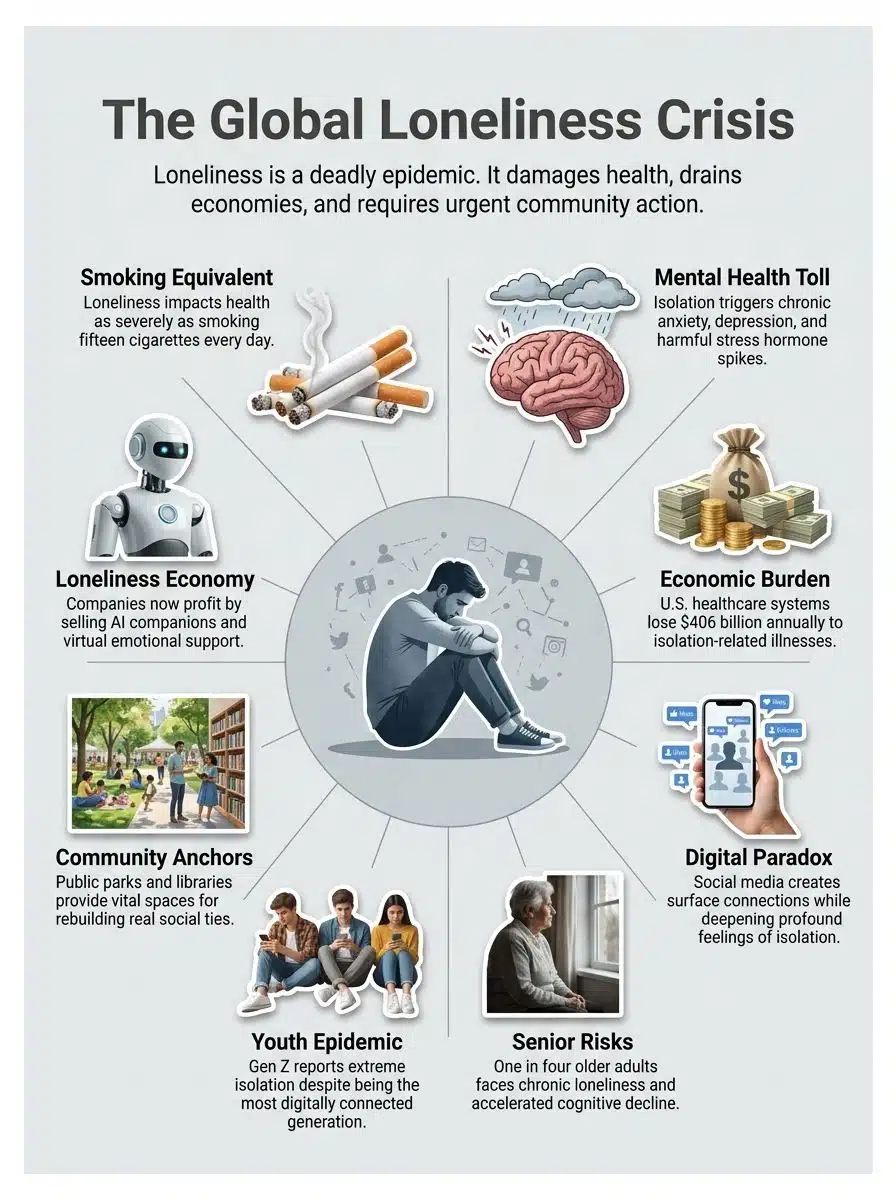
Definition and scope of loneliness
Loneliness is far more than just feeling alone in a crowded room. It describes the painful gap between the social connections you have and the ones you want. This mental health crisis spreads across all ages and income levels.
In a major 2023 and 2024 advisory, U.S. Surgeon General Dr. Vivek Murthy confirmed that nearly half of all U.S. adults experience measurable levels of loneliness. This is a staggering statistic that proves isolation is a systemic problem, not a personal failure.
Dr. Murthy noted that social disconnection carries the same premature mortality risk as smoking daily, elevating it to an urgent national priority.
The scope of loneliness extends beyond sadness to shape how your body responds to stress. The definition encompasses both objective isolation and subjective feelings of disconnection.
How loneliness impacts mental and physical health
Now that we understand how widespread this is, we need to look at the real damage isolation causes to our bodies and minds. The 2024 data from the Centers for Disease Control and Prevention paints a stark picture.
According to the CDC, loneliness directly damages your physical health in the following ways:
- Heart Disease Risk: Lack of social connection increases your risk of developing heart disease by 29 percent.
- Stroke Vulnerability: Isolated individuals face a 32 percent higher risk of suffering a stroke.
- Dementia Rates: For older adults, severe loneliness is linked to a 50 percent increased risk of dementia.
Depression and anxiety flourish in lonely environments. Stress hormones flood your system, making you feel constantly on edge and exhausted. Your mental health takes a direct hit when you lack meaningful interaction.
The Rise of Loneliness in the Modern Age
We spend more time scrolling through screens than sitting across from friends, yet we feel more isolated than ever before. Our neighborhoods have completely transformed.
The role of technology and digital isolation
Technology promised to bring us closer together, yet it often pushes us further apart. Social media platforms connect millions of people, though many users report feeling completely disconnected.
A 2025 study by the Pew Research Center found that nearly half of U.S. teens are online almost constantly. This constant digital presence creates the illusion of togetherness while starving us of genuine interaction.
“We trade depth for breadth, sacrificing meaningful bonds for surface-level interactions that leave us feeling empty,” notes cyberpsychology researcher Dr. Rachel Wood.
Digital isolation creeps into our daily lives without warning. Remote work separates colleagues, and text messages replace face-to-face conversations. Online communities offer support, but they cannot fully replace the warmth of a real handshake.
Shifts in community structures and relationships
Our neighborhoods look very different today. People move often for work, and the structures that once held communities together have simply faded away.
A revealing 2026 study from the Survey Center on American Life found a severe lack of social gathering spots. The data highlights these key shifts in our environment:
- Missing Third Places: One in ten Americans has zero access to public parks, coffee shops, or libraries in their local neighborhoods.
- Commercial Barriers: People with less formal education are significantly less likely to live near accessible cafes or fitness centers.
- Fewer Casual Chats: Without neighborhood amenities, residents rarely speak to their neighbors, completely halting organic friendships.
Work schedules grew demanding, and commutes grew longer. These shifts in how we live created isolation on a massive scale, leaving many without the support systems their grandparents enjoyed.
The Economic Impacts of Loneliness
Loneliness drains billions from healthcare systems every year. Companies now profit from our isolation, selling products to fix what broken communities have left behind.
The cost of loneliness on healthcare systems
Loneliness drains healthcare budgets at an alarming rate. A landmark AARP Foundation study revealed that Medicare spends an estimated $6.7 billion in additional funds annually on socially isolated older adults. Here is how isolation impacts the medical system:
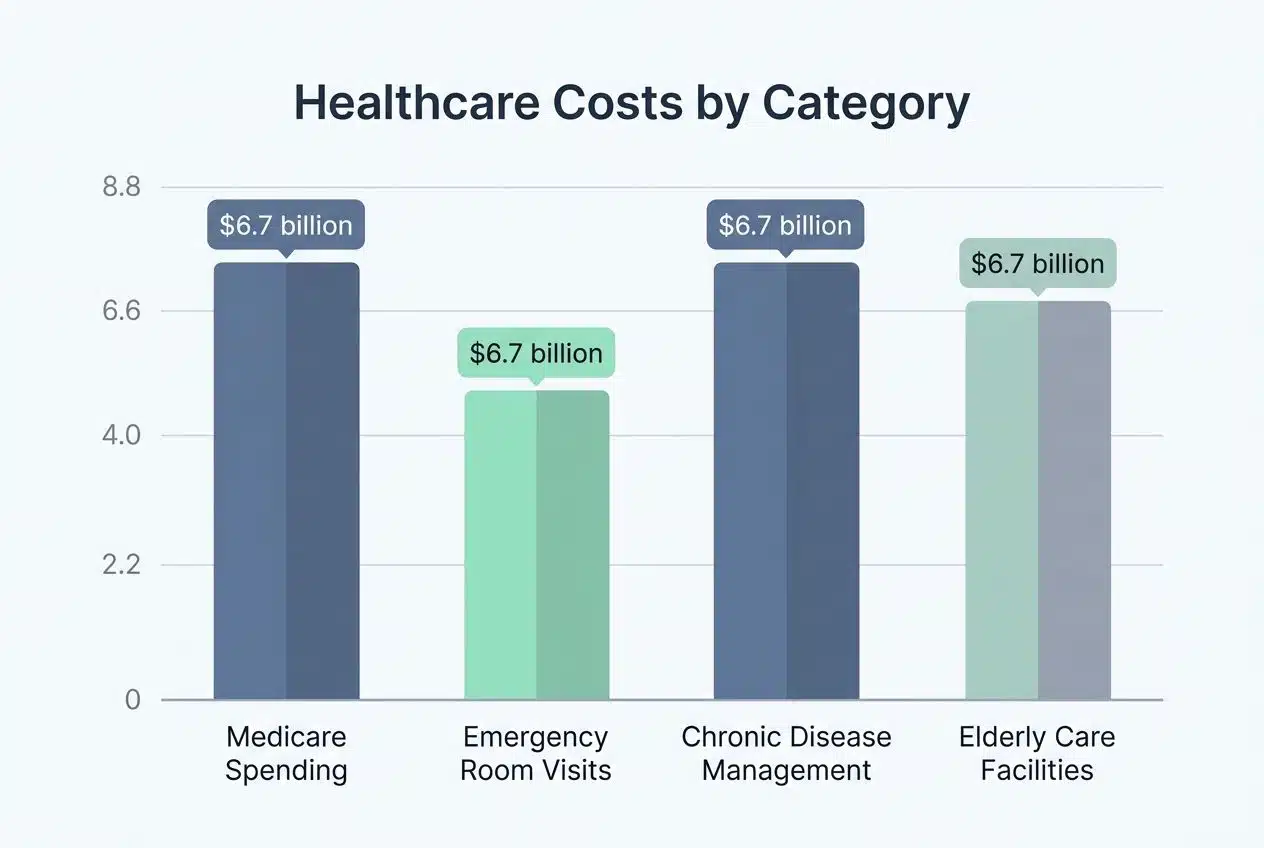
| Healthcare Cost Category | Financial Impact | Key Details |
|---|---|---|
| Medicare Spending | $6.7 billion annually | Medicare spends roughly $1,608 more per year on each socially isolated older adult compared to connected peers. |
| Emergency Room Visits | High Frequency Costs | Isolated individuals visit ERs more frequently for anxiety, depression, and stress-related episodes. |
| Chronic Disease Management | Elevated Expenditures | Isolated people develop heart disease, diabetes, and stroke at higher rates, demanding expensive treatments. |
| Elderly Care Facilities | Skilled Nursing Overuse | Socially isolated seniors are significantly more likely to require expensive skilled nursing facility care. |
Preventive care programs that build social connections cost far less than treating advanced diseases. Government agencies recognize that investing in connection saves money on expensive medical bills down the line.
The rise of the “loneliness economy”
Companies now sell products and services to fight isolation, creating a massive market worth billions. The global AI companion market alone hit $37 billion in 2025.
Businesses profit directly from our need for emotional health support. Here are the leading sectors of this booming industry:
- Online Therapy: Platforms like BetterHelp generated over $1 billion in revenue in 2024 by offering accessible digital counseling.
- AI Chatbots: Virtual friends that offer subscription-based companionship are multiplying rapidly across the app stores.
- The Pet Industry: Americans spent over $150 billion on pets in 2024, with younger generations adopting animals at record rates for comfort.
This market keeps expanding as startups launch new apps monthly. The industry generates revenue by turning isolation into a commodity, raising serious ethical questions.
The Role of Technology in Addressing Loneliness
A pro-tip I always share when analyzing digital trends is that technology offers real tools that help people connect across distances. Apps and digital platforms give isolated folks a way to reach out and find their tribe.
AI companions and virtual influencers
AI companions have emerged as a direct response to the isolation epidemic. Apps like Character.ai reached an astonishing 20 million monthly active users by early 2026.
These digital companions learn your preferences and provide consistent interaction without judgment. The appeal is clear, especially for the massive user base where over half are under the age of 24.
However, this technology brings significant risks. Relying on an AI chatbot may actually deepen social isolation rather than cure it. We must ask if we are solving the public health crisis of isolation, or just masking it with software.
Online communities and digital support groups
Online communities have become lifelines for people seeking connection. These digital spaces bring together individuals who share similar struggles.
Platforms like 7 Cups and Reddit groups such as r/CasualConversation offer real people real help at any hour, breaking down geographical barriers.
Members post their stories, share coping strategies, and remind each other they are not alone. A teenager in rural Montana can connect with peers across the globe who understand their anxiety.
Digital support groups have transformed how people access wellbeing resources. Technology bridges gaps that physical distance once made impossible to cross, proving that digital tools can foster genuine support.
The Science Behind Loneliness
Loneliness triggers real changes in your brain and body. Scientists have discovered that chronic isolation rewires your nervous system, making you more vulnerable to disease.
Effects on mental health
Isolation eats away at your mental health like rust on metal. Your brain craves connection, and without it, your body enters a state of high alert.
The science of isolation affects the brain in specific, measurable ways:
- Cortisol Flooding: Loneliness keeps your body’s stress response engaged, continuously producing cortisol even when there is no immediate danger.
- Hypervigilance: Your brain becomes wired to perceive social threats, making it harder to trust others and form new relationships.
- Anxiety Spikes: Constant stress hormone exposure intensifies existing mental health conditions and deepens emotional exhaustion.
Emotional health deteriorates rapidly in isolation. Addressing this epidemic requires personal connections to rebuild the social fabric and calm our stressed nervous systems.
Effects on physical health
Loneliness damages your body in serious ways, acting as a slow fire that burns away your health. Your heart suffers the most from the constant strain.
A comprehensive 2024 study led by the Harvard T.H. Chan School of Public Health revealed alarming cardiovascular impacts. Researchers tracked older adults and found the following physical health consequences:
- Stroke Incidence: People experiencing chronic loneliness face a 56 percent higher risk of stroke compared to those who are not lonely.
- Systemic Inflammation: Stress hormones create chronic inflammation throughout the body, weakening the immune system.
- Sleep Disruption: Anxiety keeps your mind racing at night, and poor sleep then triggers weight gain and metabolic issues.
Your metabolism slows down when loneliness takes hold. The well-being of your entire system depends on feeling connected to others physically and emotionally.
Loneliness Across Different Demographics
Loneliness strikes different age groups in vastly different ways. Each generation faces its own set of challenges that shape how isolation affects their daily lives.
Loneliness among the elderly
Older adults face a silent epidemic where isolation often becomes their daily reality.
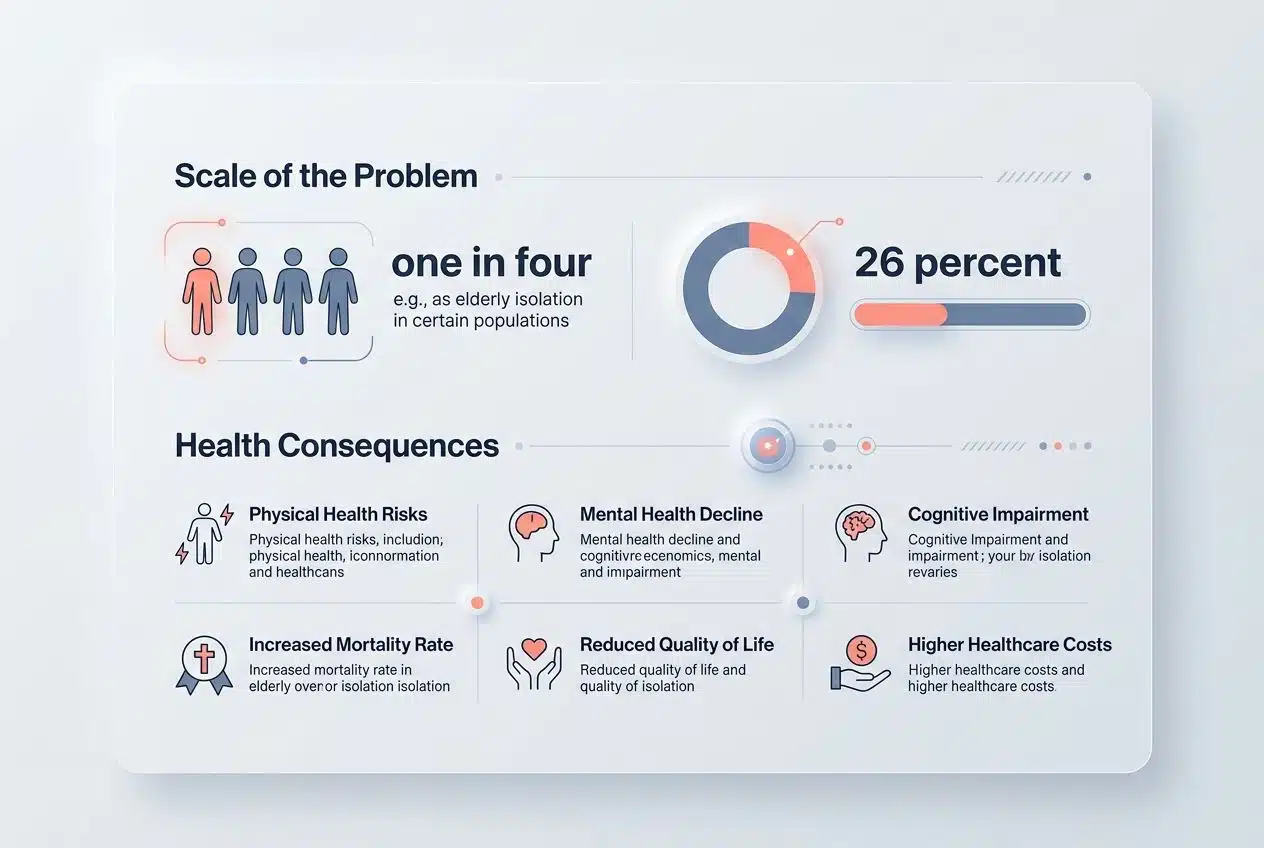
| Aspect | Key Points |
|---|---|
| Scale of the Problem | AARP reports that one in four adults over 45 experiences chronic loneliness. Roughly 26 percent of Americans aged 60 and older live alone. |
| Health Consequences | Chronic isolation increases heart disease risk and accelerates cognitive decline. Mortality risk shoots up significantly for those experiencing severe loneliness. |
| Why Elderly Populations Suffer Most | Retirement strips away work relationships. Mobility issues, hearing loss, and transportation challenges trap seniors at home. |
| Behavioral Patterns | Isolated seniors often neglect self-care and medication routines. Nutrition suffers when eating alone becomes the norm. |
| Solutions Making Real Difference | Senior centers provide structured social activities. Intergenerational programs and pet companionship reduce isolation dramatically. |
Family members must check on their older relatives. Simple phone buddy systems create regular contact points that save lives.
Loneliness in younger generations
Young people today face a loneliness epidemic driven by social media paradoxes and fractured community bonds.
| Key Insight | What This Means for Young People |
|---|---|
| The Demographic Reality | Gen Z experiences loneliness at rates 20 to 30 percent higher than older generations, turning assumptions about age and isolation upside down. |
| Social Media’s False Connection | Scrolling through feeds creates the illusion of togetherness. Yet, young adults report feeling more isolated than ever due to constant comparison. |
| The Friendship Recession | Young adults spend less time with friends than previous generations did. Meeting new people requires massive effort, and dating app fatigue is common. |
| Economic Pressures | Student debt and housing costs strain social life. Young people skip gatherings to save money, turning financial anxiety into a conversation killer. |
| Lack of Third Spaces | Young people have fewer neutral places to gather casually. Intentional hangouts feel forced compared to organic encounters. |
Young adults carry the weight of perfectionism on social platforms. Authentic connection requires a level of vulnerability that feels dangerous in a world of screenshots.
Strategies to Combat Loneliness
Fighting loneliness takes real action, not just good intentions. We need to actively rebuild the spaces where people connect.
Communities thrive when people connect face-to-face. Strong social bonds reduce isolation and create networks of support.
- Organize Active Meetups: Use platforms like Meetup.com to launch neighborhood walking groups and fitness classes, giving people regular, healthy reasons to gather and interact outdoors.
- Foster Purpose-Driven Volunteerism: Coordinate local volunteer programs and community gardens, creating spaces where residents work side-by-side to grow food and support shared charitable goals.
- Facilitate Generational Mentorship: Create mentorship initiatives through local neighborhood associations that pair experienced members with younger people to transfer knowledge and combat age-related isolation.
- Host Shared Meals and Festivals: Establish regular community potlucks and cultural festivals that celebrate diverse backgrounds, breaking down social barriers through shared food and entertainment.
- Develop Targeted Support Groups: Build specific support circles for challenges like grief or parenting, while funding local transportation to ensure elderly residents can easily attend these vital meetings.
These direct actions provide immediate relief to those feeling disconnected. By participating, you build a safety net for yourself and your neighbors.
Policies to rebuild community infrastructures
Governments must invest in physical spaces where people gather. Strong community infrastructure acts as the backbone for social well-being.
- Fund Public Gathering Spaces: Utilize U.S. government grants to revitalize public parks, affordable community centers, and local libraries, transforming them into safe, multi-use hubs for all ages.
- Improve Transit and Walkability: Invest heavily in public transportation and complete streets initiatives, ensuring neighborhoods are walkable and isolated individuals can easily access community events.
- Support Dedicated Demographic Centers: Direct funding to youth after-school programs and senior care facilities to prevent depression and provide crucial companionship for the most vulnerable age groups.
- Integrate Community Health Systems: Establish mental health clinics directly within neighborhoods and deploy trained community health workers to connect struggling residents with local support resources.
- Stabilize Housing and Governance: Create affordable housing initiatives to keep families rooted, while empowering neighborhood associations so residents can actively participate in local decision-making.
Addressing the loneliness epidemic requires sustained commitment to these infrastructure investments. These policies form the foundation for thriving social networks.
The Ethical Dilemma of Profiting from Loneliness
Companies now sell solutions to loneliness, making money off human pain. We must ask ourselves if we can fix a crisis while turning it into a product.
Commodification of emotional experiences
Corporations now sell loneliness solutions like they sell cereal. Tech companies launch AI companions like Replika that mimic human connection, charging vulnerable users for digital friendship.
The financial barrier to feeling connected is very real. While human therapy can cost hundreds of dollars, AI companion subscriptions often cost just five to ten dollars a month, making them the only affordable option for many.
“The loneliness economy turns human suffering into profit margins, selling band-aids instead of addressing the root causes of community breakdown,” warns industry analyst Kaushik Rajan.
Entrepreneurs spot vulnerable populations and create products to fill the emotional void. The market grows fat off isolation, raising tough questions about corporate responsibility.
Balancing innovation with ethical responsibility
Tech companies face a real tension between helping lonely people and making money. AI tools offer genuine support to those who need connection, but they also create exploitative new markets.
To advance innovation safely, we must implement responsible guidelines:
- Professional Guardrails: The American Psychological Association is actively pressing for regulations to protect young users from harmful digital relationships.
- Transparent Design: Tech companies must clearly label artificial interactions to prevent users from mistaking software for genuine human empathy.
- Prioritizing People: Health support systems must prioritize actual human connection over digital substitutes whenever possible.
Mental health professionals need seats at the table when companies design new technologies. The goal is to steer innovation strictly in the direction of genuine healing rather than the commodification of emotional pain.
Final Thoughts on The Loneliness Economy
Governments, healthcare providers, and communities must act now to address this growing epidemic. Social connection forms the foundation of human wellbeing, yet many people struggle to find meaningful relationships in today’s fast-paced world.
Solutions exist, and they work when people prioritize community and emotional health. Investment in local programs, mental health services, and social infrastructure creates real change.
Your role matters, whether you volunteer, support a neighbor, or advocate for better policies. Action starts with recognizing that human connection is essential medicine for our collective well-being.
Frequently Asked Questions (FAQs) on The Loneliness Economy
1. Why is loneliness now seen as a global public health crisis?
The US Surgeon General issued an advisory in 2023 calling loneliness a public health epidemic because it increases your risk of early death by about 26%. It’s linked to heart disease, stroke, depression, and dementia. Your body responds to chronic loneliness the same way it responds to physical injury or illness.
2. How did loneliness get so widespread around the world?
People move more often for work, digital communication has replaced many face-to-face gatherings, and the pandemic has isolated millions for extended periods. In the US, about half of adults reported feeling lonely in recent surveys. Smaller households and fewer community ties than previous generations also play a big role.
3. What are some signs that someone might be struggling with loneliness?
Watch for someone withdrawing from activities they used to enjoy or mentioning they feel disconnected even in groups. They might sleep poorly, seem unusually tired, or say everything feels pointless.
4. Can anything help fight this public health problem?
Yes, and you don’t need a big program to start. Regular check-ins with neighbors, joining a local group, or volunteering just a few hours a week can cut loneliness significantly. Communities with active social spaces like libraries, parks, and recreation centers report better mental health outcomes among residents.