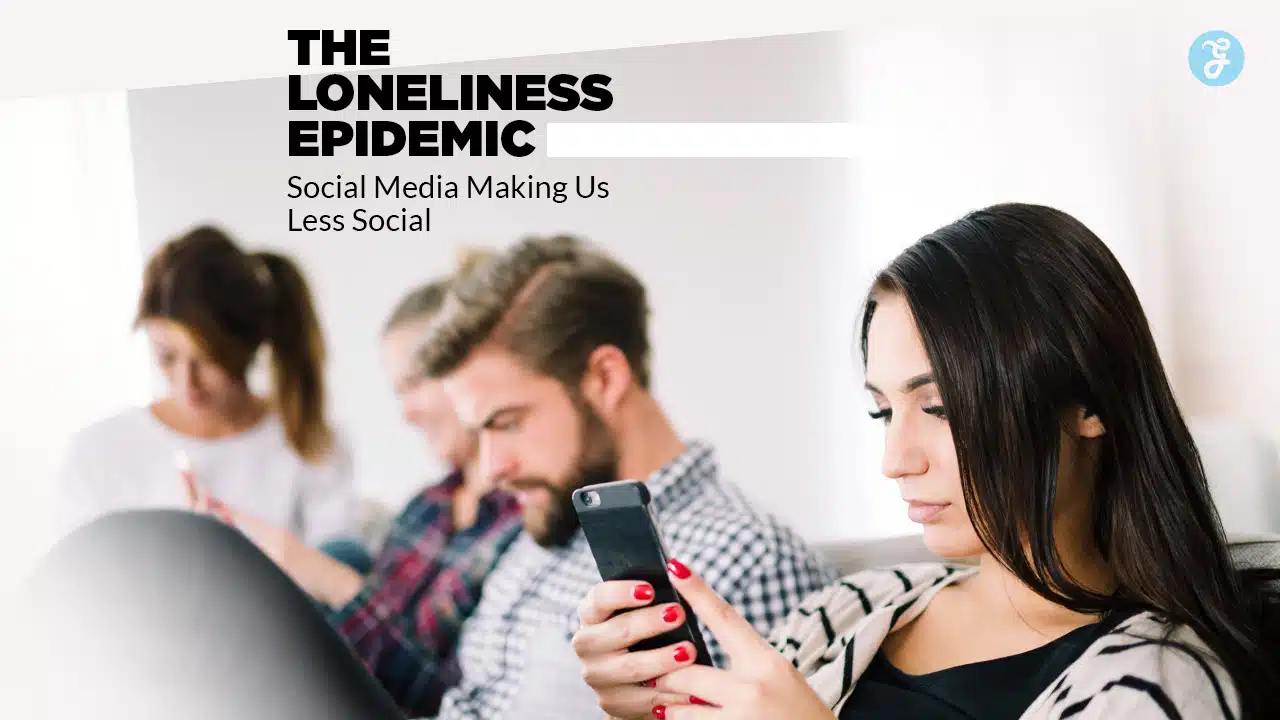
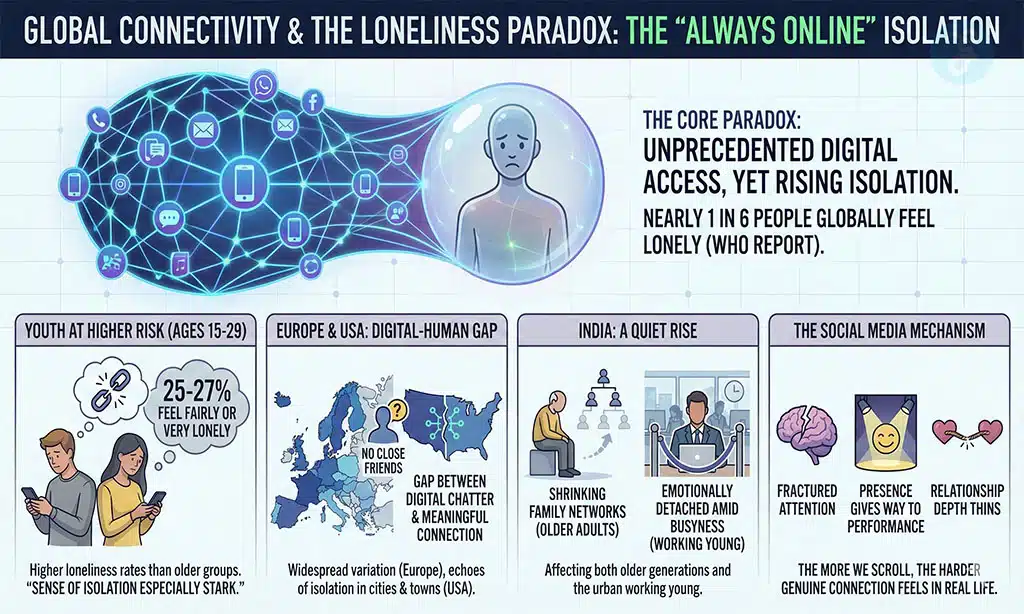
Worldwide, we are more “connected” than ever. A tap, a swipe, a message away from anyone on the planet. Looks so easy… And yet, nearly one in six people today say they feel lonely, according to the latest World Health Organization report, which warns that social isolation has become a major public health concern with deep effects on our well-being. This growing sense of social media loneliness speaks to our moment: always online, always reachable, yet emotionally distant.
The sense of isolation is especially stark among the young. Global survey data show that roughly 25 to 27 percent of people aged 15 to 29 feel fairly or very lonely, higher than in older age groups.
In Europe, loneliness varies widely, with some countries reporting high numbers of adults who feel socially cut off and say they lack close friends.
Across the United States, surveys show millions of adults describing a gap between digital chatter and meaningful human connection, a feeling echoed in many cities and towns.
And in India, recent assessments point to a quiet rise in loneliness. Older adults are especially affected, as family networks shrink and urban living becomes more independent. Health experts and policymakers are beginning to take note.
Among the working young in India’s cities, surveys suggest many feel emotionally detached and alone. This is true even amid busy workplaces and crowded streets. It is a reminder that the loneliness epidemic is not confined to any single age group.
This is the contradiction of our time. We are constantly online, always reachable, and endlessly updated, yet many of us feel emotionally adrift. Social media promised connection, community, and belonging. It gave us followers, group chats, and digital applause. But somewhere along the way, the depth of our relationships began to thin. Conversations became shorter. Attention fractured. Presence gave way to performance. And the more we scroll, the harder genuine connection sometimes feels in real life.
A Life Full of Contacts, and No One to Come Home To
Balakrishna Subramaniam (name changed on request) is an Associate Vice President with a multinational firm based in Delhi. On paper, he is doing well. The job is demanding, the salary steady, and the designation impressive. His wife lives in another city because of work, and over time, the office has quietly become his first home. He spends most of his waking hours there. “Some days,” he says, “I don’t even feel like going back home. There’s nothing waiting.”
Online, however, Balakrishna is everywhere. He has close to 50,000 followers and over 12,000 friends across social media platforms. He is always connected. Always available. Yet, he describes himself as deeply lonely. “I feel nobody really loves me,” he says, without drama or self-pity. “The only person who ever loved me was my mother. She is no more.”
Social media, instead of comforting him, deepens the ache. He opens his phone and scrolls through smiling faces, vacations, celebrations, and perfect families. “I keep comparing,” he admits. “Everyone looks happier than me.” The irony is not lost on him. He earns well, lives comfortably, but doesn’t know how to use that money to feel happy. “People keep saying, ‘Love yourself.’ I don’t know how to do that. I loved many people in my life. But nobody loved me back. And now, I don’t think I even know how to love myself. “And these days,” he adds, “I don’t like the idea of interacting with people personally.”
His story isn’t rare. It is just rarely said out loud.
“Surrounded by People, With No One to Turn To”
Shivali Singh (name changed on request) is a young working professional from Meghalaya, now settled in Hyderabad. Online, she has thousands of connections. In real life, she says, she doesn’t have one person she fully trusts.
At work, the days are hard. She is often scolded by her manager. Some evenings, she breaks down and cries. The HR team checks in and offers a conversation and a few reassuring words. But there are limits to what can be said in an office room. “You can’t share everything with HR,” she says. “Some things are too personal.”
Her parents live far away. When she tries to open up, she is told to manage on her own. “My father says, ‘Handle it yourself.’” She pauses, then asks quietly, “So what do I do? Who do I talk to?”
Shivali spends most of her time indoors, except for office hours. Going out isn’t simple. Socializing often means expensive cafés, restaurant bills, or weekend trips she cannot afford. She is careful with money, sending support back home, helping her younger brother. “My colleagues go out, travel in expensive cars, and post pictures,” she says. “I don’t do that. I can’t.”
The loneliness, for her, is not about being alone. It’s about being present everywhere, yet feeling unseen. “I’m unhappy,” she says simply. And there is no dramatic pause after that. Just silence.
Why Social Media Can Feel Emotionally Unsafe, a Psychologist Explains
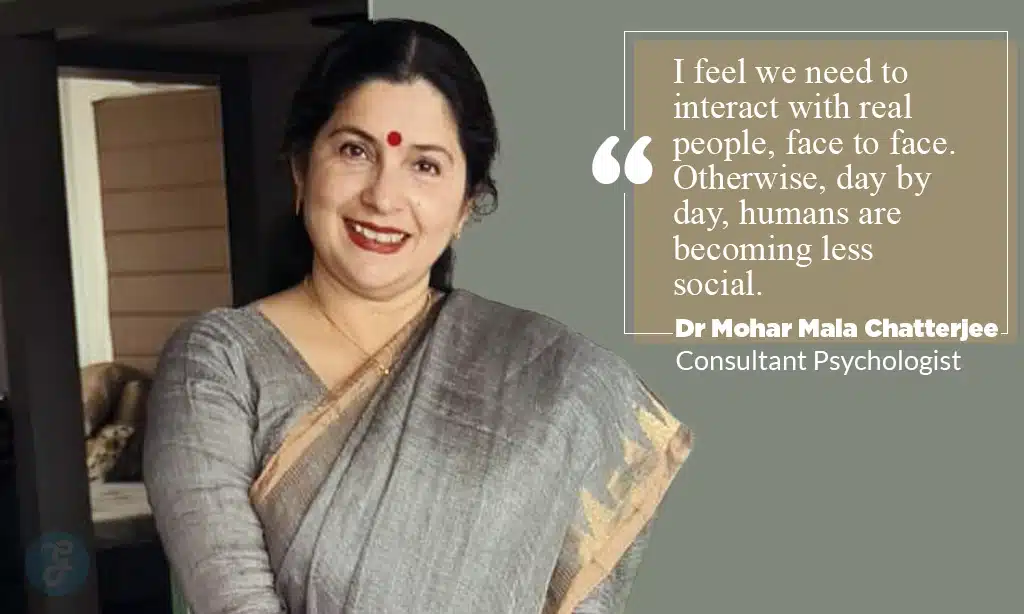
Social media, says Dr Mohar Mala Chatterjee, consultant psychologist, is far from a psychologically neutral space. “It is not very safe emotionally,” she explains. “People across age groups enter the same arena, and what they encounter there is constant comparison.”
According to her, the problem isn’t just screen time, but perception. “There is this strong feeling that everyone else is happy. Everyone is travelling, meeting people, living better lives except you. But what you are often seeing is just two people going out, captured from the best angle, at the best moment.”
This creates what she calls a silent, exhausting competition. “There is suppressed rivalry everywhere. Approval seeking. Validation hunger. You are comparing your everyday life with someone else’s highlight reel.” Over time, that gap between appearance and reality begins to feel unbridgeable.
Dr Chatterjee also points to how digital interaction changes real-world behaviour. “You may be talking comfortably with someone online. But if that same person were sitting next to you in real life, would you still feel like talking to them?” she asks. “We are slowly losing the ease of face-to-face connection.”
Even when people step out, she adds, the habit of comparison doesn’t leave. “We go out, but we are still watching others. We don’t truly connect with anyone. Still measuring. Still scrolling.” “What remains,” she says, “is this odd mix of being seen but still distant, where everyone is present, yet few feel truly connected.”
“I feel we need to interact with real people, face to face. Otherwise, day by day, humans are becoming less social,” she adds.
Not All Scrolls Are Empty
Let’s be clear. Social media is not the villain of this story. It has helped people find communities where none existed. It keeps families connected across cities and continents. It gives voice to niche interests, support groups, and people who might otherwise feel invisible. For many, especially those living alone or far from home, it can even feel protective.
But problems begin when online connection starts replacing real interaction instead of complementing it. When scrolling becomes easier than stepping outside. When likes stand in for conversation. Moderation matters. So does mindfulness.
Sometimes, connection doesn’t require a screen at all. It can be as simple as sharing a moment with someone nearby, noticing a colleague, or having a brief chat with someone you see regularly. These small interactions remind us that life exists beyond feeds and filters.
Social media can be a bridge. But it was never meant to be the destination.
The Larger Question: When Connection Is Everywhere, Why Does Loneliness Persist?
Balakrishna and Shivali live very different lives. One is senior, well-paid, and professionally secure. The other is young, careful with money, and still finding her footing in a new city. Their loneliness looks different on the surface. Yet, at its core, it feels strikingly similar. Both are constantly connected. Both are surrounded by people. And both feel alone in ways that social media cannot soothe.
This is where the conversation needs to slow down. It would be easy to blame social media entirely. But that would be dishonest. Platforms today do real work. They help people stay in touch across distance and time. They build communities for those who feel invisible in their immediate surroundings. They offer support, information, and sometimes even safety. For many, especially those living away from home, social media is not an escape. It is a lifeline.
And yet, it is also a space that quietly reshapes how we relate to one another. It changes expectations. It amplifies comparison. It makes happiness look effortless and loneliness feel like a personal failure. Balakrishna scrolls through smiling faces and wonders why love feels absent in his life. Shivali watches colleagues post about dinners and drives she cannot afford and withdraws further into herself. Neither is weak. Neither is wrong. They are responding to a world where connection is visible everywhere but rarely deep.
What social media struggles to provide is presence. It cannot sit beside you after a hard day at work. It cannot read the pauses in your voice. It cannot offer the kind of attention that comes without an audience. Likes and comments may reassure us briefly, but they rarely replace the steady warmth of being seen and understood by another human being.
Perhaps the real question is not whether social media makes us less social, but whether it is replacing meaningful connection with constant contact. We message instead of meeting. We react instead of listening. We know many stories, but few people deeply. Over time, that gap begins to show. In how hesitant Balakrishna feels about meeting people at all. In how Shivali stays indoors, unsure where she belongs.
The answer, if there is one, does not lie in abandoning technology or romanticizing the past. It lies in balance. I’m using social media as a bridge, not a replacement. In being mindful of how much of our emotional life we outsource to screens. And in remembering that connection often begins in ordinary places. A conversation with a neighbor. A few words with the shopkeeper downstairs. A shared laugh at work. These moments may not be post-worthy, but they quietly hold us together.
Social media isn’t inherently isolating. But it does challenge us to rethink what connection really means. True friendship, after all, asks for time. It asks for presence. And it asks us to show up, not just online, but in each other’s lives.