


You know that feeling when your calendar looks less like a schedule and more like a crime scene? You want to be helpful, you want to be a team player, but deep down, you’re running on fumes. I’ve been there, nodding “yes” to a favor while my brain is screaming “absolutely not.”
You aren’t the only one.
Learning to say “no” isn’t just about being stubborn; it is a vital skill for survival. In fact, a 2025 study found that 66% of American employees are experiencing burnout, often because they simply cannot draw the line.
This guide is going to walk you through the exact steps to reclaim your time. We will cover the scripts, the psychology, and the tools you need to stop feeling guilty and start protecting your peace.
So, grab a coffee and let’s get into it.
Why Saying “No” Matters in 2026
Life moves faster every single year. The demands on your time aren’t just in your head; they are statistically higher than ever before.
The impact of modern challenges on boundaries
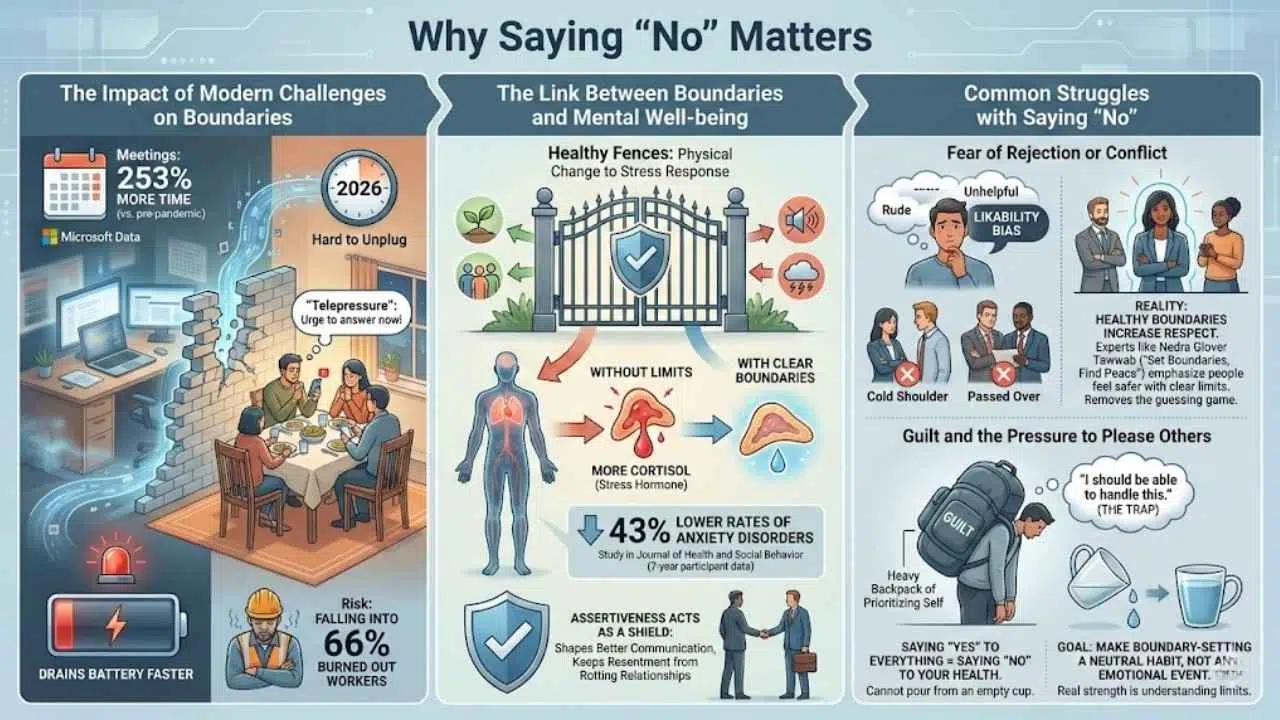
Technology has dissolved the walls between our work and our personal lives. According to Microsoft, people are spending 253% more time in meetings now than they did before the pandemic. That is a massive chunk of your life gone before you even open your email.
In 2026, these digital hurdles make it incredibly hard to unplug. We deal with “Telepressure”—that urge to answer emails during dinner just to clear the notification badge.
People feel forced to be “always on.” This pressure drains your battery faster than you can recharge it. Without strong fences, you risk falling into the 66% of workers who are already burned out.
The link between boundaries and mental well-being
Healthy fences do more than just free up your Saturday afternoon; they physically change your body’s stress response. When you fail to set limits, your body produces more cortisol, the stress hormone.
“A seven-year study published in the Journal of Health and Social Behavior found that participants with clear boundaries reported 43% lower rates of anxiety disorders.”
That is a huge drop. Assertiveness acts as a shield. It shapes better communication at work and keeps resentment from rotting your relationships.
Think of limits as gates. They let in the projects and people that help you grow, while keeping out the noise that just wears you down.
Common Struggles with Saying “No”
Even when we know we should decline, the words often get stuck in our throats. It’s usually because we are fighting against deep-seated social instincts.
Fear of rejection or conflict
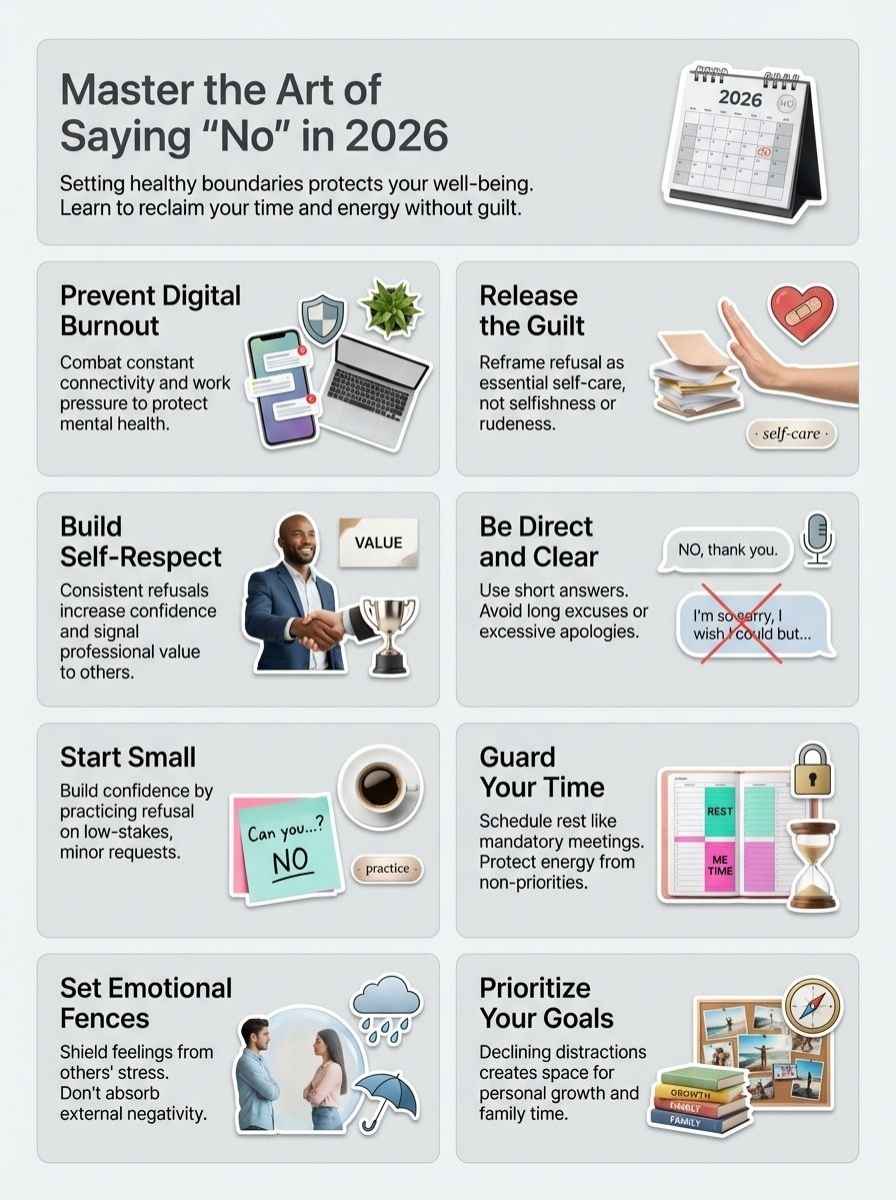
Most of us avoid the word “no” because of something psychologists call the “Likability Bias.” We worry that if we decline a request, people will think we are rude or unhelpful. This fear is a major roadblock to emotional well-being.
You might worry that a coworker will give you the cold shoulder or that your boss will pass you over for a promotion.
But here is the reality: healthy boundaries usually increase respect. Experts like Nedra Glover Tawwab, author of Set Boundaries, Find Peace, emphasize that people actually feel safer around those who are clear about their limits. It removes the guessing game.
Guilt and the pressure to please others
Guilt is the heavy backpack we wear when we try to prioritize ourselves. In the US, where hustle culture is still strong, saying “no” can feel like a moral failure.
You might think, “I should be able to handle this.” But that is a trap. Saying “yes” to everything means you are saying “no” to your own health.
If you are constantly worried about hurting feelings, you end up hurting yourself. Real strength is understanding that you cannot pour from an empty cup. The goal is to make boundary-setting a neutral habit, not an emotional event.
The Benefits of Setting Healthy Boundaries
Setting clear limits gives you the space to actually enjoy your life. It protects your energy like a bouncer at a club, only letting in the good stuff.
Increased self-respect and confidence
Saying “no” trains your brain to value your own time. Each time you decline a request that doesn’t fit your goals, you are casting a vote for your own worth.
Confidence grows when you stop shrinking to fit others’ expectations. Research consistently shows that professionals who set boundaries are less likely to experience “Decision Fatigue,” that foggy feeling you get after making too many choices.
Improved relationships and communication
It sounds backward, but saying “no” can actually save your relationships. When you say “yes” but mean “no,” you build resentment. That resentment eventually leaks out as sarcasm or frustration.
| Relationship Type | Without Boundaries | With Healthy Boundaries |
|---|---|---|
| Workplace | Passive-aggressive emails, missed deadlines, burnout. | Clear expectations, respect for off-hours, higher quality work. |
| Friendships | Flaking on plans last minute, feeling drained after hanging out. | Honest “can’t make it” texts, present and engaged when together. |
| Family | Silent treatment, guilt trips, dreading holidays. | Mutual respect for privacy, enjoyable visits without pressure. |
A clear refusal sets expectations. If a coworker knows you don’t answer emails after 6 PM, they won’t panic when you don’t reply until morning. Trust is built on consistency, not constant availability.
Reduced stress and emotional burnout
We know that 52% of employees felt burned out in 2024. By setting limits, you remove yourself from that statistic.
Keeping personal boundaries means you sleep better. You aren’t lying awake worrying about a project you shouldn’t have taken on. Your body feels lighter when you honor your needs first.
Practical Steps to Master the Art of Saying “No”
You don’t need to be rude to be firm. You just need a toolkit of scripts and strategies ready to go.
Be clear and assertive in your communication
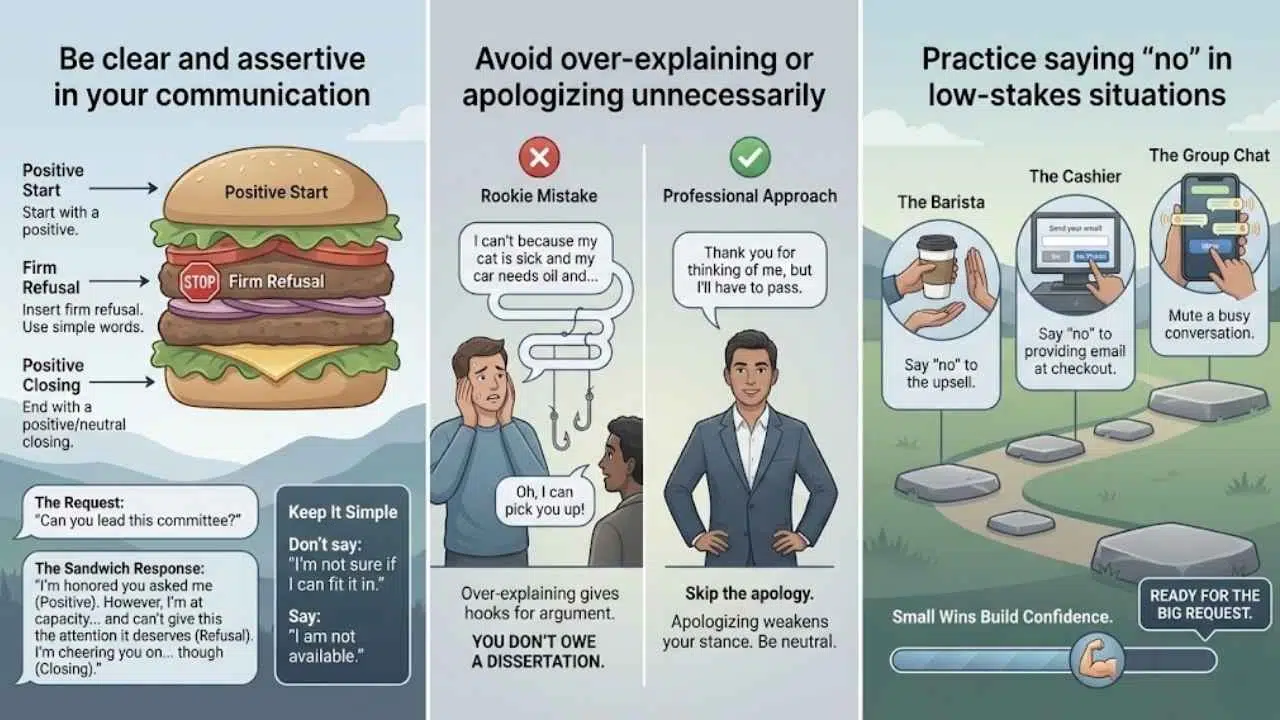
The best way to say “no” is the “Sandwich Method.” You start with a positive, insert the firm refusal, and end with a positive or neutral closing.
- The Request: “Can you lead this committee?”
- The Sandwich Response: “I’m honored you asked me (Positive). However, I’m at capacity with my current projects and can’t give this the attention it deserves (Refusal). I’m cheering you on from the sidelines, though (Closing).”
Use simple words. Don’t say, “I’m not sure if I can fit it in.” Say, “I am not available.”
Avoid over-explaining or apologizing unnecessarily
This is a classic rookie mistake. You do not owe anyone a dissertation on why you can’t help move their couch.
When you over-explain (“I can’t because my cat is sick and my car needs oil…”), you give the other person hooks to argue with (“Oh, I can pick you up!”).
Skip the “I’m so, so sorry.” Apologizing weakens your stance. Instead, try “Thank you for thinking of me, but I’ll have to pass.”
Practice saying “no” in low-stakes situations
Don’t start by saying “no” to your boss. Start small to build the muscle.
- The Barista: Say “no” to the upsell on your coffee.
- The Cashier: Say “no” to providing your email address at checkout.
- The Group Chat: Mute a conversation that is buzzing too much.
Each small win builds your confidence. By the time a big request comes along, you will be ready.
Types of Boundaries to Establish
Boundaries aren’t one-size-fits-all. You need different fences for different parts of your life.
Emotional boundaries
These shield your feelings from other people’s chaos. If you have a friend who treats you like an unpaid therapist, an emotional boundary is necessary.
You can say, “I love you and want to support you, but I don’t have the emotional bandwidth to talk about this heavy stuff right now. Can we talk about something lighter?” This isn’t rejection; it is self-preservation.
Time and energy boundaries
Your energy is a finite resource, like money in a bank account. You wouldn’t let everyone withdraw cash whenever they wanted, so don’t let them withdraw your time.
In 2026, tools can help you here. Use features like Focus Mode on iOS or apps like Freedom to block distractions. Block out “Deep Work” time on your calendar where no one can book a meeting.
Physical boundaries
This includes your personal space and your physical body. It is perfectly okay to tell a coworker, “I’m a handshake person, not a hugger.”
It also applies to your environment. If you work from home, a physical boundary might be closing the office door at 5 PM to signal the end of the workday.
Overcoming the Fear of Setting Boundaries
It is scary to draw a line in the sand. But courage is just fear that has said its prayers.
Recognize your limitations and priorities
You have 24 hours in a day. That is it. You cannot manufacture more time.
Start by identifying your “Non-Negotiables.” Maybe it is dinner with your kids, or your morning gym session. Once you know what matters most, it becomes easier to say “no” to the things that threaten those priorities.
Reframe “no” as an act of self-care
Stop thinking of “no” as a weapon. Think of it as a shield.
Dr. Brené Brown famously said, “Daring to set boundaries is about having the courage to love ourselves, even when we risk disappointing others.”
When you decline a request, you aren’t being mean. You are choosing to protect your mental health so you can show up fully for the things you actually said “yes” to.
The Magic of Saying “No”
Once you get good at this, it feels like a superpower. You stop being a passenger in your own life and start driving the car.
How it empowers you to say “yes” to what truly matters
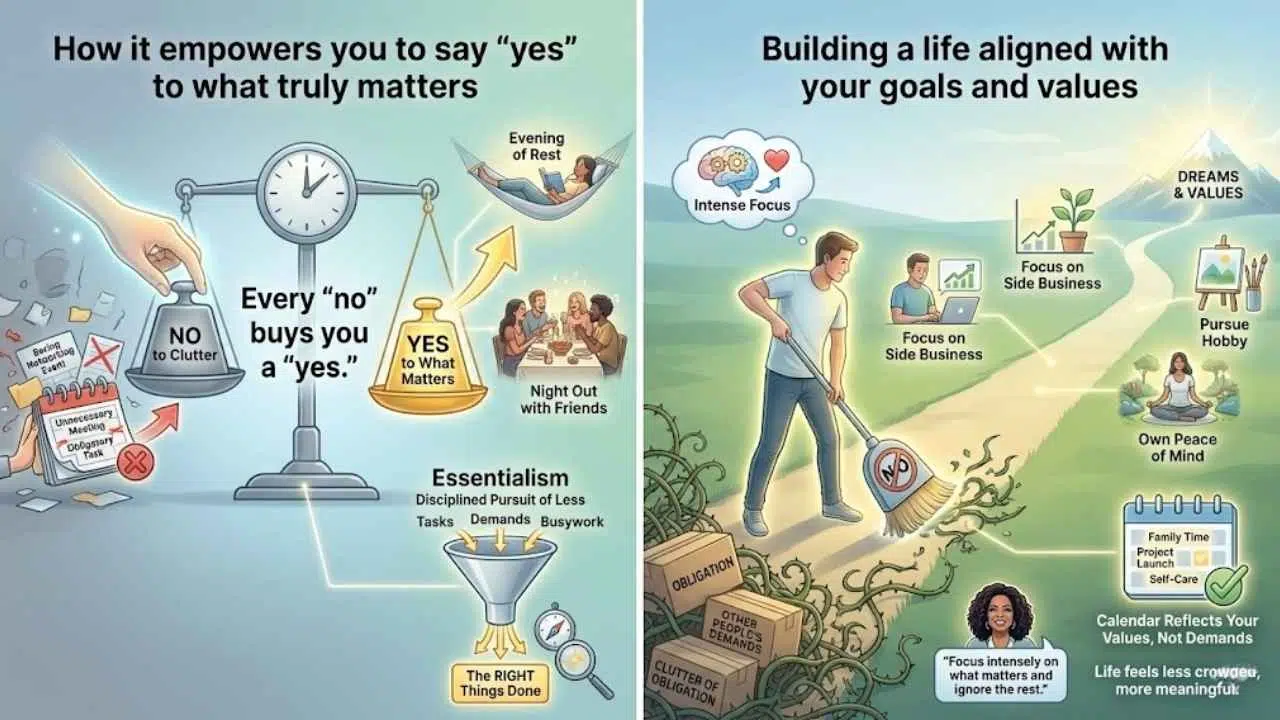
Every “no” buys you a “yes.” By turning down that boring networking event, you bought yourself an evening of rest or a night out with friends.
Essentialism, a concept championed by Greg McKeown, is all about the disciplined pursuit of less. It is not about getting more done; it is about getting the right things done.
Building a life aligned with your goals and values
When you clear out the clutter of obligation, you make room for your dreams. You can focus on that side business, that hobby, or just your own peace of mind.
Oprah Winfrey credits her success to her ability to focus intensely on what matters and ignore the rest. You can do the same. Life immediately feels less crowded and more meaningful when your calendar reflects your values, not everyone else’s demands.
Final Thoughts
Mastering the art of saying “no” is the best gift you can give yourself this year. It hands you back control over your time, your energy, and your sanity. You will find that people respect you more, not less, when you stand firm.
Start small today. Try one of the scripts we talked about. You can check out the free Boundaries, Solved Guide for extra help if you’re ready to take action right now. As my grandma used to say, “You can’t pour from an empty cup.” Choose yourself first.





















