

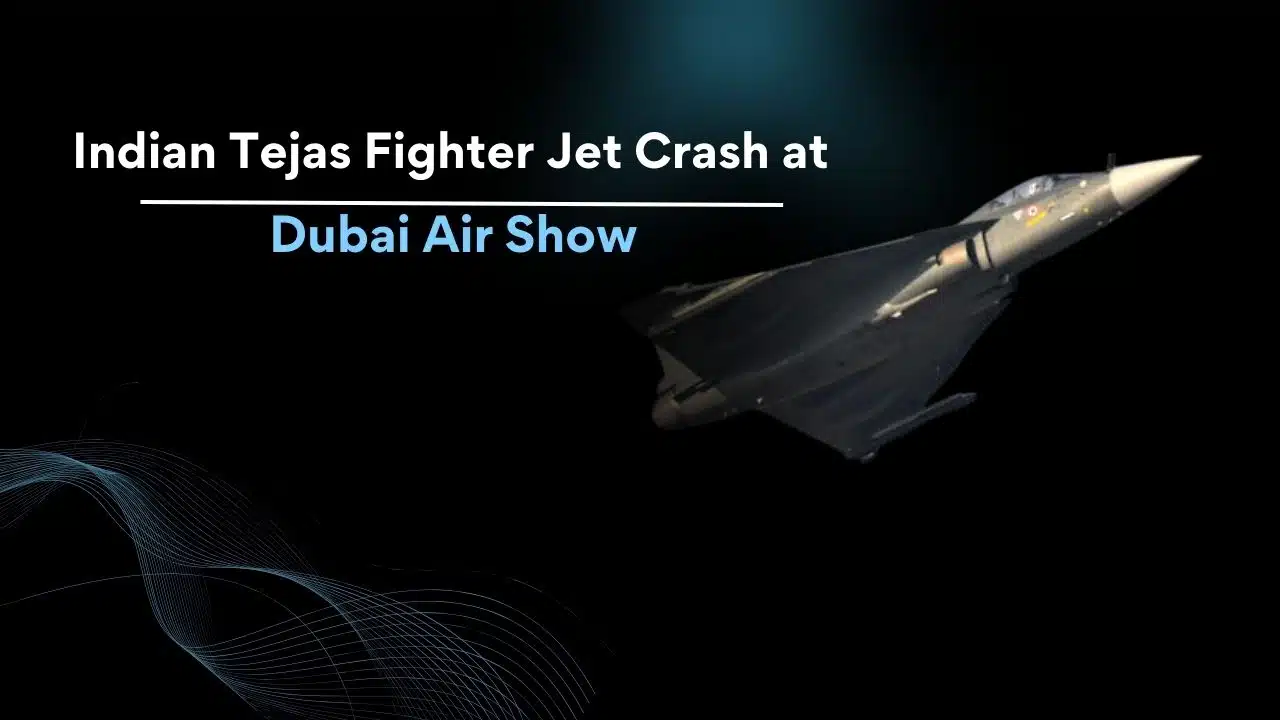
An Indian-manufactured Tejas fighter jet crashed on Friday afternoon during a flying demonstration at the Dubai Air Show, one of the world’s largest aerospace exhibitions. The incident occurred at Al Maktoum International Airport in Dubai World Central, where thousands of spectators had gathered to watch scheduled aerial performances.
According to official information released by Dubai authorities, the accident took place shortly after the aircraft completed a low-level manoeuvre. The crash happened around 2:10 p.m. local time, equivalent to 10:10 GMT. The fighter jet reportedly descended rapidly after executing a low roll, lost stability, and impacted the ground roughly 1.6 kilometres (about one mile) from the main show area. A fire broke out immediately after the aircraft hit the ground, sending heavy smoke into the air and prompting an urgent emergency response.
Firefighters and rescue personnel reached the crash site within minutes. Their efforts focused on extinguishing the flames, securing the surrounding area, and preventing additional hazards in a zone that remained crowded with aircraft, engineers, crew members, and air-show participants. Despite the quick response, the pilot did not survive the impact. The United Arab Emirates’ media authorities confirmed the fatality, and Indian officials later verified that the pilot was an Indian Air Force officer who had been participating in the scheduled demonstration flight.
The aircraft had reportedly made multiple passes across the display zone before the accident. Eyewitness footage shared by journalists and spectators indicated that the jet appeared to lose control moments before the crash. Observers noted that there were no visible signs of the pilot ejecting prior to the impact. Aviation analysts who reviewed the footage described the aircraft’s trajectory as a steep, uncontrolled descent that left very little time for corrective action.
Indian Air Force Initiates a Formal Inquiry
Indian officials have announced that a specialised Court of Inquiry will be formed to determine the exact cause of the crash. Such inquiries typically examine a broad range of factors, including aircraft systems performance, recent maintenance records, flight-control data, pilot training history, and environmental conditions at the time of the demonstration.
Demonstration flights at international air shows often involve complex, high-precision manoeuvres designed to highlight an aircraft’s performance capabilities to global defence delegations. Aviation experts note that low-altitude aerobatics carry increased risk because pilots operate with much narrower margins for error. These constraints mean that even minor technical, mechanical, or aerodynamic issues can escalate quickly during such manoeuvres.
Authorities in Dubai are also conducting their own assessment, working in coordination with Indian defence and aviation officials. The crash area has been secured for investigators to collect debris samples, examine impact patterns, and recover flight components that may indicate the sequence of failure.
India’s Lightweight, Single-Engine Combat Aircraft
The aircraft involved in the crash was a Tejas fighter jet, a single-engine, multi-role, lightweight combat aircraft developed by Hindustan Aeronautics Limited (HAL), a major state-run aerospace company in India. The Tejas is designed for air-to-air, air-to-ground, and reconnaissance missions. It is capable of flying at high speeds, carrying a range of precision-guided munitions, and operating in demanding combat environments.
The Tejas programme forms a key part of India’s long-term effort to modernise its air force and reduce dependency on foreign-built aircraft. Much of India’s current fleet consists of older Russian and Soviet-era models, many of which are nearing the end of their operational life cycles. By developing and deploying a domestic fighter platform, India aims to strengthen self-reliance in defence production and expand its presence in the global military-aviation market.
In recent years, India’s Defence Ministry approved the procurement of 97 additional Tejas jets to enhance the operational strength of its air force. The aircraft’s engines are manufactured by General Electric in the United States, and the programme has required several imported components, which has contributed to periodic delays in production and delivery schedules.
Previous Incidents and Operational Context
Friday’s accident is the second confirmed crash involving a Tejas fighter jet. The previous incident occurred during a training exercise in the Indian state of Rajasthan in 2024. In that case, the pilot successfully ejected and survived. The relative rarity of accidents involving the Tejas has often been cited by Indian defence officials as evidence of the aircraft’s overall stability and reliability. Nevertheless, each incident triggers detailed technical evaluations to ensure safety, particularly as India expands the programme and promotes the aircraft to potential international buyers.
In the days leading up to the Dubai Air Show crash, a separate video circulated online reportedly showing fluid leaking from a Tejas jet during pre-show preparations. Indian authorities clarified that the fluid seen was condensed water from the aircraft’s environmental control system rather than an oil leak, emphasising that the aircraft remained fully airworthy. The clarification became part of broader social-media discussions surrounding the programme as the Dubai demonstration approached.
Because air shows attract global defence representatives and aircraft buyers, the performance of participating aircraft often influences international perception. A crash in such a setting can have reputational implications, especially for countries seeking to strengthen bilateral defence partnerships or promote military exports.
Impact and Broader Significance
The crash is a significant setback for India’s defence-manufacturing ambitions, particularly as the Tejas is one of the nation’s most prominent indigenous aerospace projects. Air shows like the one in Dubai serve as high-visibility platforms for demonstrating advanced technological capabilities to international observers. The loss of an aircraft and its pilot in such a setting draws global attention and raises questions that official inquiries will now work to address.
The Tejas remains a central component of India’s modernisation roadmap for its air force, which also includes the development of more advanced platforms such as the Tejas Mk2 and the fifth-generation Advanced Medium Combat Aircraft (AMCA). Findings from the investigation could influence future operational procedures, display-flight protocols, and technical assessments within the programme.
For Dubai Air Show organisers and aviation authorities, the incident is a reminder of the inherent risks associated with aerobatic displays. Military aircraft performing aggressive manoeuvres must operate within strict safety zones, but even with rigorous standards, high-performance demonstrations carry unpredictable variables. Air-show officials typically re-evaluate safety procedures after such incidents to ensure that risks to spectators, crew members, and pilots remain as low as possible.
What Happens Next
The formal investigation by the Indian Air Force will provide detailed insights into what caused the aircraft to lose control. Technical teams will analyse flight-control systems, engine performance, recent maintenance reports, the manoeuvre being attempted, and any environmental or mechanical issues that may have played a role. The UAE’s own aviation authorities will coordinate with Indian teams to share available data, including radar tracking, sensor readings, and recovery of remaining aircraft components.
The results of the inquiry will guide future safety protocols for demonstration flights, influence decisions on public displays of the Tejas platform, and may have operational implications for ongoing and upcoming batches of the aircraft being produced for the Indian Air Force.






















