I used to end my workdays completely exhausted, yet looking at my to-do list, I couldn’t figure out what I had actually accomplished. I thought I was a master of multitasking. I would answer a Slack message while drafting a client proposal, or jump into a messy email thread in the middle of a strategic planning session. It felt like I was operating at maximum efficiency.
In reality, it was a recipe for burnout. Eventually, I hit a wall and started looking into the science of human focus. What I learned completely changed how I work: the human brain is fundamentally incapable of multitasking. When we think we are doing two things at once, we are actually just task switching, rapidly toggling our attention back and forth. And every single toggle comes with a massive cognitive tax.
Here is what I learned about task switching cost, the biology behind why we do it, and how I redesigned my daily routine to finally get my time back.
Multitasking vs Task Switching: The Great Myth
To build a better workday, I first had to understand what I was actually doing to my brain. We use the word “multitasking” as a badge of honor, but it’s biologically impossible for complex cognitive tasks.
True multitasking only happens when one of the tasks is completely automatic, like walking while listening to a podcast, or folding laundry while watching TV.
If both tasks require conscious thought (like writing an email while listening to a conference call), you aren’t doing them simultaneously. Your brain is rapidly pausing one task, shifting to the new one, and then shifting back. This is task switching, and it is the enemy of deep, meaningful work.
The Dopamine Trap: Why We Self-Interrupt
If task switching is so bad for us, why do we constantly do it? I used to blame my boss, my team, and my notifications. But the uncomfortable truth is that nearly half of all workplace interruptions are self-inflicted.
Every time you open a new tab, refresh your email, or check your phone, your brain gets a tiny hit of dopamine. Our brains are hardwired to seek novelty. Checking off a two-minute email feels like a quick “win,” giving you a false sense of productivity. You feel incredibly busy, but you are actually just feeding a dopamine loop that prevents you from tackling the deep, challenging work that truly moves the needle.
The Hidden Penalty: What Task Switching Actually Costs You
For a long time, I thought taking a ten-second break to check a message didn’t matter. But cognitive psychology paints a very different picture. When you switch tasks, you pay a steep price in three specific ways:
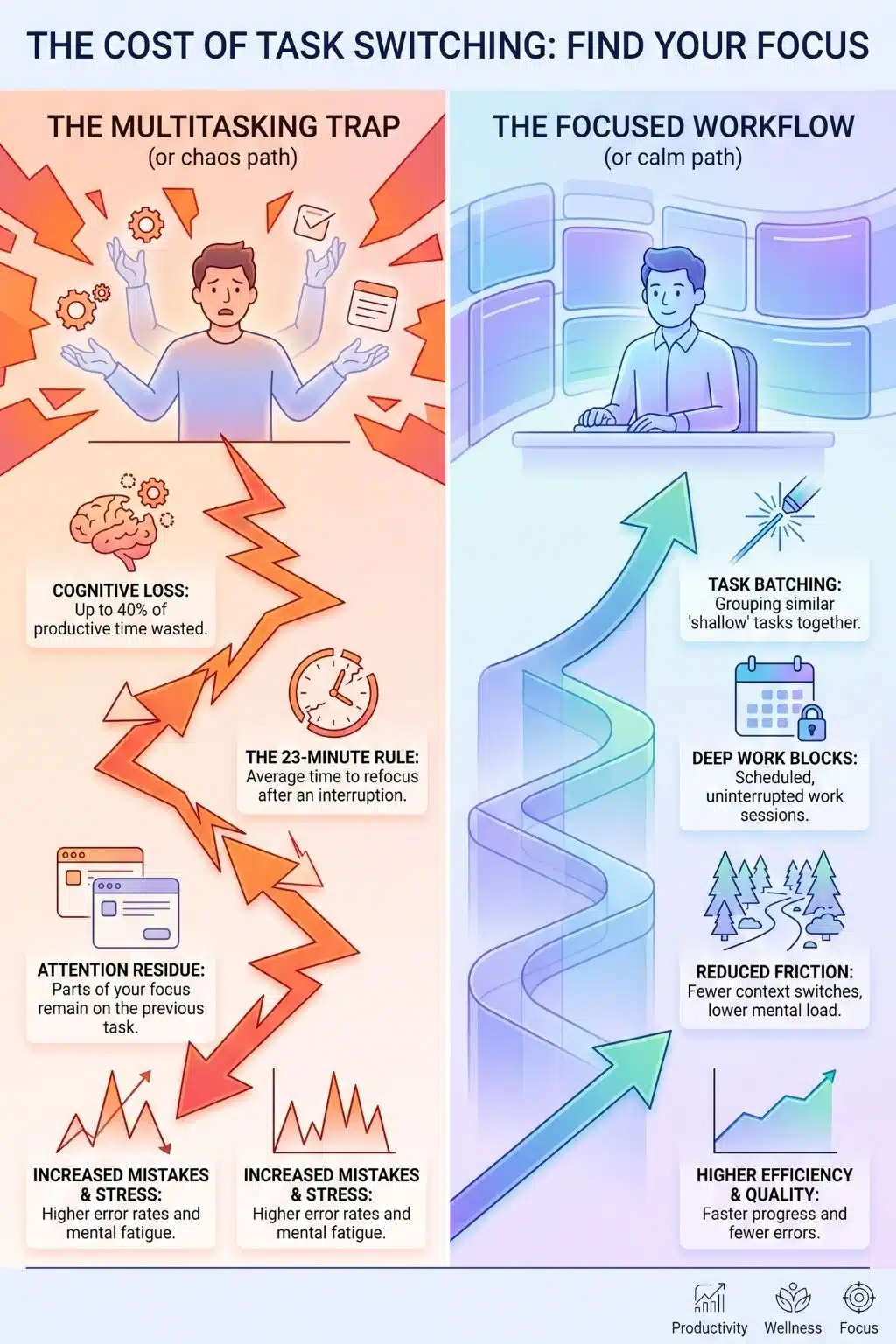
- The 40% Productivity Tax: Shifting between tasks forces the brain through two distinct stages: deciding to shift goals, and turning on the “rules” for the new task. These mental gymnastics can consume up to 40% of your daily productive time.
- The 23-Minute Rule: After a single interruption, it takes an average of 23 minutes and 15 seconds to fully regain your deep focus. Think about that. If you check your phone three times an hour, you are essentially never operating at your full cognitive capacity.
- Attention Residue: When you switch from a spreadsheet to a team chat, your brain doesn’t transition cleanly. A slice of your attention stays stuck on the previous task. By mid-afternoon, after hundreds of micro-switches, this residue builds up into a thick mental fog.
The Warning Signs: Are You Paying the Toll?
Before I fixed my habits, I didn’t realize how badly the switching cost was affecting me. If you aren’t sure if task switching is your problem, look for these three symptoms:
- The 3:00 PM Crash: Feeling completely mentally depleted by mid-afternoon, even if you haven’t done any heavy strategic thinking.
- High Error Rates: Making silly mistakes, forgetting attachments on emails, or missing obvious details. (Task switching is proven to increase error rates by up to 50%).
- The “Busy but Broke” Feeling: Working a full eight-hour day but feeling like you have zero tangible results to show for it.
How I Designed My Day to Defeat Task Switching
Once I realized my workflow was working against my biology, I stopped trying to force it. I started designing my environment to protect my attention. Here is exactly what I do now to insulate my focus.
1. I Batch the “Shallow” Work
I used to treat my inbox like a group chat, responding to things the second they arrived. Now, I batch my communication. I check email and messages at designated times: morning, noon, and late afternoon. By grouping all these shallow, low-friction tasks together, I pay the switching cost once instead of a dozen times throughout the day.
2. I Schedule Deep Work Blocks
I block off 90 to 120 minutes every morning for my most demanding work. During this time, I close all irrelevant browser tabs, put my phone in another room, and turn my computer on “Do Not Disturb.” Giving myself a solid, unbroken block of time ensures I actually reach a state of flow without self-sabotaging.
3. I Build Moats Around My Attention
Since novelty is so addictive, I rely on friction to break bad habits. If I don’t need the internet for a writing task, I turn off my Wi-Fi. I use full-screen mode on my applications so I can’t see the clock or notification badges out of the corner of my eye. I make doing the wrong thing slightly harder than doing the right thing.
4. I Created a Transition Ritual
When I inevitably have to switch from a deep project to a team meeting, I don’t just click a new window and start talking. I give my brain a minute to clear the attention residue. I stand up, write down exactly where I left off on my current task (which tells my brain it’s safe to let it go), and take a deep breath before opening the next app.
Reclaiming Your Attention
At the end of the day, time management is really just attention management. We live in a world that is constantly trying to fracture our focus through notifications, endless tabs, and the expectation of instant replies. It is up to us to protect our cognitive space. By respecting the hidden costs of task switching and designing a workday that honors how the human brain actually works, you don’t just get your time back, you get your sanity back, too.
Frequently Asked Questions About Task Switching Cost
1. Is multitasking ever actually possible?
Only for a tiny fraction of the population, about 2.5%, known as “supertaskers.” For the rest of us, true multitasking only works if one task is completely automatic and requires zero conscious thought. If both tasks require cognitive effort, your brain is just switching back and forth.
2. How do I stop self-interrupting?
Start by adding physical or digital friction. Put your phone in a drawer during focus blocks. Use browser extensions that block social media or news sites during your working hours. The goal isn’t to rely on willpower, but to make the distraction harder to access.
3. What if my job requires me to be highly responsive on chat or email?
If you can’t strictly batch your communication, try to negotiate a “focus hour” with your team where you are completely offline. Alternatively, tackle your deep work first thing in the morning before the rest of the office logs on, so your uninterrupted time doesn’t conflict with their need for answers.
4. Does listening to music count as task switching?
It depends on the music and the task. Listening to instrumental music, lo-fi, or ambient noise can actually help mask distracting background sounds and improve focus. However, listening to music with complex lyrics while trying to write or read forces your brain to process two streams of language at once, which triggers a heavy switching cost.
5. How long should a “deep work” block actually be?
Most research suggests that 90 to 120 minutes is the optimal window. It takes about 20 minutes just to settle into a task and overcome the initial friction. This gives you a solid hour or more of deep, productive flow before mental fatigue naturally starts to set in. After 120 minutes, you genuinely need to step away and let your brain rest.