Speculation has abounded online that every episode of Stranger Things Season 5 would stretch to movie lengths—some saying 90 minutes to two hours per episode. However, co-creator Ross Duffer recently disclosed, via Instagram, the actual runtimes for the first four episodes of the new season. His clarification serves to undercut viral leaks and reset expectations. The confirmed runtimes show variation rather than uniform excess length.
The first episode, titled “The Crawl,” will run approximately one hour and eight minutes. Episode Two, whose full title remains unrevealed, will last 54 minutes. The third episode, “The Turnbow Trap,” clocks in around one hour and six minutes. Episode Four, titled “Sorcerer,” will be the longest of the first batch, at roughly one hour and twenty-three minutes. These reveal lengths fall short of rumors claiming all episodes would exceed 90 minutes or even stretch to feature film durations.
The refuted rumors included a viral screenshot purporting that every episode would run from 90 minutes to two hours. Some entertainment news outlets reprinted that version, citing alleged internal Netflix sources. Ross Duffer’s public clarification confirms that those runtime tables were exaggerated and inaccurate.
Why Fans and Media Spread Runtime Speculation
The hype around extended runtimes is not accidental. After several seasons of near-standard hour-long episodes, Stranger Things shifted toward much longer episodes in Season 4. In that season, almost every installment surpassed the 70-minute mark, with the final three episodes taking on feature-length form—the finale alone ran over two hours. This dramatic shift changed audience expectations about what constitutes an episode and fueled rampant speculation about Season 5.
Moreover, rumors thrive in the absence of official data. Early leaks, diagrams, or speculative runtime charts receive clicks, and as fans parse the franchise details, misinformation takes on a veneer of credibility. Some media outlets published runtime tables as fact without independent confirmation, which further muddied expectations.
By publishing accurate runtimes himself, Duffer takes control of the narrative and reorients discussion toward story content rather than sensationalized episode length.
Release Strategy & Structure for Season 5
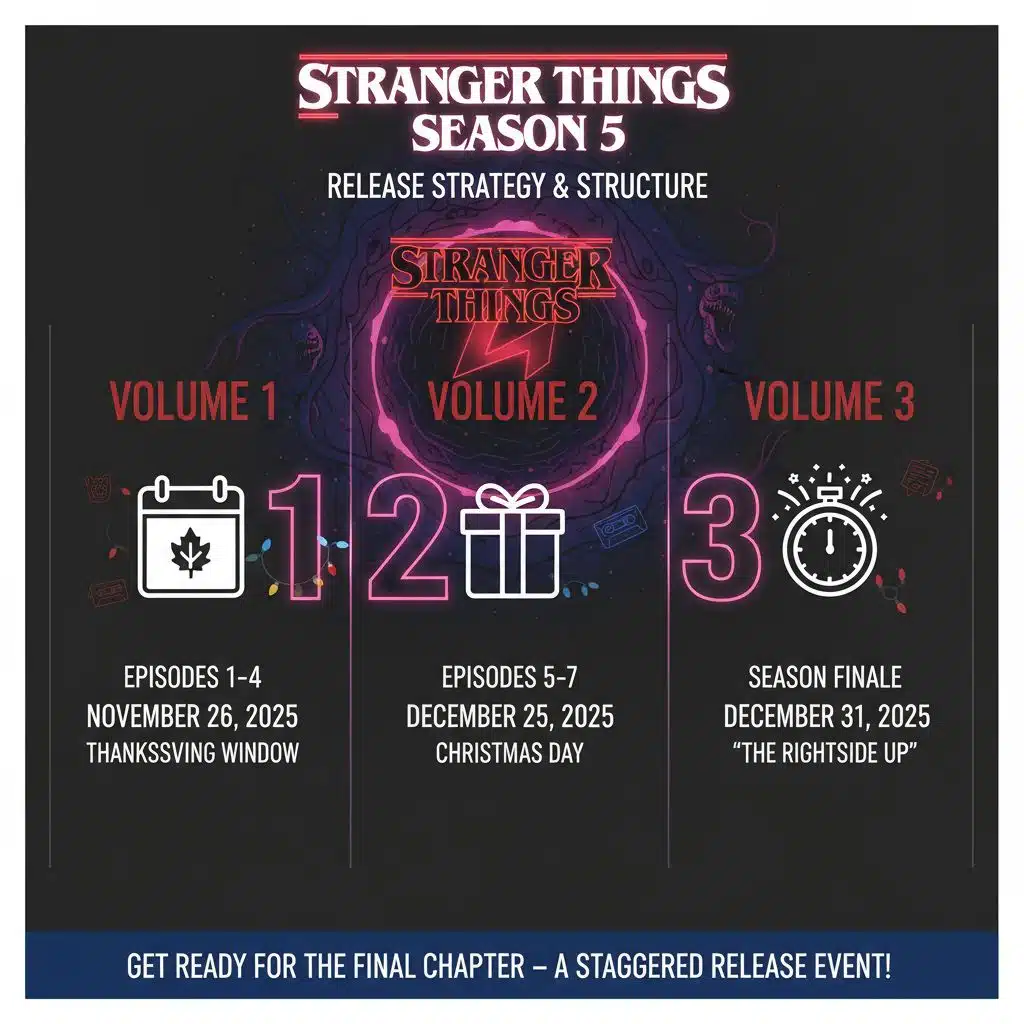
Netflix will roll out Stranger Things Season 5 in three discrete volumes, following a staggered release plan:
-
Volume 1 — Episodes 1 through 4 premiere November 26, 2025 (timed for the Thanksgiving holiday window).
-
Volume 2 — Episodes 5 through 7 drop on December 25, 2025 (Christmas Day).
-
Volume 3 — The season finale, titled “The Rightside Up,” will premiere on December 31, 2025 (New Year’s Eve).
This multi-episode rollout spreads out engagement, builds suspense, and aligns with festive calendar milestones. It also means that while U.S. audiences will see the finale on December 31, some international viewers may view it in early January depending on time zones, which has generated some confusion around the official date.
Notably, Stranger Things is reassembling its full cast for the final season. Names returning include Winona Ryder, David Harbour, Millie Bobby Brown, Finn Wolfhard, Gaten Matarazzo, Caleb McLaughlin, Noah Schnapp, Sadie Sink, Natalia Dyer, Charlie Heaton, Joe Keery, and Maya Hawke. The directing lineup includes the Duffer brothers, executive producer Shawn Levy, and veteran filmmaker Frank Darabont (known for The Shawshank Redemption).
The decision to break the season into volumes mirrors a trend in streaming content strategy, allowing shows to maintain relevance over weeks rather than dropping all episodes at once.
What This Means for Storytelling & Production
By clarifying runtimes, the creators signal a balance between cinematic ambition and narrative discipline. Season 4 pushed boundaries with long episodes and potential bloat. If the revealed schedules hold, Season 5 seems more modestly paced—still ambitious, but not uniformly epic.
The variability in runtime from episode to episode suggests that each chapter will be tailored to narrative needs. Some episodes may lean quicker and tighter, while others utilize longer runtime for crucial plot development or emotional beats.
Given the star cast, scale of conflicts, and narrative stakes—especially for a concluding season—the show will likely demand high production values, visual spectacle, and careful plotting. Rain or shine, the story will need breathing space to land emotionally without feeling overstretched.
The confirmation also reduces speculation stress for fans trying to anticipate how long each viewing block will last. For viewers organizing watch parties, planning sessions, or streaming marathons, the clarified timings offer planning certainty.
The Information is Collected from Variety and Yahoo.