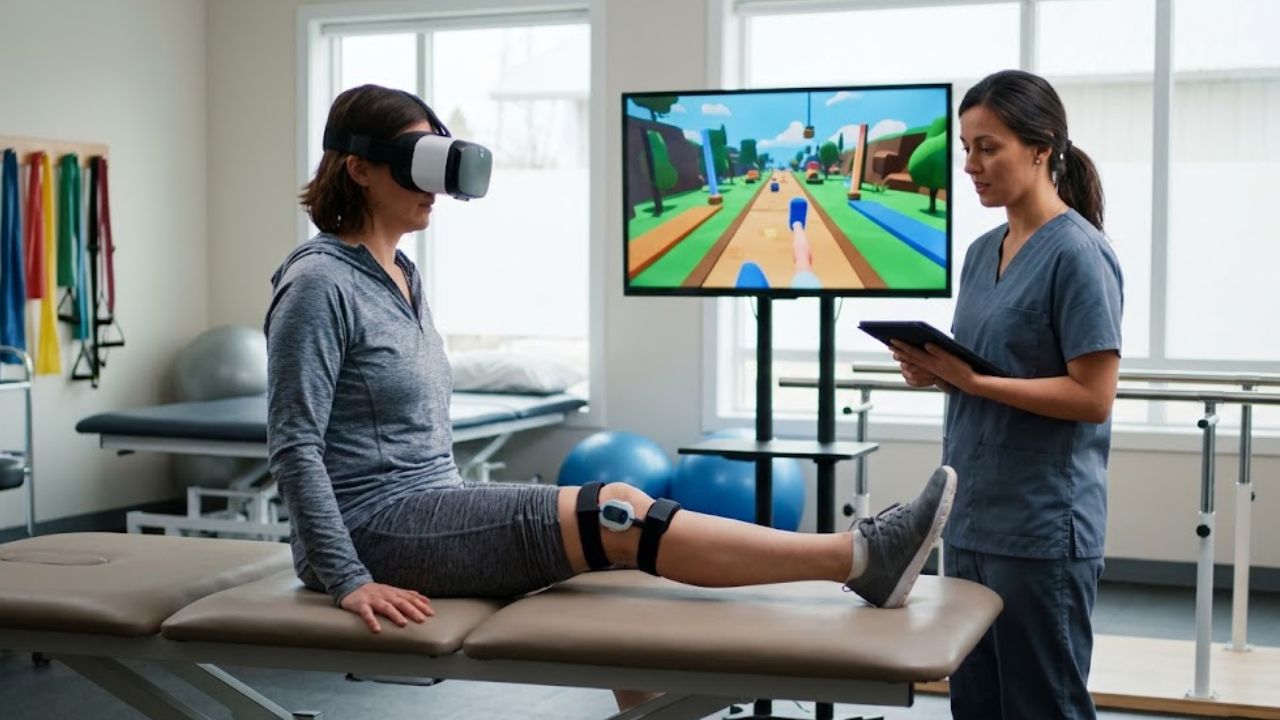
After a hand injury, a patient may spend weeks relearning a motion as small as bringing the thumb and index finger together. In a supervised session, hand-tracking cameras can turn that movement into a task the patient can see and repeat. That’s one use of virtual reality in injury rehabilitation.
Depending on the injury, VR physical therapy can give patients feedback on how they move, help them practice balance, or take some of the focus off pain during a difficult exercise. Some applications are still being tested in clinical trials.
The setup can be a headset that fills the field of view or a screen that responds to movement. And the goal can change completely from one session to the next. In a burn unit, the team might measure how much a stretch hurts. In a hand clinic, the measure might be how far the wrist bends. Both fit into the wider picture of virtual reality in Australian healthcare.
1. Rebuilding Hand and Finger Movement After Trauma
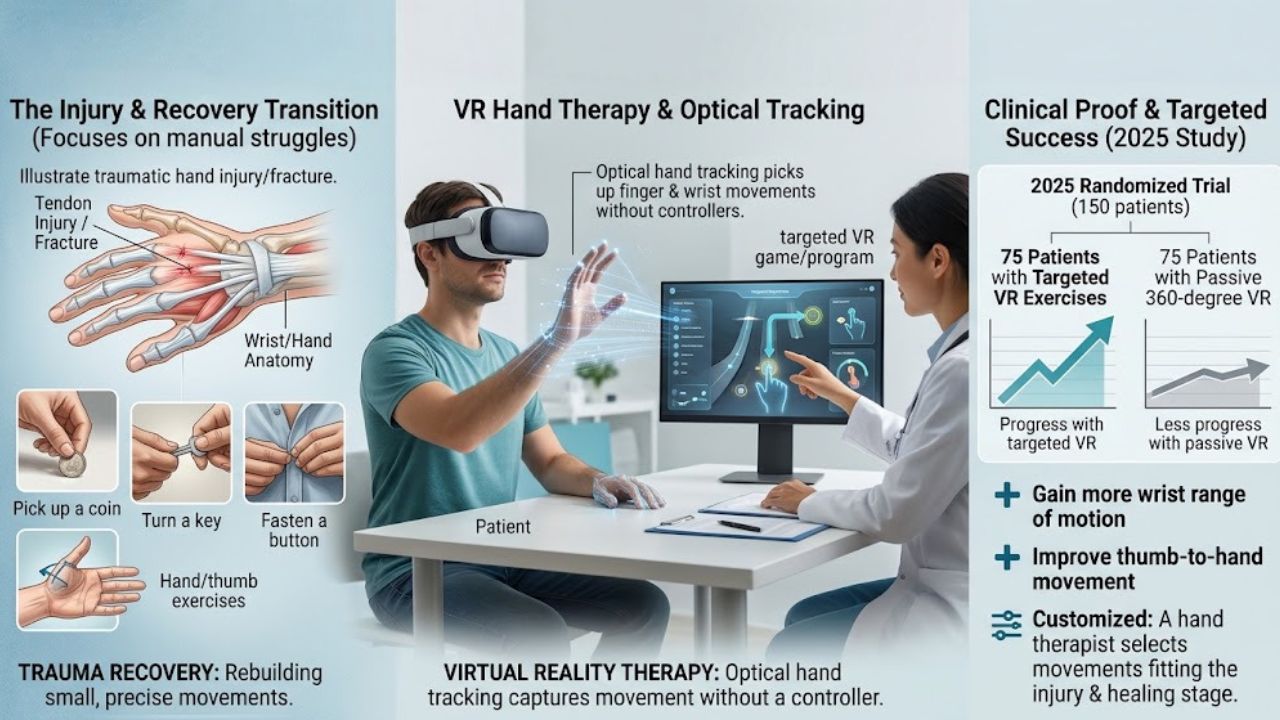
A person recovering from a tendon injury or a fracture may eventually need to pick up a coin, turn a key, or fasten a button again. Those tasks rely on small, precise movements. In VR physical therapy, optical hand tracking can pick up finger and wrist movements without asking an injured hand to grip a controller.
A 2025 randomized trial offers a concrete example of virtual reality in injury rehabilitation. It assigned 150 hospital patients with traumatic hand injuries to either targeted exercises in a hand-tracking system or untargeted hand exercises while viewing passive 360-degree VR. After three weeks, the targeted group gained more wrist range of motion and improved more at bringing the thumb across the hand. The trial compared two ways of using VR, so its results apply most directly to the targeted program the researchers tested.
The movements will sound familiar to anyone who has read about hand exercises after an injury. A hand therapist chooses which movements fit the injury and its stage of healing.
2. Practicing Knee Control After ACL Reconstruction
After surgery to reconstruct a torn anterior cruciate ligament, or ACL, a patient has to rebuild strength and learn to control how the knee moves under load. VR physical therapy can make part of that work visible. For example, a screen-based task can show whether a patient has shifted enough weight to reach a target. The therapist can watch for compensations, such as leaning the upper body to finish the task.
Studies of virtual reality in injury rehabilitation have tested balance training after ACL reconstruction. A 2025 review of six randomized trials found some improvements in knee function scores, strength, and measures of joint position sense, the ability to tell where the knee is without looking at it. Much of the evidence was low or very low certainty. Readiness to return to sport requires its own assessment.
An ACL tear can also occur alongside other knee damage. One example was Neymar’s knee injury during a World Cup qualifier, which involved both the ACL and the meniscus.
3. Training Arm and Grip Strength After Spinal Cord Injury
After an injury to the spinal cord in the neck, small changes in arm or hand strength can matter. Think of reaching a cup, holding it steady, and bringing it to the mouth. In VR physical therapy, a series of targets can prompt the patient to repeat parts of a movement while the therapist watches how the shoulder, elbow, and wrist work together.
One small trial of virtual reality in injury rehabilitation involved 20 people with motor-incomplete cervical spinal cord injuries, meaning some movement was preserved below the injury. Patients who used immersive VR alongside conventional rehabilitation made larger gains on some strength measures, including grip and certain types of pinch. The results came from one small, specific group. A change in grip strength still leaves a practical question for the care team to assess, such as whether the patient can hold a cup with less assistance.
4. Practicing Balance and Visual Motion After Concussion
A person can feel steady in a quiet room and dizzy in a crowded aisle. After a concussion, moving people or patterns can bring on symptoms that are harder to reproduce in a still clinic. With VR physical therapy, a clinician can control how much motion appears in a scene and observe how the patient responds. That can make it easier to repeat an assessment under similar conditions. Dizziness and sensitivity to visual motion can be part of the wider picture of persistent symptoms after concussion.
This is an early use of virtual reality in injury rehabilitation. A 2026 systematic review included ten studies of VR and similar tools for balance and eye-movement problems after concussion. Only one evaluated treatment. The others focused on assessment, validation, or whether certain scenes brought on symptoms. The review found no consistent advantage for VR treatment over conventional therapy.
5. Easing Pain During Burn Rehabilitation
Moving a joint after a serious burn can be painful, even when the patient controls the stretch. In this setting, VR physical therapy can give the patient something else to focus on while the therapist supervises the exercise. The virtual scene may have little to do with the movement itself. Its job is to hold the patient’s attention during a difficult part of the session.
This use of virtual reality in injury rehabilitation has been tested directly. In a study of 39 hospitalized burn patients, each person did supervised exercises with and without immersive distraction, in random order. With VR, participants reported less intense and less unpleasant pain during the exercises. Their measured range of motion stayed similar. Feeling more comfortable during a session was the benefit the study found.
6. Rehearsing Everyday Decisions After a Brain Injury
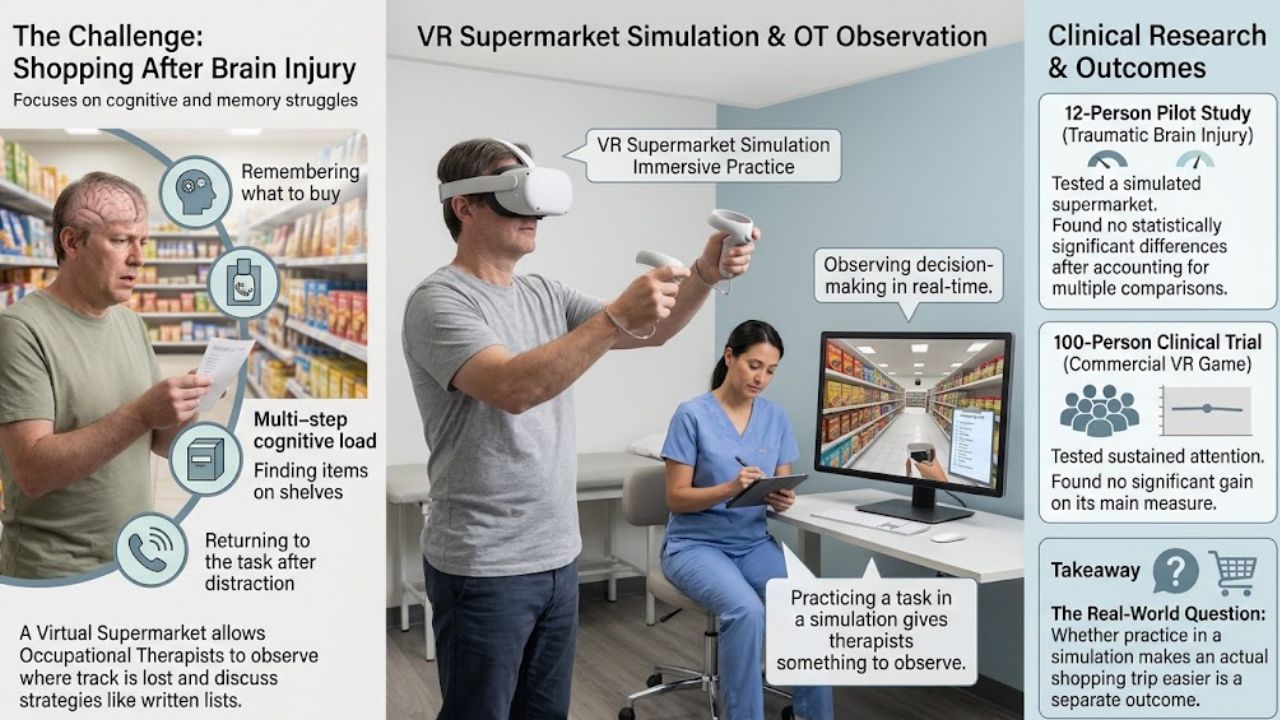
Shopping takes planning. A person has to remember what to buy, find it, and return to the list after a distraction. A virtual supermarket gives an occupational therapist a way to observe those steps. For example, the therapist can see where a person loses track of the task and discuss whether a written list or another strategy would help.
Researchers studying virtual reality in injury rehabilitation tested a simulated supermarket in a 12-person pilot involving adults with traumatic brain injury. The study found no statistically significant differences after accounting for multiple comparisons. A separate 100-person trial tested a commercial VR game. It found no significant gain on its main measure, sustained attention. Practicing a task in a simulation gives therapists something to observe. Whether that practice makes an actual shopping trip easier is a separate outcome.
7. Exploring Relief for Phantom Limb Pain After Amputation
After an amputation, some people feel pain that seems to come from the missing hand, foot, or other part of the limb. Specialized systems let patients see a digital limb while trying to move the missing one or imagining the movement. Some setups use surface sensors to pick up signals from the muscles that remain.
In this use of virtual reality in injury rehabilitation, researchers have also combined virtual tasks with augmented reality, which overlays the digital limb on a camera view. An 81-person trial published in Pain found that reported pain fell in both the movement-attempt and mental-rehearsal groups. Both groups used extended reality, the umbrella term for these technologies, so the study couldn’t isolate how much pain relief came from the technology itself.
Final Thoughts
The value of virtual reality in injury rehabilitation depends on what the patient needs to do again. That might be turning a key, tolerating a stretch, or following a shopping list in a busy space. A therapist can use VR physical therapy when the simulated task serves that goal and check progress using a measure that matters to the patient. A score inside the simulation tells only part of the story.
Frequently Asked Questions
How is virtual reality used in therapy?
Clinicians use virtual reality in injury rehabilitation to guide exercises, simulate everyday tasks, or provide distraction during painful movement. In VR physical therapy, a headset or motion-tracking screen can give feedback while the patient practices.
How does virtual physical therapy work?
A physical therapist can assess movement, demonstrate exercises, and adjust a plan over a video visit. VR physical therapy uses a simulated environment and may take place in a clinic. For more on remote care, see how telerehabilitation services work in Ukraine.
What are the downsides of VR therapy?
VR physical therapy can cause motion sickness, including dizziness or nausea. Headsets can also make it harder to see the physical space around the patient, which matters during standing or balance tasks.