

Does the phrase “standardized testing for homeschoolers” make your stomach tighten a little? You are not the only parent who wants clear answers before picking a test.
The good news is that testing does not have to hijack your curriculum or turn your home education routine upside down. In most cases, you need a test that fits your child, a calendar that fits your state, and a simple way to keep records.
Below, I’ll walk you through the main test types, the testing requirements that matter most, and the practical choices that help you measure growth without losing the flexibility that makes home education work so well.
What is Standardized Testing for Homeschoolers?
Standardized testing for homeschoolers means using a test that is given and scored in a consistent way, so your child’s results can be compared to a larger group. That comparison can show whether your student is working above, below, or right around the level expected for the grade.
Most homeschool families use one of two broad tools: a norm-referenced achievement test, which compares your child with a national sample, or a college entrance exam, such as the SAT, ACT, or CLT, for older students. Some states also allow evaluation routes that lean more on work samples, written narratives, or portfolio reviews.
As of 2026, the North Carolina Division of Non-Public Education requires each enrolled homeschool student to take a nationally standardized test or equivalent measure every academic year, and the state says families must keep those results available for inspection. North Carolina also allows parents to administer the test themselves if the publisher permits it, which can make compliance much easier for home-based programs.
Georgia law takes a lighter approach. Home study students must take an appropriate nationally standardized test at least every three years beginning at the end of third grade, and the scores must be kept in your records, but they do not have to be routinely submitted to the state.
- For compliance: the right test is the one your state accepts.
- For planning: the right test gives clear score reports you can actually use.
- For peace of mind: the right test fits your child’s age, stamina, and learning style.
A few states give families more room. Pennsylvania uses a portfolio and evaluator system for home education, and New York allows a written narrative in certain years for grades 4 through 8, so a portfolio can be a real option there. That said, a portfolio is not a substitute if your own state requires a nationally standardized assessment every year.
Why is Standardized Testing Important?
Standardized testing for homeschoolers matters because it gives you an outside measurement of achievement without forcing you to copy a public school model. Used well, it supports assessment, evaluation, accountability, and smarter curriculum choices.
Measuring academic progress
A good achievement test helps you spot patterns that daily schoolwork can hide. You may feel that reading is strong and math is slipping, but a score report can show whether the issue is broad math performance or one narrow skill, such as computation, word problems, or pacing.
That is why score labels matter. Many norm-referenced tests report percentile ranks, stanines, and grade-equivalent data, which gives you more than a simple pass or fail result and makes it easier to decide whether your child needs review, acceleration, or a different teaching approach.
Meeting state requirements
Testing also protects your homeschool legally. If your state asks for annual or periodic evaluation, your test date, score report, and proof of administration become part of the paper trail that shows your program is operating within state rules.
- Keep the test date in your planner.
- Save the full score report, not just the summary page.
- Store records by school year, so you can show growth over time.
- Note whether the test was timed, untimed, remote, or in person.
Preparing for college admissions
For older students, testing can do double duty. A college entrance score gives admissions offices a familiar third-party benchmark to read beside a homeschool transcript, and it can also help with course placement or scholarship screening.
College Board lists the digital SAT at 2 hours and 14 minutes of testing time, while CLT’s current structure gives students 2 hours of testing plus brief setup time, and ACT’s enhanced format is shorter than the older version. That means juniors and seniors benefit from practicing the exact rhythm of the exam they plan to take, instead of relying on general academic strength alone.
Types of Standardized Tests for Homeschoolers
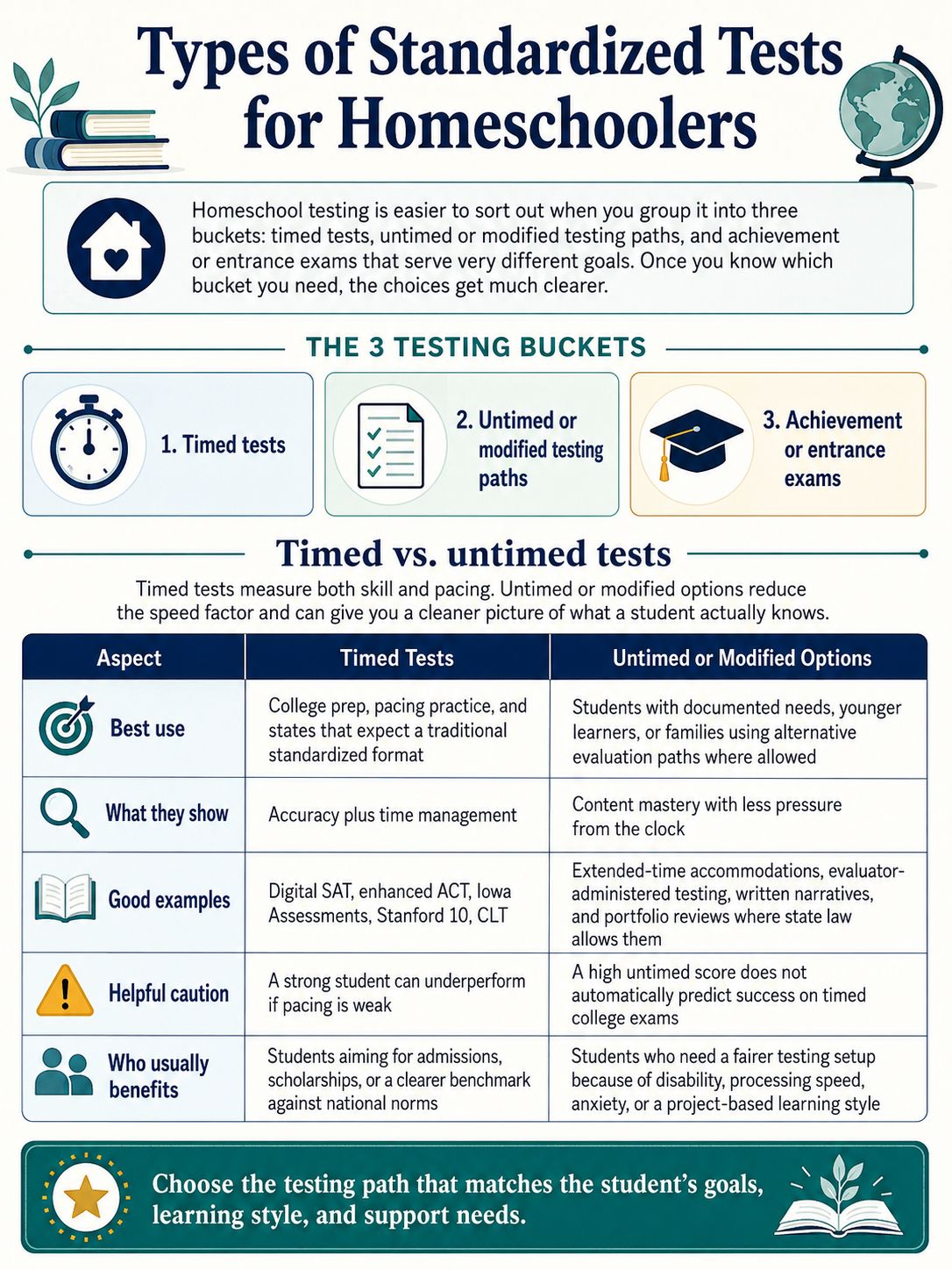
Homeschool testing is easier to sort out when you group it into three buckets: timed tests, untimed or modified testing paths, and achievement or entrance exams that serve very different goals. Once you know which bucket you need, the choices get much clearer.
Timed vs. untimed tests
Timed tests measure both skill and pacing. Untimed or modified options reduce the speed factor and can give you a cleaner picture of what a student actually knows.
| Aspect | Timed Tests | Untimed or Modified Options |
|---|---|---|
| Best use | College prep, pacing practice, and states that expect a traditional standardized format | Students with documented needs, younger learners, or families using alternative evaluation paths where allowed |
| What they show | Accuracy plus time management | Content mastery with less pressure from the clock |
| Good examples | Digital SAT, enhanced ACT, Iowa Assessments, Stanford 10, CLT | Extended-time accommodations, evaluator-administered testing, written narratives, and portfolio reviews where state law allows them |
| Helpful caution | A strong student can underperform if pacing is weak | A high untimed score does not automatically predict success on timed college exams |
| Who usually benefits | Students aiming for admissions, scholarships, or a clearer benchmark against national norms | Students who need a fairer testing setup because of disability, processing speed, anxiety, or a project-based learning style |
Achievement tests
Achievement tests measure what your child has learned in subjects such as reading, language, math, science, and social studies. They are usually the best match when your main goal is annual evaluation, curriculum planning, or meeting state testing requirements.
This is where norm-referenced reporting becomes useful. Instead of asking, “Did my child finish the workbook?” you can ask, “How did my child perform compared with students nationally, and where should I adjust instruction next?”
College entrance exams (SAT, ACT, CLT)
College entrance exams serve a different purpose. They are built less around annual homeschool accountability and more around readiness for admissions, merit review, and college-level academic work.
College Board says the digital SAT uses two adaptive sections, Reading and Writing plus Math, with a 10-minute break between them. ACT’s 2025-26 handbook reflects the enhanced ACT format, where English, math, and reading make up the core composite and science is optional, which matters if your student is choosing a testing strategy for a STEM or non-STEM path.
CLT is worth looking at if you want a homeschool-friendly option. Its current exam structure uses verbal reasoning, grammar and writing, and quantitative reasoning, and CLT does not allow calculators, so students who rely heavily on calculator habits should practice that format before test day.
Examples of Popular Standardized Tests
Homeschool parents often hear a long list of test names, but the best choice usually comes down to format, score detail, and how easy the test is to schedule. The chart below highlights the most practical differences.
| Test | Typical grade range | Why parents choose it | Best fit |
|---|---|---|---|
| Iowa Assessments | Elementary through high school | A well-known achievement test with clear strengths and weaknesses reporting; some homeschool providers now use updated 2024 norms | Families who want a traditional, widely recognized benchmark |
| Stanford Achievement Test, Tenth Edition | K-12 on paper, grades 3-12 online | Reports percentile rank, stanine, grade equivalent, and NCE scores | Parents who want detailed score interpretation and online testing for older students |
| California Achievement Test, often offered with TerraNova options | K-12 options vary by provider | Flexible scheduling, including year-round availability through some homeschool testing services | Families who need a simple testing window and quick administration |
| Woodcock-Johnson Tests of Achievement | Broad age span through school years and beyond | Deep diagnostic reporting in reading, math, and written language, with equivalent forms that help when retesting | Students who need a more individualized evaluation or follow-up after learning concerns |
Iowa Test of Basic Skills (ITBS)
Many parents still use the old name ITBS, but the current product is generally referred to as Iowa Assessments. It remains a strong choice when you want familiar reporting and a test that many homeschool providers already know how to administer.
One practical advantage is logistics. BJU Press notes that grades 3 through 8 can often be grouped for administration, and grades 9 through 12 can also be grouped, which is helpful for co-ops or families coordinating test day with friends.
Stanford Achievement Test
The Stanford 10 is separate from the college-admissions SAT, and that distinction matters. It is an achievement test, not an admissions exam.
Pearson describes the Stanford 10 as available in paper form for grades K through 12 and online for grades 3 through 12. It also gives parents a rich score set, which makes it useful if you want more than a single overall performance number.
California Achievement Test (CAT)
The CAT remains popular because it is simple to schedule and easy to understand. Some homeschool testing services offer CAT or TerraNova testing year-round, which is a big help if your school year does not match a traditional August-to-May calendar.
That flexibility matters most for families who school through summer or want to test right after finishing a unit of study, while the material is still fresh. It also helps parents spread out stress instead of stacking testing on top of spring activities.
Woodcock-Johnson Test
The Woodcock-Johnson works especially well when you need diagnostic depth rather than a quick annual benchmark. Riverside’s test materials break scores into clusters such as Broad Reading and Broad Mathematics, which gives you a clearer instructional target than a single composite score.
It is also useful when you expect to retest. The WJ IV includes equivalent forms in its standard battery, so an evaluator can measure change over time with less concern that the student is simply remembering the test format.
Accommodations for Special Needs Students
Homeschool students can get accommodations, but the process goes more smoothly when you treat it like a paperwork project, not a last-minute request. Start earlier than feels necessary, and keep a folder with every plan, evaluation, and approval letter in one place.
Testing accommodations for the SAT and ACT
College Board says accommodation requests should be submitted at least seven weeks before the intended start date for in-school assessments, and approval can take time if documentation needs review. If your student uses breaks, text-to-speech, screen reader support, or extended time in daily instruction, practice with those exact supports before test day.
ACT has a separate path for homeschooled or non-enrolled examinees. ACT says those students must submit extra information directly, including the accommodations request form, an exceptions statement completed by the educational instructor, and diagnostic documentation that shows both the disability and its functional impact.
- Gather current evaluations, medical documentation, and any learning plans before you register.
- Save proof of classroom accommodations, because testing agencies want to see that the support is used regularly, not requested only for the exam.
- Run at least one full practice session with approved tools, such as text-to-speech or extra breaks, so test day feels familiar.
- If your student has prior approval from another testing program, keep that letter in your records because it may help support future requests.
Options for untimed or modified tests
If a fast-paced group test is a poor fit, do not assume your only option is to skip assessment. In some cases, a modified testing path or a different test family gives you better information and a fairer evaluation.
- Ask about extended time first. It preserves standardization more than switching tests entirely, and it may satisfy both state expectations and your child’s real needs.
- Use CLT rules strategically. CLT says accommodations for the CLT and CLT10 must be submitted at least four weeks before the test date, while CLT3-8 accommodations are handled by the parent, school, or co-op based on normal instructional needs.
- Consider an evaluator-administered test. A Woodcock-Johnson evaluation can give stronger diagnostic detail when broad achievement testing is not telling you enough.
- Check whether your state permits narrative or portfolio alternatives. This matters in states with flexible evaluation laws, but it does not replace required testing in states like North Carolina.
- Match the tool to the question. If you need legal compliance, choose what your state accepts. If you need insight into a suspected skill gap, choose the option that gives the clearest subtest data.
How to Choose the Right Test for Your Homeschooler
Picking the right test gets easier once you stop asking, “What is the best test?” and start asking, “What job do I need this test to do?” For most families, the answer falls into one of four jobs: legal compliance, curriculum feedback, accommodations support, or college prep.
Understanding your child’s learning style
Start with the child in front of you. A student who knows the material but slows down under pressure may need an untimed achievement test or a formal accommodations path, while a student headed for college entrance exams needs some timed practice long before junior year.
Project-based learners can still do well on standardized assessment, but they often need a little more previewing. Show them sample question types, explain how multiple-choice logic works, and make the first test a low-stakes experience rather than a high-pressure judgment day.
Checking state requirements
Your state law should narrow the list fast. If your state demands a nationally standardized achievement test every year, do not waste time comparing portfolio systems that your state will not accept.
- Check whether testing is annual, periodic, or tied to specific grades.
- Confirm whether the test must be nationally norm-referenced.
- Ask who may administer the test: parent, proctor, certified teacher, or evaluator.
- Keep score reports and progress records for the number of years your state requires.
Comparing likely costs
Fees can shape the decision faster than parents expect, especially for high school students who may take more than one entrance exam. As of July 2026, College Board lists the SAT at $68; ACT lists its core test at $70 with a $5 science add-on and a $25 writing add-on; and CLT lists the remotely proctored CLT at $112, the CLT10 at $69, and the CLT3-8 at $39.
| Option | Current listed base fee | What to watch for |
|---|---|---|
| SAT | $68 | Late registration and score-related extras can raise the total |
| ACT core test | $70 | Science and writing are add-ons, and late changes cost more |
| CLT | $112 | Good for families comparing homeschool-friendly remote options |
| CLT10 | $69 | Useful as a college-prep step before senior-year admissions testing |
Achievement-test costs vary more by provider because proctoring, shipping, and scoring packages change the final bill. Always check the total checkout price, not just the base test price.
Considering long-term educational goals
If your child is in elementary or middle school, the smartest move is usually a dependable annual benchmark and clear score reporting. If your child is moving into high school, you may want a two-part plan: a norm-referenced achievement test for yearly evaluation and a college entrance exam once admissions or scholarship goals become real.
Some universities still ask home-educated applicants for official standardized scores, even when they review transcripts, course descriptions, and other materials. That is why it helps to think several years ahead instead of treating each test as a one-time event.
Benefits of Standardized Testing for Homeschoolers
Used wisely, standardized testing gives you something every homeschool parent needs, a neutral checkpoint. It does not replace your daily teaching, but it can sharpen it.
Identifying strengths and weaknesses
A strong score report helps you teach with more precision. If reading comprehension is solid but written expression lags, you can shift from generic “language arts” work to targeted writing instruction.
This is where good reporting earns its keep. The Stanford 10 reports multiple score types, and Woodcock-Johnson style clusters can separate reading, math, and writing performance in ways that make your next curriculum decision much easier.
Building test-taking skills
Testing is also a skill. Students improve when they practice the format they will actually face, not a random worksheet that only looks similar from a distance.
- Use Bluebook practice for the SAT format.
- Use official ACT practice materials that match the enhanced test.
- Use CLT sample tests if that is the exam on your calendar.
- Practice bubbling, pacing, and taking a short break without losing focus.
Short practice sessions often work better than marathon mock exams for younger homeschool students. You are building stamina, familiarity, and calm, not trying to recreate a stressful test center every week.
Benchmarking against national standards
Norm-referenced testing gives you a common language for evaluation. Instead of saying, “Math seems okay,” you can say, “My child is at the 62nd percentile overall, but problem-solving is stronger than computation.”
Percentile rank is a comparison to other students in the norm group, not a classroom grade. That one distinction saves many parents from misreading a perfectly solid score report.
That kind of benchmarking helps with accountability, transcript planning, and curriculum adjustments. It also gives you a cleaner story to tell if a future evaluator, umbrella school, scholarship program, or college asks how your student has been progressing in home education.
Final Thoughts
Standardized testing for homeschoolers works best when you treat it as a tool, not a verdict.
Pick the test that fits your state rules, your child’s learning needs, and your long-term goals. Then keep clean records, review the score report carefully, and use what you learn to shape stronger instruction next year.
FAQs about Standardized Testing For Homeschoolers
1. Do homeschoolers have to do standardized testing?
It depends on your state; some states require yearly standardized testing or an outside assessment, and others accept a portfolio or teacher evaluation.
2. What kinds of tests can homeschoolers take?
Homeschoolers can take state assessments, public school tests, private company exams, or college entrance tests, and parents may also use practice tests to watch progress.
3. How do I prepare my child for testing?
Use short practice tests, review weak skills, and make test day calm and normal; think of it like a small field trip, not a big performance.
4. What should I do with the test results?
Use the results to spot skill gaps, change lessons, and track growth; some families keep records for state laws or to share with colleges.