Are you tired of high energy bills from your home or office building? Buildings eat up about 40% of all energy used in the US, making it a big problem. This blog will show you 8 cool smart glass technologies that can cut down on energy consumption and save money.
Keep reading to see how smart windows can help!
Key Takeaways
- Smart glass technologies can cut energy use in US buildings by up to 20%, according to the Department of Energy.
- Electrochromic glass reduces energy consumption by 10 to 30%, with a Brussels study showing a drop from 100.9 kWh to 38.6 kWh per square meter.
- Hybrid smart glass, like TECSW, saves 96.60 kWh per square meter yearly on HVAC costs, cutting 17.25% of a building’s energy use.
- SPD glass market is expected to grow from $3.4 billion in 2018 to $9.76 billion by 2024, boosting energy efficiency.
- Smart windows at Dallas/Fort Worth Airport kept areas 20 degrees cooler, showing real energy-saving results.
Electrochromic Glass
Hey there, folks, let’s chat about electrochromic glass, a cool kind of smart window that’s changing the game for energy efficiency in buildings. Picture a window that tints itself darker or lighter with just a flick of a switch, cutting down on solar heat gain without needing clunky blinds.
Studies show these windows can slash energy consumption by 10 to 30 percent compared to windows with movable shades, and a whopping 50 to 75 percent against bare glass. That’s a big deal for reducing your carbon footprint and keeping office buildings comfy without cranking the HVAC system.
Dig this, a study by Ajaji and Andr in Brussels found that electrochromic windows dropped primary energy use from 100.9 kWh per square meter down to an impressive 38.6 kWh per square meter.
Pretty neat, right? Though, here’s the catch, these smart glasses often need an external power source to work their magic, which slows down their use in sustainable construction across the board.
Still, geeky minds like Cao and team have pushed the tech forward with Ta-doped TiO2 nanocrystals, boasting a charge storage of 466 mAh per square centimeter. Imagine the potential for energy savings in smart cities with innovations like these paving the way!
Thermochromic Glass
Let’s chat about a remarkable player in smart glass technology. This innovative material changes its appearance based on temperature variations. Envision your windows darkening as the sun intensifies, reducing harsh glare.
They assist in controlling solar radiation and maintaining a comfortable environment without overusing air conditioning. Moreover, these windows store energy, functioning as a small power reserve for your building.
It’s an intelligent approach to improving energy efficiency and addressing climate change in US buildings.
Now, consider this: smart windows with thermochromic hydrogel are transformative. They allow an impressive 91.2% of visible light to pass through for a natural lighting effect. At the same time, they block 99.2% of sunlight when necessary, protecting your space from excessive heat.
Even more impressive, they can produce 75 amps of current with only a 40-degree Celsius difference. That’s a significant advantage for cutting energy use in office buildings. Think of it as a quiet champion, helping to reduce heating and cooling expenses while promoting sustainable design.
Photochromic Glass
Hey there, readers, let’s talk about photochromic glass, an impressive innovation in smart glass technology. This material operates like a charm, adjusting its tint based on sunlight exposure.
Imagine it as sunglasses for your building, darkening to shield against intense rays and lightening up when the sun disappears. It helps reduce energy use by decreasing the need for artificial cooling.
Plus, it conserves energy while modifying its optical contrast, making it a smart pick for energy efficiency in US buildings.
Now, consider this, photochromic glass holds its ground as a strong choice alongside electrochromic and thermochromic smart glass. It manages solar gain without any wires or switches, relying solely on its response to light.
This results in less heat entering your office buildings, maintaining thermal comfort. So, if you’re focused on sustainable building designs, this technology could be your ideal ally in combating climate change and cutting energy costs.
Suspended Particle Device (SPD) Glass
Dig into this cool tech, folks, and see how Suspended Particle Device, or SPD glass, transforms energy efficiency in US buildings. This smart glass tweaks its transparency and light reflectance on demand, cutting down energy consumption like a champ.
Imagine slashing those hefty electric bills in office buildings; SPD glass makes it happen by controlling daylight and heat transfer without guzzling extra power. Even better, it runs without external power supplies, making it a green pick for sustainable buildings aiming for net-zero energy status.
Now, let’s chat about the bigger picture with SPD glass and its role in smart glass technology. Studies show this market, including SPD glass, is set to jump from $3.4 billion in 2018 to a whopping $9.76 billion by 2024.
Current work blends SPD with other smart windows like electrochromic and thermochromic types for top-notch results. Plus, experts use multi-criteria decision-making models to weigh its performance, helping pick the best options for energy-efficient buildings.
Ain’t that a neat way to fight climate change?
Polymer-Dispersed Liquid Crystal (PDLC) Glass
Hey there, folks, let’s talk about an innovative technology that’s transforming energy efficiency in US buildings. I’m referring to Polymer-Dispersed Liquid Crystal, or PDLC glass, a kind of smart window focused on conserving energy.
Think of a window that shifts from clear to cloudy at the flick of a switch. That’s PDLC for you, allowing you to manage light and privacy while reducing energy use. It acts like a protective barrier against the sun’s heat, lessening the demand for air conditioning in office spaces.
Plus, its fast switching response times offer an instant solution for daylight management. How impressive is that?
Now, envision this as a key element in a broader strategy for sustainable building. PDLC glass integrates seamlessly into the field of smart glass technology, alongside alternatives like thermochromic and electrochromic windows.
It offers remarkable control over light transmission, meaning it adjusts brightness to conserve power. Even more exciting, combining it with energy storage solutions brings us nearer to achieving net-zero energy buildings.
Research, including studies using fuzzy Multi-Criteria Decision-Making models, highlights it as a leading option for eco-friendly solutions. So, pairing PDLC with solar energy systems could be a significant move in combating climate change and reducing dependence on fossil fuels.
Solar-Control Glass
Solar-control glass is a game-changer for energy efficiency in US buildings. Think of it as a shield, blocking out excess heat from the sun while still letting in natural light. This smart glass cuts down on the need for air conditioning, slashing energy consumption in office buildings.
It’s like giving your windows a superpower, automatically adjusting to keep things cool without wasting electricity.
Now, imagine a hot summer day, and your building stays comfy without blasting the AC. Solar-control glass, much like the smart windows Rao Mulpuri of View in California talks about, works as “transition glass” for structures.
It adapts to sunlight, reducing direct solar gains and helping with climate change goals. Plus, it pairs well with ideas like cool roofs or solar reflectance, making your space a champ at saving energy.
Vacuum Insulated Glass (VIG)
Hey there, let’s talk about something really impressive, Vacuum Insulated Glass, or VIG for short. This innovative glass technology is transforming energy efficiency in US buildings.
Imagine a window that doesn’t just exist but actively combats energy waste by adjusting solar radiation. That’s right, VIG helps maintain a comfortable building environment without overusing heating or cooling, significantly reducing energy use.
It’s a vital component in achieving net-zero energy buildings, which means less environmental impact and greater resource preservation for future generations.
Now, consider this, VIG isn’t chosen randomly. Experts employ sophisticated approaches like Multi-Criteria Decision-Making, using fuzzy and TODIM models, to evaluate its benefits.
They analyze factors like insulation performance, cost-efficiency, and its ability to lower CO2 emissions in the fight against climate change. Plus, recent developments are reducing production costs, making VIG suitable for widespread use in large office buildings.
So, with this glass, you’re not just cutting costs, you’re contributing to the green building movement. How awesome is that?
Hybrid Smart Glass Technologies
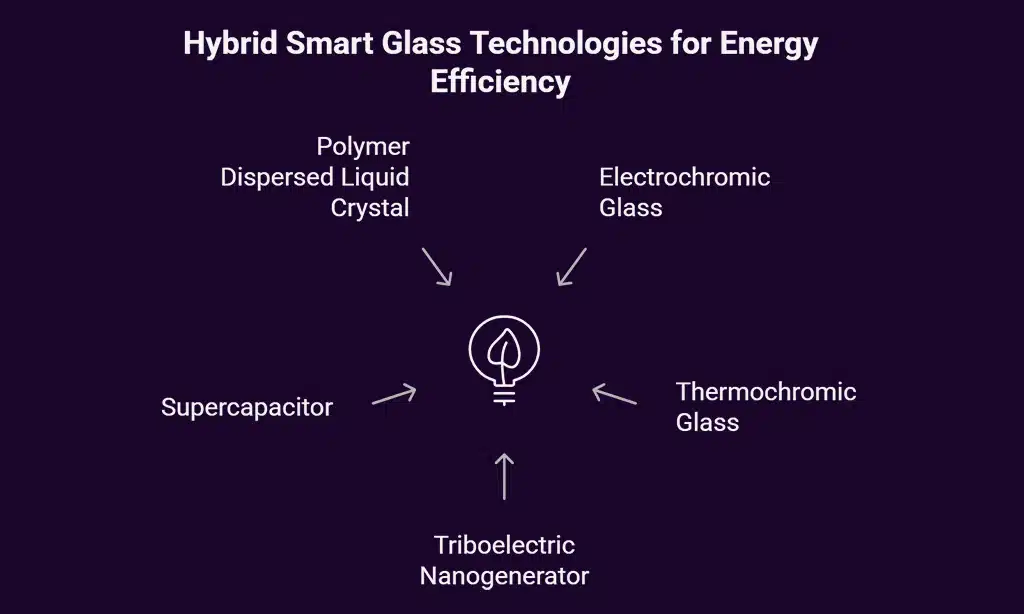
Let’s chat about something cool, folks. Hybrid smart glass technologies mix different types of smart glass, like electrochromic and thermochromic, to create super windows for energy efficiency.
Imagine a window that changes shade with sunlight and stores power at the same time. That’s the magic here. These combos can tackle multiple needs, such as daylight control and cutting down on energy consumption.
For instance, the Triboelectric Nanogenerator-powered electrochromic smart window, or TECSW, saves a whopping 96.60 kWh per square meter each year in HVAC costs. That’s like slashing 17.25% off a building’s total energy use.
Pretty neat, right?
Now, think of these hybrid setups as a dream team for office buildings. They often pair electrochromic supercapacitor smart windows with other tech to boost performance. These windows can store energy, darken when charged, and lighten when discharged, all while managing infrared radiation and thermal emissivity.
It’s like having a window that’s also a battery. Plus, blending in polymer dispersed liquid crystal tech adds even more control over sunlight. With climate change knocking at our door, using such smart glass in infrastructure helps fight global warming through better energy conservation.
Stick around to see how this ties into bigger systems!
Integration of Smart Glass with Building Automation Systems
Hey there, folks, have you ever considered how smart glass can collaborate with building automation systems to conserve energy? Envision smart windows equipped with tiny coatings and computer chips integrating seamlessly into a building’s core, the automation system.
These innovative setups employ app-controlled features to regulate incoming sunlight, reducing unnecessary HVAC energy needs. It’s akin to having a dedicated helper for your office buildings, adjusting the light and temperature effortlessly.
Now, think of this technology syncing with the Internet of Things, or IoT, making energy efficiency incredibly simple. Smart glass technology communicates with sensors and smart grids, quickly determining the right level of daylight management.
This collaboration significantly reduces energy use, particularly in US buildings aiming for lower costs. So, stay with me, and let’s explore how this innovation maintains your space’s comfort while addressing climate change!
Benefits of Smart Glass for Energy Efficiency in Buildings
Smart glass technology is a game-changer for cutting energy costs in buildings across the US. Imagine slashing your energy needs by up to 20%, as reported by the Department of Energy.
That’s a huge deal for office buildings, hotels, and even airports like San Francisco International Airport (SFO), where smart windows are already hard at work. These clever panes, also called switchable glass, adjust to sunlight and keep spaces comfy without cranking up the AC or heat.
It’s like having a built-in shield against energy waste, saving both cash and the planet.
Tests at Dallas/Fort Worth International Airport showed smart windows from View kept seating areas 20 degrees cooler than regular glass. Think about that for a second; cooler spaces without extra energy consumption! Plus, high-performance tools like these could save a whopping $476.6 million by 2030 if more places jump on board.
Using smart glass means less reliance on power-hungry systems, paving the way for better energy efficiency and a nod to climate change solutions. It’s a win-win, don’t you think?
Takeaways
Hey there, let’s wrap this up with a quick nod to smart glass tech! These innovations are changing the game for energy-saving in US buildings. Imagine slashing energy bills while keeping spaces cool and comfy, all with a tap on your app.
Isn’t it neat how windows can now fight climate change? Stick with these ideas, and watch your office or home turn into an energy champ!
FAQs on Smart Glass Technologies
1. What exactly are smart windows, and how do they help US buildings save power?
Hey there, smart windows, often called smart glass, are nifty panes that tweak their tint to control daylight. They slash energy consumption in office buildings by cutting down on artificial lighting and cooling needs. Pretty slick for tackling climate change, right?
2. How does thermochromic smart glass play a role in energy efficiency?
Well, thermochromic smart glass is a game-changer; it shifts color with temperature to manage heat. This trick helps in reducing energy consumption by keeping indoor spaces comfy without overworking HVAC systems.
3. Can smart glass technology team up with solar panels for better results?
Absolutely, pairing smart glass with solar panels is like peanut butter and jelly; they boost renewable energy use together. This combo ramps up energy efficiency in buildings by harnessing solar power while controlling light and heat. It’s a win for cutting down on traditional energy sources.
4. What’s the deal with suspended particle devices in smart glass?
Suspended particle devices are a cool bit of smart glass technology that adjust transparency with electric signals. They’re awesome for daylight control, helping to lower energy consumption in office setups.
5. How does the Internet of Things tie into smart glass for energy retrofits?
Picture this: the Internet of Things, or IoT, connects smart glass to building systems for real-time tweaks. It’s like having a brainy buddy optimizing energy-efficiency through climate adaptive building shells. This setup is key for energy retrofits in older US structures.
6. Why should decision-makers care about multi-criteria decision-making for smart glass?
Hey, decision-makers, listen up; multi-criteria decision-making, or MCDM, along with the analytic hierarchy process, helps weigh options like cost, reliability, and life cycle for smart glass picks. It’s not just a shot in the dark; it factors in risk attitudes and preferences to boost renewable energy sources in buildings. Plus, it ties into Industry 4.0, making your choices future-ready with tech like radiative cooling or double glazed windows.