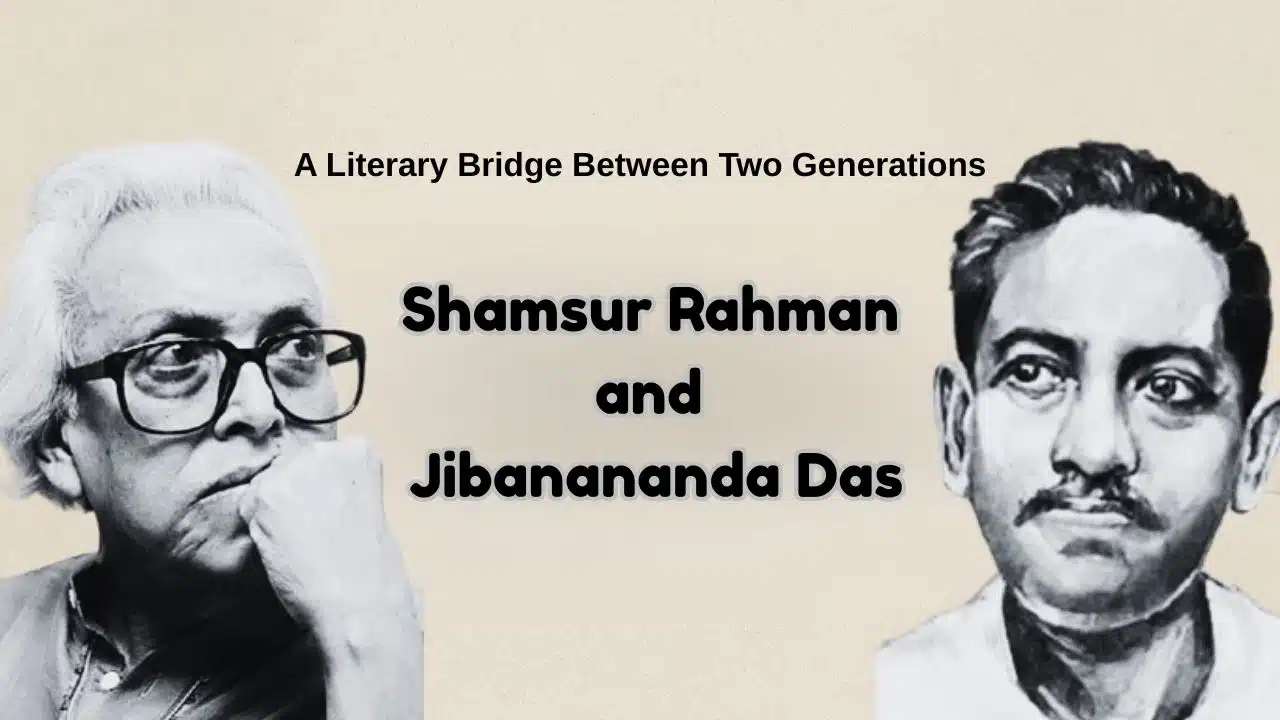
When we speak of modern Bengali poetry, two names rise like twin peaks across generations: Shamsur Rahman and Jibanananda Das. Though separated by decades, their works are bound by an invisible bridge. Jibanananda, often described as the Poet of Beautiful Bengal, wrote in quiet solitude, weaving fog, owls, rivers, and timeless faces into a new modernist language that was ahead of his time.
Shamsur, on the other hand, brought poetry into the public square—his verses thundered in rallies, newspapers, and freedom movements, becoming the heartbeat of a nation in struggle. One whispered about the mysteries of existence; the other bellowed against oppression. Yet together, they shaped the arc of Bengali poetry—from the inward turn of modernism to the outward cry of civic humanism.
On Shamsur Rahman’s 19th death anniversary, revisiting this bridge between poets is not just a literary exercise but a meditation on the conscience of Bangladesh itself.
Shamsur Rahman and Jibanananda Das: The First Glance
Bengali literature in the twentieth century was shaped by two poets who, at first glance, seem worlds apart: Jibanananda Das (1899–1954) and Shamsur Rahman (1929–2006). Jibanananda wrote in relative obscurity during his life, a modernist pioneer whose elliptical imagery and enigmatic lines bewildered many contemporaries.
Shamsur, on the other hand, became a household name during his lifetime, his poems ringing across rallies, newspapers, and public debates. Yet, to read them side by side is to see a continuity—a bridge between generations. Jibanananda rewired the inner soul of Bengali poetry with his meditations on solitude and time, while Shamsur translated that inward modernism into a public lyric that could inspire protests, resist tyranny, and celebrate freedom.
Two Historical Contexts, Two Poetic Visions
Jibanananda Das was born at the turn of the century in Barishal. His formative years were marked by the waning of Tagore’s dominance and the growing anxieties of colonial modernity.
Partition, political uncertainty, and a deep sense of existential dislocation colored his works. Known later as Rupashi Banglar Kabi—the Poet of Beautiful Bengal—he spent much of his life as a teacher and critic, underappreciated in his time, canonized only after his death.
Shamsur Rahman, born three decades later in Dhaka, grew up amid the turbulence of a different Bangladesh. His career unfolded through the 1952 Language Movement, the 1969 uprising, the 1971 Liberation War, and the pro-democracy struggles of the 1980s.
He was not only a poet but also a journalist and editor, lending his pen to both literature and daily civic debate. Where Jibanananda’s solitude seemed to retreat from the political storm, Shamsur’s verse walked directly into it.
Opinion: One turned inward, making Bengali poetry modern. The other turned outward, making it civic.
Aesthetics & Form: Modernist Echoes vs. Rhythmic Lyricism
Jibanananda’s poetics are marked by dense imagery, surreal landscapes, and elliptical syntax. His famous poem Banalata Sen exemplifies this: an exhausted wanderer finding solace in the eyes of a timeless woman, against a backdrop of cosmic time and fading civilizations. His modernism demanded patient reading, often alienating casual audiences.
Shamsur Rahman, by contrast, wrote in supple free verse, often in a conversational tone. His style was deeply influenced by modernism but reshaped to be accessible. Poems like Asader Shirt transform the everyday image of a blood-stained shirt into a national symbol of sacrifice. His rhythmic free verse could be read aloud at a rally, yet retain literary sophistication.
Opinion: Jibanananda whispers; Shamsur bellows. But both are unmistakably modernist in their reimagining of Bengali verse.
Imagery & Space: The Pastoral Threshold vs. the Metropolis Pulse
For Jibanananda, Bengal itself was the canvas. His landscapes teem with foggy owls, silent rivers, and moonlit fields. The pastoral scenery is never mere description—it becomes a space of memory, nostalgia, and existential questioning.
Shamsur’s imagery, on the other hand, is rooted in the immediacy of the metropolis. His Dhaka is alive with political demonstrations, blood on the streets, and the defiant heart of Bangladesh. The poem Buk Tar Bangladesher Hridoy situates the nation’s democratic pulse within the very chest of the protester.
Opinion: If Jibanananda offered poetry as a mirror to Bengal’s timeless essence, Shamsur turned poetry into a megaphone for its living struggle.
History & Protest: Inner Resistance vs. Open Defiance
Jibanananda’s modernism was itself a form of resistance. By breaking away from the grand romanticism of Tagore, he quietly redefined Bengali literature, refusing easy idealism in favor of difficult truths. His poems carry an oblique defiance—challenging literary tradition more than political regimes.
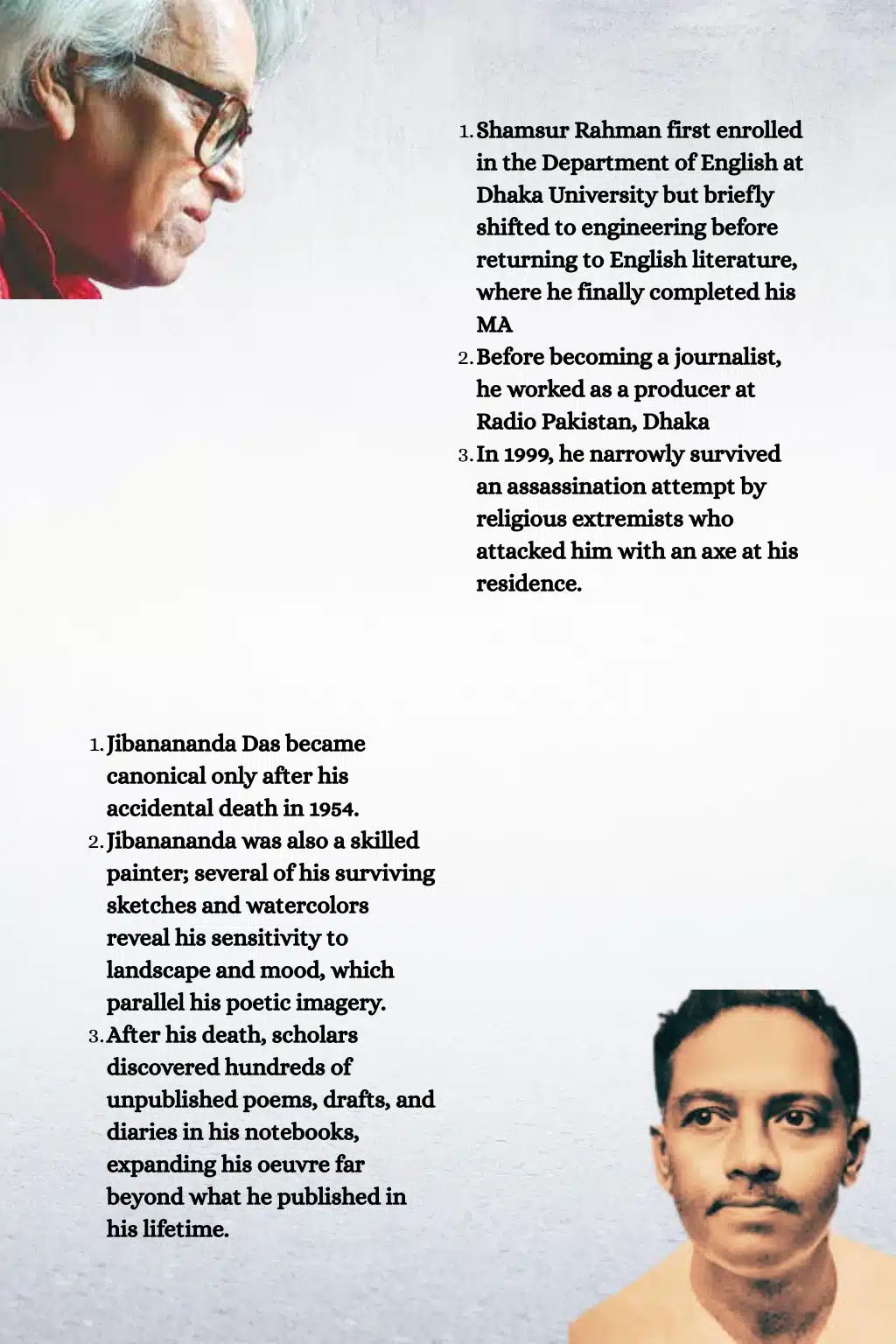
Shamsur’s defiance was direct and political. His Asader Shirt became the anthem of the 1969 uprising. His wartime collection Bondi Shibir Theke gave voice to a nation under fire during 1971. Later, during the 1980s, his poems were rallying cries against General Ershad’s autocracy. His pen did not retreat from history—it became part of it.
Opinion: If Jibanananda internalized resistance as existential solitude, Shamsur externalized it as civic solidarity. One deepened the conscience; the other mobilized it.
Reception & Legacy: Posthumous Canon vs. Lifelong Icon
Jibanananda’s obscurity in life is now legendary. Critics found him too obscure, too complex. Only after his accidental death in 1954 did his reputation grow, eventually making him one of the “three pillars” of Bengali poetry alongside Tagore and Nazrul. His collected works are now staples in curricula.
Shamsur Rahman, by contrast, was widely celebrated during his lifetime. He received the Bangla Academy Award, the Ekushey Padak, and the Independence Day Award. He even survived a 1999 assassination attempt by extremists—proof that his words were potent enough to threaten ideologies. His funeral in 2006 was a national event.
Opinion: Jibanananda’s recognition came late, as a modernist rediscovered. Shamsur’s came early, as a people’s poet. Both, however, are firmly lodged in the canon today.
Translation & Global Presence
Jibanananda’s poetry has found readers abroad, particularly through translations of Banalata Sen and Rupashi Bangla. His enigmatic lyricism appeals to global audiences drawn to atmosphere and mood.
Shamsur’s works, though less translated, appear in anthologies of freedom poetry and human rights literature. His reputation outside Bangladesh rests on his role as the voice of the Liberation War and democratic struggles.
Opinion: Jibanananda whispers across languages with timeless beauty. Shamsur travels less smoothly but carries the urgency of history. Together, they give Bangladesh both lyrical mystery and political resonance on the world stage.
Shamsur Rahman and Jibanananda Das: The Bridge in Full
So what exactly does this bridge look like? On one end stands Jibanananda, with his patient seeing, his enigmatic solitude, and his insistence that Bengali poetry be more than Tagorian lyricism. On the other side stands Shamsur, with his fearless sayings, his civic humanism, and his insistence that poetry belong not only in books but also in the squares and streets.
Together, they form a continuum: from inner consciousness to public conscience.
Counterpoint
Some might object: “These two poets are incomparable—they belonged to different eras and different struggles.” Yet comparison does not erase difference; it illuminates continuity.
Without Jibanananda’s inward modernism, Shamsur’s civic lyric might not have carried the same depth. Without Shamsur’s public resonance, Jibanananda’s solitude might have remained a private whisper. Literature matures by such bridges.
Takeaways
On this 19th death anniversary of Shamsur Rahman, Bangladesh should remember not only the public poet of protests but also the continuum he represents. Shamsur gave us the courage to speak truth to power. Jibanananda gave us the patience to see truth within ourselves.
In an age of polarization, we need both voices. The quiet owl-haunted landscapes of Jibanananda remind us who we are in silence. The defiant blood-stained shirt of Shamsur reminds us who we are in struggle. Read them side by side. Let one teach us to feel, the other to speak.