Every calendar date carries its own distinct tapestry of human triumph, tragedy, scientific breakthroughs, and geopolitical upheavals. August 19 is no exception. Across millennia, this single 24-hour cycle has witnessed the passing of Rome’s founding emperor, the democratic birth of visual documentation through photography, covert operations that altered the course of the Middle East, and heroic voyages into the cosmos.
From the riverbanks of Bengal to the streets of Paris, Moscow, and Baghdad, August 19 serves as an intersection where national destinies were written and cultural icons were born. Here is an in-depth, globally balanced retrospective on August 19.
The Bangalee Sphere & South Asian Milestones
The Indian subcontinent, and specifically the cultural and intellectual landscape of Bengal, has experienced transformative political, artistic, and social developments on August 19.
1757: The First Colonial Rupee Minted in Calcutta
Following the Battle of Plassey in June 1757, Robert Clive and the British East India Company entered into a binding pact with the newly installed Nawab of Bengal, Mir Jafar. Under this agreement, the Company secured the sovereign right to mint its own coinage. On August 19, 1757, the first East India Company rupee coins were struck at the Calcutta mint. This event marked not merely a fiscal development, but the structural beginning of British commercial hegemony and economic extraction across Bengal and the wider subcontinent.
1942: The Ballia Uprising and the “Swaraj” Government
During the fever pitch of Mahatma Gandhi’s Quit India Movement, the town of Ballia in eastern Uttar Pradesh staged a remarkable anti-colonial revolt. Led by revolutionary leader Chittu Pandey, thousands of freedom fighters stormed the local jail on August 19, 1942, liberated political prisoners, and established an independent parallel people’s administration (Swaraj Sarkar). While the British colonial military brutally recaptured the district days later, Ballia earned the permanent moniker Bagi Ballia (Rebel Ballia) for this audacious assertion of self-rule.
1946: Relief and Resilience in the Wake of the Great Calcutta Killings
Following the communal violence that erupted in Calcutta on Direct Action Day (August 16, 1946), August 19 marked the decisive turning point where civilian relief brigades, student volunteers, and community leaders across neighborhood lines organized mass shelters and mobile medical kitchens. Intellectuals and humanitarian groups across Bengal worked to rescue stranded families and halt the spread of further violence.
Prominent South Asian Births & Deaths
August 19 is linked to iconic figures in South Asian cinema, literature, social reform, and public life.
Zahir Raihan (Born August 19, 1935 –Died January 30, 1972)
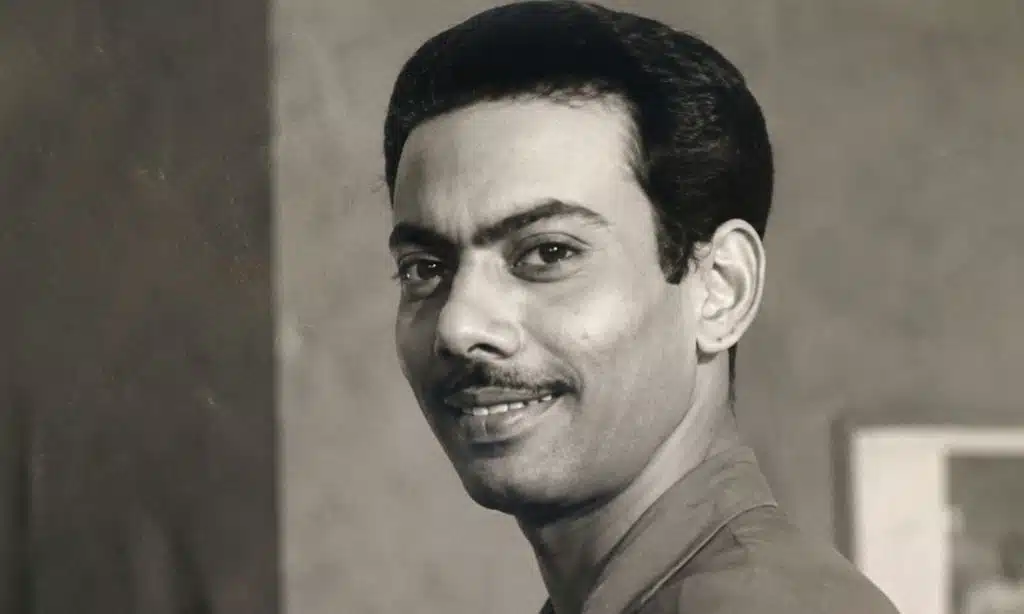
Born in Majupur village in Feni, Zahir Raihan emerged as one of the most brilliant cultural visionaries in Bengal’s history. An active participant in the 1952 Bengali Language Movement, his creative output was inseparable from the struggle for democratic rights and self-determination. His 1970 political satire film, Jibon Theke Neya, used the metaphor of a domineering matriarch to openly subvert the autocratic regime of Pakistan’s General Yahya Khan.
During the 1971 Bangladesh Liberation War, Raihan documented the atrocities committed against the civilian population in his 20-minute documentary, Stop Genocide, which played an invaluable role in awakening global conscience. He disappeared under tragic and mysterious circumstances in January 1972 while searching for his missing brother, the celebrated journalist Shahidullah Kaiser, in Mirpur, Dhaka.
Padmaja Naidu (Born August 19, 1900 – Died May 2, 1975)
The daughter of legendary poet and independence leader Sarojini Naidu, Padmaja Naidu was an influential freedom activist in her own right. Following India’s independence, she served as the Governor of West Bengal from 1956 to 1967—making her the longest-serving female governor in Indian history. She later served as the chairperson of the Indian Red Cross Society and dedicated decades to public health, refugee rehabilitation, and wildlife conservation. The Padmaja Naidu Himalayan Zoological Park in Darjeeling stands named in her honor.
Utpal Dutt (Died August 19, 1993 – Born March 29, 1929)
The world of Indian drama lost one of its most formidable forces when Utpal Dutt passed away on this day in 1993. Founder of the Little Theatre Group (later the People’s Little Theatre), Dutt utilized street theatre and proscenium stages to produce unapologetic, Marxist-inspired political dramas such as Kallol, Angar, and Tiner Toloar.
Dutt was equally celebrated across commercial and parallel Indian cinema. He won the National Film Award for Best Actor for his role in Mrinal Sen’s groundbreaking film Bhuvan Shome (1969) and achieved enduring popular acclaim for his comedic genius in Hrishikesh Mukherjee classics like Gol Maal (1979) and Naram Garam (1981).
Global History
Outside the subcontinent, August 19 has served as the stage for some of the most consequential decisions and paradigm shifts in world history.
14 CE: The Death of Caesar Augustus and the Transition of Imperial Rome
On August 19, 14 CE, Gaius Julius Caesar Octavianus (Emperor Augustus) died in Nola, Italy, at the age of 75. Having emerged victorious from the bloody civil wars that tore apart the Roman Republic, Augustus fundamentally reshaped the Western classical world. He established the Roman Principate, initiated the Pax Romana (two centuries of internal imperial peace), overhauled taxation, and rebuilt the physical infrastructure of Rome. His dying words—reportedly, “I found Rome a city of bricks and left it a city of marble”—symbolized the permanent institutionalization of the Roman Empire.
1839: France Gifts Photography to the World
In a joint session of the French Academy of Sciences and the Académie des Beaux-Arts in Paris, physicist and politician François Arago unveiled the full technical processes of Louis Daguerre’s revolutionary Daguerreotype. Recognizing the transformative democratization of visual memory, the French Government purchased the patent rights and declared photography “a free gift to the world.” This watershed moment made August 19 the globally celebrated World Photography Day.
1942: Operation Jubilee – The Tragedy and Lessons of Dieppe
During the darkest days of World War II, approximately 6,000 Allied soldiers—predominantly from the 2nd Canadian Infantry Division, supported by British Commandos and American Rangers—launched a large-scale amphibious assault on the German-occupied French port of Dieppe.
Operation Jubilee was a catastrophic tactical disaster: over 900 Canadian soldiers were killed within hours, and nearly 2,000 were captured on the exposed gravel beaches. However, the operational failures at Dieppe yielded critical military intelligence regarding amphibious armor deployment, shore bombardment, and logistical timing, directly informing the successful execution of the D-Day landings in Normandy two years later.
1953: Operation Ajax and the Overthrow of Mohammad Mosaddegh
In Iran, August 19, 1953, marked the culmination of a covert intelligence operation orchestrated by the United States Central Intelligence Agency (CIA) and the United Kingdom’s Secret Intelligence Service (MI6). Known as Operation Ajax (officially TP-AJAX), the coup d’état brought about the forced removal of Iran’s democratically elected Prime Minister, Dr. Mohammad Mosaddegh, who had nationalized the country’s oil reserves.
The coup consolidated absolute monarchical authority under Shah Mohammad Reza Pahlavi. The geopolitical fallout of this operation generated deep anti-Western sentiments that culminated in the 1979 Iranian Revolution, permanently altering modern Middle Eastern diplomacy.
1960: Sputnik 5 and the Canine Astronauts Belka and Strelka
Before human beings could venture into the vacuum of space, scientists had to determine whether complex biological organisms could survive orbital radiation and weightlessness. On August 19, 1960, the Soviet Union launched Sputnik 5 (Korabl-Sputnik 2), carrying two stray dogs named Belka (“Squirrel”) and Strelka (“Little Arrow”), along with 40 mice, 2 rats, and a variety of plant seeds.
After completing 17 orbits around the Earth, the spacecraft made a safe atmospheric re-entry. Belka and Strelka became the first living creatures to safely journey into orbit and return alive, providing the physiological verification needed for Yuri Gagarin’s historic human spaceflight in April 1961.
1989: The Pan-European Picnic and the Piercing of the Iron Curtain
Near the border town of Sopron between Hungary and Austria, a peace demonstration known as the Pan-European Picnic took place on August 19, 1989. With the quiet consent of Hungarian reformist authorities, a border gate was symbolically opened for three hours. Over 600 East German citizens vacationing in Hungary seized the opportunity to cross into Austria, creating the first massive breach in the Iron Curtain. This peaceful exodus catalyzed the chain of events that led directly to the fall of the Berlin Wall in November 1989.
1991: The Soviet “August Coup” Attempt
In Moscow, a hardline faction of the Communist Party, military chiefs, and KGB leadership formed the “State Committee on the State of Emergency” (GKChP) and launched a coup d’état against Soviet President Mikhail Gorbachev. Placing Gorbachev under house arrest at his dacha in Foros, Crimea, the conspirators deployed tanks onto the streets of Moscow to prevent the signing of the New Union Treaty.
Instead of capitulating, tens of thousands of Russian citizens barricaded the Russian Parliament building under the leadership of Boris Yeltsin. The three-day coup collapsed, permanently undermining the Communist apparatus and accelerating the formal dissolution of the Soviet Union four months later.
2003: The Canal Hotel Bombing in Baghdad
Tragedy struck the humanitarian community on August 19, 2003, when a suicide truck bomb detonated outside the United Nations headquarters at the Canal Hotel in Baghdad, Iraq. The blast killed 22 people and wounded over 100 others.
Among the victims was Sérgio Vieira de Mello, the UN High Commissioner for Human Rights and Special Representative of the Secretary-General to Iraq. A brilliant and compassionate Brazilian diplomat, Vieira de Mello’s death sent shockwaves through international diplomacy. In his memory and in tribute to all humanitarian workers, the United Nations officially designated August 19 as World Humanitarian Day.
Regional Historical Highlights
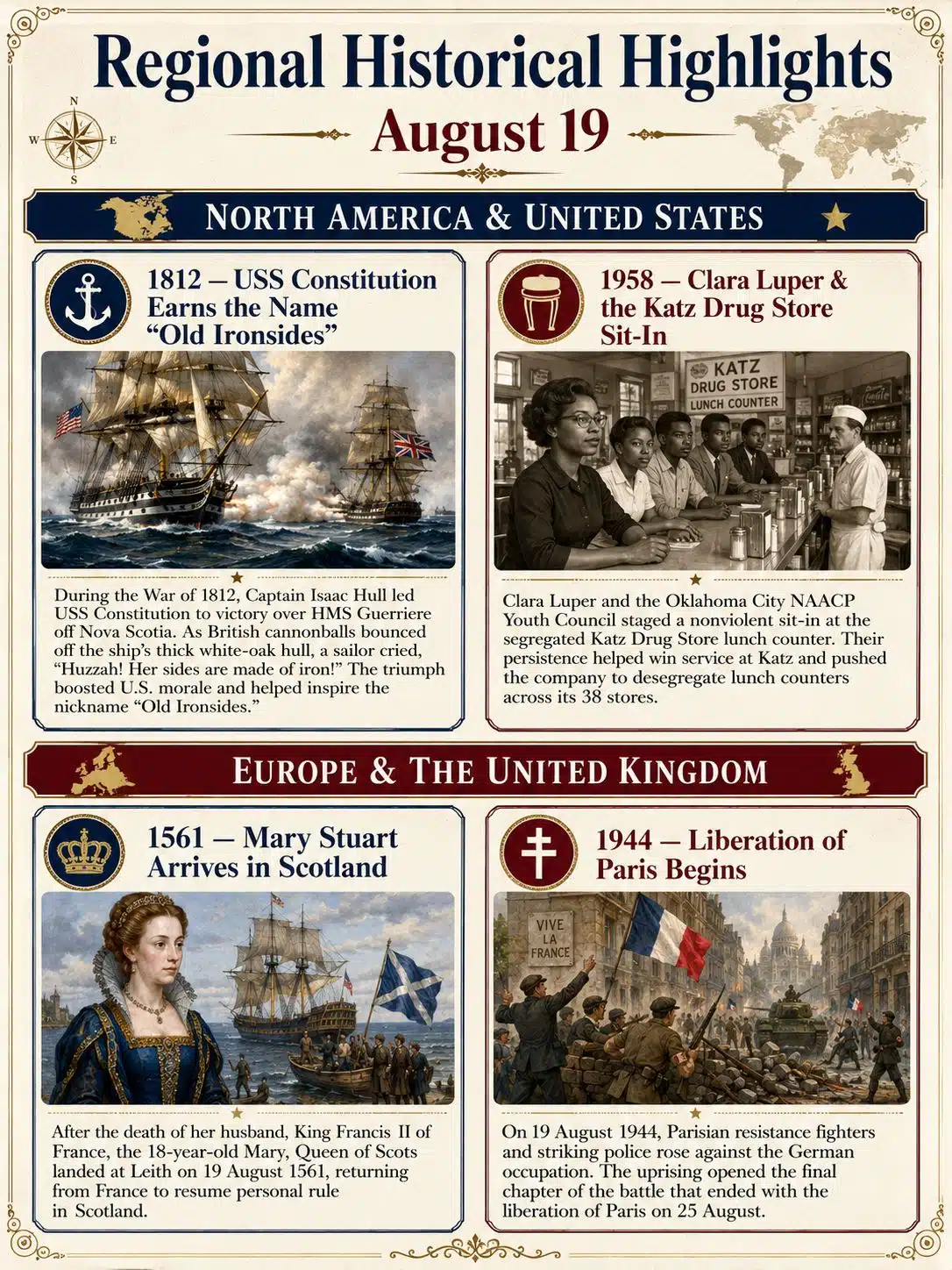
North America & United States
-
1812 — USS Constitution Earns the Name “Old Ironsides”: During the War of 1812, Captain Isaac Hull commanded the USS Constitution in an engagement against the British frigate HMS Guerriere off the coast of Nova Scotia. As British 18-pound cannonballs bounced off the dense American white oak hull without penetrating, an American sailor famously shouted, “Huzzah! Her sides are made of iron!” The American victory demonstrated naval parity with Britain.
-
1958 — Clara Luper & The Katz Drug Store Sit-In: Civil rights pioneer Clara Luper and members of the Oklahoma City NAACP Youth Council organized a desegregation sit-in at the whites-only lunch counter of the Katz Drug Store in Oklahoma City. Their non-violent perseverance led the ownership to desegregate lunch counters across its 38 retail stores across three states.
Europe & The United Kingdom
-
1561 — Mary Stuart Arrives in Scotland: Following the untimely death of her husband, King Francis II of France, the 18-year-old Mary, Queen of Scots arrived at the Port of Leith to formally reclaim her throne after living in France since early childhood.
-
1944 — Liberation of Paris Begins: The French Forces of the Interior (FFI), combined with striking railway workers and municipal police, took up arms across Paris against the occupying German garrison. This set the stage for General Philippe Leclerc’s 2nd French Armored Division and Allied forces to officially liberate the capital on August 25.
Global Famous Birthdays
A diverse cross-section of leaders, inventors, cultural figures, and visionaries share August 19 as their date of birth:
Orville Wright (August 19, 1871 – January 30, 1948)
Alongside his elder brother Wilbur, Orville Wright fundamentally redefined human mobility. On December 17, 1903, at Kitty Hawk, North Carolina, Orville piloted the Wright Flyer for a 12-second, 120-foot flight that marked humanity’s first controlled, sustained, motor-driven flight. In the United States, August 19 is officially observed as National Aviation Day in honor of his birth anniversary.
Coco Chanel (August 19, 1883 – January 10, 1971)
Born Gabrielle Bonheur Chanel in Saumur, France, Coco Chanel revolutionized women’s fashion in the post-World War I era. By rejecting restrictive corsetry in favor of sporty, comfortable, and tailored silhouettes, she introduced timeless staples such as the “little black dress,” the Chanel suit, and Chanel No. 5 perfume. Her design ethos democratized elegance and championed modern female autonomy.
Gene Roddenberry (August 19, 1921 – October 24, 1991)
A World War II combat pilot and former Los Angeles police officer, Gene Roddenberry became an influential television pioneer when he created the science fiction franchise Star Trek (1966). Through his depiction of the 23rd-century starship Enterprise, Roddenberry presented an optimistic, humanist future free from poverty, racism, and war. The series broke ground by featuring an integrated, multinational crew during the height of the Cold War and the Civil Rights Movement.
Global Notable Deaths (August 19)
August 19 also marks the passing of scientists, philosophers, literary figures, and political leaders whose contributions continue to resonate.
Blaise Pascal (June 19, 1623 – August 19, 1662)
French polymath Blaise Pascal passed away in Paris at the young age of 39. Despite lifelong chronic illness, Pascal made fundamental contributions to natural science, hydrodynamics, and mathematics—including the invention of an early mechanical calculator (the Pascaline) and the mathematical formulation of probability theory alongside Pierre de Fermat. In physics, the SI unit of pressure, the pascal (Pa), and Pascal’s Law stand as permanent tributes to his scientific discoveries.
Federico García Lorca (June 5, 1898 – August 19, 1936)
One of the brightest luminaries of Spain’s Generation of ’27, poet and dramatist Federico García Lorca was abducted and executed by Nationalist paramilitary forces at the outbreak of the Spanish Civil War. Renowned for poetry collections such as Romancero Gitano (Gypsy Ballads) and plays like Blood Wedding and The House of Bernarda Alba, Lorca’s assassination transformed his memory into an enduring international symbol of creative resistance against fascist totalitarianism.
Linus Pauling (February 28, 1901 – August 19, 1994)
American chemist, biochemist, and peace activist Linus Pauling remains the only individual in history to win two unshared Nobel Prizes. He was awarded the 1954 Nobel Prize in Chemistry for his research on the nature of the chemical bond and the structure of complex molecules, followed by the 1962 Nobel Peace Prize for his tireless international campaign against nuclear weapons testing.
International Observances & National Days
-
World Humanitarian Day (UN): Officially designated by the United Nations General Assembly in 2008, this day commemorates the humanitarians who risk their lives delivering emergency relief across conflict zones, refugee corridors, and climate-stricken regions worldwide.
-
World Photography Day: Celebrated by millions of professional photographers, photojournalists, and enthusiasts who document human truth and artistic expression.
-
National Independence Day (Afghanistan): August 19 marks Afghan National Day, commemorating the signing of the Anglo-Afghan Treaty of Rawalpindi on August 19, 1919, in which the British Empire officially acknowledged the Emirate of Afghanistan’s full sovereignty over its foreign affairs.
“Did You Know?” Historical Trivia
-
The “Cold War Puppies” of Sputnik 5: After returning safely from orbit on August 19, 1960, the space dog Strelka gave birth to six healthy puppies. Soviet Premier Nikita Khrushchev later gifted one of the puppies, named Pushinka (“Fluffy”), to US First Lady Jacqueline Kennedy. Pushinka mated with the Kennedy family dog, Charlie, producing four puppies that President John F. Kennedy affectionately referred to as pupniks.
-
Photography’s Free Gift Had One Exception: When the French government purchased Louis Daguerre’s patent in August 1839 to donate the invention royalty-free to humanity, they were unaware that Daguerre had filed an independent patent in Great Britain just days earlier. Consequently, while photographers worldwide used the process freely, British practitioners were legally required to purchase expensive operator licenses until the patent lapsed.
-
The Augustus Coincidence: Augustus died on August 19, 14 CE, in the Italian town of Nola—in the exact same room where his biological father, Gaius Octavius, had died 72 years earlier. The Roman Senate had renamed the month of Sextilis to Augustus in 8 BCE to honor his military and political achievements.
Quotes of the Day
“If we worked on the assumption that what is accepted as true really is true, then there would be little hope for advance.”
— Orville Wright (Born August 19, 1871)
Final Thoughts
Examining August 19 across the centuries reveals how individual choices and collective movements shape our modern world. From the establishment of colonial currency in Bengal in 1757 to the tragic sacrifices at Dieppe in 1942, and from the visionary cinematic resistance of Zahir Raihan to the democratic gift of photography in 1839, this date stands as a testament to the resilience, creativity, and complexity of the human experience.
Reflecting on these milestones reminds us that the freedoms, technologies, and artistic traditions we enjoy today are the direct result of historic efforts made on days just like August 19.