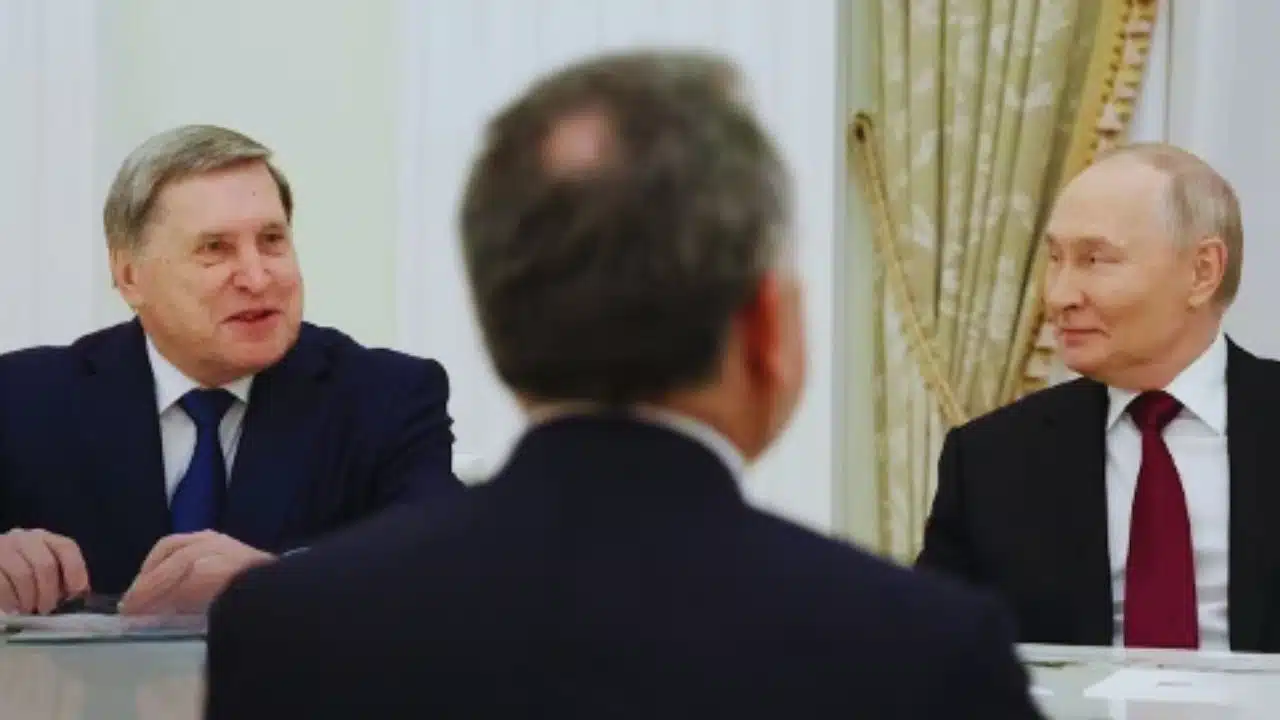
A five-hour high-stakes meeting in Moscow between Russian President Vladimir Putin and senior U.S. envoys ended without a breakthrough on a Ukraine peace deal early Wednesday, leaving relations frozen and fighting on the ground unchanged. The talks had been closely watched because any path toward a ceasefire was seen as the only realistic route to easing tough U.S. oil sanctions on Russian energy giants Rosneft and Lukoil. With no compromise reached, those sanctions remain in place, and oil markets reacted immediately, with Brent crude briefly rising about 1.3% to roughly 63 dollars a barrel and U.S. benchmark WTI climbing around 1.5% to just under 60 dollars.
Talks end with no deal
The Kremlin meeting brought together Putin, U.S. special envoy Steve Witkoff, and President Donald Trump’s son‑in‑law Jared Kushner, alongside senior Russian figures including Kremlin aide Yuri Ushakov and Russian Direct Investment Fund head Kirill Dmitriev. According to both Russian and U.S. accounts, the discussion ran for around five hours and stretched past midnight in Moscow, signaling that both sides took the opportunity seriously even though expectations for a decisive breakthrough were low.
Ushakov later called the talks useful and constructive, saying some American ideas were acceptable to Moscow, but he confirmed that no draft agreement or even a basic outline of a peace plan was agreed. Speaking from Washington, President Donald Trump described the situation as extremely complex and chaotic, pointed to wartime casualty figures that could run to tens of thousands a month, and stressed that more discussions would be needed rather than any quick fix.
Territorial issues block peace
The main obstacle remains territory, especially the future of the Donbas region in eastern Ukraine, where Russia has claimed the annexation of occupied areas and demands international recognition of its control. Reports about the Moscow session indicate that the U.S. side explored ideas such as ceasefire lines, demilitarized buffers, and possible future referendums, but Russia refused any scheme that would require it to pull back from land it now labels as part of the Russian Federation.
Ukraine, which was not directly represented in Moscow, has repeatedly said it will not formally surrender occupied land, limiting how far U.S. envoys can go without undermining Kyiv’s publicly stated red lines. This stalemate over maps and borders meant that even areas where there was more room for compromise—like prisoner exchanges or limited security measures—could not be packaged into a broader political deal that might justify easing sanctions.
Sanctions on Rosneft and Lukoil
At the core of market attention are the oil sanctions the U.S. Treasury announced in late October 2025 against Rosneft and Lukoil, formally citing their role in Russia’s energy sector and the support that revenues provide to the war. These measures bar U.S. persons and many financial institutions from dealing with the companies, restrict access to dollar funding, and extend to key trading arms that handle the shipping and sale of Russian crude and refined fuels.
Analysts estimate that more than 2 million barrels per day of Russian oil and petroleum product exports—roughly 30% of its overseas flows—now face direct disruption risk from these restrictions. The aim is to squeeze Moscow’s budget and logistics by forcing major buyers such as India, China, and Turkey to divert purchases through more complex channels, pay higher transport and insurance costs, or gradually diversify away from Russian supplies.
Oil market reaction and risks
Because of this backdrop, traders went into the Moscow talks looking for any sign of a tentative peace framework that could eventually justify a step‑by‑step relaxation of sanctions. Once it became clear that no such roadmap existed, prices moved up modestly rather than surging, reflecting a view that sanctions‑driven tightness in Russian supply would persist but that weak global demand and comfortable inventories still limit how high crude can climb.
Market analysts, including Tony Sycamore of IG, note that worries about oversupply and slowing economic growth remain strong, and they argue that oil likely needs to stay above the mid‑50 dollar range per barrel to avoid triggering a deeper, momentum‑driven sell‑off. In practice, the failed talks removed one potential bearish factor—sanctions relief—without changing the broader tug‑of‑war between possible supply shocks and a fragile world economy.
Ukrainian strikes on energy infrastructure
On the battlefield, Ukraine has stepped up attacks on Russian energy infrastructure, seeking to erode Russia’s ability to fund and support long campaigns through oil revenues. In November alone, Ukrainian forces carried out at least 14 drone strikes on refineries inside Russia, according to independent reporting, the highest monthly number so far and including hits on major facilities deep inside Russian territory. On December 1, Ukrainian operatives also damaged a section of the Druzhba oil pipeline in Russia’s Tambov region, the fifth recorded strike on that pipeline system this year, briefly disrupting one of the key routes for Russian crude shipments toward Europe.
Taken together, these infrastructure attacks and the U.S. sanctions on Rosneft and Lukoil create sustained pressure on Russia’s energy system and state revenues, but they also inject new uncertainty into global supply routes, which is why oil markets are reacting not only to diplomatic failures in Moscow but also to explosions on pipelines and refinery fires across Russia.