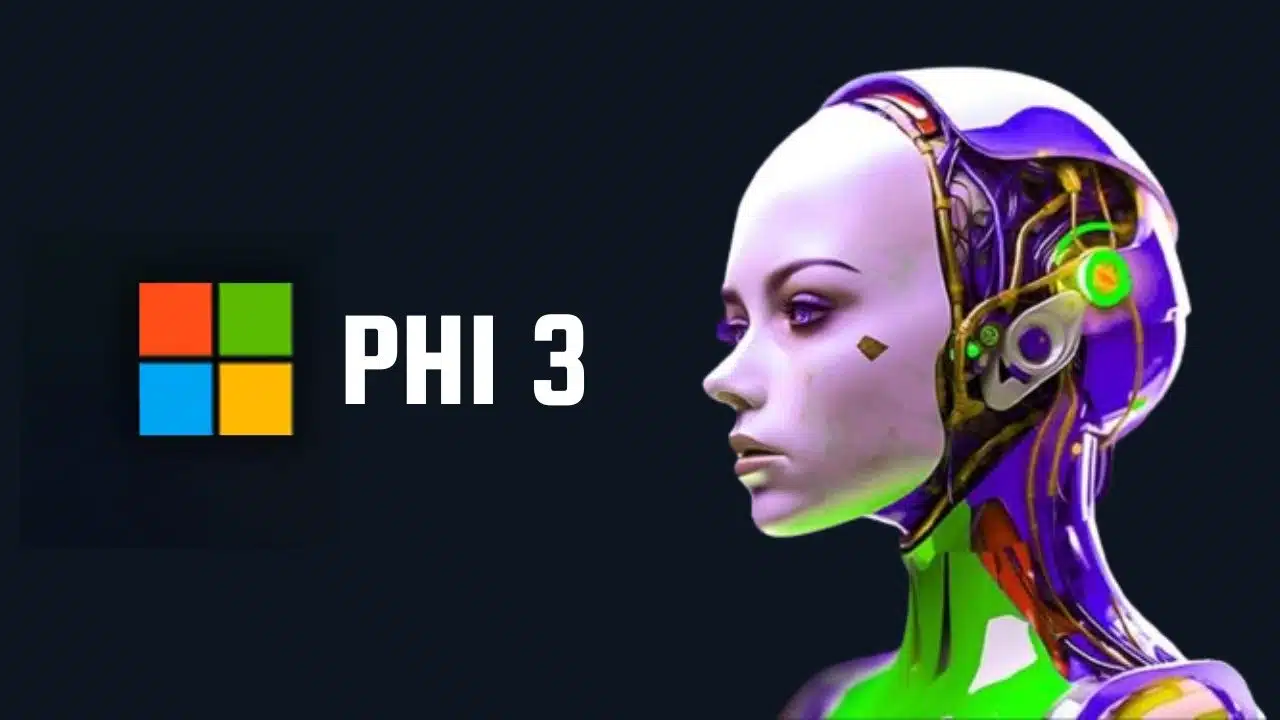
On Tuesday, Microsoft introduced Phi-3-mini, a new, freely available lightweight AI language model that promises capabilities similar to the free version of ChatGPT while being more efficient and less resource-intensive than traditional large language models (LLMs). This development could pave the way for AI models with impressive natural language processing capabilities to run locally on smartphones and other devices without requiring an internet connection.
Understanding AI Language Model Size
AI language models are typically measured by their parameter count, which refers to the numerical values in a neural network that determine how the model processes and generates text. These parameters are learned during training on large datasets and essentially encode the model’s knowledge. Generally, more parameters allow for more nuanced and complex language generation but also demand more computational resources to train and run.
Some of the largest language models, like Google’s PaLM 2 and OpenAI’s GPT-4, have hundreds of billions or even over a trillion parameters, requiring powerful data center GPUs and supporting systems to operate effectively.
Phi-3-mini: Small but Mighty
In contrast to these behemoths, Microsoft’s Phi-3-mini contains only 3.8 billion parameters and was trained on 3.3 trillion tokens. This compact size makes it ideal for running on consumer GPU or AI-acceleration hardware found in smartphones and laptops. Phi-3-mini is a follow-up to Microsoft’s previous small language models, Phi-2 (released in December) and Phi-1 (released in June 2023).
Despite its small size, Phi-3-mini boasts a 4,000-token context window, and Microsoft has also introduced a 128K-token version called “phi-3-mini-128K.” The company plans to release 7-billion and 14-billion parameter versions of Phi-3 later, claiming they will be “significantly more capable” than phi-3-mini.
Impressive Performance Benchmarks
According to Microsoft, Phi-3’s overall performance “rivals that of models such as Mixtral 8x7B and GPT-3.5,” as detailed in their paper titled “Phi-3 Technical Report: A Highly Capable Language Model Locally on Your Phone.” Mixtral 8x7B, from French AI company Mistral, utilizes a mixture-of-experts model, while GPT-3.5 powers the free version of ChatGPT.
AI researcher Simon Willison, who downloaded Phi-3 to his Macbook laptop, was impressed with the model’s performance. “I got it working, and it’s GOOD,” he said in a text message to Ars. Willison noted that Phi-3-mini runs comfortably with less than 8GB of RAM and can generate tokens at a reasonable speed even on a regular CPU. He also highlighted that the model is licensed under MIT and should work well on a $55 Raspberry Pi, with the quality of results comparable to those of models four times larger.
The Secret to Phi-3-mini’s Efficiency
Microsoft’s researchers attribute Phi-3-mini’s impressive performance to carefully curated, high-quality training data initially pulled from textbooks. “The innovation lies entirely in our dataset for training, a scaled-up version of the one used for phi-2, composed of heavily filtered web data and synthetic data,” Microsoft explains. “The model is also further aligned for robustness, safety, and chat format.”
Implications for AI’s Environmental Impact
The development of smaller, more efficient AI models like Phi-3-mini could have significant implications for the environmental impact of AI. As machine learning experts continue to increase the capability of smaller models, the need for larger, more resource-intensive models may diminish, at least for everyday tasks. This shift could lead to substantial energy savings and a reduced environmental footprint for AI technologies.
Phi-3-mini is immediately available on Microsoft’s cloud service platform Azure, as well as through partnerships with machine learning model platforms Hugging Face and Ollama, a framework that allows models to run locally on Macs and PCs.
As AI continues to evolve and advance, developments like Phi-3-mini demonstrate the potential for more efficient, accessible, and environmentally friendly language models. If the benchmark results hold up to scrutiny, models like Phi-3 could represent a significant step toward a future where powerful AI capabilities are readily available on a wide range of devices without the need for constant internet connectivity or extensive computational resources.
The information is taken from Ars Technica, Investopedia, and Microsoft.