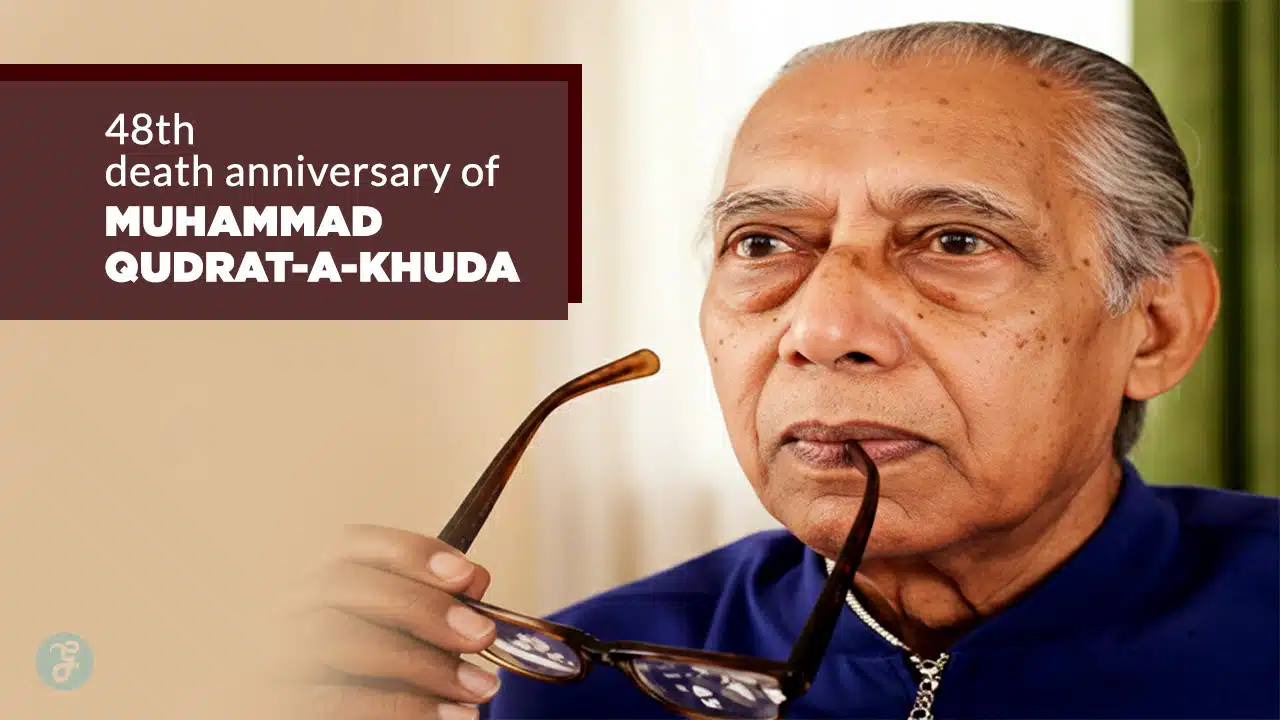
In the story of Bangladesh’s intellectual awakening, one name stands tall—Dr. Muhammad Qudrat-i-Khuda (1900–1977). A chemist, educator, philosopher, and visionary, he was far more than a scientist—he was an architect of national thought.
As the nation observes his 48th death anniversary, it is not merely a moment of remembrance but a call to reignite his dream: a Bangladesh driven by science, reason, and human progress.
Early Life and Education: Seeds of a Visionary Mind
Before Dr. Muhammad Qudrat-i-Khuda became a national icon of science and education, he was a curious boy from a remote village in Bengal. His early journey reveals how a rural upbringing, disciplined intellect, and relentless curiosity forged the foundation of a man who would later redefine Bangladesh’s scientific identity.
Birth and Early Curiosity in Birbhum
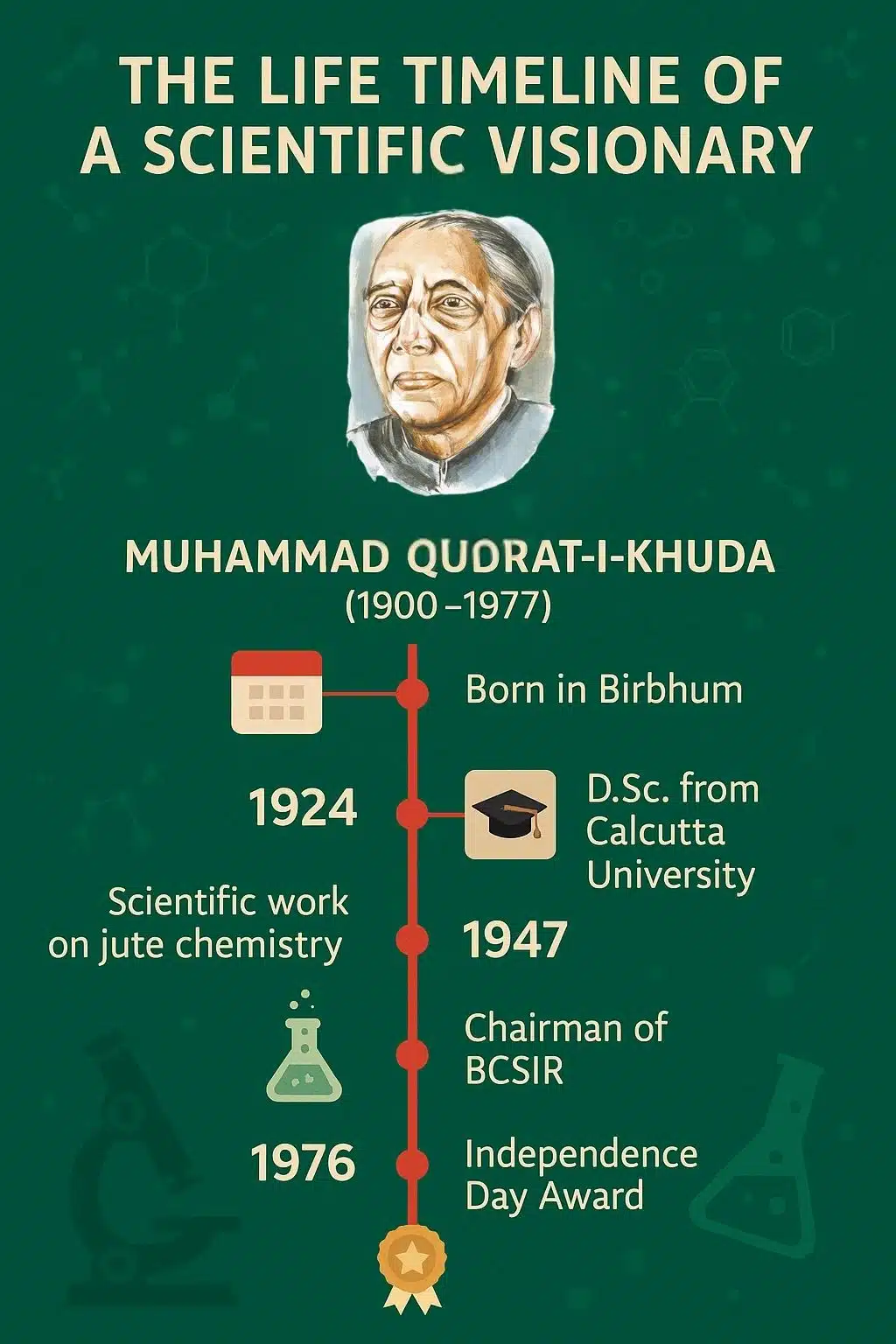
Dr. Muhammad Qudrat-i-Khuda was born on May 1, 1900, in Margram, Birbhum, then part of undivided Bengal. His childhood fascination with the natural world—from rural plants to everyday chemical reactions—foreshadowed a mind destined for discovery.
Academic Brilliance at Calcutta University
At Calcutta University, Qudrat-i-Khuda’s brilliance in chemistry earned him top honors and later a Doctor of Science (D.Sc.) degree. His doctoral research focused on organic and agricultural chemistry, pioneering methods to extract valuable compounds from indigenous materials—decades before “local innovation” became a policy buzzword.
Shaping a Scientific Worldview
His formative years coincided with British colonial rule, when scientific progress was largely imported. Qudrat-i-Khuda envisioned a future where Bengal—and later Bangladesh—would generate its own knowledge, fostering self-reliance rather than dependence.
Breakthroughs in Chemistry and Jute Research
The laboratory became his battlefield—and jute, the humble golden fiber, his instrument of change. In an age dominated by foreign technology, Qudrat-i-Khuda’s pioneering research on indigenous resources proved that innovation could thrive within local soil. His experiments laid the groundwork for sustainable industry long before the term existed.
The Scientific Quest for Indigenous Innovation
At a time when imported industrial chemicals dominated, Dr. Qudrat-i-Khuda turned to local plants, fibers, and natural resources. His experiments explored everything from jute by-products to herbal extracts, revealing new possibilities for industry and agriculture.
Pioneering Work on Jute and Agricultural Chemistry
His most celebrated research revolved around jute, Bangladesh’s “golden fiber.” He analyzed its chemical composition, identified valuable derivatives, and proposed methods to convert waste into usable materials. These studies laid the groundwork for the jute-based industries that would later support the country’s economy.
Building the Foundation for Industrial Self-Reliance
His work carried a philosophical message: true independence requires mastery of science. He believed a developing nation must own its raw-material research base, and he spent his career proving that principle in laboratories and classrooms alike.
From Researcher to National Builder
Science was never an isolated pursuit for him; it was a tool for nation-building. After independence, Dr. Qudrat-i-Khuda transformed from a solitary researcher into a strategic leader—guiding Bangladesh’s scientific infrastructure with vision, pragmatism, and purpose. His leadership at BCSIR marked a turning point in the country’s research culture.
Leadership at BCSIR
Following Bangladesh’s independence, Dr. Qudrat-i-Khuda became Chairman of the Bangladesh Council of Scientific and Industrial Research (BCSIR). Under his guidance, the council shifted from replication to original research—focusing on food processing, pharmaceuticals, agriculture, and chemical engineering suited to local needs.
Institutional Vision
He advocated for state-backed laboratories, industry-academia collaboration, and applied science education. The blueprint he drafted still underpins the country’s research ecosystem.
Science as a Nation-Building Tool
For Qudrat-i-Khuda, science was not an elite pursuit but the backbone of sovereignty. His post-independence work reflected an urgency to equip the young republic with the intellectual tools for survival and growth.
The Champion of Bengali Science Education
For Qudrat-i-Khuda, science belonged to everyone—not just those fluent in English or privileged in education. His revolutionary decision to teach and write science in Bengali became an act of cultural liberation. It empowered generations to see knowledge not as a foreign import but as an inheritance of their own language and identity.
Why He Made Science Speak the Mother Tongue
While English remained the language of academia, Qudrat-i-Khuda broke convention by insisting that science must be taught in Bengali. His goal was democratization—enabling every student, not just the privileged, to access knowledge.
Writing Popular Science in Bengali
He authored numerous books and essays that translated complex theories into clear, relatable prose. Titles like Biggyaner Bani (The Message of Science) and Biggyan O Manob Jiban (Science and Human Life) made him a household name among Bengali readers.
Inspiring Generations of Students
His approach ignited curiosity across classrooms and inspired educators to embrace bilingual science education. He believed that language was not a barrier to progress but a bridge—a belief that remains profoundly relevant in Bangladesh’s education policy debates today.
Philosophy: Faith, Rationalism, and the Light of Knowledge
Beyond the lab coat and microscope, Qudrat-i-Khuda was a philosopher of reason. He believed that true progress arises when faith and logic coexist in harmony. In his writings and speeches, he showed that scientific inquiry, far from opposing spirituality, can deepen one’s understanding of creation itself.
Harmony Between Spirituality and Science
Dr. Qudrat-i-Khuda’s intellectual foundation rested on balance. A devout believer, he saw no contradiction between faith and reason. For him, understanding nature was a form of worship, and scientific discovery, a path to divine truth.
Rational Thought as a Pillar of Progress
He urged the youth to question, to analyze, and to think empirically. “Blind faith,” he warned, “is the enemy of civilization.” In this, his views echoed global rationalists, but his tone remained rooted in cultural humility and spirituality.
Relevance in Modern Bangladesh
In today’s era of misinformation and ideological polarization, his voice calls across decades—reminding us that progress demands intellect, not noise; inquiry, not imitation.
Recognition and Awards
Greatness often finds its recognition late, and so it was with Dr. Qudrat-i-Khuda. His accolades—from the Independence Day Award to numerous academic honors—symbolized more than personal achievement. They stood as national gratitude for a man who turned ideas into enduring institutions and inspired others to follow his path.
The Independence Day Award
In 1976, Bangladesh honored Dr. Qudrat-i-Khuda with the Independence Day Award, the nation’s highest civilian honor, for his outstanding contribution to science and education.
Earlier Distinctions
Before independence, he had received Pakistan’s Tamgha-e-Pakistan, which he later renounced as a statement of national identity. His dignity reflected not only personal principle but also the integrity of a nation under formation.
Academic and Global Recognition
His papers were cited internationally, and his influence extended through conferences and collaborations that positioned Bengal on the scientific map long before formal globalization.
The Enduring Legacy of Dr. Qudrat-i-Khuda
Forty-eight years after his passing, Dr. Qudrat-i-Khuda’s influence still pulses through Bangladesh’s scientific landscape. His ideas shaped not only institutions but mindsets—embedding self-reliance, rational inquiry, and respect for indigenous innovation into the nation’s intellectual DNA. His legacy remains a compass for a country still striving toward true scientific independence.
Modern Science Ecosystem
Every scientific institution in Bangladesh—from BCSIR to agricultural universities—carries traces of his vision. His model of research with relevance continues to shape national priorities, from biotech to renewable energy.
Lessons 48 Years Later
Nearly half a century after his passing, Bangladesh stands as a nation aspiring toward innovation. Yet the foundations—local problem-solving, rational inquiry, and linguistic inclusivity—remain his enduring fingerprints.
Inspiring the Future
If Dr. Qudrat-i-Khuda were alive today, he would likely challenge young scientists to look inward—to explore their own soil, language, and society for solutions. His message remains timeless: science belongs to those who dare to think for themselves.
Quotes and Sayings by Dr. Qudrat-i-Khuda
“Science is the light of civilization.”
“Knowledge must be shared in the language of the people.”
“A nation that neglects research digs its own grave.”
Use these quotes in callout blocks or graphics across the article for visual rhythm and shareability.
Takeaways
Dr. Muhammad Qudrat-i- Khuda’s life is more than a biography—it is a manifesto for rational nation-building. He showed that scientific progress does not require foreign validation; it requires courage, clarity, and conviction.
As Bangladesh commemorates 48 years since his death, remembering him is not nostalgia—it is a responsibility. His light, once kindled in the laboratories of Calcutta and the halls of BCSIR, still guides every student, researcher, and dreamer who believes that the pursuit of knowledge can change the destiny of a nation.