
If you are reading this, you probably know the feeling. It’s that tightness in your chest when you read the morning headlines. It’s the hesitation you feel before planning a summer vacation, wondering if heatwaves will cancel it. It’s the late-night scrolling, looking for some assurance that things will be okay, only to find more bad news.
You are not alone. And more importantly, you are not “crazy.”
In the last few years, the conversation has shifted. Back in 2020 or 2022, we called it “worry.” Today, mental health professionals recognize it as a chronic public health reality. We aren’t just dealing with a changing planet; we are dealing with our internal response to it.
This guide isn’t about recycling more or buying an electric car. You already know about that. This is about you. t is about the psychological toll of living in an era of crisis, and the evidence-based climate anxiety coping mechanisms for 2026 that can help you move from paralysis to resilience.
Beyond “Worry”: The Real Psychological & Physical Costs
For a long time, people thought eco-anxiety was just a mindset—a philosophical worry about the future. But as we move deeper into 2026, research shows that the cost is much closer to home. It is biological, and it is immediate.
Defining Climate Distress in 2026
First, let’s give what you are feeling a name. It isn’t just “anxiety.” Anxiety is often defined as a fear of an unknown future. But with climate change, the threat is known. It is real.
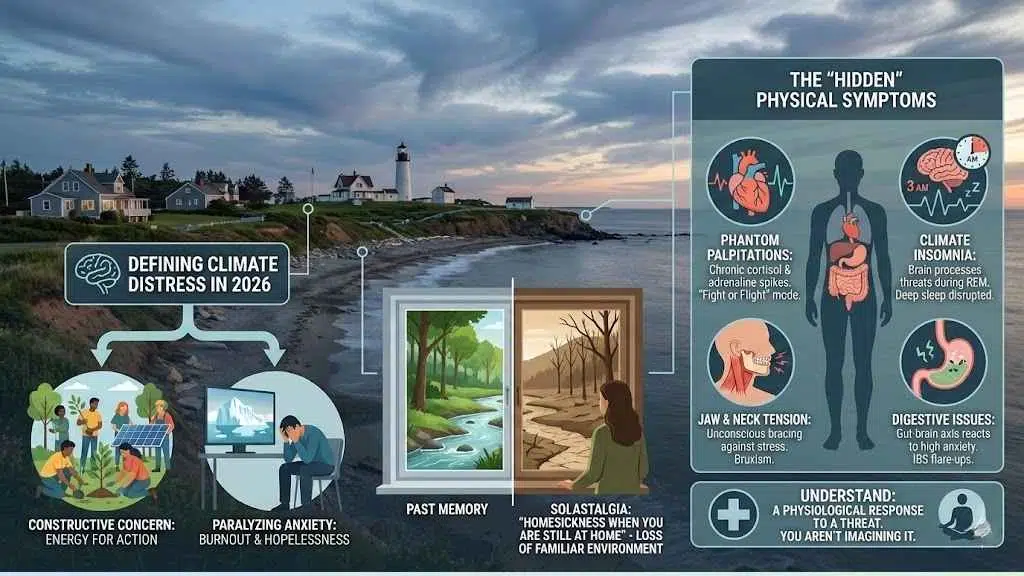
Psychologists now distinguish between Constructive Concern and Paralyzing Anxiety.
- Constructive Concern: This pushes you to act. It’s the energy that gets you to a community meeting or makes you switch to renewable energy.
- Paralyzing Anxiety: This is where the brain shuts down. It’s the “freeze” response. It leads to burnout, apathy, and a sense of hopelessness.
There is another word you need to know: Solastalgia
Coined by philosopher Glenn Albrecht, solastalgia meaning is often described as “homesickness when you are still at home.” It is the distress caused by environmental change impacting your own backyard—whether that’s a local river drying up or the seasons shifting so much that winter doesn’t feel like winter anymore. If you look out your window and feel a sense of loss, that is solastalgia.
The “Hidden” Physical Symptoms
We often treat the mind and body as separate, but they are not. Chronic stress about the climate triggers the same biological alarms as being chased by a predator. When that alarm rings for years on end, the body takes a hit.
Doctors are now identifying eco-anxiety symptoms that manifest physically. In 2026, we are seeing a rise in patients presenting with these issues who have no other underlying medical cause:
| Symptom | How It Manifests | Why It Happens |
| Phantom Palpitations | Random racing heart rate while resting or reading news. | Chronic spikes in cortisol and adrenaline keep the body in “fight or flight” mode. |
| Climate Insomnia | Waking up at 3 AM unable to fall back asleep. | The brain processes existential threats during REM cycles, disrupting deep sleep. |
| Jaw & Neck Tension | Clenching teeth (bruxism) or chronic headaches. | Unconscious bracing against stress. |
| Digestive Issues | IBS flare-ups or nausea during heatwaves. | The gut-brain axis reacts immediately to high anxiety levels. |
If you are experiencing these physical symptoms of climate burnout, please understand: This is a physiological response to a threat. You aren’t imagining it.
Why “Just Taking Action” Isn’t Enough Anymore
For years, the standard advice was: “If you feel anxious, do something! Action creates hope.”
While well-meaning, this advice is incomplete. In 2026, many activists are hitting a wall. Why? because individual action, no matter how noble, cannot single-handedly stop global warming. When you try to “fix” the climate to soothe your anxiety, you set yourself up for failure because the problem is too big for one person.
The Trap of Problem-Focused Coping
Problem-Focused Coping is when you try to eliminate the source of stress.
- Example: Your roof is leaking, so you fix the roof. Stress gone.
But with climate change, you cannot “fix” the source of stress immediately. If your primary coping mechanism is trying to solve the crisis, you will eventually crash when emissions don’t drop fast enough. This leads to what psychologists call “Eco-Depression.”
The Shift to Meaning-Focused Coping
The most resilient people in 2026 have shifted to Meaning-Focused Coping.
This approach accepts that the situation is difficult but focuses on finding purpose and values within the struggle. It asks, “Who do I want to be during this time?” rather than “How do I solve this right now?”
It shifts the goal from Outcome (saving the world) to Process (living with integrity). This shift is crucial for long-term mental health.
5 Evidence-Based Coping Mechanisms for 2026
So, how do we actually build this resilience? Based on the latest psychology and adaptation strategies, here are five concrete mechanisms to help you navigate climate anxiety coping mechanisms 2026.
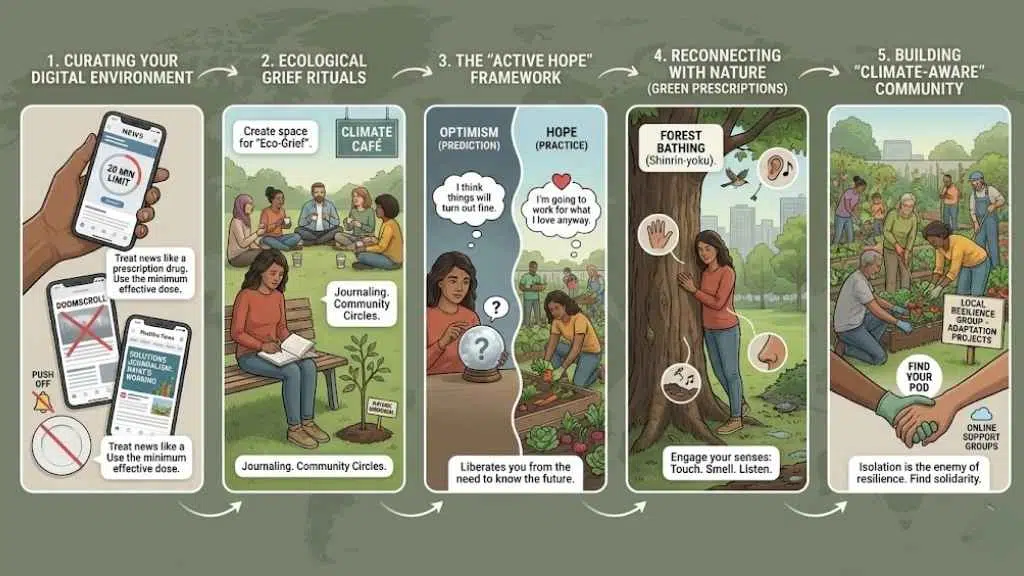
1. Curating Your Digital Environment (Stopping the Doomscroll)
Information toxicity is the number one driver of acute anxiety spikes. In 2026, the news cycle is faster and more visceral than ever. Your brain was not designed to process global tragedy 24/7.
The Strategy: Treat news like a prescription drug. Use the minimum effective dose.
- The 20-Minute Rule: Allocate 20 minutes in the morning to catch up on global events. Once that time is up, the “news door” is closed for the day.
- Curate Your Feed: For every negative news source you follow, follow one “Solutions Journalism” source. Sites like Positive News or Euronenews Green focus on what is being fixed, not just what is breaking.
- Turn Off Push Notifications: Do not let a breaking news alert interrupt your dinner. Reclaim your attention.
Action Step: Go to your phone settings right now. Turn off notifications for all news apps. Check them on your schedule, not theirs.
2. Ecological Grief Rituals
We are good at mourning people, but we are bad at mourning places. When a forest burns down or a species goes extinct, we feel grief, but we often push it down because it feels “silly.”
Suppressing grief leads to numbness. To cope, you must let yourself feel the sadness.
The Strategy: Create space for “Eco-Grief.”
- Journaling: Write a letter to a place you loved in childhood that has changed. Acknowledge what is lost.
- Community Circles: Many communities now hold “Climate Cafés”—safe spaces where people gather just to talk about how they feel, without trying to fix anything.
- Nature Memorials: Plant a native tree or build a small garden section dedicated to resilience.
3. The “Active Hope” Framework
Joanna Macy’s concept of “Active Hope” remains one of the most powerful tools we have. It differentiates between Optimism and Hope.
- Optimism is a prediction: “I think things will turn out fine.” (This is hard to sustain in 2026).
- Hope is a practice: “I don’t know how this ends, but I’m going to work for what I love anyway.”
Active Hope liberates you from the need to know the future. You act not because you are guaranteed a win, but because it is the right thing to do. This aligns with meaning-focused coping and protects you from burnout.
4. Reconnecting with Nature (Green Prescriptions)
It sounds contradictory: Nature is the source of my stress, so I should go into nature?
Yes. Research proves that time spent in green spaces lowers cortisol levels, reduces blood pressure, and improves immune function. We call these “Green Prescriptions.”
The Strategy: Forest Bathing (Shinrin-yoku).
You don’t need a pristine national park. A city park or a garden works. The goal is to engage your senses.
- Touch the bark of a tree.
- Smell the damp soil.
- Listen to birdsong.
This sensory grounding pulls you out of your anxious thoughts and back into your physical body. It reminds you that despite the crisis, there is still beauty and life right now.
5. Building “Climate-Aware” Community
Isolation is the enemy of resilience. When you worry alone, the shadows seem bigger. When you worry with others, you find solidarity.
The Strategy: Find your “Pod.”
- Join a local community garden.
- Volunteer with a local resilience group (focus on adaptation, like flood defenses or tree planting).
- Connect with online groups specifically for climate grief counseling or support.
One of the most common Google searches today is parents asking, “How do I talk to my kids about climate change?” Parents are carrying a double burden: their own fear, and the fear of failing to protect their children.
Talking to Kids Without Scaring Them
Children are perceptive. They know something is happening. If you don’t talk to them, they will fill the silence with their own terrifying imagination.
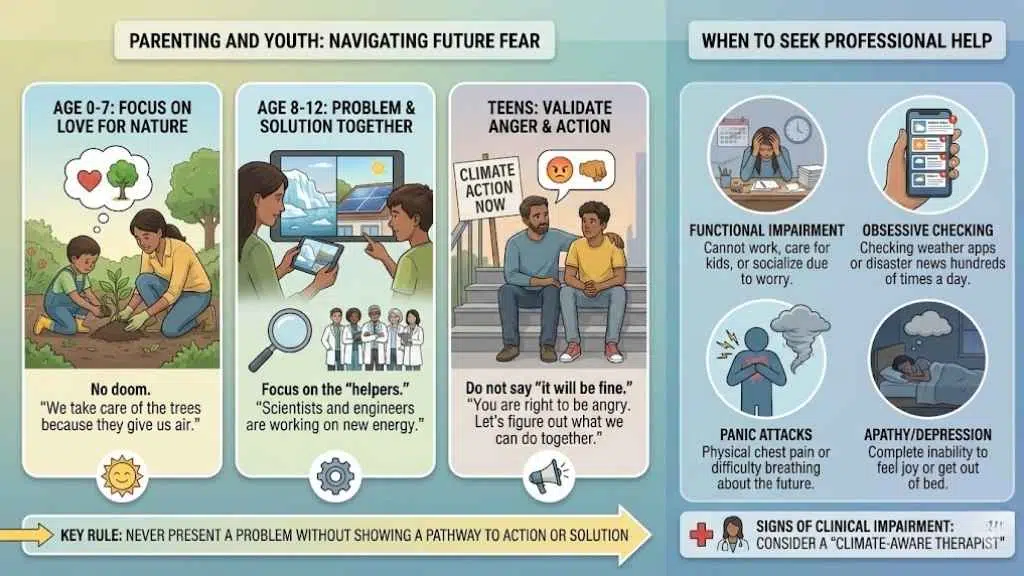
- Age 0-7: Focus on love for nature. “We take care of the trees because they give us air.” No doom.
- Age 8-12: Introduce the problem and the solution together. ” The earth is getting warmer, which is a problem, but look at all these scientists and engineers working on new energy.” Focus on the “helpers.”
- Teens: Validate their anger. Do not tell them “it will be fine.” Tell them, “You are right to be angry. I am angry too. Let’s figure out what we can do together.”
Key Rule: Never present a problem without showing a pathway to action or solution.
When to Seek Professional Help
Sometimes, self-care isn’t enough. As we navigate 2026, the medical community has established clearer guidelines for when climate anxiety becomes a clinical issue requiring professional intervention.
Signs of Clinical Impairment
If you recognize these signs, it may be time to speak with a “Climate-Aware Therapist”:
- Functional Impairment: You cannot go to work, care for your kids, or socialize because of the worry.
- Obsessive Checking: You check weather apps or disaster news hundreds of times a day.
- Panic Attacks: Physical chest pain or difficulty breathing when thinking about the future.
- Apathy/Depression: A complete inability to feel joy or get out of bed.
Final Thoughts
The year 2026 is challenging, there is no denying that. The climate has changed, and so must we. But humans are incredibly adaptive creatures. The goal of this guide isn’t to make the anxiety disappear completely. A little bit of anxiety is a rational response to a dangerous situation—it keeps us alert. The goal is to manage that anxiety so it doesn’t run your life. By curating your digital world, allowing yourself to grieve, connecting with nature, and finding purpose in the process, you can build a psychological armor. You can move from being a victim of climate stress to being a resilient participant in our planet’s future. Take a deep breath. Look at the sky. You are still here. And there is still work to be done.