What Exactly Is Programmatic SEO and How Has It Changed in 2026?
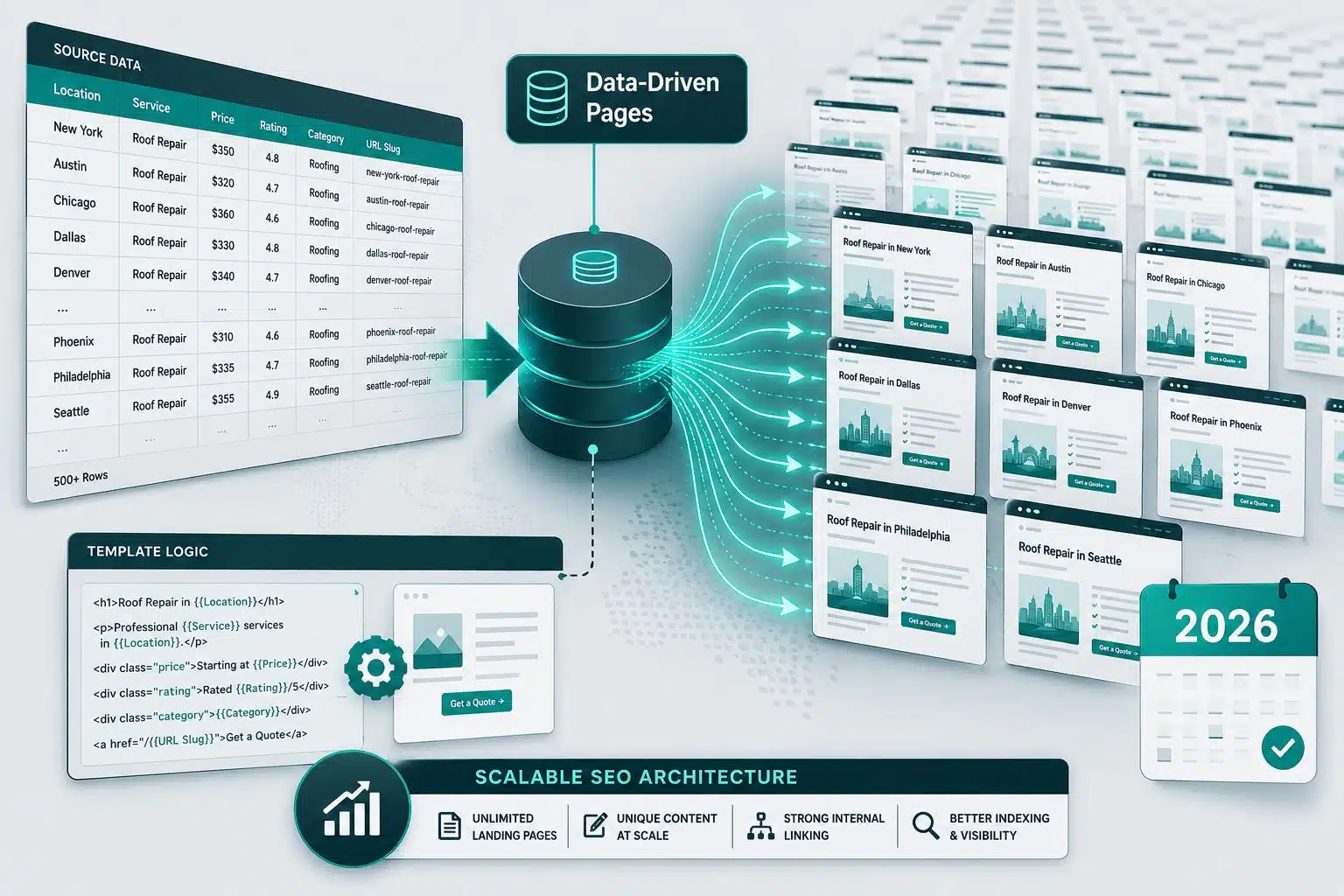
Programmatic SEO is the practice of building large numbers of web pages automatically from a structured dataset and a reusable template, targeting keyword patterns that repeat at scale. A classic example: a job board generating one page per city per job title, or a travel site creating pages for every airport-to-airport route combination.
In 2026, the definition hasn’t changed, but the execution requirements have changed significantly.
What’s different now:
- Google’s quality threshold is higher. Pages that passed in 2022 because they had any unique text now fail if that text doesn’t answer a real user need better than existing results.
- AI content is everywhere, so differentiation matters more. Because LLMs made content generation trivially cheap, the supply of thin programmatic pages exploded between 2023 and 2025. Google responded by tightening its scaled content abuse detection.
- Indexing is more selective. Google has become more conservative about crawling and indexing large page sets from sites without established authority. New programmatic sites often see only a fraction of their pages indexed, even when those pages are technically sound.
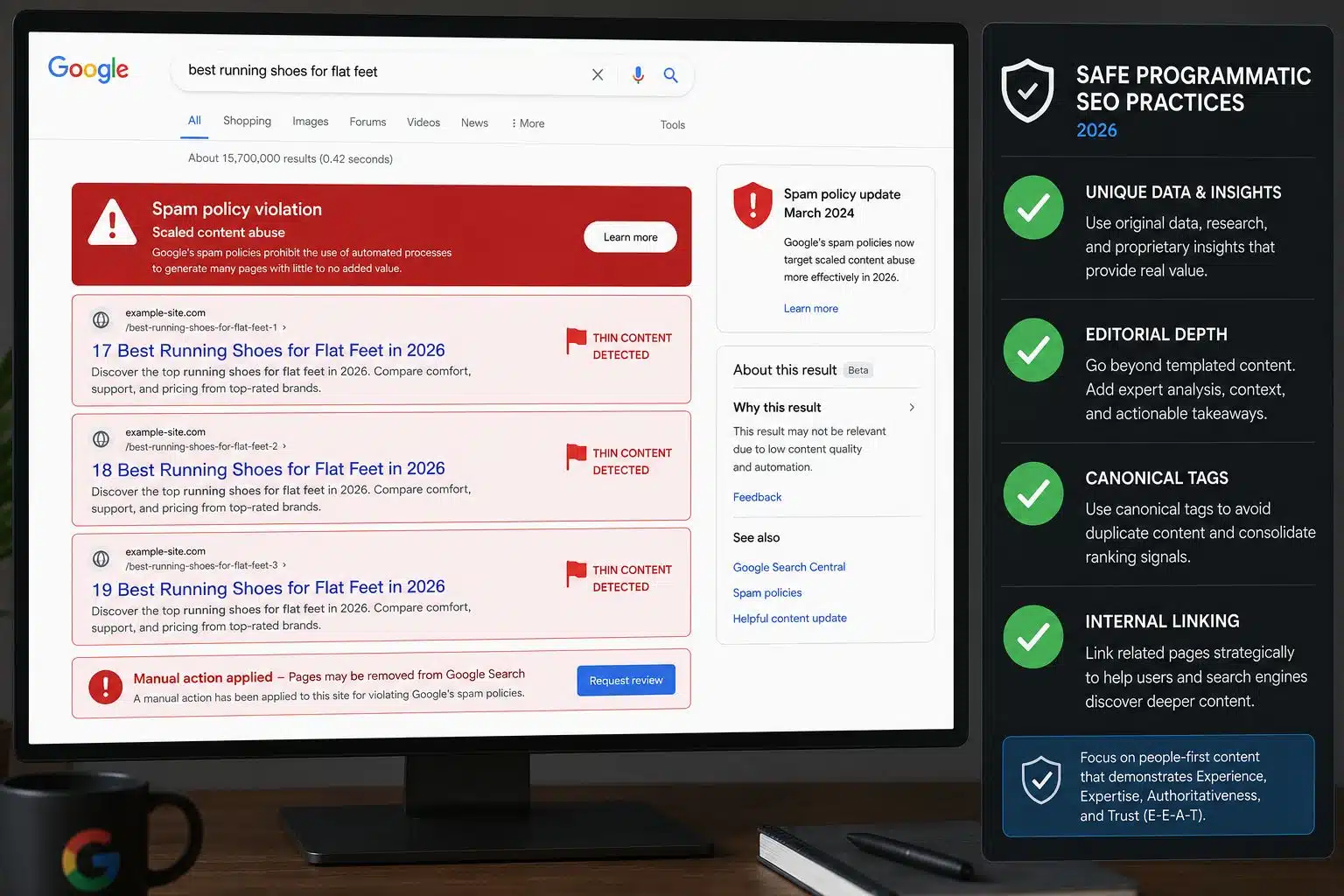
- Structured data and E-E-A-T signals matter more at the page level. Each programmatic page now needs to demonstrate experience, expertise, authoritativeness, and trustworthiness, not just the domain.
The sites winning with programmatic SEO in 2026 treat it as a data product problem, not a content volume problem.
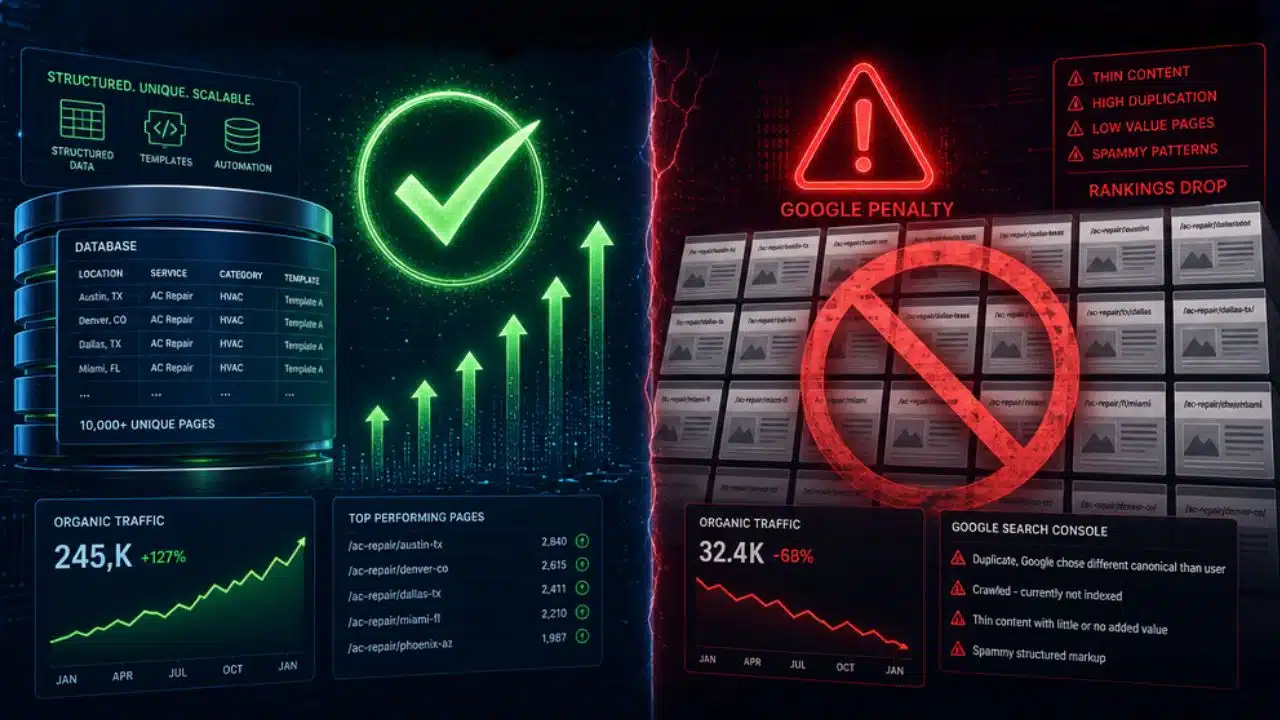
Which Programmatic SEO Techniques Are Getting Penalized by Google Right Now?
Google’s spam and quality systems are actively penalizing several specific patterns. The clearest signal is Google’s scaled content abuse policy, which it formalized in its March 2024 core update documentation and has continued enforcing through 2025 and into 2026.
Penalized patterns to avoid:
- Pure variable substitution with no unique data. Pages that change only a city name or product name while keeping every other sentence identical are the clearest target.
- AI-generated text without editorial review. Unedited LLM output, especially when it contains hallucinated facts or generic filler, is a strong spam signal.
- Thin pages with no original data. Aggregating publicly available data that users can find in one click elsewhere adds no value and is treated as thin content.
- Doorway page patterns. Pages clearly designed to funnel users to one destination rather than serve the query directly still trigger doorway page penalties.
- Excessive internal linking from low-quality programmatic pages to a money page. This pattern can drag down the authority of the target page rather than boost it.
- Duplicate or near-duplicate meta content across hundreds of pages. Identical title tags and meta descriptions at scale are a crawl-efficiency red flag and a quality signal.
Common mistake: Many SEOs assume that adding a single unique paragraph per page is enough to avoid a thin content penalty. In 2026, Google’s systems evaluate the ratio of unique, useful content to templated filler across the entire page, not just whether any unique text exists.
Is AI Content Generation Still Working for Programmatic SEO Pages?
AI-generated content is not banned, and it does still work, but only under specific conditions. Google’s guidance has consistently stated that the origin of content (human or AI) is less important than whether the content is helpful, accurate, and original.
When AI content works in programmatic SEO:
- The AI is enriching structured data, not inventing it. For example, using an LLM to write a two-sentence summary of a restaurant’s cuisine type when the core facts (address, hours, menu categories) come from a verified database.
- A human editor reviews output for accuracy, tone, and factual correctness before publishing.
- The AI-generated portion is a minority of the page’s unique value, not the entire page.
When AI content gets pages penalized:
- The entire page is LLM output with no grounding in real data.
- The content contains factual errors or hallucinations that erode trust.
- The writing is generic, interchangeable across pages, and adds nothing a user couldn’t find in a Google snippet.
What Are the Best Tools for Programmatic SEO Automation in 2026?
The core toolstack for programmatic SEO in 2026 hasn’t changed dramatically, but LLM integration has become standard in most serious builds.
| Layer | Popular Tools in 2026 |
|---|---|
| Data storage | Airtable, Google Sheets, PostgreSQL, Supabase |
| Page generation | Webflow CMS, Next.js, Gatsby, custom Python/Node scripts |
| AI enrichment | OpenAI API (GPT-4o), Anthropic Claude API, Gemini API |
| Internal linking | LinkWhisper (WordPress), custom scripts |
| Crawl monitoring | Screaming Frog, Sitebulb, Google Search Console |
| Indexing management | IndexNow, Google Search Console API |
| Analytics | GA4, Ahrefs, Semrush |
How Much Does It Cost to Build a Programmatic SEO Site in 2026?
Costs vary widely based on scale, technical complexity, and whether you’re building in-house or hiring out. These are realistic estimates, not guarantees, based on typical project scopes as of 2026.
Rough cost ranges:
- DIY with no-code tools (Webflow + Airtable): $50–$300/month in tool costs, plus 40–80 hours of setup time.
- Small custom build (freelance developer, up to 50k pages): $3,000–$10,000 one-time build cost, plus $100–$500/month hosting.
- Mid-scale agency build (100k–1M pages, custom stack): $15,000–$60,000+ depending on data sourcing, AI integration, and ongoing maintenance.
- Data acquisition: Often the largest hidden cost. Proprietary datasets can cost $500 to $50,000+ depending on the source and licensing.
The data layer is where most programmatic SEO projects underinvest. A cheap build on poor data will not rank regardless of technical quality.
Who Should Use Programmatic SEO and Who Should Avoid It?
Programmatic SEO is the right strategy for a specific type of site and a specific type of problem. It is not a universal growth hack.
Good fit for programmatic SEO:
- Sites with access to large, structured, proprietary datasets (real estate listings, job postings, product catalogs, financial data, local business data).
- Businesses targeting keyword patterns that repeat across hundreds of variables (location, category, comparison pairs).
- Teams with at least one developer and one SEO professional who can maintain the system over time.
Poor fit for programmatic SEO:
- Early-stage sites with no domain authority. Google is unlikely to index thousands of pages from a new domain.
- Niches where every query requires nuanced, expert judgment (medical, legal, financial advice at the individual level).
- Teams without the technical capacity to maintain and update the system as data changes.
- Businesses where the keyword opportunity doesn’t actually exist at scale. Not every topic has enough query volume variations to justify programmatic execution.
What Common Mistakes Are Killing Programmatic SEO Sites in 2026?
Several patterns consistently destroy programmatic SEO projects, even when the underlying strategy is sound.
- Publishing before establishing domain authority. Launching 100,000 pages on a new domain almost guarantees poor indexing and potential quality flags.
- Ignoring crawl budget. Large page sets on slow or poorly structured sites waste Google’s crawl allocation, leaving most pages unindexed.
- No data freshness plan. Programmatic pages built on stale data (outdated prices, closed businesses, old statistics) degrade quickly and generate user dissatisfaction signals.
- Forgetting internal linking logic. Pages that aren’t linked from anywhere in the site structure won’t be crawled or indexed reliably.
- Using the same template for every page regardless of data completeness. Pages where half the data fields are empty or “N/A” look thin and often are thin.
- Scaling too fast. Publishing thousands of pages per day on a site that previously published ten per month is an anomaly signal Google’s systems notice.
How Do I Prevent Google from Deindexing My Programmatic Pages?
The goal isn’t to “hide” programmatic pages from Google. It’s to ensure every indexed page genuinely deserves to rank. That said, there are concrete technical and editorial practices that protect large page sets.
Protective practices:
- Noindex low-data pages. If a page has fewer than three unique data points, noindex it until the data improves.
- Use canonical tags correctly. Near-duplicate pages should canonicalize to the strongest version, not to a page that doesn’t exist.
- Monitor Google Search Console’s Coverage report weekly. Catch indexing drops early before they cascade.
- Implement gradual rollouts. Publish in batches (500–1,000 pages at a time) and monitor indexing rates before scaling further.
- Build topical authority first. Publish strong pillar content before launching the programmatic layer. A site with 50 high-quality editorial pages indexes programmatic pages more reliably than a site with zero editorial content.
- Ensure page speed is consistent across the template. Core Web Vitals issues that affect all pages in a template are amplified at scale.
What Kind of Sites and Niches Are Still Successful with Programmatic SEO?
The niches where programmatic SEO in 2026 performs best share one characteristic: they have access to real, structured, frequently updated data that users genuinely want.
Consistently strong niches:
- Real estate: Property listings, neighborhood comparisons, school district data, rental price trends.
- Jobs and careers: Job listings by role and location, salary data by industry and geography.
- Travel and hospitality: Flight route comparisons, hotel availability by city and date range, visa requirement pages.
- SaaS comparison and review: Tool comparisons, feature matrices, integration pages (e.g., “Does [Tool A] integrate with [Tool B]?”).
- Local services: Service provider directories with genuine review data, pricing data, and availability.
- Finance: Stock data pages, ETF comparison pages, mortgage rate pages by state.
Niches where it’s increasingly difficult:
- General “best of” lists without proprietary data.
- Health and medical information (YMYL scrutiny is very high).
- News and current events (requires real-time data infrastructure that’s expensive to maintain).
How Much Traffic Can You Realistically Get from Programmatic SEO in 2026?
Traffic outcomes from programmatic SEO vary enormously, and the “millions of pages = millions of visitors” narrative is misleading. Realistic expectations depend on niche competition, page quality, and domain authority.
Realistic traffic benchmarks (estimates based on typical project patterns):
- A well-executed programmatic site in a medium-competition niche with 10,000 indexed pages might generate 5,000–50,000 organic visits per month within 12–18 months.
- In highly competitive niches (real estate, finance), even 100,000 pages may generate less traffic than 100 excellent editorial pages on an authoritative domain.
- Click-through rates on programmatic pages targeting long-tail queries are often low (1–3%) because many appear in informational positions where users don’t click.
The honest answer: programmatic SEO is a long-term compounding strategy, not a quick traffic spike. Sites that see dramatic results typically have both strong domain authority and genuinely differentiated data.
What Technical Skills Do You Need for Programmatic SEO?
Programmatic SEO in 2026 requires a broader skill set than most purely editorial SEO work. A solo practitioner needs at least foundational competency across several areas.
Core skills required:
- Database basics: Understanding how to structure, query, and maintain a relational or spreadsheet-based dataset (SQL or Airtable-level).
- HTML/CSS templating: Ability to build and modify page templates without breaking layout or introducing rendering issues.
- Crawl and indexing mechanics: Understanding of robots.txt, sitemaps, canonical tags, noindex directives, and crawl budget management.
- Basic scripting: Python or JavaScript for data cleaning, API calls, and automation. Not required for no-code builds, but essential for anything at significant scale.
- Analytics interpretation: Reading GA4 and Google Search Console data to identify which pages are indexing, ranking, and converting.
Nice to have but not required for every build:
- Server-side rendering knowledge (Next.js, Nuxt).
- API integration experience for real-time data pulls.
- LLM prompt engineering for content enrichment pipelines.
What Are the Best Alternative Strategies If Programmatic SEO Stops Working?
If a programmatic SEO site gets hit by a Google quality update or the niche becomes too competitive, there are adjacent strategies worth pivoting toward.
Strongest alternatives:
- Topical authority content clusters: Deep editorial coverage of a subject area, built around a hub-and-spoke internal linking model. This is what programmatic SEO was supposed to support, not replace.
- Data journalism: Publishing original research, surveys, or data analyses that earn backlinks and establish genuine authority. This is the editorial layer that makes programmatic sites more resilient.
- Structured product data (e-commerce SEO): For product-based businesses, properly structured product and category pages with schema markup serve a similar function to programmatic pages but with stronger commercial intent alignment.
- Community and UGC: User-generated content platforms (reviews, forums, Q&A) create unique pages at scale with lower spam risk because real users produce the variation.
Final Thoughts
Programmatic SEO in 2026 remains one of the most powerful strategies for scaling organic traffic, but the rules of the game have changed significantly. Simply generating thousands of keyword-targeted pages with AI or templated content is no longer enough to achieve long-term rankings. Google’s evolving algorithms now focus heavily on content usefulness, originality, user intent, topical authority, and real-world value. Websites that rely on thin automation, duplicate pages, keyword stuffing, or low-quality AI-generated content are increasingly vulnerable to ranking losses, deindexing, and manual penalties.
At the same time, programmatic SEO is far from dead. In fact, it continues to drive massive growth for SaaS platforms, marketplaces, travel websites, directories, affiliate publishers, and data-driven businesses that prioritize quality and user experience. The most successful websites in 2026 are combining automation with human expertise, unique datasets, expert insights, interactive elements, and strong internal linking structures to create scalable yet genuinely helpful content ecosystems.
Frequently Asked Questions (FAQs) about Programmatic SEO in 2026
Is programmatic SEO still worth doing in 2026?
Yes, for sites with access to proprietary structured data and a team capable of maintaining quality at scale. It’s not worth doing as a shortcut to rankings using thin, templated content.
How many pages should I start with on a new programmatic site?
Start with 500–1,000 high-quality pages on a domain that already has some authority. Launching tens of thousands of pages on a new domain is a common mistake that leads to poor indexing.
Does Google penalize all AI-generated content on programmatic sites?
No. Google penalizes content that is unhelpful, unoriginal, or inaccurate, regardless of how it was produced. AI-generated content that is grounded in real data and reviewed by humans is not automatically penalized.
What’s the biggest difference between programmatic SEO in 2022 and 2026?
The quality bar. In 2022, thin variable-substitution pages could rank in low-competition niches. In 2026, Google’s scaled content abuse detection catches most of those patterns, and the pages that rank have genuine data depth.
How long does it take to see results from a programmatic SEO build?
Typically 6–18 months for a new site, faster (3–9 months) for an established domain with existing authority. Indexing alone can take 3–6 months for large page sets.
Can a small team run a successful programmatic SEO site?
Yes. A two-person team (one developer, one SEO/content strategist) can manage a well-architected build with the right toolstack. The constraint is usually data quality, not team size.