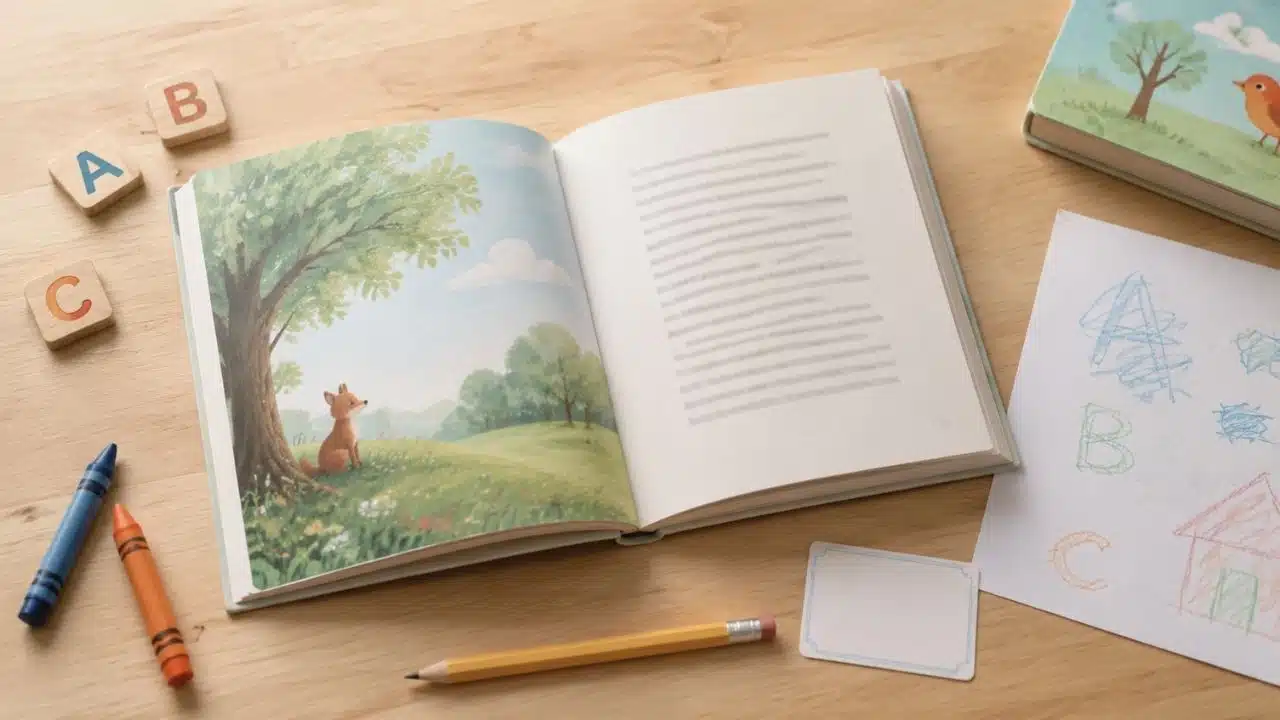
Print awareness is a child’s understanding that print carries meaning and follows recognizable rules. It includes knowing that books contain words as well as pictures, that letters form words, and that written English generally moves from left to right and from the top of the page downward.
Children begin developing this understanding long before they can read. They watch adults turn pages, notice signs and labels, pretend to write, and gradually realize that the marks around them are communicating something.
To me, the clearest sign of print awareness is not a child reciting the alphabet. It is the moment the child understands that print has a job.
What Print Awareness Actually Includes
Print awareness, sometimes called concepts of print, brings together several early understandings about written language.
A child with developing print awareness may know that:
- Print communicates a message.
- Words and pictures have different purposes.
- Books have covers, titles, pages, authors, and illustrators.
- English text is usually read from left to right and top to bottom.
- Letters combine to form words.
- Spaces separate one word from another.
- Punctuation marks help organize sentences.
- A list, menu, sign, label, and story use print differently.
- The words an adult says while reading are connected to the printed text.
Children do not learn all these ideas at once. A child may know how to hold a book but not yet understand where one word ends and another begins. Another may recognize several letters while still assuming that an adult is creating the story from the illustrations.
Both are normal stages of learning how print works.
Print Awareness Is Not the Same as Reading
A child does not need to decode words to demonstrate print awareness. Asking what a sign says, pointing to a title, or pretending to read a favorite book can all show that the child recognizes print as meaningful.
These behaviors should not be confused with conventional reading, though.
A child may recite an entire story from memory without reading its individual words. The same is true of familiar logos. A preschooler might recognize a restaurant sign or cereal package by its colors, shape, or location but fail to identify the brand name when it appears in plain text.
That does not make the recognition unimportant. It shows that the child understands symbols can communicate meaning. It simply is not the same as decoding an unfamiliar word.
Other early literacy skills are related to print awareness but remain distinct:
- Alphabet knowledge is the ability to recognize and name letters.
- Letter-sound correspondence is knowing that letters or letter groups represent sounds.
- Phonological awareness involves hearing and working with sounds in spoken language, such as rhymes and syllables.
- Phonics teaches children to use relationships between letters and sounds when reading and spelling.
These skills eventually work together, but no single one represents the entire reading process.
Why Print Awareness Matters
Print awareness prepares children to understand formal reading instruction.
Before sounding out a word, a child needs to recognize that the letters on the page represent language. Before following a sentence, the child needs to know where reading begins and how the text moves. Before separating a sentence into words, the child needs some awareness of spaces and word boundaries.
That makes print awareness an important part of emergent literacy. Still, I would not present it as a guarantee of later reading success or as the only skill that matters.
Children also need oral language, vocabulary, alphabet knowledge, phonological awareness, early writing experience, and clear instruction in how letters represent sounds. Print awareness provides part of the foundation. It does not replace the rest of it.
How Print Awareness Develops
Print awareness begins earlier than many people expect. Its development is gradual, and it does not follow an identical timetable for every child.
Books Begin as Objects
Babies may grab, pat, mouth, or stare at books. Although this may not look like literacy learning, they are becoming familiar with books as physical objects.
They also watch adults hold books, turn pages, point to pictures, and use a different rhythm of speech during story time. These repeated experiences begin establishing what a book is and what people do with it.
Toddlers Begin Participating
A toddler may help turn pages, request the same story repeatedly, point to familiar pictures, or pretend to read aloud. Some begin recognizing signs, symbols, or letters from their names.
Their scribbles may also start carrying meaning. A toddler might draw several lines and call them a shopping list or a message. The marks may not resemble conventional writing, but the child has discovered something important: marks can preserve an idea.
Preschoolers Notice the System
During the preschool years, children usually become more attentive to print itself. They may ask what a word says, distinguish writing from a picture, identify parts of a book, notice spaces, or show where reading begins.
They also start recognizing that printed materials serve different purposes. A menu lists food, a calendar keeps track of dates, a sign gives information, and a storybook tells a story.
These examples are broad developmental patterns, not deadlines. Children arrive with different abilities, languages, interests, and levels of exposure to print.
How Kids Build Print Awareness in Everyday Life
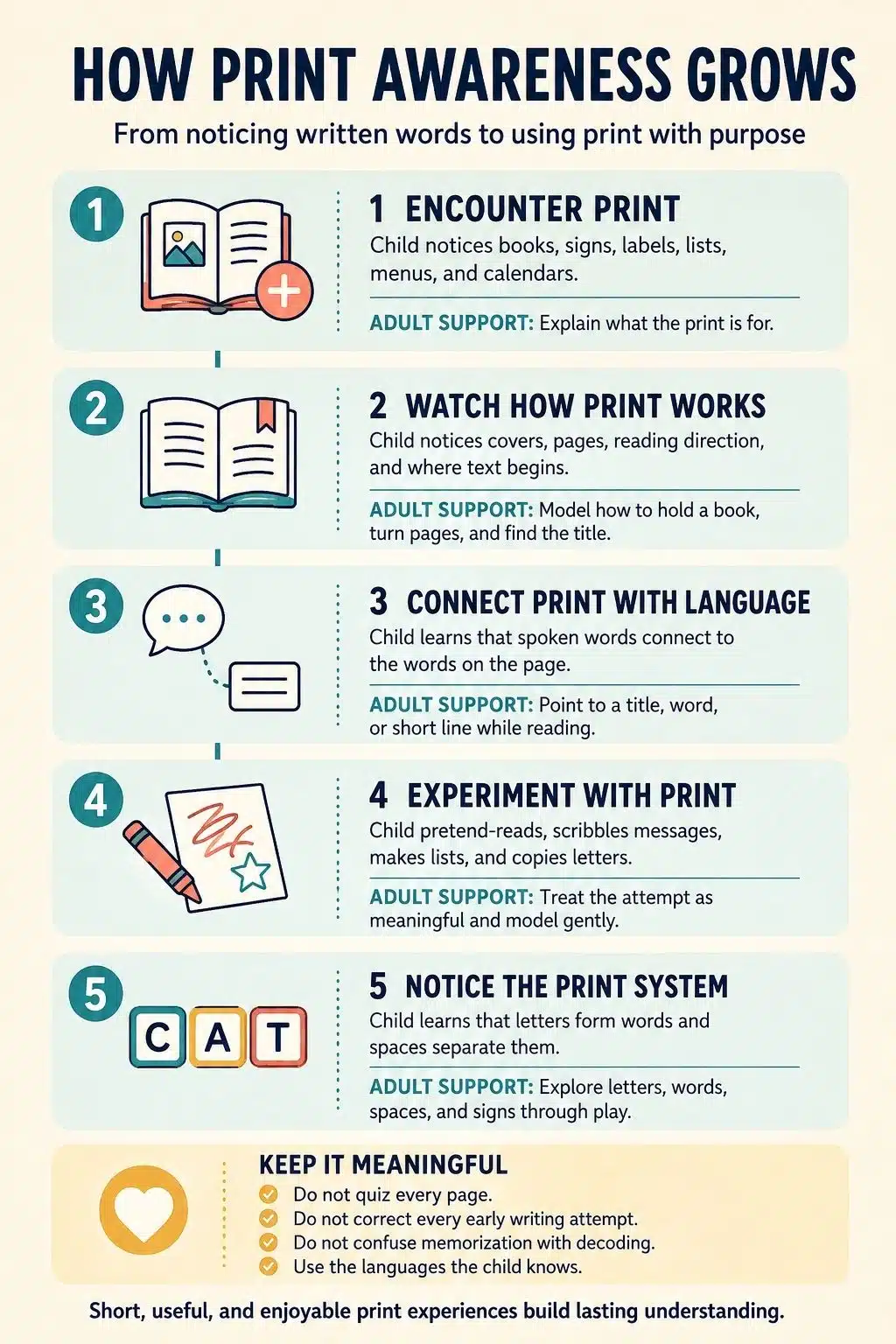
Children learn how print works through interaction. Having books and labels available helps, but adults make those materials more meaningful by showing how they are used.
Read Together Without Turning Every Book Into a Lesson
Shared reading gives children a close view of how an experienced reader handles a book and follows written text.
Before reading, an adult might point to the title and explain that it names the book. During the story, the adult can briefly show where a sentence begins, move a finger under a short line, or point out a familiar letter.
Useful prompts include:
- “Where should I start reading?”
- “Can you find a letter from your name?”
- “Do you see the space between these words?”
- “These words tell me exactly what to say.”
- “What do you think this sign means?”
The key is restraint. Pointing out every letter, word, and punctuation mark can make the story difficult to enjoy. A few natural comments are usually more helpful than constant questioning.
Sometimes the best choice is simply to read the story.
Show What Everyday Print Does
Print awareness does not require special materials. Written language is already present in homes, classrooms, stores, and neighborhoods.
Children can learn from:
- Shopping lists
- Food labels
- Recipes
- Calendars
- Birthday cards
- Street signs
- Store names
- Menus
- Maps
- Notes and reminders
The most useful conversations go beyond naming letters. Saying, “This list helps us remember what to buy” teaches the function of print. Saying, “This label tells us what is inside the box” connects the words with a real purpose.
Let Children Write Before They Can Spell
Early writing includes drawing, scribbling, copying familiar letters, making letter-like shapes, and attempting to write names.
A child can make a pretend shopping list, sign a picture, create a card, label a block structure, or dictate a story for an adult to write down. These activities demonstrate that writing can record and share a message.
I would avoid correcting every reversed letter or unconventional spelling at this stage. Adults can model the standard form without dismissing the child’s attempt to communicate.
Give Writing a Role in Play
Play makes the purpose of print easier to see.
A pretend restaurant can use menus and order slips. A doctor’s office can have appointment cards. A construction area can include plans and warning signs. Children running a pretend store can create price labels, shopping lists, and receipts.
Here, writing is not an isolated school exercise. It helps the play continue.
Return to Familiar Books
Repeated reading gives children time to notice different things.
The first reading can focus on understanding and enjoying the story. During a later reading, the adult might draw attention to the title, a repeated word, or the direction of the text. Eventually, the child may join in with a familiar sentence.
Predictable and patterned books can support participation and help children notice how print looks on a page. However, memorizing a pattern should not be treated as decoding. When children begin learning to read unfamiliar words, they still need phonics instruction and suitable decodable texts.
Check out our app on Alphabet magic trace & phonics.
Use the Languages the Child Knows
Children can build print awareness through the languages their families use. Reading in a home language does not interfere with learning how English print works.
Adults may need to explain differences between writing systems. English moves from left to right, but that direction is not universal. Some languages move from right to left, while others use different characters or arrangements.
A child applying the conventions of another language is drawing on prior knowledge, not making a careless mistake.
Common Mistakes That Get in the Way
One common mistake is assuming that surrounding a child with printed words is enough. A classroom wall can be covered with labels, but those labels have limited value if no one reads or uses them with the children.
Another is turning shared reading into a test. Too many questions interrupt the story and can make books feel like assignments. Children also need adults to comment, model, respond, and follow their interests.
Worksheets are not automatically harmful, but they should not become the center of print awareness instruction. Helping create a real list or sign usually teaches more about the purpose of writing than repeatedly circling letters on a page.
Adults should also avoid pushing children to perform before they are ready. The aim is to help them understand written language, not to make toddlers appear as though they can read.
How to Tell Whether Print Awareness Is Growing
Most progress can be noticed during ordinary reading, writing, and play. A formal test at home is rarely necessary.
Over time, a child may begin to:
- Hold and open a familiar book correctly.
- Identify its front or title.
- Distinguish a picture from printed text.
- Show where reading begins.
- Point to a letter, word, or space.
- Explain what a familiar sign or list is used for.
- Follow the expected direction of the writing system being used.
- Give meaning to their own drawing or writing.
A child does not need to demonstrate every behavior at once. I find it more useful to look for gradual changes across different situations than to judge ability from one reading session.
If an older preschooler is missing many communication and early literacy milestones despite regular opportunities to interact with books and print, families can discuss the pattern with the child’s teacher or pediatrician. Concerns involving speech, language, or hearing may also warrant guidance from an audiologist or speech-language pathologist.
One missed skill by itself does not indicate a developmental problem.
Let Print Have a Real Purpose
Children do not need expensive programs to discover how written language works. They need books they can explore, adults who read and write around them, materials for making their own marks, and opportunities to see print serving a real purpose.
A shopping list, street sign, familiar story, pretend menu, or scribbled card can all build print awareness. The adult’s role is not to turn every moment into a lesson. It is to make the meaning of print visible and leave enough room for the child’s curiosity to take over.
Frequently Asked Questions on Print Awareness
1. At what age does print awareness begin?
It begins in infancy. Babies learn by touching books, watching adults turn pages, looking at pictures, and listening during shared reading. Their understanding becomes easier to observe during toddlerhood and preschool.
2. What is the best activity for building print awareness?
Shared reading is one of the most useful activities, especially when an adult occasionally points out a title, word, space, or reading direction. Everyday writing activities, such as making lists and signs, are valuable too.
3. How is print awareness different from phonological awareness?
Print awareness focuses on written language, including books, words, spaces, and reading direction. Phonological awareness focuses on the sounds in spoken language, such as rhymes, syllables, and beginning sounds.
4. Does recognizing signs and logos mean a child can read?
Not necessarily. A child may recognize the color, shape, or setting rather than the printed letters. It is still a useful early step because it shows the child understands that symbols can carry meaning.
5. Can bilingual children build print awareness in both languages?
Yes. Children can learn that print carries meaning through any language used at home. Adults can then help them notice differences in direction, letters, characters, and book organization.