Turning routine family mealtimes into playful literacy opportunities allows young children to connect learning with positive sensory experiences. When families practice letters at the dinner table, they create low-pressure, interactive environments that foster pre-reading skills, fine motor development, and joyful learning, all without relying on structured flashcards or screen-based technology.
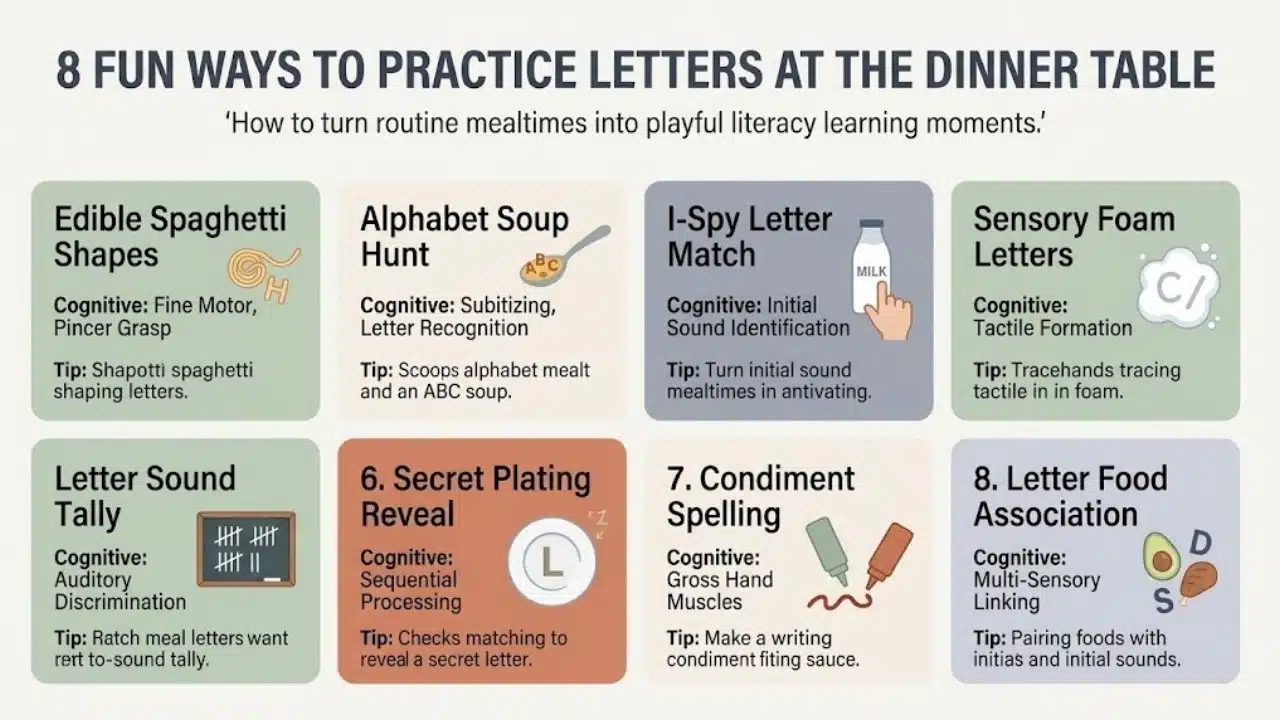
| Mealtime Activity | Core Developmental Skill | Sensory & Cognitive Focus | Preparation Level |
| 1. Edible Spaghetti Shapes | Fine motor control (pincer grasp) | Tactile & creative shaping | Low (regular pasta) |
| 2. Alphabet Soup Hunt | Letter recognition (subitizing) | Visual scanning & identification | Low (canned soup) |
| 3. I-Spy Letter Match | Initial sound identification | Auditory processing & vocabulary | Zero |
| 4. Sensory Foam Letters | Tactile letter formation | Sensory exploration & shape memory | Medium (clean foam + mats) |
| 5. Letter Sound Tally | Phonics (phonemic awareness) | Auditory discrimination & quantity tracking | Low (paper/chalkboard) |
| 6. Secret Plating Reveal | Sequential processing & anticipation | Pattern recognition & mystery | Low |
| 7. Condiment Spelling | Large motor muscle memory | Visual spatial tracking | Low (squeeze bottle/spoon) |
| 8. Letter Food Association | Conceptual categorization | Multi-sensory food and sound linking | Low |
8 Fun Ways to Practice Letters at the Dinner Table
1. Edible Spaghetti Shape Shifting
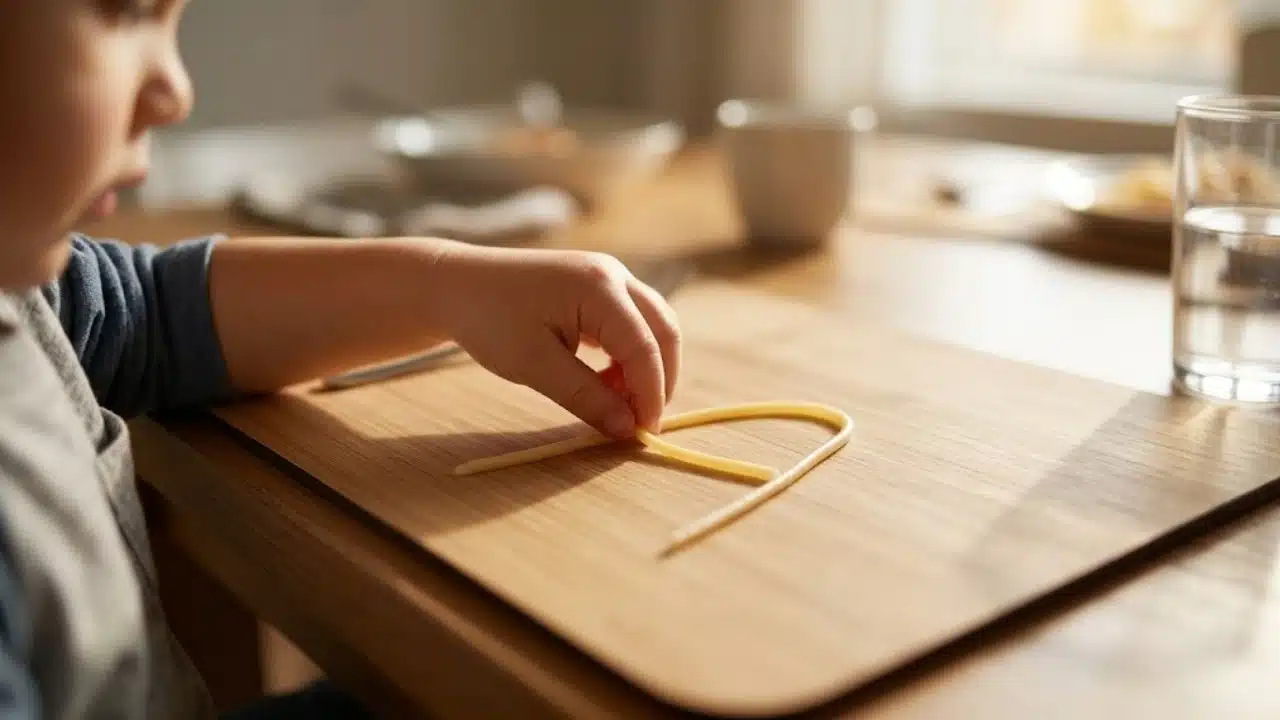
After the meal is mostly complete, reserve a small handful of plain cooked spaghetti. Challenge your child to manipulate the slippery noodles into simple capital letters like ‘A’, ‘O’, or ‘I’. This activity requires delicate finger movements, reinforcing the pincer grasp and muscle control essential for writing, while building tactile familiarity with letter structures.
2. The Classic Alphabet Soup Letter Hunt
Serve a bowl of alphabet soup and invite your child to become a “letter explorer.” When they scoop up a letter, have them identify the shape and the sound it makes before eating it. Incorporating early literacy standards for sensory learning shows that connecting food, taste, and active retrieval boosts letter recognition and phonetic subitizing skills.
3. Tabletop “I-Spy” Letter Sound Match
Engage the whole family in a simple phonics game. The leader calls out a sound (“I spy something that starts with /m/”) and participants point to relevant objects on the table (Milk, Macaroni, or even Mom). This activity develops phonemic awareness—the critical pre-reading skill of isolating initial sounds in words—without requiring any physical tools.
4. Sensory Shaving Foam Alphabet Practice
Place a large silicone mat on the table and squirt a small amount of clean white foam (shaving or non-toxic sensory foam) onto it. Invite your child to trace uppercase letters directly into the smooth texture with their index finger. Interactive early childhood strategies emphasize that tactile feedback deepens learning and builds strong mental muscle memory for correct letter formation.
5. Dinner Conversation Letter Sound Tally
Focus on auditory discrimination during casual table talk. Pick one letter—like ‘D’ for dinner—and use a small piece of paper or a small chalkboard to make a tally mark every time anyone uses a word that starts with that sound (e.g., “Pass the dishes, please, Dad”). This turns listening into an active sorting and tracking game.
6. Secret Initial Plating Reveal
Before plating the meal, write the child’s initial (or the initial of a favorite family pet) on the center of the plate using a thin line of non-toxic edible marker or even just a pattern of vegetables or sauce. When you serve the food around the initial, the letter is revealed as they clear their plate, building sequential expectation and visual recognition of symbols.
7. Ketchup and Mustard Squeeze-Bottle Spelling
Give your child controlled access to squeeze bottles of non-toxic condiments. On a clean section of their plate, let them “write” uppercase letters, or even just practice vertical/horizontal lines (letter pre-writing), using the controlled flow of sauce. This strengthens gross hand muscles while providing tactile and visual-spatial practice.
8. Multi-Sensory Letter and Food Associations
Connect letter sounds directly to the sensory characteristics of the food being eaten. When serving green beans, discuss the ‘/G/’ sound of the beans. When eating bread, highlight the ‘/B/’. This associates phonetic concepts with existing multi-sensory experiences (taste, texture, and color), reinforcing learning through positive association.
Rethinking Mealtime: The Developmental Value of Integrated Learning
The hidden developmental truth in standard literacy curriculum is that learning to read does not begin with flashcards; it begins with tactile, relational, and multi-sensory physical interaction. Standard education models frequently isolate literacy skills into structured blocks, missing crucial opportunities to integrate learning into routine daily life. Placing pressure on a child to memorize a letter shape from a book page can create resistance. Conversely, asking a child to shape that same letter from a noodle after they’ve happily eaten their favorite pasta converts the learning task into an extension of positive sensory play.
Looking forward, as digital screens dominate “passive learning,” mealtimes remain one of the last bastions of physical, face-to-face interaction. The irreplacable sensory feedback of touching a textured noodle, the rhythmic nature of Auditory discrimination, and the anticipation of a secret plated reveal create multiple cognitive “hooks” for memory retention that screen-based apps cannot replicate. Integrating learning into physically present routine activities is not just “fun”—it is developmentally essential.
Frequently Asked Questions (FAQs) About Practice Letters at the Dinner Table
How do I ensure learning doesn’t ruin the mealtime experience?
Keep activities casual and optional. Use natural dinner transitions (before plating or after eating) rather than interrupting the flow. If a child resists or gets frustrated, stop immediately and return to relaxed dining. The positive relational aspect of the meal is priority.
What age can children begin practicing letters at mealtimes?
Simple activities like I-Spy or Letter Food Association can begin around age 2.5 or 3. Active tactile shaping (spaghetti, sensory foam) and specific letter recognition are best suited for preschoolers aged 3.5 to 5, as their fine motor skills and cognitive vocabulary develop.
How long should we spend practicing letters at the dinner table?
Keep it brief. Integrated learning activities should last only 5 to 10 minutes total during the entire meal. The goal is positive exposure and playful integration, not extended structured instruction.
Why are tactile activities better than flashcards for letter learning?
Tactile feedback (touch and texture) activates different brain regions and reinforces shape memory more deeply than visual input alone. Children who physically build or trace letters develop a much stronger physical intuition for correct formation when they eventually learn to write.
Is this a real pre-reading skill, or just a fun game?
Phonemic awareness—the ability to isolate and identify individual sounds in words (as practiced in I-Spy and Letter Tally)—is widely recognized as one of the single best predictors of future reading success. These games are foundational pre-reading instruction in a play-based format.