

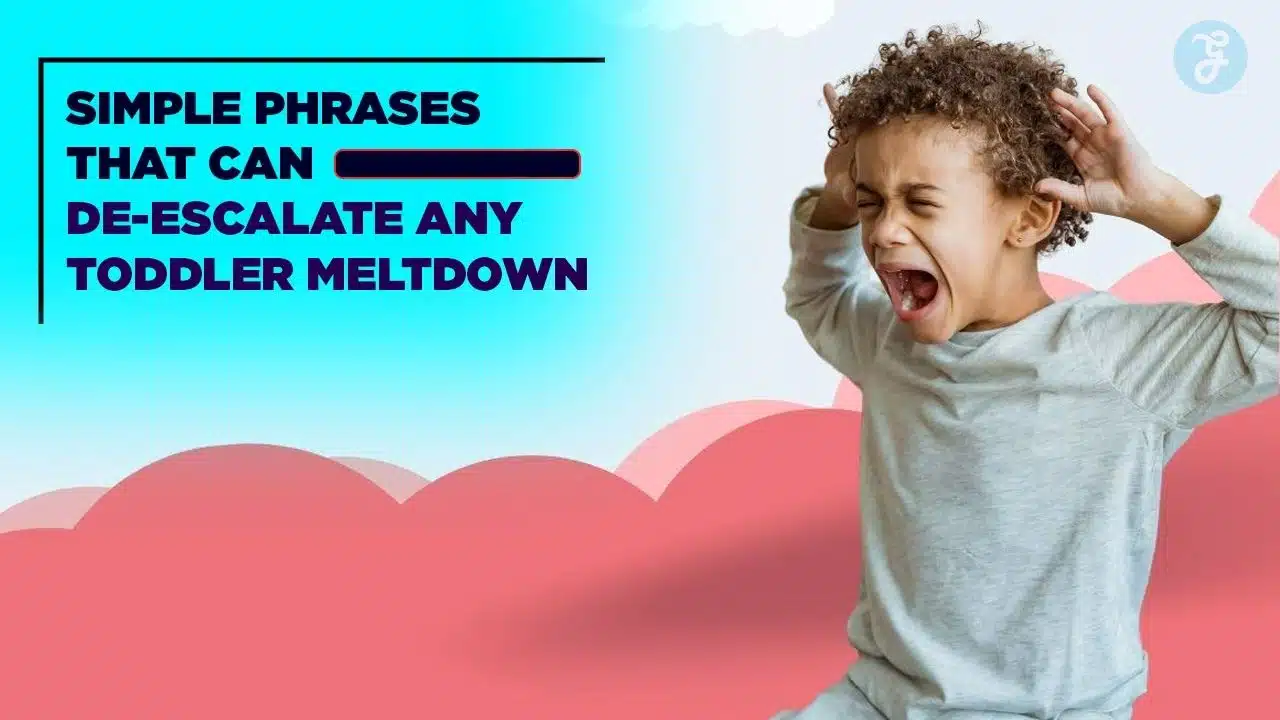
Every parent knows the scene. You are in the supermarket, at the park, or by the front door. Your toddler’s face is red. Shoes are flying, tears are streaming, and logic has left the building. You feel every eye in the room on you.
Moments like this feel chaotic. Yet they are also communicating. Research on tantrums and meltdowns shows that young children often explode when big emotions collide with limited language and immature self-regulation. They literally do not yet have the brain wiring to handle the surge.
The question is not whether meltdowns will happen. They will. The real question is what you say in those seconds that follow. That is where 10 simple phrases that can de-escalate any toddler meltdown can quietly change the script. The right words do not magically erase distress, but they lower the temperature, protect the relationship, and help a small child borrow your calm until they can find their own.
Understanding Toddler Meltdowns
Toddler meltdowns are driven by emotional overload, not intentional defiance. When you understand what triggers them, you respond with clarity instead of frustration. This section breaks down the real reasons behind the chaos.
What A Meltdown Really Is?
A toddler meltdown is not a debate you are losing. It is a nervous system in overload.
Specialists in child mental health describe tantrums and meltdowns as surges of “big emotions” that young children cannot yet manage. They are often triggered by anger, frustration, tiredness, or sensory overload, and they are a normal part of early development.
Your child is not choosing chaos to embarrass you. They are stuck in it.
Common Triggers Parents Overlook
Patterns show up quickly when you look closely:
- Basic needs: hunger, tiredness, and overstimulation are classic triggers. East Lake Pediatrics+1
- Transitions: leaving the park, turning off a screen, or stopping a favorite activity.
- Frustrated independence: wanting to “do it myself” but not having the skill yet.
- The word “no”: constant rejection without explanation can inflame power struggles.
When you see meltdowns as a stress response instead of “bad behavior,” the role of language shifts. You are not trying to win. You are trying to help a dysregulated brain feel safe enough to come back online.
Why 10 Simple Phrases That Can De-Escalate Any Toddler Meltdown Actually Work
These phrases are grounded in child-development science, helping toddlers feel safe, seen, and supported. They calm the body first so the brain can reset, making connection—not control—the key to de-escalation.
Co-Regulation, Not Control
During a meltdown, the thinking part of your child’s brain takes a back seat. What they borrow instead is your nervous system.
Clinicians call this co-regulation: the process by which a calmer adult helps a distressed child return to emotional balance. Staying calm, speaking softly, and using predictable phrases are all part of this. Pediatric and mental health experts are remarkably consistent on this point: shouting at a child to calm down does the opposite of what you want.
So, 10 simple phrases that can de-escalate any toddler meltdown are really tools for co-regulation. They do not remove the storm. They help you be the lighthouse.
Validation, Safety, And Brain Science
Research-backed guidance on tantrums highlights a few themes that show up in effective phrases:
- Validation: naming and accepting feelings (“You sound upset and angry”) reduces intensity and helps children start to label emotions.
- Safety: repeated reassurance (“I’m here with you; you’re safe”) anchors children when they are overwhelmed.
- Structure: simple choices and first/then language give back a sense of control and predictability.
These elements sit behind the 10 phrases below. The wording is flexible. The principles are not.
10 Simple Phrases That Can De-Escalate Any Toddler Meltdown
Use these 10 simple phrases that can de-escalate any toddler meltdown as scripts, not slogans. You can adjust the language to your child’s age, your culture, and your personality. What matters is the message underneath: You are safe, your feelings make sense, and I am not going anywhere.

Phrase 1: “I’m Here. You’re Safe.”
Why it helps:
In a meltdown, a toddler’s sense of safety often collapses. Short, steady reassurance that you are there and they are safe calms the body first, so the brain can follow. Guides on de-escalation emphasize that children in distress need repeated signals of physical and emotional safety.
How to use it:
- Keep your voice low and slow.
- Stay close, at their level if possible.
- Repeat the phrase while you sit beside them, without adding lectures.
You are not discussing behavior yet. You are sending the clearest possible message: you are not alone in this.
Phrase 2: “It’s Okay To Feel Upset.”
Why it helps:
Many parenting resources stress the difference between accepting emotions and setting limits on behavior. Validating statements like “It’s okay to feel upset” tell your child that big feelings are allowed, even when certain actions are not.
How to use it:
- Pair the phrase with a simple limit if needed:
- “It’s okay to feel upset. It’s not okay to hit.”
- Keep the language simple and repeatable.
- Avoid adding “but” in a way that cancels the validation.
Over time, toddlers who hear this message learn that emotions are safe to express and talk about, not something to hide or fear.
Phrase 3: “I Can See This Is Really Hard For You.”
Why it helps:
When a child is struggling with a zipper, a shoe, or a goodbye, it does not help to pretend it is easy. Phrases that acknowledge struggle (“I can see this is really hard for you”) mirror the child’s internal state. Psychologists point out that reflective language—simply noticing and naming effort and frustration—reduces shame and defensiveness.
How to use it:
- Use it when your child is battling a task or transition.
- Add a gentle offer, not a demand:
- “I can see this is really hard for you. Do you want help, or do you want to try one more time?”
- Keep your body language open: soft eyes, relaxed shoulders.
You are siding with your child against the problem, not with the problem against your child.
Phrase 4: “Let’s Breathe Together.”
Why it helps:
Breathing advice can sound cliché to adults. To a toddler, though, “Let’s breathe together” is a simple, concrete action that helps slow the body. Pediatric and media-health guidance recommends that parents pause, take deep breaths, and model calm rather than reacting impulsively.
How to use it:
- First, take one visible slow breath yourself.
- Then invite, not order: “Watch my breath. In… out… let’s do three together.”
- Turn it into a mini-game if your child responds to play: blowing out “birthday candles,” pretending to inflate a balloon, or smelling a flower and blowing a feather.
Not every toddler will join in every time. Even if they do not, your own slower breathing still lowers the emotional temperature in the room.
Phrase 5: “Use Your Words, And I’ll Listen.”
Why it helps:
Tantrums often come from limited language. Tools from parenting and developmental psychology stress the value of helping children move from acting feelings out to speaking them.
“Use your words, and I’ll listen” does two things:
- It tells your child that language works better than screaming.
- Also, it promises that you will pay attention when they try.
How to use it:
- Offer this phrase once the peak of the meltdown has passed.
- Keep your demand realistic: accept partial words, gestures, or pointing from younger toddlers.
- Follow through on the “I’ll listen” part. Stop what you are doing and focus when they try to communicate.
Over time, the child learns that words, not explosions, are the route to getting needs met.
Phrase 6: “You Can Choose A Or B.”
Why it helps:
Experts repeatedly recommend limited choices as a way to reduce power struggles and restore a sense of control. “You can choose A or B” gives structure. It narrows the field, but still lets the child feel some autonomy.
How to use it:
- Keep choices simple and concrete:
- “You can choose to hold my hand or ride in the stroller.”
- “You can choose the blue cup or the green cup.”
- Avoid offering choices you cannot accept.
- Do not add a third or fourth option in the heat of the moment.
This phrase is especially effective early in the escalation, when your child is not yet fully flooded.
Phrase 7: “First We Do This, Then We Do That.”
Why it helps:
So-called first/then language is widely used in early childhood education and therapy. It links a non-preferred task with a preferred one and makes the sequence predictable.
How to use it:
- State the “first” calmly and clearly.
- Follow with a motivating “then”:
- “First we put on shoes, then we go outside.”
- “First, we tidy the blocks, then we read your book.”
- Avoid turning it into a threat. It is a roadmap, not a punishment.
First/then phrases are short, repeatable, and easy for toddlers to grasp, especially when paired with gestures.
Phrase 8: “Would You Like A Hug Or Some Space?”
Why it helps:
Some children seek contact when upset. Others pull away. Child psychologists suggest following the child’s cues while still signaling that you remain available. themompsychologist.com+2The Times of India+2
“Would you like a hug or some space?” offers both.
How to use it:
- Ask this when the meltdown is intense but not dangerous.
- Respect the answer. If your child chooses space, stay nearby but do not crowd.
- If they choose a hug, hold them without talking too much.
This phrase teaches that both closeness and space are safe options, and that you can handle either.
Phrase 9: “Let’s Find A Way To Fix This Together.”
Why it helps:
Once the peak has passed, meltdowns become teaching moments. Parenting resources highlight the importance of collaborative problem-solving—working with, not against, the child to find solutions. “Let’s find a way to fix this together” moves you into that stage.
How to use it:
- Save this phrase for the recovery phase, not the worst minute of the tantrum.
- Ask simple questions: “What would help?” “Should we try it a different way?”
- Offer one or two realistic options, then decide together.
This language builds skills for later life: negotiation, compromise, and shared responsibility.
Phrase 10: “When You’re Ready, I’m Still Here.”
Why it helps:
Not every meltdown ends in a neat conversation. Sometimes your child needs to cry, thrash, and then quietly drift back to calm. De-escalation experts underline that patience and presence, not speed, define a successful response. “When you’re ready, I’m still here” keeps the door open.
How to use it:
- Say it softly as your child begins to settle.
- Stay within sight, doing something calm and predictable.
- Welcome them back with warmth, not “I told you so.”
- The message is simple and powerful: storms pass, but your relationship does not.
How To Use Calming Phrases During A Toddler Meltdown
Words alone won’t stop a meltdown; timing, tone, and body language complete the impact. This section shows how to match each calming phrase to the right moment for maximum effect.
Tone, Body Language, And Timing.
The words you choose matter. How you say them matters more.
Across medical and mental health guidance, the same principles repeat: stay calm, use a soft voice, and be a role model for emotional control.
A few practical rules:
- Lower your volume, not raise it. A quieter voice often pulls attention better than a shout. Urban Wellness
- Get down to their level. Eye-level presence feels less threatening.
- Use an open posture. Unclenched hands, relaxed shoulders, and a slight lean forward signal safety.
- Pick your moment. Some phrases (like “Let’s find a way to fix this together”) work best after the emotional peak, not at the top of the storm.
Think of these 10 simple phrases that can de-escalate any toddler meltdown as tools in a small, portable kit. You do not use every tool in every situation. You choose the right one for the job.
Matching The Phrase To The Moment
You can roughly align phrases to stages.
Rising tension:
- “You can choose A or B.”
- “First we do this, then we do that.”
Full meltdown:
- “I’m here. You’re safe.”
- “It’s okay to feel upset.”
- “I can see this is really hard for you.”
- “Let’s breathe together.”
- “Would you like a hug or some space?”
Recovery:
- “Use your words, and I’ll listen.”
- “Let’s find a way to fix this together.”
- “When you’re ready, I’m still here.”
This simple mapping helps you recall what to say when your own stress levels are high.
Common Mistakes To Avoid When Using Calming Phrases
Many parents undermine de-escalation without realizing it—by talking too much, reacting too fast, or using threats. Here, you’ll learn what to avoid so your calming phrases actually work when emotions spike.
Talking Too Much
In the name of guidance, adults often flood a melting-down toddler with language: explanations, reminders, mini-lectures about gratitude and good behavior. In the middle of a meltdown, the child cannot process lengthy reasoning.
Short, repeated phrases are more effective. This matches expert advice to use simple, clear communication and short directives when de-escalating a young child.
Bribing, Threatening, Or Shaming
The pressure of public meltdowns can push parents toward quick fixes. For example:
- “If you stop crying, I’ll buy you a toy.”
- “If you keep screaming, we’re never coming here again.”
- “Everyone is looking at you. You’re being bad.”
These tactics might stop the noise in the moment, but they create new problems:
- Bribes teach children that escalation is a route to rewards.
- Threats increase anxiety and erode trust.
- Shame messages (“You’re embarrassing”) attack the child, not the behavior.
De-escalation works best when you protect the relationship even as you uphold boundaries.
Expecting A Magic Switch
Even with excellent language, meltdowns do not vanish instantly. Child psychiatrists and de-escalation trainers remind parents that calming a child is a gradual process, not a light switch.
You may need to cycle through a few of these 10 simple phrases that can de-escalate any toddler meltdown before you see a shift. That does not mean they are failing. It means your child is still in the wave.
Build Your Version of Phrases That Can De-Escalate Any Toddler Meltdown
Every family communicates differently, and your phrases should reflect that. These parenting tips help you personalize the scripts so they feel natural, consistent, and effective in everyday parenting moments.
Adapting Language To Your Family Culture
The exact phrasing in this article is a starting point, not a script you must follow word-for-word.
You might:
- Translate each phrase into your home language.
- Swap in familiar nicknames or cultural references that make your child feel anchored.
Shorten phrases for very young toddlers:
- “Safe. I’m here.”
- “Big feelings, okay.”
The important part is that your personal set still reflects the core of 10 simple phrases that can de-escalate any toddler meltdown: safety, validation, structure, and collaboration.
Practicing Calm Words Before The Next Storm
In the middle of a meltdown, no parent has time to improvise. You are tired. You are stressed. You are human.
It helps to:
- Write your favorite three phrases on a note in your phone.
- Practice saying them out loud when things are calm.
- Share them with other caregivers so your child hears consistent messages.
When the next outburst hits, you will have language ready, the way you might rehearse an emergency drill. The goal is not perfection. It is predictability.
Final Words: From Daily Chaos to Daily Connection
Toddler meltdowns will never be pleasant. They are loud, messy, and often arrive at the worst possible moment. Yet they are also predictable, understandable, and, with the right tools, manageable.
10 simple phrases that can de-escalate any toddler meltdown give you a small but powerful set of responses:
- They validate big feelings without endorsing harmful behavior.
- They anchor your child’s sense of safety while your own heart is pounding.
- They turn repeated crises into repeated opportunities to practice emotional skills.
You cannot remove every storm from your child’s path. You can, however, be the steady presence they learn to look for in the middle of it—quietly repeating words that say, in different ways, the same thing:
You are safe. You are heard. And we will figure this out together.





















