

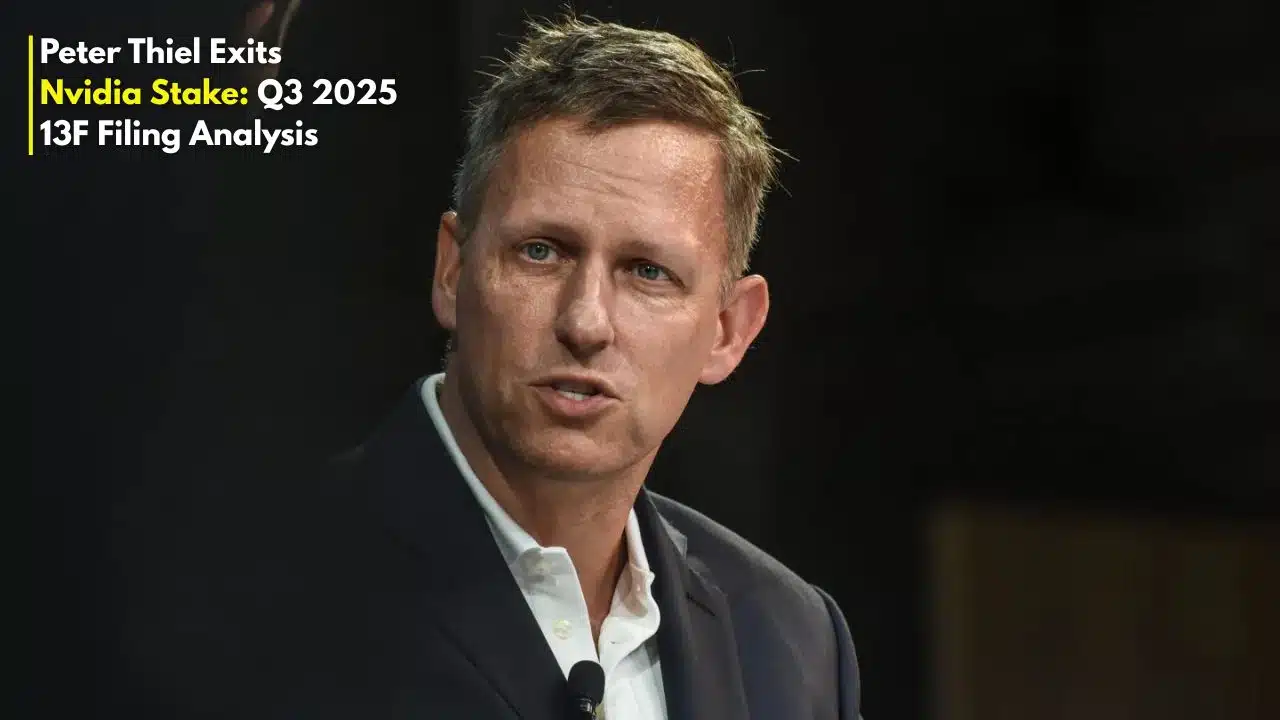
In a stark signal to the burgeoning artificial intelligence market, billionaire investor Peter Thiel has completely exited his position in Peter Thiel Exits Nvidia Stake, joining a growing chorus of smart money rushing for the exits ahead of the chipmaker’s critical earnings report this week.
Filings submitted to the Securities and Exchange Commission (SEC) over the weekend reveal that Thiel Macro LLC, the hedge fund acting as a family office for the PayPal co-founder, liquidated 100% of its Nvidia holdings—approximately 537,000 shares—during the third quarter of 2025. The move marks a decisive bearish turn from one of Silicon Valley’s most influential contrarians, suggesting a belief that the AI hardware trade may have peaked.
“This isn’t a rebalance; it’s a statement,” said a senior portfolio strategist at a major Wall Street firm. “When you see insiders like Thiel and conglomerates like SoftBank selling into the $5 trillion rally, it suggests the ‘easy money’ phase of the AI infrastructure boom is over.”
The Great Rotation: From Hardware to Software?
The 13F filing paints a clear picture of Thiel’s current market outlook: defensiveness.
While shedding Nvidia and fully exiting energy firm Vistra Corp (VST), Thiel Macro initiated new positions in Microsoft and Apple. This rotation suggests a strategic bet that the value in AI is shifting from the builders of infrastructure (Nvidia) to the owners of distribution and application layers (Microsoft/Apple), or simply a flight to safety amidst overheating valuations.
Thiel Macro Portfolio Shifts (Q3 2025)
| Ticker | Action | Shares Traded | Status |
| NVDA | SOLD (100%) | -537,742 | Exited |
| VST | SOLD (100%) | -208,747 | Exited |
| MSFT | BOUGHT | +49,000 | New Position |
| AAPL | BOUGHT | +79,181 | New Position |
| TSLA | REDUCED | -207,613 | Trimmed |
Bubble” Warnings Grow Louder
Thiel has previously compared the current AI hype cycle to the Dotcom bubble of 1999, warning of “stretched valuations.” With Nvidia’s market capitalization hovering near $4.85 trillion, the stock is priced for perfection.
The exit aligns with a broader institutional trend. Just last week, Japanese conglomerate SoftBank Group disclosed it had sold its remaining 32.1 million shares of Nvidia in October, netting $5.8 billion. SoftBank founder Masayoshi Son, a long-time AI bull, is reportedly reallocating those funds directly into AI startups like OpenAI rather than public chip stock
Market Impact: Volatility Ahead of Earnings
The timing of Thiel’s disclosure—just 48 hours before Nvidia’s earnings call on November 19—has injected fresh anxiety into the market.
Nvidia stock (NVDA) has seen a meteoric rise, up over 48% year-to-date in 2025. However, the “smart money” exits are creating a divergence between retail enthusiasm and institutional caution.
Latest Data (As of Nov 17, 2025):
- Current Price: ~$187.24
- Implied Volatility: ~70% (suggesting massive expected price swings post-earnings).
- Institutional Flows: Net negative for Q3, with Bridgewater Associates also cutting its stake by nearly two-thirds.
“The technicals are flashing warning signs,” notes Sarah Jenkins, Chief Market Analyst at AlphaTrend Analytics. “We are seeing a ‘distribution pattern’ where retail investors are buying at the top while whales like Thiel and Dalio are distributing—selling—their shares. If Nvidia misses guidance on Wednesday, the correction could be severe.”
Expert Analysis: Is the Party Over?
While Thiel’s exit is headline-grabbing, not all analysts agree the sky is falling.
“Peter [Thiel] is a classic contrarian. He sells when the crowd is euphoric,” said tech analyst Dan Baker in a note to clients. “But Nvidia’s fundamental dominance in the GPU market remains unchallenged. This may simply be profit-taking after a historic run, rather than a fundamental indictment of the company’s technology.”
However, the simultaneous exit of Vistra Energy (VST), a utility company seen as a “pick-and-shovel” play on AI data center power needs, reinforces the theory that Thiel believes the entire “AI Infrastructure” trade is overheated.
What to Watch Next
- Nvidia Earnings (Nov 19): All eyes are on CEO Jensen Huang. Can he justify the $5 trillion valuation with continued triple-digit growth?
- Microsoft & Apple Performance: Will Thiel’s bet on “Big Tech safety” pay off if the AI hardware bubble bursts?
- 13F Fallout: Will other copycat investors follow Thiel’s lead and dump NVDA in the coming weeks?
Conclusion
Peter Thiel’s complete departure from Nvidia is more than just a trade; it is a vote of no confidence in the current valuation of the AI hardware sector. As the market braces for Nvidia’s earnings this Wednesday, the divergence between the “AI believers” and the “valuation skeptics” has never been wider. For now, one of Silicon Valley’s smartest investors has decided to take his chips off the table.





















