The best pet travel apps solve specific problems: finding accommodation that genuinely accepts your pet, planning sensible stops, checking border requirements, tracking an escape-prone animal, and locating help when something goes wrong.
For general trip planning, BringFido is the strongest all-round option. Roadtrippers is more useful for building a driving route, while Tractive adds live location tracking. International travelers should also consult official tools from USDA APHIS and IATA rather than depending entirely on commercial apps.
I treat these services as a travel toolkit, not as ten interchangeable products. The right combination depends on whether you are driving, flying, hiking, crossing a border, or staying somewhere unfamiliar. More importantly, no app should replace confirmation from a hotel, airline, veterinarian, park authority, or government agency.
The Best Pet Travel Apps and Tools at a Glance
| Rank | App or tool | Best for | Important limitation |
| 1 | BringFido | Pet-friendly hotels and activities | Primarily designed for dog owners |
| 2 | Roadtrippers | Planning a pet-friendly driving route | Pet filters cover limited categories |
| 3 | USDA APHIS Pet Travel | U.S. travel requirements and documents | Mainly relevant to travel involving the U.S. |
| 4 | IATA Traveler’s Pet Corner | Preparing for air travel | Airlines and destinations set final rules |
| 5 | Tractive GPS | Live pet location tracking | Requires hardware, a subscription, and coverage |
| 6 | American Red Cross Pet First Aid | First-aid and emergency guidance | Cannot replace veterinary treatment |
| 7 | AllTrails | Finding dog-friendly outdoor routes | Dog-friendly does not always mean off-leash |
| 8 | Vetster | Non-emergency virtual veterinary help | Availability and prescribing rules vary |
| 9 | Rover | Temporary pet care at a destination | Services and protections differ by market |
| 10 | AAHA Microchip Registry Lookup | Checking microchip registration | Primarily focused on U.S. registries |
1. BringFido: Best Overall Pet Travel App
Best for: Finding pet-friendly accommodation, restaurants, attractions, and local services.
BringFido is the most complete general-purpose option among the pet travel apps on this list. Its directory includes more than 500,000 hotels, vacation rentals, restaurants, parks, beaches, trails, events, and pet-related services across all 50 U.S. states and more than 100 countries.
Travelers can examine available pet-policy information before booking. Filters may help identify hotels that welcome large dogs, permit multiple pets, or do not charge a pet fee. Photographs and reviews from other dog owners can also reveal practical details that may not appear in a hotel’s standard description.
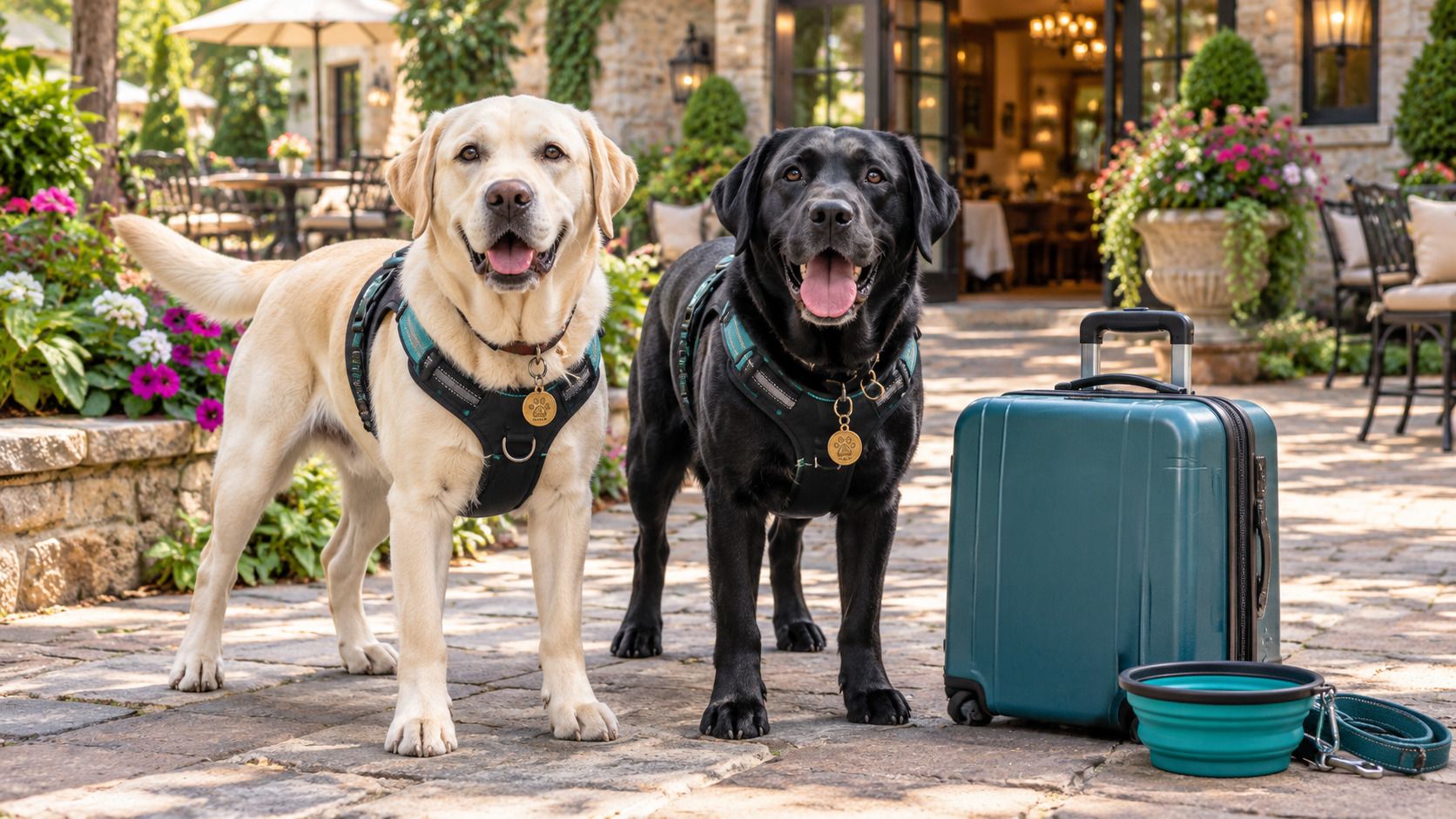
BringFido becomes particularly helpful after arrival. The same app can locate a nearby dog-friendly restaurant, walking area, veterinarian, groomer, or pet-supply store.
Qualifying hotel reservations completed through BringFido may be covered by its Pet Friendly Guarantee. However, that guarantee does not cancel a hotel’s stated conditions. Restrictions involving room type, animal size, number of pets, and undeclared animals still apply.
The service remains strongly dog-focused. A property described as pet-friendly may not accept cats, birds, rabbits, or other animals. Before booking, confirm:
- Accepted species
- Weight or breed limits
- Maximum number of pets
- Pet fees and deposits
- Permitted room types
- Rules for leaving a pet unattended
BringFido is an excellent discovery tool, but a direct confirmation with the property can prevent an unpleasant check-in surprise.
Explore pet-friendly vacation destinations here.
2. Roadtrippers: Best for Pet-Friendly Road-Trip Planning
Best for: Organizing accommodation and camping stops along a driving route.
BringFido helps travelers investigate individual places. Roadtrippers is better at arranging those places into a workable journey.
Users can create a route, add overnight stops, estimate travel time, and explore places near the planned drive. Its pet-friendly filter works within Hotels & Unique Stays, Places to Camp, and Campendium.
That limitation matters. Roadtrippers does not currently provide one universal pet-friendly filter for every attraction, restaurant, park, or roadside stop. A place appearing on the map should not automatically be treated as pet-friendly.
Its official place coverage focuses on the United States, Canada, Australia, and New Zealand. Travelers driving elsewhere may find the available data too limited. Some advanced trip-planning features also require a paid membership.
For a long drive, I would use Roadtrippers to establish the route and BringFido to research individual stops more closely. Together, they can help identify:
- Overnight accommodation
- Campgrounds reporting that they accept pets
- Breaks at reasonable driving intervals
- Parks and walking areas near the route
- Backup places to stay if plans change
Roadtrippers itself advises users to reconfirm pet policies because hotels and campgrounds can change their rules after a listing is published.
Check out pet travel accessories you can take in your car here.
3. USDA APHIS Pet Travel: Best for U.S. Rules and Paperwork
Best for: Researching official requirements for travel involving the United States.
USDA APHIS Pet Travel is a government web tool rather than a conventional app. For international journeys involving the United States, however, it may be more important than any commercial service.
The portal helps travelers investigate requirements for taking a pet from the U.S. to another country, bringing certain animals into the country, and moving pets between states. Depending on the destination, requirements may include:
- Microchip identification
- Rabies or other vaccinations
- Laboratory testing
- Parasite treatment
- Import permits
- Veterinary health certificates
- Government endorsement
Travelers leaving the United States may need to work with a USDA-accredited veterinarian. The veterinarian can review destination rules, examine the animal, prepare the required documents, and submit certificates for official endorsement when necessary.
Dogs entering the U.S. may also be subject to separate CDC requirements. At the time of writing, each dog entering the country requires a CDC Dog Import Form. Additional conditions depend on where the dog has been during the previous six months and whether its rabies vaccination was issued in the U.S. or abroad.
There is no single document or preparation timeline that covers every international journey. Rules may come from the departure country, destination, transit countries, airline, USDA, CDC, and local authorities.
Start early. Some tests, vaccinations, permits, and waiting periods cannot be completed a few days before departure.
4. IATA Traveler’s Pet Corner: Best for Flight Preparation
Best for: Understanding the basic requirements and welfare considerations of transporting a pet by air.
Airline pet policies can vary by carrier, route, aircraft, season, animal size, and breed. IATA Traveler’s Pet Corner provides a useful foundation for understanding how animals are transported on commercial flights.
Its guidance covers travel containers, advance preparation, documentation, feeding, cabin travel, and cargo transportation. IATA’s Live Animals Regulations also form an important industry standard for transporting animals safely.
The container guidance is especially useful. A suitable carrier should allow the animal to stand, sit, turn around, and lie in a natural position. However, a product advertised as “IATA-compliant” is not automatically accepted by every airline.
Contact the operating carrier directly to verify:
- Whether the animal may travel in the cabin
- Carrier dimensions and combined weight limits
- Required health documents
- Breed or age restrictions
- Seasonal temperature embargoes
- Check-in location and timing
- Advance reservation requirements
- Procedures for connecting or codeshare flights
Do not assume that two airlines involved in the same booking follow identical rules.
IATA also discourages routinely sedating animals during transport because sedation can cause adverse effects. Medication decisions should be discussed with a veterinarian and the airline well before departure.
IATA is an excellent preparation resource. It is not a substitute for the destination’s official rules or the operating airline’s current policy.
5. Tractive GPS: Best for Live Location Tracking
Best for: Monitoring a pet that could escape in an unfamiliar environment.
A pet can slip through a hotel door, pull free at a rest stop, or become disoriented in a new area. Tractive adds a layer of protection by displaying the location of a compatible tracker through its mobile app.
Available features include live tracking, virtual fences, escape notifications, and location history. The tracker uses a built-in SIM and cellular networks to send location information to the owner’s phone.
International use requires the Premium plan. Tractive states that this plan works in more than 175 countries where compatible cellular service and GPS reception are available. Its Basic plan works in one selected country.
Coverage should be checked before crossing a border. Even in a supported country, forests, mountains, and remote rural areas may have weak or unavailable cellular service.
Tractive also has practical limitations:
- The tracker must remain attached to the pet
- Its battery must be charged
- GPS reception is necessary
- Location updates depend on cellular coverage
- Remote areas may show only the last known position
- The device requires an ongoing subscription
A GPS tracker should complement a microchip and visible ID tag, not replace them. The tag offers immediate contact information, the tracker may help locate the animal, and the microchip provides permanent identification if the collar is lost.
6. American Red Cross Pet First Aid: Best for Emergency Guidance
Best for: Keeping first-aid instructions accessible while away from home.
The free American Red Cross Pet First Aid app provides step-by-step information about emergencies and everyday health concerns involving cats and dogs. Its content includes instructional videos, quizzes, and guidance for situations such as wounds, choking, seizures, breathing problems, and heat-related illness.
During a stressful incident, structured instructions may help an owner stay calm and take sensible immediate action. The app can also help identify warning signs that require urgent professional treatment.
It cannot examine an animal, perform diagnostic tests, administer treatment, or account for every medical condition. First aid may help until professional treatment becomes available, but it is not a replacement for veterinary care.
Before departing, save the following information outside the app as well:
- Your regular veterinarian’s telephone number
- A 24-hour veterinary hospital near the destination
- Emergency clinics along a long driving route
- Current medications and dosages
- Vaccination and medical records
- A pet poison-control service relevant to your location
Review the app before the journey instead of opening it for the first time during an emergency. Carrying a physical pet first-aid kit is equally important.
7. AllTrails: Best for Dog-Friendly Outdoor Trips
Best for: Finding walks and hikes that may allow dogs.
AllTrails is not exclusively designed for pet owners, but its dog-friendly filter makes it valuable for outdoor travel. Users can refine routes by distance, difficulty, elevation, length, and features such as forests, lakes, rivers, or waterfalls.
These filters can help owners avoid choosing a route that exceeds their dog’s fitness level. Paid Plus and Peak members can also download maps for offline navigation, which is useful in forests, parks, and rural areas with unreliable mobile service.
Download the required map before leaving coverage and confirm that it is stored on the device.
A dog-friendly label still requires further investigation. It does not necessarily mean:
- Dogs can be off-leash
- Every section permits animals
- The route is open throughout the year
- Drinking water is available
- The surface is safe in current weather
- The trail suits every dog
- Wildlife or livestock risks are absent
Check official notices from the park or land manager before setting out. Recent user reviews may describe mud, damaged paths, crowds, or closures, but official restrictions should take priority.
Weather deserves particular attention. A manageable route in cool conditions can become dangerous during extreme heat, snow, or storms.

8. Vetster: Best for Non-Emergency Veterinary Advice
Best for: Discussing mild symptoms or deciding whether local care is necessary.
Vetster connects pet owners with veterinary professionals through video appointments on the web and supported mobile apps. It can be helpful when an animal develops a minor or uncertain problem far from its regular clinic.
During a virtual appointment, a veterinarian may review symptoms, photographs, medical history, diet, medication, and changes in behavior. The consultation may help an owner decide whether monitoring is appropriate or an in-person examination is needed.
Access is not identical in every country. Provider coverage, app availability, appointment options, and the legal scope of virtual care depend on location.
The ability to diagnose or prescribe medication also varies. Veterinary professionals must follow the laws where they are licensed and where the animal is physically located. In some jurisdictions, a prescription may require an existing veterinarian-client-patient relationship or a previous physical examination.
A virtual appointment therefore does not guarantee medication. Vetster is not an emergency service.
Seek immediate in-person help for symptoms such as:
- Collapse or unconsciousness
- Seizures
- Uncontrolled bleeding
- Severe injury or pain
- A swollen abdomen
- Difficulty breathing
- Inability to urinate
Virtual veterinary care is most useful for non-emergency questions, follow-up guidance, and determining the appropriate next step.
9. Rover: Best for Temporary Care at the Destination
Best for: Finding a sitter, walker, daycare provider, or boarding service while traveling.
Rover is not a dedicated travel-planning app. Its value appears after travelers reach a destination.
A pet-friendly holiday may still include a museum, tour, restaurant, business meeting, or protected park area where animals are prohibited. Some hotels also forbid guests from leaving pets unattended in their rooms.
Depending on the market, Rover may help owners find:
- Overnight boarding
- House sitting
- Doggy daycare
- Dog walking
- Drop-in visits
Certain bookings may include photographs, messages, walk routes, and updates about food, water, or bathroom breaks through Rover Cards.
Finding an available profile is only the first step. Before leaving a pet with someone unfamiliar:
- Read recent verified reviews
- Arrange a meet-and-greet when possible
- Disclose behavior and escape risks
- Explain feeding and medication instructions
- Share veterinary and emergency contacts
- Ask whether other animals will be present
- Confirm sleeping and supervision arrangements
- Discuss emergency transportation
- Keep important communication on the platform
Rover operates across parts of North America and Europe, but services, identity checks, booking protections, and other features vary by location. Read the terms applying to the specific market and booking.
10. AAHA Universal Pet Microchip Lookup: Best for Checking Identification
Best for: Confirming which registry may hold a pet’s microchip information.
The AAHA Universal Pet Microchip Lookup Tool helps users identify which participating registry may contain information connected to a microchip number.
It does not register a chip, update contact details, or reveal private owner information. Instead, it identifies the registry that a pet owner, veterinary clinic, shelter, or recovery organization may need to contact.
Use the tool several weeks before travel:
- Ask a veterinary clinic to scan the chip.
- Confirm that the number matches your records.
- Enter the number into the lookup tool.
- Identify the relevant registry.
- Contact that registry directly.
- Update telephone numbers and addresses.
- Add an emergency contact where supported.
The service primarily covers chips distributed in the United States and searches only participating registries. Travelers in other countries may need a local or national lookup service.
A microchip is not a GPS device. It helps identify an animal after a clinic, shelter, or authority scans it. For stronger protection, combine a registered microchip with a visible ID tag and, when appropriate, a GPS tracker.
International travelers should also verify whether the chip format and implantation date satisfy the destination’s entry rules.
How to Combine Pet Travel Apps for Different Trips
Most people do not need every tool on this list. A smaller combination based on the actual journey will be more useful.
For a road trip
Use Roadtrippers to construct the route and BringFido to examine accommodation and stops. Add Tractive if the pet is prone to escaping, and keep the Red Cross Pet First Aid app available for emergencies.
For an international flight
Begin with the destination government and USDA APHIS when the U.S. is involved. Review IATA guidance, then confirm every detail with the operating airline and an accredited veterinarian.
For an outdoor holiday
Combine AllTrails with downloaded maps, current identification, a GPS tracker, and a physical first-aid kit. Check weather and official park notices before each outing.
For a city stay
Use BringFido to find accommodation, restaurants, parks, and attractions. Rover may help when an activity does not allow pets or the hotel prohibits leaving them unattended.
For an international relocation
Start with government requirements. Consider a professional pet shipper when the journey involves cargo transport, quarantine, customs, or several jurisdictions.
Choosing the Right Pet Travel Tools
BringFido is the most broadly useful starting point for an ordinary pet-friendly trip. Roadtrippers is the stronger route planner for drivers, while AllTrails helps with outdoor activities. Tractive provides additional reassurance for owners worried about an animal escaping.
For health support, the Red Cross app offers immediate first-aid guidance, and Vetster can assist with suitable non-emergency concerns. USDA APHIS and IATA become essential when a journey involves international borders or air transport.
The smartest approach is not to install every app available. Choose the pet travel apps that address the genuine risks in your itinerary. Then verify the details that matter most and prepare for moments when your battery, mobile connection, or preferred service may not be available.
A good app can make a trip easier. Careful preparation is what makes it safer.
Frequently Asked Questions about the best Pet Travel Apps
What is the best app for traveling with a dog?
BringFido is the strongest general-purpose choice for finding dog-friendly accommodation, restaurants, parks, attractions, and services. For a multi-stop driving journey, pair it with Roadtrippers.
Which app can help me find pet-friendly hotels?
BringFido specializes in pet-friendly accommodation and may show fees, size limits, and the number of permitted animals. Roadtrippers can also filter reported pet-friendly hotels and campsites. Confirm the current policy directly before booking.
Can a GPS pet tracker work internationally?
Some trackers can, but coverage depends on the device, subscription, cellular network, and destination. Tractive requires its Premium plan for international use across supported countries. GPS and compatible cellular coverage are still necessary.
What documents does a pet need for international travel?
Requirements depend on the species, origin, destination, transit countries, vaccination history, airline, and travel date. A microchip, rabies record, blood test, import permit, treatment record, or endorsed veterinary certificate may be required. Check government requirements and consult an accredited veterinarian early.
Are pet-friendly app listings always accurate?
No. Hotel policies, fees, trail restrictions, and access rules can change after a listing is published. Use pet travel apps for research, then verify essential information with the property, airline, park authority, veterinarian, or relevant government agency.