

OpenAI, the company behind ChatGPT, is on the verge of launching its own AI-powered web browser—a move that could mark one of its most ambitious expansions yet. According to people familiar with the development, the browser is expected to go live in the coming weeks and is designed to reshape how users experience the internet by deeply integrating artificial intelligence into the browsing process.
The goal is to offer a smarter and more efficient alternative to existing browsers, especially Google Chrome, which currently dominates the market. With over 3 billion active users globally, Chrome is not just a tool for browsing; it plays a central role in Google’s massive advertising business by collecting user behavior data and driving search traffic to its engine. OpenAI’s browser could threaten this system by offering a fundamentally different approach.
An AI-Driven Browsing Experience
OpenAI’s new browser isn’t just a traditional browser with AI features tacked on. Instead, it aims to redesign how people interact with the internet. Unlike standard browsers that require users to manually navigate through search results and websites, OpenAI’s browser will keep many interactions within an intelligent, ChatGPT-style interface.
This means that instead of opening a dozen tabs to complete tasks, users might simply ask the AI to book a flight, fill out a form, or summarize content—all without leaving the native interface. It’s a shift from passive browsing to active task completion, where AI plays the role of both assistant and navigator.
This approach is part of a broader vision by OpenAI to integrate its services more deeply into both the personal and professional lives of users. As of mid-2025, ChatGPT is already being used weekly by an estimated 400 million people, and over 3 million businesses subscribe to its premium services. A web browser could serve as a natural next step in expanding this ecosystem.
Potential Impact on Google and Online Advertising
Google Chrome plays a critical role in Alphabet Inc.’s advertising dominance. Chrome helps Google collect vast amounts of behavioral data, which is then used to deliver personalized ads and optimize its advertising algorithms. According to financial filings, advertising contributes nearly 75% of Alphabet’s total revenue.
OpenAI’s browser, if widely adopted, could disrupt this model. By keeping many interactions within its own AI environment, OpenAI would reduce the need for users to visit ad-supported websites or interact with Google Search. This would limit the data Google collects and potentially reduce the effectiveness of its ad targeting systems.
Moreover, OpenAI would gain access to new streams of user data—something it lacks when operating purely through APIs or browser plug-ins. This data would be invaluable for improving its AI models, especially its planned AI agents designed to take actions on users’ behalf.
A Browser Built on Familiar Technology
OpenAI’s upcoming browser is reportedly being built on Chromium, the same open-source codebase used by Google Chrome, Microsoft Edge, Opera, and other popular browsers. Chromium provides a stable foundation while allowing companies to customize the user experience and integrate their own features.
By building its own full browser rather than releasing a plugin for existing browsers, OpenAI ensures greater control over how data is processed and used. This also gives the company flexibility to tightly integrate its own AI features, such as its upcoming AI agent tool Operator, directly into the browser interface.
This shift represents a strategic change from OpenAI’s earlier browser integrations through plugins and extensions. It now aims to fully own the browser environment, collecting user behavior data and optimizing its services based on real-time feedback.
AI Agents to Power Everyday Tasks
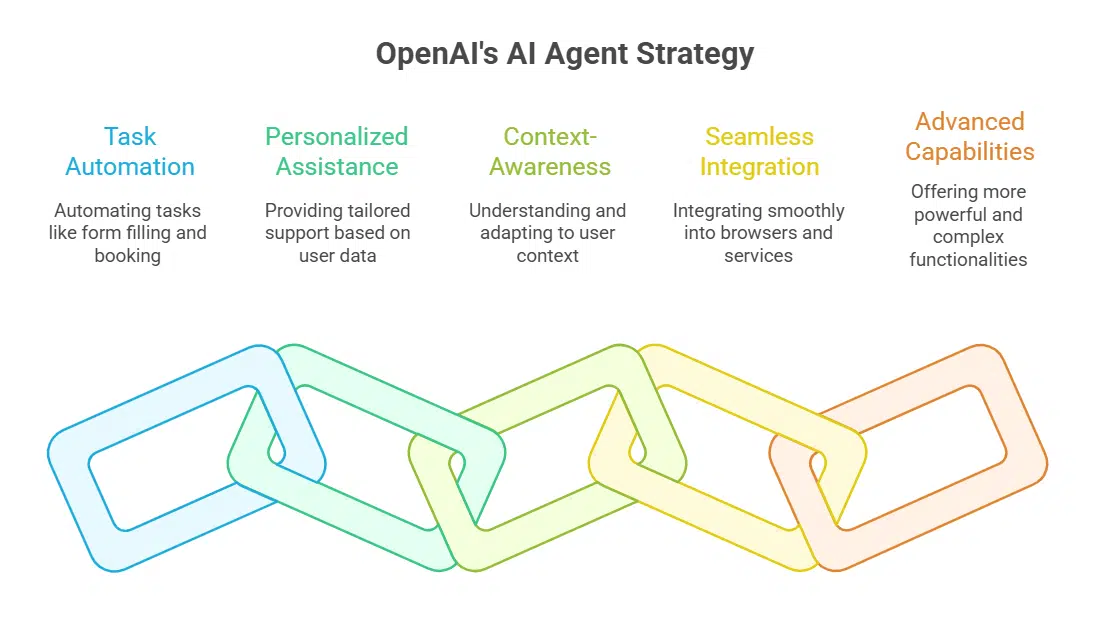
A key component of OpenAI’s browser strategy involves the use of intelligent AI agents—digital assistants that can complete tasks for users without constant instruction. These agents can be integrated directly into the browser, enabling seamless actions like auto-filling forms, booking appointments, making purchases, and more.
With access to the user’s browsing activity, preferences, and history, these agents can operate more effectively, offering personalized assistance across a range of websites and applications. This capability positions OpenAI to lead the next evolution of internet use: moving from passive search to active task delegation.
The vision is similar to how voice assistants like Alexa or Siri operate—but far more powerful, context-aware, and capable of navigating complex websites and services.
Competition in the AI Browser Space
OpenAI’s entry into the browser market won’t go uncontested. Several AI-focused companies are already experimenting with similar products. For example:
-
The Browser Company, known for developing the Arc browser, has added AI features that enhance user productivity.
-
Brave, a privacy-first browser, has incorporated tools that summarize articles and provide AI-powered search support.
-
Perplexity, an emerging AI search engine startup backed by major investors, just launched its own AI browser called Comet in July 2025. Comet is designed to provide search-driven browsing with integrated AI responses.
These companies are all exploring how AI can streamline internet usage, automate repetitive tasks, and offer more value than traditional search engines and browsers.
Strategic Hires and Ambitious Goals
OpenAI has made strategic hires to support this initiative. In 2024, the company recruited two senior executives from Google who had played key roles in the early development of Chrome. These experienced engineers are now leading efforts to bring OpenAI’s browser to life.
The company had reportedly considered building a browser in the past but only recently committed to full-scale development. According to testimony in a U.S. antitrust case, an OpenAI executive even suggested that OpenAI would be interested in purchasing Chrome if regulators forced Alphabet to divest the browser.
While Google has not made Chrome available for sale and has appealed the antitrust ruling that labeled it a monopoly, the fact that OpenAI entertained the idea shows the scale of its ambition.
Regulatory Context and Monopoly Concerns
The U.S. Department of Justice has taken increasing interest in Google’s control over digital markets. In 2023, a federal judge ruled that Google held an unlawful monopoly in search and online advertising, citing Chrome as a core asset in its dominance. Regulators have since called for Chrome’s divestiture, although the case is still under appeal.
By entering the browser space now, OpenAI positions itself to benefit from any future changes in the competitive landscape. If regulatory actions weaken Google’s grip on browser distribution, OpenAI could quickly gain ground with its AI-native alternative.
A Natural Extension of OpenAI’s Ecosystem
This new browser is not an isolated product—it fits within a broader plan. Earlier in 2025, OpenAI acquired io, a hardware startup led by former Apple design chief Jony Ive, in a $6.5 billion deal. This move signaled OpenAI’s entry into consumer hardware.
Combining an AI browser with future AI devices could allow OpenAI to control both the software and hardware environments users interact with. It could pave the way for a unified AI-powered ecosystem that spans mobile, desktop, and physical devices—similar to how Apple created an integrated experience through iPhone, Mac, and Safari.
What Happens Next
OpenAI has not officially confirmed or commented on the browser’s development, and sources familiar with the project have remained anonymous due to confidentiality agreements. However, based on multiple reports and internal developments, the launch appears imminent.
If OpenAI’s browser gains traction with its massive ChatGPT user base, it could reshape not just how we browse—but how we interact with the internet entirely. It represents a step toward a future where AI is not just a tool we consult but an assistant that manages our digital lives on our behalf.
OpenAI’s upcoming AI browser could challenge Google Chrome’s dominance, reduce Google’s advertising reach, and redefine the future of online interaction. By merging AI with daily web use, OpenAI is betting on a future where users spend less time searching and more time getting things done—with AI at the helm.
Whether it will disrupt the industry as dramatically as ChatGPT did in 2022 remains to be seen. But one thing is clear: the browser wars are entering a new phase—one powered by artificial intelligence.





















