

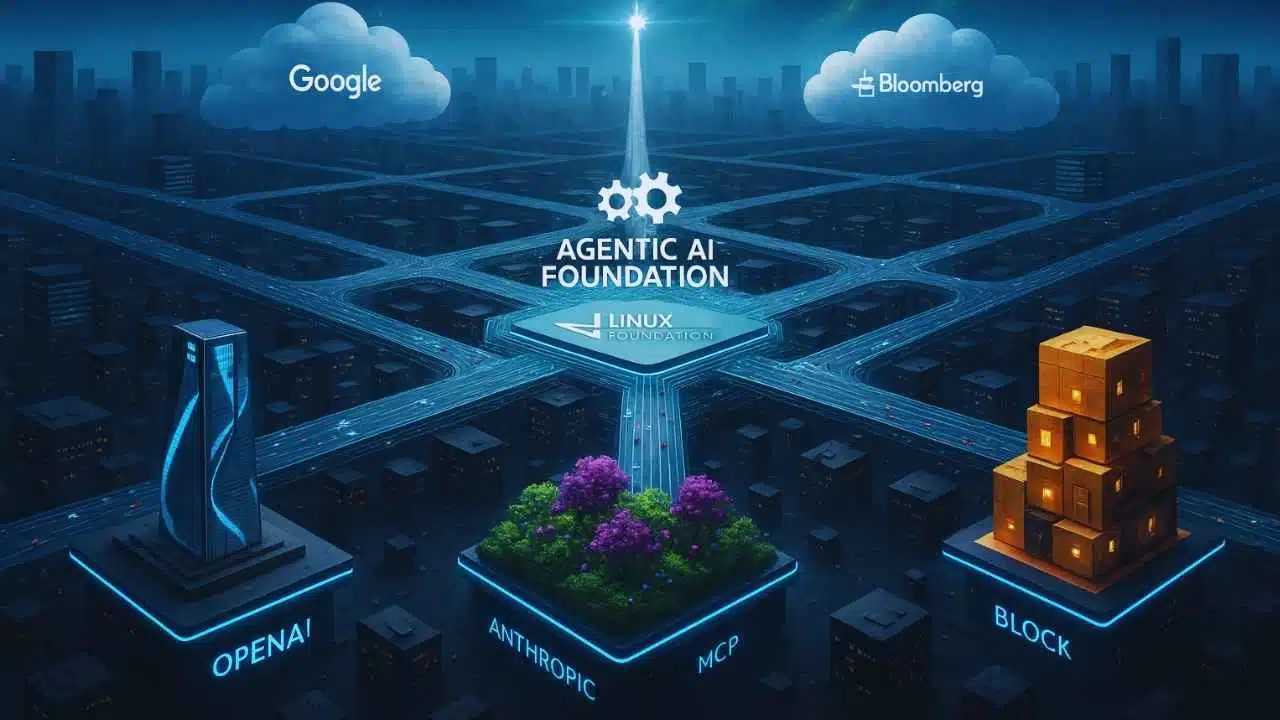
OpenAI, Anthropic, and Block have jointly launched the Agentic AI Foundation, a major new initiative under the Linux Foundation designed to create open standards for the rapidly growing field of autonomous AI systems. These systems, often called “agentic AI,” are capable of planning, reasoning, and executing tasks with minimal human intervention. The foundation marks one of the most coordinated industry efforts yet to ensure these emerging technologies develop in a safe, secure, and interoperable way.
The coalition is not limited to the three founding contributors. Major technology companies, including Amazon Web Services, Bloomberg, Cloudflare, Google, and Microsoft, have joined as platinum members, signaling strong industry alignment around the need for shared rules and technical frameworks. This level of collaboration reflects rising recognition that autonomous AI will become deeply embedded in both consumer and enterprise environments—and will require standardization to function reliably across platforms.
Key Technologies Contributed to Build a Unified Framework
Each of the foundation’s founding companies has contributed widely adopted technologies that already play foundational roles in the AI ecosystem. Anthropic offered its Model Context Protocol (MCP), originally created in 2024 to help its internal teams connect AI systems to data and tools. MCP has since gained immense traction, with more than 10,000 published servers and integrations across major platforms including ChatGPT, Google Gemini, Microsoft Copilot, and Visual Studio Code.
OpenAI contributed AGENTS.md, a markdown-based specification introduced in 2025. Used by more than 40,000 open-source projects, it provides AI coding agents with project-specific instructions, enabling consistent behavior across different development environments. Similarly, Block donated Goose, its open-source framework that allows developers to build, orchestrate, and deploy AI agents more efficiently.
Together, these contributions form the backbone of the foundation’s work: creating a consistent, open environment where agents built by different developers and systems can understand each other, share data, and collaborate securely. The Linux Foundation’s leadership emphasized that these tools have quickly become indispensable for developers and will only grow in importance as autonomous AI evolves.
Increasing Momentum Behind Autonomous AI Adoption
The launch of the Agentic AI Foundation coincides with rapid enterprise adoption of agentic systems. Organizations are testing and deploying AI capable of handling tasks such as workflow automation, data analysis, customer interactions, content generation, and multi-step decision-making. Leaders at the foundation noted that the technology is moving from conversational assistants to autonomous agents that can operate independently and work in coordinated systems.
Still, the shift raises challenges. Security risks—particularly around tool access, interoperability, and permissioning—require careful governance. Inter-agent communication must be standardized to prevent fragmentation. Companies have expressed concerns about building on proprietary ecosystems that may limit flexibility, prompting calls for open standards to ensure long-term stability and trust.
A Push for Openness and a Clear Vision for the Future
Block’s leadership emphasized that the next decade of AI development will be shaped by decisions made now—either keeping the technology locked behind closed systems or ensuring it remains open and widely accessible. OpenAI echoed that sentiment, noting that cross-provider communication will be essential as companies adopt multiple AI models and agent systems.
By creating a shared, community-driven foundation, the Agentic AI Foundation aims to guide AI toward transparency, interoperability, and responsible innovation. As autonomous agents continue to mature, the foundation’s work may become a defining influence on how AI collaborates, scales, and integrates across every sector of the digital economy.





















