
Highlights:
- There is a notable rise in the availability of digital resources across all levels of education.
- Today, most educational settings use a mix of technologies and traditional printed materials.
- While there are some cost benefits and improved access linked with digital resources, they also pose some obstacles.
The position of digital resources is taking center stage in the changing American education sector. Technological advancements and the need for distance learning have fast-tracked this transformation as seen from online study materials to digitized books which are gradually replacing the old printed versions. This article investigates if there is any possibility for online study materials to take over from conventional textbooks and also outlines the changing nature of American schooling with respect to such kinds of digital tools or resources available nowadays.
The Effectiveness of Digital vs. Traditional Resources
Research done in the health education sector by the American Journal of Pharmaceutical Education showed that there is minimal difference in the ability to read between the students who use digital text and those who use print text. However, it emerged that students achieved slightly better grades when they read from print materials pertaining to their respective disciplines. According to research at the University of Valencia, print reading is capable of enhancing one’s skills six to eight times better than digital reading.
It is evident from teachers that even those referred to as digital natives may have difficulties in understanding written information displayed on screens, especially at the lower and middle levels of education. This indicates that although it is convenient to use online notes and e-books, printed material could enhance memory with regard to difficult reading activities. These distinctions are minor in many cases and there is ongoing research on ways to bridge any divide such as through interactive e-books and teaching students how to read effectively with digital devices. With the option to get an Ivy League level of education online without any print material nowadays as shared by an article in Newsweek, the competence of online learning has reached new heights and will continue to evolve.
Adoption Rates of Digital Resources
There was a high rate of adoption of digital learning tools during the COVID-19 pandemic. For example, most K-12 schools moved towards 1:1 device programs. Prior to the outbreak, it was observed that such an initiative was missing in at least one-third and two-fifths of the districts having middle/high school-going children and elementary school-going kids respectively. However, a report by The Screentime Consultant showed that over 90% of districts offered every student at the secondary level a device while 84% did so for those in elementary grades.
The usage of digital instructional materials increased significantly on a daily basis from before the pandemic when 28% of teachers used them, to 52% in 2022. There has been an equally significant transformation in higher education. In 2022, about 20% of the college courses still needed students to buy a print textbook which has currently reduced to less than 10%. Most courses had e-books by 2024; almost every mandatory textbook could be found in a digital format according to a report by the National Institutes of Health [NIH].
Student and Teacher Preferences
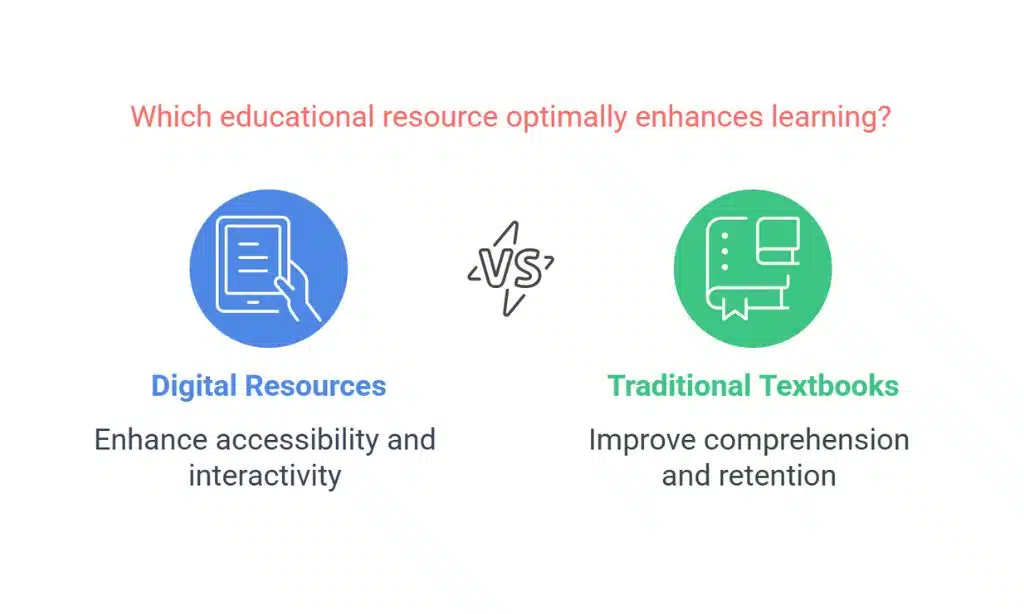
Many educators and pupils prefer using the customary learning resources despite the increase in digital content. Research shows that a majority of teachers in kindergarten to grade twelve feel that students comprehend more when they read printed books. For instance, one such poll carried out by Bay View Analytics in the 2023-2024 academic years indicated that 57% of teachers were of the opinion that “students learn better from print” while only 9% took the opposite view. It is also stated from similar research data that 61 % of all K-12 teachers admitted to favoring traditional over technological resources.
There is a mixture of what students like. The majority of college students prefer printed books because they are easy to read and enhance concentration, as well as being able to underline and write on paper. On the other hand, kids like hard-copy materials though it is common for them to take soft notes and research from Google as well. Today, a significant number of K-12 learners have developed a habit of seeking solutions from online resources thereby indicating their preference for digital aids available nowadays.
Trends in Policies and School Practices
Digital learning is now seen as a common feature in education policies. It was observed by NCES [National Center for Education Statistics] that 96% of public schools offered gadgets for out-of-school students who might require them. Districts also channeled resources towards the enhancement of Wi-Fi hotspots and internet connectivity to close the “digital divide.” Numerous states promoted or enforced emergency remote studying alternatives thereby making e-learning part and parcel of school systems today.
A combination of both is the current focus for educational regulations. In most schools today, teachers must upload homework and study aids on the internet, a practice that applies to physical class settings too; this ensures that pupils who are absent or their parents can still be able to see such materials. Besides, it is becoming more apparent that children in elementary and secondary education should acquire knowledge about digital technologies because some areas have included “media literacy” as well as “digital note taking” among other things into their grade level expectations.
Transforming Access to Learning Materials
The emergence of digital study resources has fundamentally altered student access to learning materials. Students can now access class notes, revision guides, and various documents to get help with their exam preparation on Studocu platform conveniently at any time or place. For instance, rather than relying solely on conventional textbooks, class notes shared by students—offer multiple perspectives and highlight key concepts, thereby helping students grasp the information more easily.
Takeaways
To sum up, there has been a transformation in learning through online study materials and digital instruments. These have increased the ease of acquiring knowledge and made it possible for many people to learn at the same time through technology. In addition, they have helped to cut off certain economic obstacles, as well as ensure that education goes on during difficult times.
It is evident that well-employed digital tools could be as good as or better than the traditional ones because they offer customization and are interactive according to various studies. The focus has shifted from whether digital print materials should be used to how best both can be applied; this is meant to secure the changing American educational needs and continue adapting appropriately in an ever-transforming global environment.