
Every calendar day carries the weight of centuries—moments when scientific breakthroughs altered our understanding of the cosmos, political showdowns redefined national borders, and artistic geniuses were born or bid farewell. October 22 stands out as a date filled with pivotal historical moments that reverberate through modern geopolitical, scientific, and cultural landscapes.
From the launch of India’s pioneering lunar probe Chandrayaan-1 to the high-stakes nuclear drama of the Cuban Missile Crisis, and from the tragic loss of Bengal’s master poet Jibanananda Das to the end of Mao Zedong’s epic Long March, October 22 has shaped human destiny in profound ways.
Below is an archive and detailed historical exploration of October 22 across the Bangalee sphere, the broader Indian subcontinent, and the global arena.
The Bangalee Sphere & South Asian Subcontinent
The Bengal region and the broader Indian subcontinent have witnessed crucial cultural shifts, scientific achievements, and political turning points on October 22.
Historical Breakthroughs & Conflicts
2008 – Launch of Chandrayaan-1: India’s First Moon Mission
On October 22, 2008, at 06:22 IST, the Indian Space Research Organisation (ISRO) launched Chandrayaan-1 aboard a PSLV-C11 rocket from the Satish Dhawan Space Centre in Sriharikota, Andhra Pradesh. The 1,380-kilogram spacecraft carried 11 scientific payloads—five developed in India and six from international agencies including NASA and the European Space Agency (ESA).
During its operational period, Chandrayaan-1 released the Moon Impact Probe (MIP), which struck the lunar south pole near Shackleton Crater. Data captured by NASA’s onboard Moon Mineralogy Mapper ($M^3$) yielded the historic discovery of water molecules ($\text{H}_2\text{O}$ and $\text{OH}$) bound to lunar surface soil, particularly near the polar regions. This discovery fundamentally altered global lunar science, proving that the Moon possessed resources capable of supporting future human bases and establishing South Asia as a major deep-space power.
1947 – Invasion of Kashmir (Operation Gulmarg)
On October 22, 1947, armed Pashtun tribesmen from Pakistan’s North-West Frontier Province, backed and organized by elements of the Pakistani military under Operation Gulmarg, crossed the border into the princely state of Jammu and Kashmir. Moving along the Jhelum River valley, the forces advanced toward Muzaffarabad and Baramulla.
Facing an immediate military threat, Maharaja Hari Singh appealed to the Indian government for assistance and signed the Instrument of Accession on October 26, 1947. This event sparked the First Indo-Pakistani War, resulting in the division of Kashmir along the Line of Control (LoC)—a territorial dispute that remains a major geopolitical flashpoint in South Asia.
Bangalee Births & Cultural Icons
Masum Aziz (1953 – 2022)
Born in Pabna, Masum Aziz was a celebrated Bangladeshi stage, television, and film actor and playwright. He began his acting career during his student days at Chittagong University, joining the theater troupe “Gano Natya Dal”. Over four decades, Aziz portrayed nuanced characters depicting rural life, social injustice, and human struggle in over 400 television dramas and acclaimed films such as Ghani (2006). In recognition of his profound contribution to Bangladeshi culture, he was awarded the Ekushey Padak in 2022, Bangladesh’s second-highest civilian honor.
Alam Khan (1943 – 2022)
Alam Khan was a titan of Bangladeshi cinema music whose career spanned over fifty years. Making his debut as an independent music director in the 1970 film Kach Kata Heera, he composed timeless melodies that defined generations of Bengali cinema. Hits like Orey Nil Dariya, Hayre Manush Rongin Fanush, and Dakiyachhen Awalia became anthems across Bangladesh and West Bengal. A master of orchestral arrangement and folk integration, Khan won seven Bangladesh National Film Awards for Best Music Director.
Swami Rama Tirtha (1873 – 1906)
Born in Gujranwala, Swami Rama Tirtha was a distinguished philosopher and teacher of Practical Vedanta. A brilliant mathematician who lectured at Forman Christian College in Lahore, he later renounced worldly life to propagate Vedantic philosophy worldwide. During his tours of the United States and Japan between 1902 and 1904, he delivered lectures linking spiritual self-realization with social reform, patriotism, and education, influencing early 20th-century anti-colonial thinkers across South Asia.
Bangalee & Subcontinent Deaths: End of Era Figures
Jibanananda Das (1899 – October 22, 1954)
The Bengali literary world suffered an irreparable loss on October 22, 1954, when poet, novelist, and essayist Jibanananda Das passed away at Kolkata’s Sambhunath Pandit Hospital, eight days after being hit by a tram near Deshapriya Park.
Often referred to as Ruposhi Banglar Kabi (“Poet of Beautiful Bengal”), Das struggled for recognition during his lifetime while working as an academic in Barisal, Delhi, and Kolkata. Posthumously, his poetry achieved monumental stature. Masterpieces such as Banalata Sen, Dhusar Tulot, Maha Prithibi, and Ruposhi Bangla introduced surrealism, ecological imagery, complex rhythm structures, and deep existential introspection into Bengali literature. Today, he is recognized as the definitive modernist voice in Bengali poetry after Rabindranath Tagore and Kazi Nazrul Islam.
Khawaja Nazimuddin (1894 – October 22, 1964)
Scion of the Dhaka Nawab family, Khawaja Nazimuddin was a prominent political figure in British India and Pakistan. He served as the Prime Minister of Bengal (1943–1945), the first Chief Minister of East Bengal following Partition in 1947, the 2nd Governor-General of Pakistan (1948–1951), and subsequently the 2nd Prime Minister of Pakistan (1951–1953).
On January 27, 1952, speaking at a public meeting at Paltan Maidan in Dhaka, Nazimuddin reiterated the central government’s stance that Urdu alone would be the state language of Pakistan. This statement outraged students and intellectuals in East Bengal, catalyzing the historic Bengali Language Movement (Bhasha Andolon) that culminated in the events of February 21, 1952. The movement established the foundational narrative for Bengali political autonomy and eventual national independence in 1971.
Maharaja Duleep Singh (1838 – October 22, 1893)
The youngest son of Maharaja Ranjit Singh, Duleep Singh was proclaimed Maharaja of the Sikh Empire in 1843 at the age of five. Following the defeat of the Sikh kingdom in the Second Anglo-Sikh War in 1849, the ten-year-old monarch was deposed by the British East India Company, forced to surrender the famous Koh-i-Noor diamond to Queen Victoria, and exiled to England. He spent his adult life in Britain as a wealthy aristocrat before attempting to return to India in his later years to reclaim his sovereign rights. He died in poverty in Paris on October 22, 1893.
International Observances & Holidays
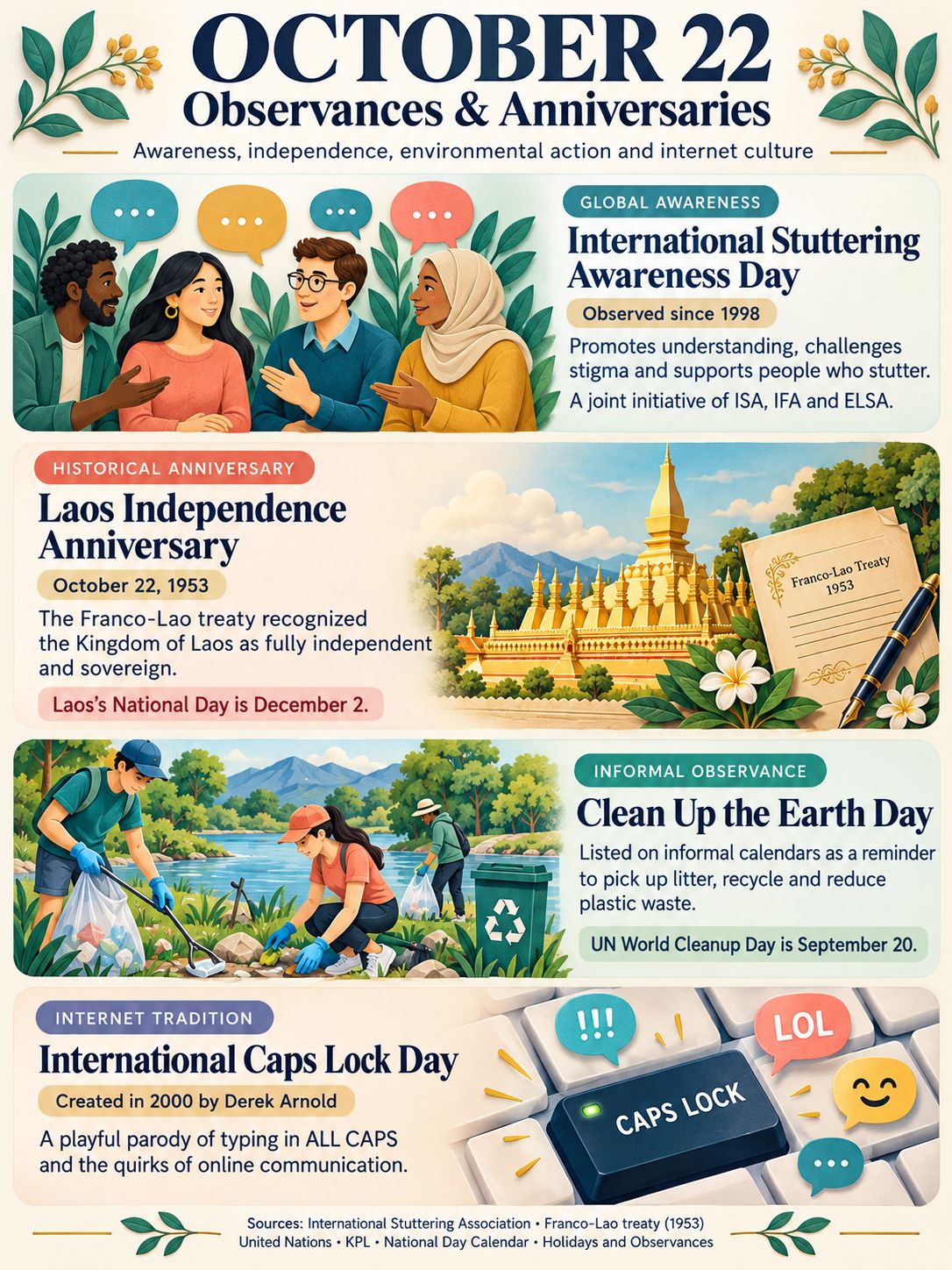
October 22 is marked by several globally recognized observances dedicated to health advocacy, environmental protection, and national sovereignty.
-
International Stuttering Awareness Day (ISAD): Established in 1998 through the combined efforts of the International Stuttering Association (ISA), the European League of Stuttering Associations (ELSA), and the International Fluency Association (IFA). Observed annually on October 22, ISAD promotes public education, combats social discrimination, and builds support networks for over 70 million people worldwide who experience speech fluency disorders.
-
Laos Independence Day (1953): On October 22, 1953, France signed the Franco-Lao Treaty of Amity and Association in Paris, transferring full constitutional sovereignty and independence to the Kingdom of Laos after six decades of French colonial rule within French Indochina.
-
Clean Up the Earth Day: An annual environmental awareness initiative encouraging local action, community recycling drives, river restoration projects, and plastic waste reduction around the world.
-
International Caps Lock Day: Created in 2000 by software developer Derek Arnold as a lighthearted internet tradition, this day pokes fun at digital communication quirks and online formatting standards.
Global History
Beyond South Asia, October 22 has been the setting for major geopolitical shifts, scientific advancements, and historical events across every continent.
United States
1962 – Cuban Missile Crisis: JFK Addresses the Nation
At 7:00 PM EST on October 22, 1962, US President John F. Kennedy delivered a 17-minute nationwide televised address revealing that American U-2 reconnaissance aircraft had discovered medium-range Soviet nuclear missile sites under construction in Cuba. Kennedy announced an immediate naval “quarantine” (blockade) around Cuba to intercept defensive and offensive military shipments.
This address marked the public onset of the 13-day Cuban Missile Crisis, bringing the United States and the Soviet Union closer to direct nuclear confrontation than at any other point in history. The standoff ended six days later when Soviet Premier Nikita Khrushchev agreed to dismantle and withdraw the missiles in exchange for a public US pledge not to invade Cuba and a secret agreement to remove US Thor and Jupiter missiles from Turkey.
1879 – Edison Tests the Practical Incandescent Electric Lamp
At his research facility in Menlo Park, New Jersey, inventor Thomas Edison successfully conducted a continuous test of an incandescent electric lamp using a carbonized cotton thread filament inside a high-vacuum glass bulb. The prototype light bulb illuminated continuously for 13.5 hours before the filament burned out.
Edison’s breakthrough demonstrated the practical viability of long-lasting electric indoor lighting. This test paved the way for U.S. Patent 223,898, the establishment of the Edison Electric Light Company, and the rollout of centralized electrical power grids across modern cities.
Additional US Historical Milestones
-
1746 – Chartering of Princeton University: The College of New Jersey received its official royal charter on October 22, 1746. Later renamed Princeton University, it developed into one of the world’s most prestigious academic institutions.
-
1836 – Inauguration of Sam Houston: Sam Houston was sworn in as the first constitutionally elected President of the Republic of Texas following its separation from Mexico.
-
1979 – Exiled Shah of Iran Arrives in New York: Deposed Iranian Shah Mohammad Reza Pahlavi entered the United States for specialized cancer treatment. The decision outraged revolutionary groups in Tehran, directly sparking the storming of the US Embassy and the 444-day Iran Hostage Crisis on November 4, 1979.
Russia & Eurasia
1721 – Proclamation of the Russian Empire
Following the victory over the Swedish Empire in the Great Northern War (1700–1721) and the signing of the Treaty of Nystad, Tsar Peter I (Peter the Great) was officially proclaimed Emperor of All Russias (Imperator Vserossiysky) by the Governing Senate and Holy Synod on October 22, 1721. This proclamation marked Russia’s formal transformation from a regional Tsardom into a major European empire with its capital at Saint Petersburg.
China & East Asia
1936 – Conclusion of the Long March
On October 22, 1936, the First, Second, and Fourth Front Armies of the Chinese Red Army successfully joined forces at Huaning in Shaanxi province. This historical meeting marked the end of the Long March—a 6,000-mile (9,600 km) strategic retreat across mountains, swamps, and rivers to escape encirclement by Nationalist (Kuomintang) forces under Chiang Kai-shek.
The successful retreat preserved the core cadre of the Chinese Communist Party (CCP) and established Mao Zedong’s undisputed leadership over the party, setting the stage for the CCP’s eventual victory in the Chinese Civil War in 1949.
1633 – Battle of Liaoluo Bay
Off the coast of Fujian province, a Ming Dynasty fleet commanded by Admiral Zheng Zhilong engaged and decisively defeated a joint armada of the Dutch East India Company (VOC) and allied pirate fleets led by Hans Putmans. The Ming victory re-established Chinese control over trade routes in the Taiwan Strait and South China Sea, forcing the Dutch to pay tributes and license fees for maritime commerce.
United Kingdom & Commonwealth
1884 – Greenwich Adopted as the Prime Meridian ($0^\circ$ Longitude)
On October 22, 1884, delegates representing 25 nations at the International Meridian Conference in Washington, D.C., voted to adopt the transit instrument at the Royal Observatory in Greenwich, London, as the Prime Meridian of the world.
The selection of Greenwich established an international standard for geographic mapping, air and sea navigation, and global time measurement via Greenwich Mean Time (GMT), establishing the framework for modern global time zones.
Continental Europe
1797 – World’s First High-Altitude Parachute Jump
French balloonist and engineer André-Jacques Garnerin made the world’s first successful high-altitude parachute descent over Parc Monceau in Paris on October 22, 1797. Garnerin ascended to an altitude of approximately 3,200 feet (1,000 meters) in a hydrogen balloon before severing the cord attaching his umbrella-like canvas parachute to the basket.
1981 – Commercial Debut of the French TGV High-Speed Train
French President François Mitterrand inaugurated commercial service for the Train à Grande Vitesse (TGV) between Paris and Lyon on October 22, 1981. Operating at speeds exceeding 260 km/h (160 mph), the electric train transformed European passenger transportation and inspired high-speed rail networks globally.
Rest of World
-
Canada (1844): Birth of Louis Riel, Métis political leader, founder of the province of Manitoba, and leader of the Red River and North-West Resistances. Riel fought to protect Métis land rights, language, and culture against federal encroachment, remaining an influential figure in Canadian history.
-
Australia (1913): The first fleet unit of the newly established Royal Australian Navy, led by the battlecruiser HMAS Australia and accompanied by cruisers and destroyers, sailed into Sydney Harbour to take over naval defense duties from the British Royal Navy.
-
Haiti (1957): François “Papa Doc” Duvalier was sworn in as President of Haiti. Duvalier established a totalitarian regime enforced by his secret police force, the Tonton Macoute, ruling until his death in 1971.
Notable Births & Deaths
October 22 marks the anniversaries of historical figures who made lasting contributions across music, science, literature, politics, photojournalism, and athletics.
Famous Birthdays
-
Franz Liszt (1811 – 1886): Hungarian Romantic composer, conductor, and piano virtuoso. Widely considered one of the greatest pianists of all time, Liszt invented the symphonic poem, composed the celebrated Hungarian Rhapsodies, and transformed concert performance through his dramatic technical skill.
-
Ivan Bunin (1870 – 1953): The first Russian author to receive the Nobel Prize in Literature (1933). Renowned for his classic works including The Village, The Gentleman from San Francisco, and Dark Avenues, Bunin preserved traditional Russian classical prose in exile following the 1917 Revolution.
-
Clinton Davisson (1881 – 1958): American physicist at Bell Telephone Laboratories who was co-awarded the 1937 Nobel Prize in Physics with George Paget Thomson. His Davisson-Germer experiment experimentally demonstrated the wave nature of electrons, providing foundational proof for quantum mechanics.
-
Robert Capa (1913 – 1954): Born Endre Ernő Friedmann in Budapest, Capa was a combat photojournalist who covered five major conflicts: the Spanish Civil War, the Second Sino-Japanese War, World War II (including the D-Day landing at Omaha Beach), the 1948 Arab-Israeli War, and the First Indochina War. In 1947, he co-founded Magnum Photos.
-
Bobby Seale (1936 – Present): Civil rights activist who co-founded the Black Panther Party for Self-Defense alongside Huey P. Newton in Oakland, California, in 1966. Serving as the party’s National Chairman, Seale organized community survival programs, including free breakfast programs for children and community health clinics.
-
Arsène Wenger (1949 – Present): French football manager and executive who managed Arsenal Football Club from 1996 to 2018. Wenger modernized English football through advancements in player nutrition, conditioning, and international scouting, leading Arsenal to three Premier League titles—including the undefeated “Invincibles” season of 2003–04.
Famous Deaths
-
Charles Martel (686 – 741): Frankish statesman and military commander who served as Mayor of the Palace. His decisive victory over the Umayyad Caliphate at the Battle of Tours in 732 halted Islamic expansion into Western Europe and laid the foundation for the Carolingian Empire under his grandson, Charlemagne.
-
Paul Cézanne (1839 – 1906): French Post-Impressionist painter whose work laid the stylistic foundations for the transition from 19th-century Impressionism to 20th-century Cubism. His exploration of structural form, planes, and color composition profoundly influenced artists like Henri Matisse and Pablo Picasso.
-
Pablo Casals (1876 – 1973): Catalan cellist, conductor, and composer widely regarded as the preeminent cellist of the 20th century. Casals brought Johann Sebastian Bach’s long-forgotten Cello Suites back to light, recording them for the first time and establishing them as core classical masterworks.
-
Kingsley Amis (1922 – 1995): Prolific English novelist, poet, and critic. Author of over 20 novels including Lucky Jim (1954) and the Booker Prize-winning The Old Devils (1986), Amis was a leading literary voice in post-war Britain.
-
Fernando Valenzuela (1960 – 2024): Mexican Major League Baseball pitcher for the Los Angeles Dodgers. In 1981, he sparked “Fernandomania” by winning his first eight starts—including five shutouts—and becoming the only player in MLB history to win both the NL Rookie of the Year and NL Cy Young Award in the same season.
“Did You Know?” Historical Trivia
-
The Prime Meridian Vote Had Holdouts: When Greenwich was chosen as the world’s Prime Meridian on October 22, 1884, the international vote was not unanimous. San Domingo (Dominican Republic) voted against the proposal, while France and Brazil abstained. France continued using the Paris Meridian ($2^\circ 20’$ E) on its maps until 1911.
-
The First Parachute Jump Had No Safety Vent: André-Jacques Garnerin’s umbrella-like canvas parachute on October 22, 1797, was designed without an oscillation vent at the top apex. As compressed air attempted to escape from under the canvas canopy during his 3,200-foot drop over Paris, the basket swayed wildly from side to side, giving Garnerin severe motion sickness before his safe landing.
-
The Great Disappointment: On October 22, 1844, tens of thousands of Millerites (followers of American preacher William Miller) gathered on hilltops across the United States expecting the Second Coming of Jesus Christ based on mathematical interpretations of Daniel 8:14. When dawn arrived on October 23 without incident, the event became known in religious history as “The Great Disappointment,” leading to the eventual formation of the Seventh-day Adventist Church.
Quote of the Day
“The path we have chosen for the present is full of hazards, as all paths are; but it is the one most consistent with our character and courage as a nation and our commitments around the world. The cost of freedom is always high, but Americans have always paid it.”
— John F. Kennedy, 35th President of the United States (Spoken on October 22, 1962, during his nationwide televised address on the Cuban Missile Crisis).
Final Thoughts
October 22 serves as a striking window into human ambition, political tension, and cultural legacy across centuries. Across different eras, this single date has witnessed scientific breakthroughs like Chandrayaan-1’s discovery of lunar water, the establishment of Greenwich Mean Time as a global standard, and the enduring literary contributions of figures like Jibanananda Das and Franz Liszt.
Reflecting on these historical moments shows how deeply connected global history remains. From the nuclear diplomacy of the Cuban Missile Crisis to the cultural resilience of the Bengali language movement, the events of October 22 continue to shape our modern world.