
Have you ever paused to think about what was happening in the world on this exact day, decades or even centuries ago? Every date on the calendar holds a treasure trove of stories, triumphs, and tragedies that have shaped the world we live in today.
October 19 is no exception. From the dramatic conclusion of the American Revolutionary War and monumental scientific breakthroughs to shifting political tides in the Indian subcontinent, this date has witnessed events that altered the course of human history.
In this comprehensive “On This Day” guide, we will journey through time to explore the significance of October 19. Whether you are a history buff, a student, or simply curious about the past, let’s dive into the prominent events, notable births, and significant deaths that define this day.
The Bangalee Sphere
The Indian subcontinent, particularly the Bengal region, boasts a rich, turbulent, and culturally vibrant history. October 19 holds several milestones in the realms of colonial resistance, spiritual legacy, and cultural contributions.
Historical Events
| Year | Event | Significance |
| 1905 | The Aftermath of the Partition of Bengal | While the British officially partitioned Bengal on October 16, the days that followed (including October 19) saw the Swadeshi movement reach a boiling point. Massive boycotts of British goods took place, and Rabindranath Tagore led initiatives for Hindus and Muslims to tie rakhis (threads of unity) on each other, fiercely resisting the “divide and rule” policy. |
| 2003 | Mother Teresa Beatified | Pope John Paul II beatified Mother Teresa of Kolkata (Calcutta). Having spent her life serving the poorest of the poor in Bengal through the Missionaries of Charity, her beatification was a monumental day for India, bringing global attention to her humanitarian legacy. |
| 2022 | Rooppur Nuclear Power Plant Milestone | Bangladesh Prime Minister Sheikh Hasina inaugurated the second and final reactor of the Rooppur Nuclear Power Plant. This marked a significant leap in the country’s energy infrastructure and technological advancement. |
Famous Births & Deaths in the Subcontinent
| Name | Year | Profession/Legacy |
| Matangini Hazra (Birth) | 1870 | Born in Tamluk (West Bengal), she was a revered revolutionary in the Indian Independence Movement. Known affectionately as Gandhi Buri, she was martyred in 1942 while bravely leading a procession against British forces. |
| Salimuzzaman Siddiqui (Birth) | 1897 | A pioneering scientist and chemist born in the subcontinent, whose groundbreaking research laid the foundation for modern natural products chemistry in South Asia. |
| Sunny Deol (Birth) | 1956 | One of Indian cinema’s most iconic action stars. Known for his powerful dialogue delivery, he shaped the landscape of Bollywood action films in the 1990s. |
International Observances & Holidays
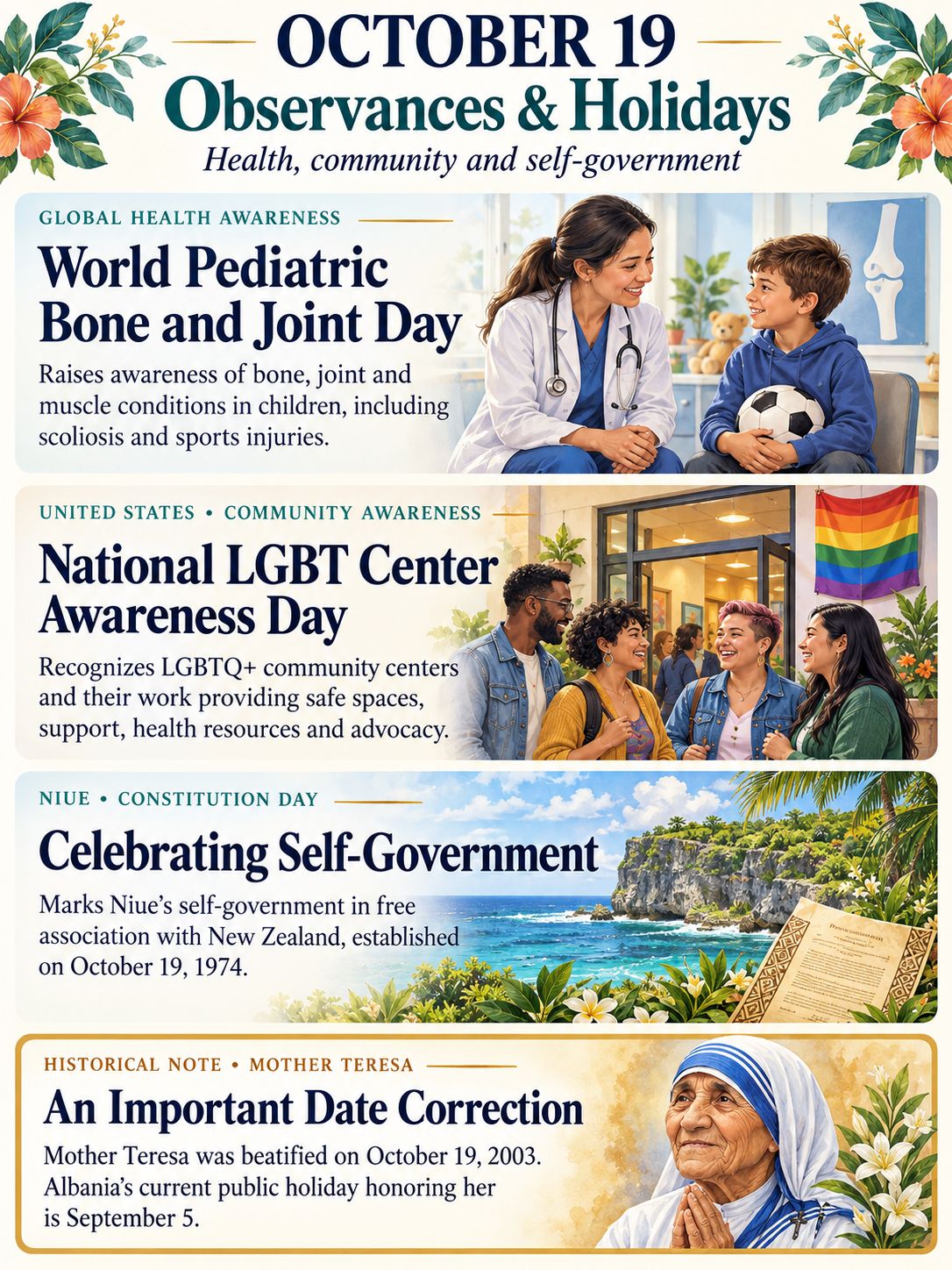
Globally, October 19 is marked by several observances that promote health, community awareness, and national pride.
| Observance | Focus Area | Why It Matters |
| World Pediatric Bone and Joint Day | Global Health | Highlights the importance of musculoskeletal health in children. It focuses on early diagnosis and treatment of conditions like scoliosis and sports injuries in growing bodies. |
| National LGBT Center Awareness Day | Human Rights | Celebrated to honor the community centers worldwide that provide crucial safe spaces, health services, and advocacy for the LGBTQ+ community. |
| Constitution Day (Niue) | National Independence | Celebrates the self-government of Niue in free association with New Zealand, established in 1974. |
| Mother Teresa Day (Albania) | National Holiday | A public holiday in Albania honoring the life, legacy, and humanitarian work of the iconic nun of Albanian descent. |
Global History
Beyond the subcontinent, October 19 has been the stage for military surrenders, scientific discoveries, and economic shocks across the globe.
United States
-
1781 (The Siege of Yorktown): In one of the most pivotal moments in world history, British General Lord Cornwallis formally surrendered his 7,000-man army to General George Washington and the French forces at Yorktown, Virginia. This effectively ended the American Revolutionary War, securing the independence of the United States.
-
1987 (“Black Monday”): The global stock markets suffered a historic crash. The Dow Jones Industrial Average plummeted by a staggering 22.6% in a single day, sending shockwaves through the global economy.
Russia
-
1812 (Napoleon’s Retreat): Realizing that his army could not survive the brutal Russian winter in the burned, deserted city of Moscow, Napoleon Bonaparte ordered the retreat of his Grand Army. This catastrophic withdrawal marked the beginning of the end for the French Empire.
China & Tibet
-
1950 (Battle of Chamdo): The Chinese People’s Liberation Army captured the city of Chamdo, effectively defeating the Tibetan army. This geopolitical shift led to the eventual incorporation of Tibet into the People’s Republic of China.
United Kingdom
-
1989 (The Guildford Four): The British justice system overturned the convictions of the “Guildford Four”—four innocent people who had spent 15 years in prison after being wrongfully convicted of the 1974 IRA pub bombings. It remains one of the most famous miscarriages of justice in UK history.
Europe & Middle East
-
1914 (World War I): The First Battle of Ypres commenced in Belgium. It was a fierce, grinding conflict that firmly established the brutal trench warfare that would define the Western Front for the next four years.
-
2005 (Saddam Hussein’s Trial): The trial of deposed Iraqi dictator Saddam Hussein began in Baghdad. He was charged with crimes against humanity for the 1982 massacre of 148 Shiites in the town of Dujail.
Rest of the World (Asia, Africa & South America)
-
1954 (Mountaineering Milestone): Cho Oyu, the sixth-highest mountain in the world located in the Himalayas, was successfully summited for the first time by an Austrian expedition alongside Nepali Sherpa Pasang Dawa Lama.
-
1986 (Aviation Tragedy in Mozambique): Mozambican President Samora Machel and 33 others died when their Soviet-built aircraft crashed under mysterious circumstances near the South African border, deeply impacting the political landscape of Southern Africa.
Notable Births & Deaths (Global)
History is ultimately shaped by the people who live it. Here are some of the most influential figures who entered or departed this world on October 19.
Famous Births
| Name | Year | Nationality | Legacy / Claim to Fame |
| John le Carré | 1931 | British | Master of the espionage novel; a former intelligence officer whose books defined Cold War spy fiction. |
| John Lithgow | 1945 | American | Highly versatile, award-winning actor known for his work in theater, film, and television (e.g., 3rd Rock from the Sun, The Crown). |
| Evander Holyfield | 1962 | American | Legendary professional boxer; the only four-time world heavyweight champion in boxing history. |
| Yakubu Gowon | 1934 | Nigerian | The third Head of State of Nigeria; led the country through the tragic and deeply consequential Nigerian Civil War (Biafran War). |
Famous Deaths
| Name | Year | Nationality | Cause / Legacy |
| Jonathan Swift | 1745 | Anglo-Irish | Literary giant and satirist, famous for writing Gulliver’s Travels. He is regarded as one of the greatest prose satirists in the English language. |
| King John | 1216 | English | King of England who famously signed the Magna Carta under duress. He died of dysentery while campaigning in eastern England. |
| Ernest Rutherford | 1937 | New Zealander | The “father of nuclear physics.” He discovered the concept of the radioactive half-life and became the first person to deliberately transmute one element into another. |
“Did You Know?” Trivia
Looking for a fascinating conversation starter? Here are three obscure but highly impactful facts related to October 19:
-
The Dawn of American Football Rules: On October 19, 1873, long before the multi-billion dollar NFL existed, representatives from Yale, Princeton, Columbia, and Rutgers universities gathered in New York to draft the very first unified set of rules for American football.
-
The Cure for Tuberculosis: On this exact date in 1943, researchers at Rutgers University successfully isolated streptomycin. This groundbreaking medical discovery became the very first antibiotic capable of treating the deadly disease tuberculosis.
-
The Original “Doughnut Run”: To boost the morale of American soldiers fighting in the muddy trenches of France during World War I, Salvation Army volunteers—dubbed the “Doughnut Lassies”—fried and served the very first wartime doughnuts on October 19, 1917.
Quote of the Day
“Vision is the art of seeing what is invisible to others.”
— Jonathan Swift (Died on this day, October 19, 1745)
Final Thoughts
October 19 serves as a profound reminder of how deeply interconnected global history is. It is a date that witnessed the end of colonial rule in America, the tragic retreat of imperial forces in Russia, scientific breakthroughs that saved millions of lives, and the birth of literary and sporting legends.
Whether we are looking at the resilient independence struggles of the Bangalee sphere, or the shifting geopolitical borders of the 20th century, history is never just a list of dates. It is a continuous narrative of human struggle, innovation, and survival. By looking back at what happened “On This Day,” we gain a much clearer understanding of the complex world we navigate today.