October 12 is a day filled with fascinating moments in history, remarkable achievements, and memorable milestones from around the world. From major political developments and groundbreaking discoveries to famous birthdays and the deaths of influential figures, this date has witnessed events that helped shape our world. Whether you enjoy exploring historical facts, learning about notable personalities, or discovering important global events, On This Day, October 12, offers plenty of stories worth revisiting.
In this article, we explore the key historical events, famous birthdays, notable deaths, and significant milestones associated with October 12.
October 12 at a Glance: Quick Historical Timeline
For readers who want to grasp the sheer weight of this date instantly, here is a quick overview of some of the most pivotal moments that occurred on October 12.
| Year | Event or Milestone | Category |
| 1492 | Christopher Columbus makes landfall in the Bahamas, beginning European colonization. | Global History |
| 1537 | King Edward VI of England is born. | Famous Births |
| 1810 | The first-ever Oktoberfest is celebrated in Munich, Bavaria. | Cultural History |
| 1870 | Confederate General Robert E. Lee passes away at age 63. | Famous Deaths |
| 1915 | British nurse Edith Cavell is executed by a German firing squad in WWI. | War History |
| 1945 | Desmond Doss becomes the first conscientious objector to win the Medal of Honor. | Military History |
| 1960 | Nikita Khrushchev pounds his shoe on a desk at the United Nations General Assembly. | Cold War Politics |
| 1964 | The Soviet Union launches Voskhod 1, the first multi-person spacecraft. | Space Exploration |
| 1990 | South Dakota becomes the first US state to rename Columbus Day to “Native American Day”. | Civil Rights |
| 1997 | Legendary folk singer John Denver dies in a tragic plane crash. | Famous Deaths |
The Bangalee Sphere & South Asia: Regional Milestones
While Western history books often dominate the “On This Day” narratives, South Asia—particularly the Bangalee sphere encompassing modern-day Bangladesh and India’s West Bengal—holds incredible historical weight on October 12.
Key Historical Events in South Asia
-
1871 – The Criminal Tribes Act: On this day, the British colonial government enacted one of its most oppressive pieces of legislation in the Indian subcontinent: the Criminal Tribes Act. This draconian law arbitrarily categorized dozens of nomadic and indigenous communities as “criminal by birth.” It subjected millions of innocent people to severe surveillance, restricted their movements, and embedded a deep societal stigma that marginalized these communities for generations.
-
1997 – Queen Elizabeth II Visits India: Commemorating the 50th anniversary of India’s independence from British colonial rule, Queen Elizabeth II and Prince Philip arrived in New Delhi. The state visit was a complex diplomatic mission, balancing modern partnerships with the heavy ghosts of colonial history.
Notable South Asian Births
-
Muhammad Shamsul Huq (1912): Born on October 12, 1912, Muhammad Shamsul Huq was a highly revered Bangladeshi academic, visionary educator, and diplomat. He later served as the Minister of Foreign Affairs for Bangladesh. His lifelong dedication to education reform and international diplomacy played a crucial role in shaping the newly independent nation’s educational infrastructure and foreign policy during the late 20th century.
-
Vijay Merchant (1911): Born in Bombay (now Mumbai), Vijay Merchant is widely regarded as one of the greatest batsmen in the history of Indian cricket. Boasting a first-class batting average that is second only to the legendary Don Bradman, Merchant’s flawless technique and run-scoring appetite made him a national sports hero in the pre-independence era.
Notable South Asian Deaths
-
Dr. Ram Manohar Lohia (1967): The “Dauntless Dr. Lohia,” a fiery freedom fighter, social reformer, and founder of the Praja Socialist Party, passed away. His anti-caste, socialist ideologies, and fierce advocacy for marginalized classes deeply shaped the landscape of modern Indian political thought.
Global Historical Events
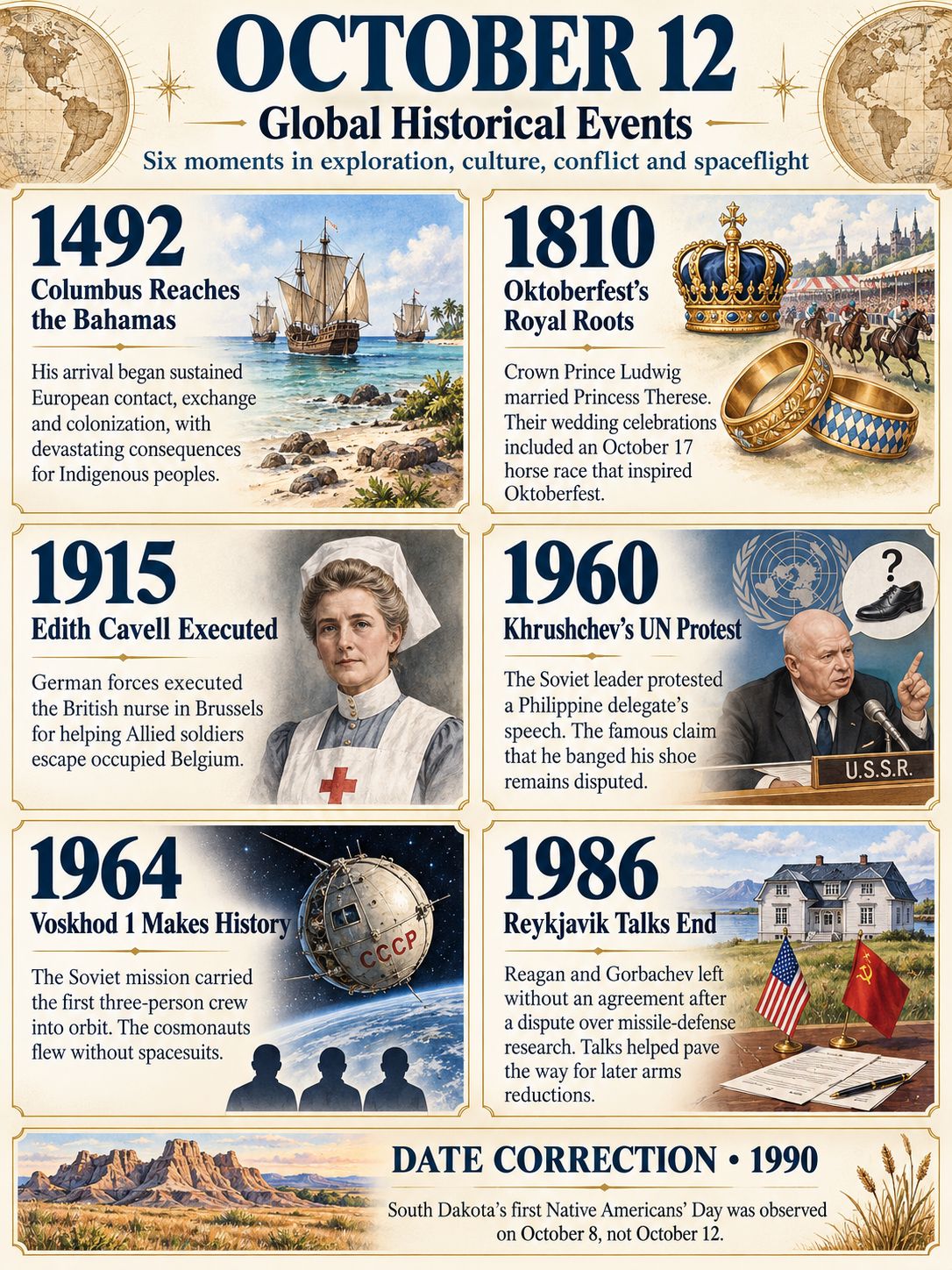
When we zoom out to the international stage, October 12 proves to be a day of exploration, political theater, and technological triumph.
1492: Christopher Columbus Reaches the “New World”
Perhaps the most famous event associated with this date occurred in 1492, when Italian explorer Christopher Columbus, sailing under the flag of Spain, sighted land in the Bahamas after a grueling 33-day voyage across the uncharted Atlantic Ocean. Columbus believed he had discovered a new western sea route to Asia. Instead, his arrival marked the beginning of sustained European contact with the Americas.
The historical impact of this day cannot be overstated. It initiated the “Columbian Exchange”—a massive transfer of plants, animals, culture, populations, technology, and ideas between the Americas and the Old World. However, it also marked the beginning of a tragic era of colonization, bringing devastating diseases, exploitation, and catastrophic population decline to the Indigenous peoples of the Americas.
1810: The Royal Origin of Oktoberfest
If you enjoy the lively celebrations of Oktoberfest, you have October 12 to thank. On this day in 1810, Bavarian Crown Prince Ludwig (who would later become King Ludwig I) married Princess Therese of Saxony-Hildburghausen. The citizens of Munich were invited to attend the festivities held on the fields in front of the city gates to celebrate the royal event. The celebration was so successful that it was repeated the following year, eventually evolving into the world’s largest Volkfest (beer festival and travelling funfair), which is now celebrated globally.
1915: The Execution of British Nurse Edith Cavell
During the dark days of World War I, October 12 marked a moment of profound tragedy and heroism. British nurse Edith Cavell, who was serving in German-occupied Belgium, was executed by a German firing squad in Brussels. Her crime? She had bravely helped hundreds of Allied soldiers escape the occupied territory to the neutral Netherlands.
Her death sent shockwaves through the international community. Rather than intimidating the Allies, her execution transformed her into a powerful martyr. Her famous last words, spoken the night before her death—”Patriotism is not enough. I must have no hatred or bitterness towards anyone”—cemented her legacy as a symbol of immense courage and moral fortitude.
1960: Khrushchev’s Infamous Shoe-Banging Incident
In the realm of Cold War politics, October 12 delivered one of the most bizarre and iconic moments in United Nations history. During a heated debate at the UN General Assembly in New York, Soviet Premier Nikita Khrushchev reportedly took off his shoe and pounded it on his desk.
He did this in furious protest against a speech by a Philippine delegate who was criticizing Soviet imperialism in Eastern Europe. Whether he merely brandished the shoe or aggressively slammed it on the mahogany desk remains a subject of minor historical debate, but the image of the fiery Soviet leader losing his temper became a lasting symbol of the volatile tensions of the era.
1964: USSR Launches Voskhod 1 (Without Spacesuits)
The Space Race between the United States and the Soviet Union saw a major milestone on October 12, 1964, when the USSR launched the Voskhod 1. This mission was historically significant for several reasons: it was the first spaceflight to carry a multi-person crew (three cosmonauts) into orbit.
More astonishingly, the spacecraft was so cramped that the crew flew without wearing spacesuits—a massive and perilous risk taken by the Soviet space program to beat the American Gemini project to a multi-crew launch. The gamble paid off, handing the Soviets another massive propaganda victory in the early years of the space race.
1986: US-Soviet Arms Talks Collapse in Iceland
On October 12, 1986, the high-stakes Reykjavik Summit between U.S. President Ronald Reagan and Soviet leader Mikhail Gorbachev dramatically collapsed. The two leaders had come remarkably close to an unprecedented agreement to eliminate all nuclear weapons. However, the talks broke down at the last minute because Reagan refused to abandon his Strategic Defense Initiative (SDI), widely mocked as “Star Wars”. Although deemed a failure that day, the groundwork laid during this summit eventually led to the signing of the historic Intermediate-Range Nuclear Forces (INF) Treaty the following year.
1990: South Dakota Renames Columbus Day
Reflecting a modern shift in how history is remembered, South Dakota made a landmark decision on October 12, 1990. The state officially became the first in the United States to rename the federal “Columbus Day” holiday to “Native American Day”. This legislative move sparked a nationwide conversation, paving the way for the broader Indigenous Peoples’ Day movement that seeks to honor the original inhabitants of the Americas rather than the man who initiated their colonization.
Notable Births on October 12
October 12 has been the birthplace of kings, visionary artists, tech pioneers, and beloved entertainers.
| Name | Year Born | Nationality | Famous For |
| King Edward VI | 1537 | English | King of England, son of Henry VIII. |
| Ralph Vaughan Williams | 1872 | English | Highly influential classical composer and educator. |
| Aleister Crowley | 1875 | English | Controversial occultist, writer, and magician. |
| Luciano Pavarotti | 1935 | Italian | One of the most acclaimed operatic tenors of all time. |
| Hugh Jackman | 1968 | Australian | Award-winning actor famously known for playing Wolverine. |
| Josh Hutcherson | 1992 | American | Actor famous for his role in The Hunger Games. |
In-Depth Look at Famous Birthdays:
-
King Edward VI (1537): The highly anticipated male heir to King Henry VIII and Jane Seymour. Though his reign was short-lived (he died at age 15), his time on the throne was critical, as it marked the firm establishment of Protestantism in England.
-
Luciano Pavarotti (1935): Born in Modena, Italy, Pavarotti grew up to become a global superstar whose voice transcended the traditional boundaries of classical opera. With his immense charisma and legendary performances alongside “The Three Tenors,” he brought operatic music to the masses.
-
Hugh Jackman (1968): This beloved Australian actor and producer has showcased incredible range throughout his career. From his gritty, career-defining role as Logan/Wolverine in the X-Men film series to his stunning musical performances in Les Misérables and The Greatest Showman, Jackman remains one of Hollywood’s most versatile talents.
Notable Deaths on October 12
History also calls on us to remember the iconic figures who passed away on this date, leaving behind lasting legacies in military history, music, sports, and entertainment.
| Name | Year Died | Nationality | Famous For / Cause of Death |
| Robert E. Lee | 1870 | American | Commander of the Confederate Army; died at age 63. |
| Edith Cavell | 1915 | British | WWI heroic nurse; executed by firing squad. |
| Tom Mix | 1940 | American | Early Western film star; died in a tragic car accident. |
| John Denver | 1997 | American | Beloved folk singer-songwriter; died in a solo plane crash. |
| Wilt Chamberlain | 1999 | American | Legendary basketball player; died of heart failure. |
| Conchata Ferrell | 2020 | American | Beloved actress (Two and a Half Men); died of cardiac arrest. |
In-Depth Look at Famous Deaths:
-
John Denver (1997): The music world wept when John Denver, the legendary acoustic folk singer known for timeless hits like “Take Me Home, Country Roads” and “Rocky Mountain High,” died at age 53. An experienced pilot, Denver died instantly when his experimental, light aircraft crashed into Monterey Bay, California.
-
Wilt Chamberlain (1999): One of the most dominant forces in the history of American sports, Wilt Chamberlain, passed away on this day. Known as “Wilt the Stilt,” he famously scored 100 points in a single NBA game—a record that still stands today as one of the most unbreakable feats in sports history.
-
Tom Mix (1940): Before John Wayne or Clint Eastwood, there was Tom Mix. As Hollywood’s first true Western megastar, Mix appeared in nearly 300 films. He tragically died when his Cord Phaeton convertible plunged into a dry wash in Arizona, a site now marked by a famous historical monument.
International Observances & Holidays
October 12 is not just a day of historical reflection; it is also a day of active global observance and celebration.
-
World Arthritis Day: Established in 1996, this vital global awareness day aims to highlight the severe impact of rheumatic and musculoskeletal diseases (RMDs). It serves to educate the public, influence public policy, and support the millions of individuals living with chronic joint pain and mobility issues worldwide.
-
Fiesta Nacional de España (National Day of Spain): In Spain, October 12 is a massive national holiday. Also known as Día de la Hispanidad, it formally commemorates the anniversary of Christopher Columbus’s first arrival in the Americas, celebrating the expansive cultural and linguistic legacy of the Spanish-speaking world. The day is marked by grand military parades in Madrid attended by the Spanish King and the Prime Minister.
-
Independence Day (Equatorial Guinea): On the African continent, Equatorial Guinea erupts in celebration on October 12. This date marks the nation’s official independence from Spanish colonial rule, which was achieved in 1968.
“Did You Know?” October 12 Trivia
Want to impress your friends at your next dinner party? Here are three fascinating, lesser-known trivia facts about October 12:
-
A Conscientious Objector’s Ultimate Honor: On October 12, 1945, U.S. Army Private First Class Desmond T. Doss made unprecedented military history. He became the first conscientious objector to ever receive the Medal of Honor. Serving as a combat medic in the brutal Pacific theater of WWII, Doss single-handedly saved the lives of 75 wounded infantrymen under heavy fire at Hacksaw Ridge—all without ever carrying a weapon.
-
Racial Tensions on the High Seas: On October 12, 1972, a major race riot erupted aboard the U.S. Navy aircraft carrier USS Kitty Hawk during the Vietnam War. Over 100 sailors were involved in violent clashes that resulted in nearly 50 injuries. The severe incident exposed the deep, systemic racial divides operating within the U.S. military at the time and forced the Navy to heavily restructure its race relations policies.
-
Alcatraz Gets an Upgrade: Long before it became a famous tourist attraction, the notorious island in the San Francisco Bay was a military fort. On October 12, 1933, the United States Department of Justice officially acquired the United States Disciplinary Barracks Pacific Branch on Alcatraz. They immediately began plans to convert the military citadel into the infamous Alcatraz Federal Penitentiary—the inescapable maximum-security prison designed for America’s worst gangsters.
Final Thoughts
The tapestry of October 12 is woven with threads of incredible discovery, royal celebration, artistic brilliance, and sobering tragedies. By looking back at the events of this day, we can map the fascinating trajectory of human history. From the waves crashing against the shores of the Bahamas in 1492 to the fiery debates of the Cold War UN floor in 1960, the ghosts of October 12 continue to shape the world we inhabit today.
Whether we are celebrating the birth of vocal powerhouses like Luciano Pavarotti, mourning the loss of icons like John Denver, or recognizing the ongoing fight for civil rights via Indigenous Peoples’ Day, this date serves as a powerful reminder of how far we have come as a global society—and the complex histories we carry with us into the future.