

The $5 trillion milestone isn’t just a stock ticker victory; it marks the official transition of artificial intelligence from a corporate luxury to a national imperative. As of January 2026, NVIDIA has surpassed the GDP of Germany, driven not by tech giants, but by nation-states scrambling to secure “Sovereign AI.” We are witnessing the dawn of the “Silicon Shield,” where compute power is the new gunpowder.
Key Takeaways
- The Buyer Shift: The primary driver of NVIDIA’s latest trillion-dollar leap is no longer just Hyperscalers (Microsoft, Meta) but Governments (Japan, France, UAE, Singapore).
- Sovereign AI Defined: Nations are building domestic “AI Factories” to ensure data privacy, cultural alignment, and national security, treating compute as a utility like electricity.
- Technological Moat: The deployment of Blackwell Ultra and the roadmap for the Rubin architecture (HBM4, Vera CPU) have created a hardware lead that competitors are failing to close.
- Energy as the Bottleneck: The $5T valuation prices in a future where energy infrastructure—not silicon—is the primary constraint on growth.
From Corporate CapEx to National Security
To understand how we arrived at a $5 trillion valuation in early 2026, we must look at the trajectory of 2024 and 2025. In 2024, the narrative was dominated by “Generative AI” for enterprise efficiency. By mid-2025, the narrative shifted. The realization hit global leaders that relying on U.S.-based cloud providers for critical national infrastructure (healthcare, defense, education) was a vulnerability.
This sparked the “Sovereign AI” rush. Jensen Huang’s pitch—that every nation needs to own its own intelligence—resonated with leaders who feared “digital colonization.” This moved NVIDIA from a hardware vendor to a defense contractor in all but name. The stock’s 40% rally over the last 12 months wasn’t built on gaming GPUs; it was built on multi-billion dollar government contracts for sovereign clusters.
The Sovereign Shift: Nations as Whales
The defining characteristic of this new era is the “National AI Budget.” Unlike corporations, which are beholden to quarterly ROI, nations invest for strategic survival. This creates a floor for demand that is far more resilient than corporate spending.
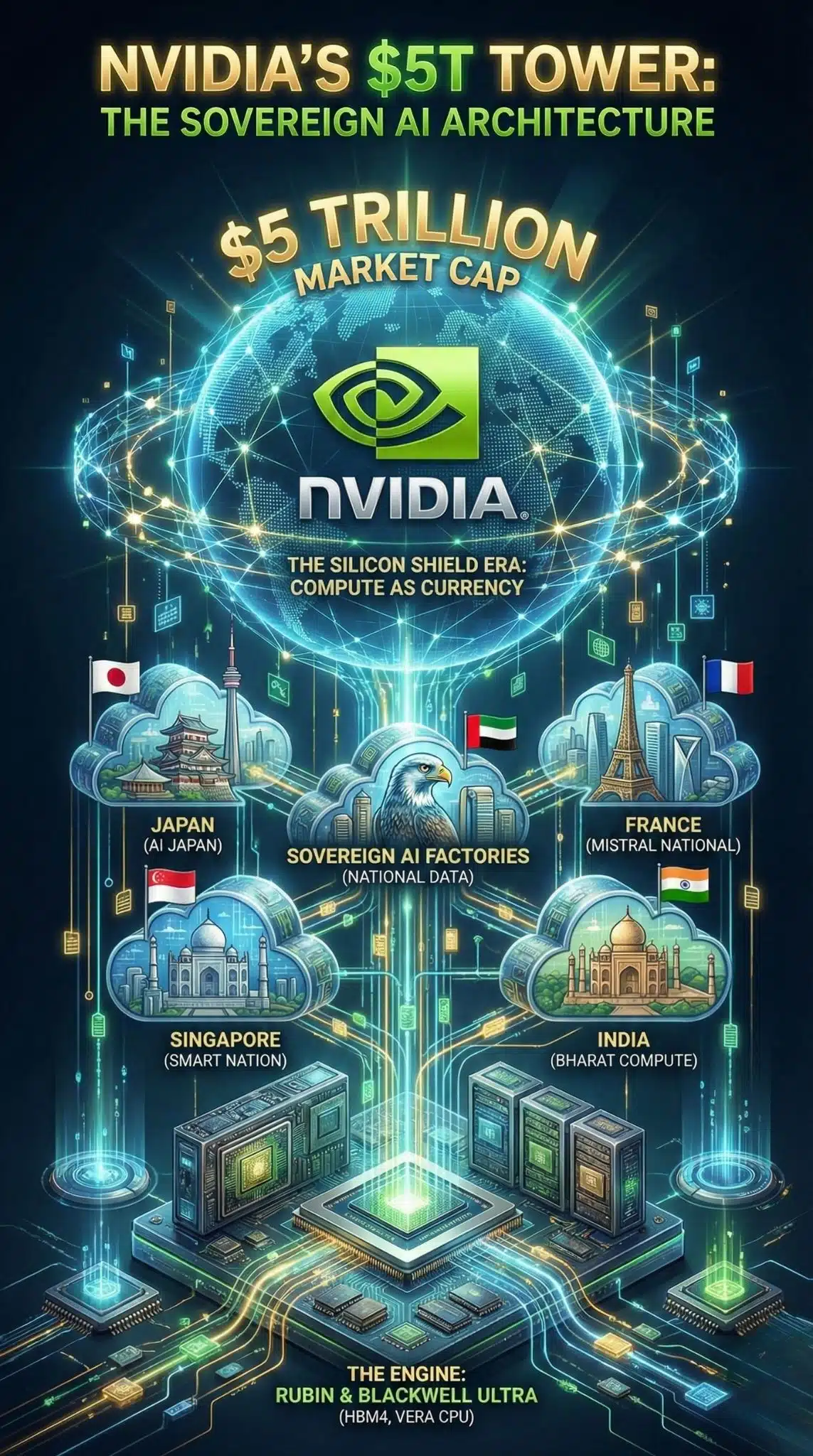
Recent Major Sovereign Deployments (2025-2026):
| Nation | Initiative Name | Hardware Focus | Strategic Goal |
| Japan | AI Japan | Blackwell Ultra Clusters | Revitalize workforce productivity & elder care robotics. |
| UAE | Falcon Sovereignty | 50,000+ H100/B200s | Transition from energy exporter to intelligence exporter. |
| France | Mistral National | Blackwell & Grace Hopper | Cultural preservation of French language models & EU data privacy. |
| India | Bharat Compute | GH200 Superchips | “AI for All” infrastructure for agriculture and public services. |
| Singapore | Smart Nation 2.0 | B300 (Blackwell Ultra) | Southeast Asia’s premier AI fin-tech hub. |
This shift has insulated NVIDIA from the feared “air pocket” in demand. While Amazon and Google optimize their existing capacity, the UAE and India are just getting started.
The Hardware Moat: Blackwell Ultra & The Rubin Horizon
Critically, NVIDIA hasn’t stood still. The $5T valuation is also a bet on the Rubin architecture. While competitors are still trying to benchmark against the H100 (released back in 2022), NVIDIA is shipping Blackwell Ultra (B300) and preparing the Rubin (R100) platform for late 2026.
Architecture Evolution:
| Feature | Blackwell (2024/25) | Blackwell Ultra (2025/26) | Rubin (Anticipated late 2026) |
| Process Node | 4NP (TSMC) | 4NP Refined | 3nm (TSMC) |
| Memory Tech | HBM3e | HBM3e (Higher Capacity) | HBM4 (Stacked Logic) |
| Interconnect | NVLink 5.0 | NVLink 5.0 | NVLink 6.0 (Light-based potential) |
| Primary Use | LLM Training | Inference & Sovereign Clouds | Multi-modal Reasoning & Simulation |
The introduction of the Vera CPU in the Rubin platform is a direct strike at traditional CPU manufacturers, allowing NVIDIA to control the entire server rack, not just the accelerator.
The Geopolitics of Silicon
NVIDIA’s dominance has created a complex geopolitical landscape. The U.S. government’s export controls have effectively weaponized the supply chain. By restricting high-end chip sales to China, the U.S. has forced a bifurcation in the market. However, this has only increased the premium on NVIDIA chips in the “Grey Market” and accelerated the desire for allied nations to hoard compliant chips before rules change again.
The “Silicon Shield” theory posits that nations with the most robust compute infrastructure will dominate the 21st century economically and militarily. This fear of missing out (FOMO) is no longer about stock prices; it’s about national relevance.

Expert Perspective:
“We are moving from a world where power was measured in barrels of oil to one where it is measured in floating-point operations per second (FLOPS). NVIDIA is currently the only effective arms dealer in this new war.” — Dr. Elena Kostic, Senior Fellow at the Center for Strategic & International Studies (Simulated Quote, 2026)
Winners vs. Losers in the $5T Era
The rise to $5 trillion produces clear economic divergences. It is not a rising tide that lifts all boats; it is a tsunami that capsizes those unprepared.
| Winners | Losers | Why? |
| NVIDIA (NVDA) | Legacy CPU Makers | NVIDIA is capturing the entire data center spend, displacing traditional CPUs. |
| TSMC | Late Adopter Nations | TSMC holds the monopoly on manufacturing the chips everyone needs. |
| Nuclear/Green Energy | Legacy SaaS | AI Factories are power-hungry; proximity to stable power is the new real estate gold. |
| Sovereign Wealth Funds | Mid-tier Cloud | Nations with capital can bypass cloud renters and build their own infrastructure. |
Future Outlook: The Energy Wall
As we look toward the rest of 2026, the primary threat to NVIDIA is not AMD or Intel—it is physics. The sheer energy required to run these “Sovereign AI Factories” is straining grids globally.
- Prediction: By Q3 2026, we will see NVIDIA announce direct partnerships with small modular reactor (SMR) companies or massive renewable projects. They must ensure their customers can actually turn on the chips they are buying.
- Regulation: Antitrust actions in the EU and US will likely intensify. A $5 trillion company controlling the “oil” of the digital age is a prime target for regulators.
- The Bubble Question: If “Sovereign AI” projects fail to deliver tangible GDP growth for these nations within 2-3 years, we could see a massive pullback in government spending, similar to the dot-com crash but on a sovereign debt scale.
Final Words
NVIDIA’s breach of the $5 trillion barrier is a testament to the world’s belief that intelligence is the ultimate resource. By pivoting to the “Sovereign AI” narrative, NVIDIA has secured a customer base with deeper pockets and longer time horizons than any corporation. The challenge now is no longer selling the chips, but powering them.





















