If I had to define a North Star Metric for subscription apps in one sentence, I would put it this way: it measures how many customers repeatedly receive the value they pay for.
That is different from measuring revenue, downloads, or total subscribers. Those numbers matter, but none proves that the product is working for its customers. Someone can subscribe and stop using the app days later. An annual plan can keep producing revenue long after the customer has disengaged.
A useful North Star Metric gives an earlier, more honest signal. It connects meaningful product use with the outcomes a subscription business needs: retention, renewals, and sustainable revenue.
What Does a North Star Metric Mean?
A North Star Metric, or NSM, is the primary product metric that best represents the value customers receive. It should also have a credible relationship with long-term business growth.
I think of it as a bridge. On one side is the outcome the customer wants. On the other are retention and recurring revenue. The North Star shows whether the product is delivering enough value to make those business results possible.
A strong North Star Metric should:
- Reflect a meaningful customer outcome
- Move early enough to guide product decisions
- Be something the team can influence
- Have a clear, consistent definition
- Match the product’s natural usage pattern
- Resist inflation through empty activity
- Be understandable across the company
Most products need one primary North Star, supported by input, outcome, and guardrail metrics. A business with genuinely separate products or customer groups may need more than one. Giving every team its own “North Star,” however, removes the shared focus the metric is meant to create.
Why Subscription Apps Need a Different Lens
Subscription businesses depend on repeated value. The first payment is only the beginning. Customers must continue believing the app deserves their time, attention, and money.
The difficulty is that financial data often arrives late. Revenue may look healthy while customers are already disengaging. Churn may not appear until the next weekly, monthly, or annual renewal. By the time revenue falls, the product problem may have been present for months.
That is why I look for a behavior that happens before renewal and demonstrates real value. In a fitness app, that might be completing planned workouts. In a design app, it could be finishing and exporting useful work. In a backup service, it may be completing successful protection cycles without the customer opening the app at all.
That last example is important. More activity is not always better. Security, backup, tax, and travel apps can deliver substantial value through occasional or passive use. The goal is to measure success, not engagement for its own sake.
A Practical Starting Model for Most Subscription Apps
For many subscription apps, I would start with this structure:
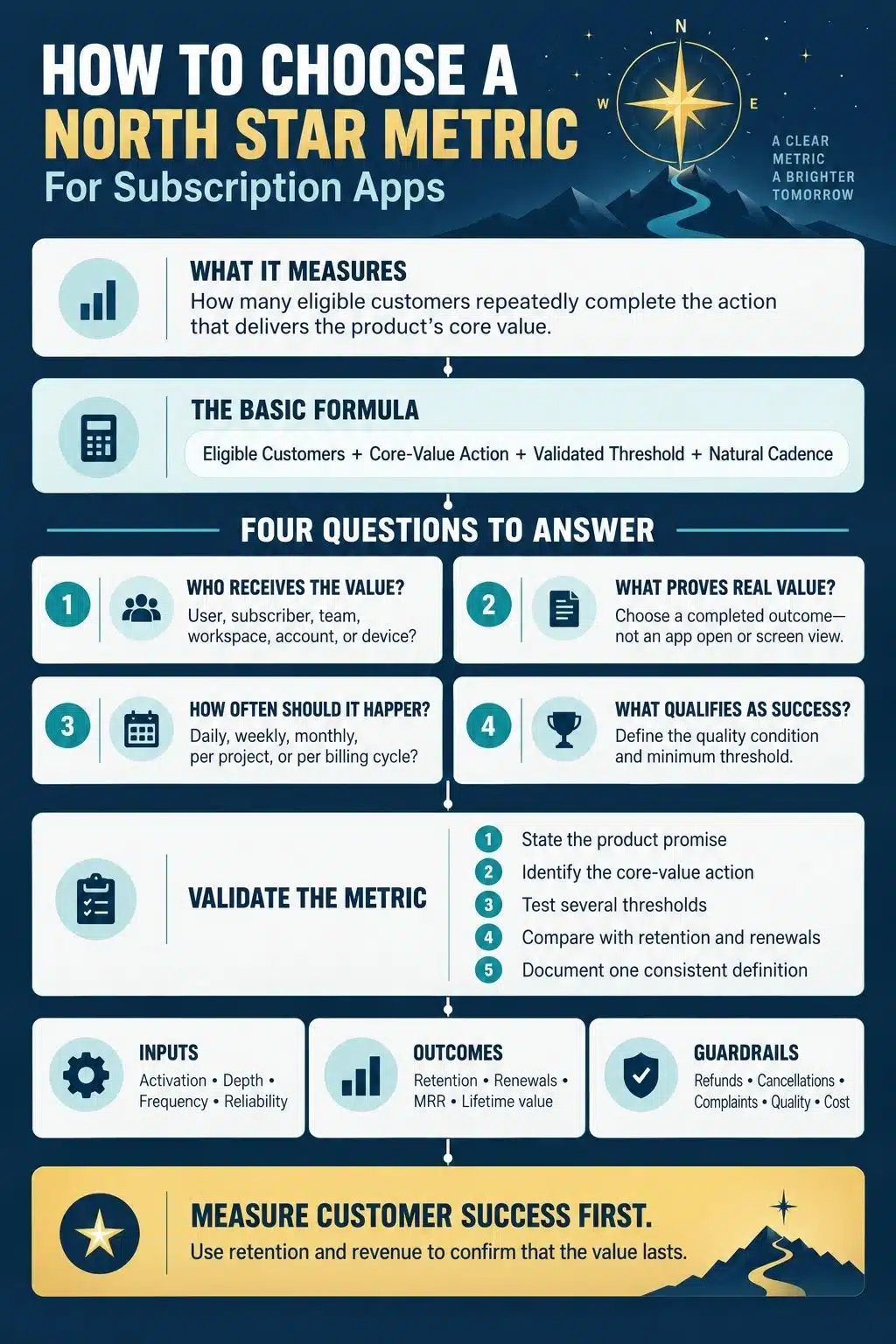
The number of unique users, subscribers, or accounts that complete a qualifying core-value action at the right frequency within a defined period.
In simple terms:
North Star Metric = Unique eligible customers reaching the validated core-value threshold during the measurement period
This is a working model, not a standardized industry formula. Each part must fit the product.
Choose the Right Unit
The unit might be a user, paying subscriber, household, team, workspace, customer account, or protected device.
A meditation app will probably measure individuals. A collaborative project-management app may learn more from active workspaces. A family subscription might measure value at the household level while tracking individual member activity as an input.
Define a Genuine Value Action
The event should represent a useful result, not a click or screen view.
“Started a workout” is weaker than “completed a planned workout.” “Opened the editor” is weaker than “created and exported a project.” For an AI tool, “generated an output” may be less meaningful than “accepted, saved, exported, or used the output.”
The closer the event is to the result the customer came for, the more informative the metric becomes.
Match the Customer’s Natural Cadence
The right period may be daily, weekly, monthly, per project, or per billing cycle. Daily activity makes sense for some habit products, but it should never be the automatic choice.
Forcing a monthly budgeting app or annual tax app into a daily-use model rewards the wrong behavior. In some productivity tools, more time spent in the app may signal friction rather than value.
Track Both the Count and the Rate
The count shows the scale of value delivered. The rate shows the share of eligible customers reaching that value.
- Core-value customer count: How many customers reached the desired outcome?
- Core-value customer rate: What percentage of eligible customers reached it?
I would monitor both. A growing count can hide poor-quality acquisition, while a rising rate can look impressive even as the total customer base shrinks.
North Star Metric Examples by Subscription App Type
These examples are starting hypotheses. Every app still needs to validate its action, threshold, and time window against real customer behavior.
| Subscription app | Possible North Star Metric |
| Fitness app | Weekly paying members completing their planned workouts |
| Meditation app | Weekly members completing meaningful sessions on multiple days |
| Language-learning app | Weekly learners completing lessons that meet a defined success condition |
| Streaming app | Monthly members completing qualified listening or viewing sessions |
| News app | Weekly subscribers completing meaningful reads on several days |
| Productivity app | Weekly users or workspaces completing and saving, sharing, or exporting finished work |
| Team collaboration app | Weekly workspaces where multiple members complete the core collaborative workflow |
| Backup or security app | Monthly users or devices completing successful protection cycles |
| Budgeting app | Monthly users reviewing an insight and completing a relevant financial action |
| AI creation app | Weekly creators producing an output and then accepting, saving, exporting, or using it |
Specific wording matters. “Weekly active users” tells me little unless “active” has a meaningful definition. “Weekly learners completing three successful practice days” identifies the user, action, quality threshold, and period.
Why Common Subscription Metrics Usually Are Not the North Star
Important metrics do not automatically make good North Stars. Each of the following belongs on a subscription dashboard, but each answers a different question.
| Metric | What it tells you | Why it is usually not the product North Star |
| Monthly recurring revenue (MRR) | The normalized monthly value of recurring subscriptions | It is a financial outcome and can rise through pricing or acquisition even as product engagement weakens. |
| Active subscribers | The size of the current subscription base | A valid subscription or continuing access does not prove that the customer is receiving value. |
| DAU, WAU, or MAU | How many users meet an activity definition | If “active” means opening the app, the metric can reward habitual checking without measuring a useful result. |
| Trial-to-paid conversion | How effectively trials become paid subscriptions | It says little about whether those customers will activate, renew, or stay. |
| Retention or churn | Whether customers remain or leave | These are powerful outcome measures, but they often appear after the behavior product teams need to improve. |
| Customer lifetime value | The estimated or realized economic value of a customer relationship | It takes time to mature, often relies on assumptions, and is too financially removed from daily product value. |
Any one of these can become a strategic focus in the right situation. The distinction is that a product North Star should reveal value delivery early enough for a team to act on it.
Retention deserves special care. It is one of the best tests of whether a proposed North Star matters, but its timing depends on the plan. An annual customer may disengage long before a renewal metric reflects it. Churn also needs context: a failed payment is not the same product signal as a customer choosing to leave.
How I Would Choose the Right North Star Metric
The process should begin with the customer, not the analytics dashboard.
1. State the Product Promise
Complete this sentence in plain language: “For this customer, our app helps them achieve ______ by ______.”
If the promise is vague, the metric will be vague too.
2. Find the Moment of Real Value
Identify the point at which the customer gets a meaningful return on their time, effort, attention, data, or money.
That moment may happen inside the app, such as completing a lesson. It may also happen outside it, such as following a workout plan, arriving at a booked destination, or successfully restoring a file.
3. Set the Unit and Time Window
Decide who receives the value and how often a healthy customer should receive it. The billing cycle provides useful context, but it should not automatically dictate the usage window.
4. Test Several Candidate Definitions
There is rarely a magical threshold. Rather than declaring that “three actions per week” is correct, compare several plausible definitions.
For example, a language app could compare learners who complete one, three, or five successful lessons across different numbers of active days. Then test which pattern most consistently distinguishes durable customers from short-term visitors.
Compare each candidate with activation, trial conversion, first renewal, later renewals, and cohort retention. Include only customers who have actually had the opportunity to reach the outcome being measured. Check the relationship across plan lengths, customer maturity, acquisition channels, platforms, and important markets or segments.
5. Check for Causality and Unwanted Incentives
Correlation alone is not enough. Highly motivated customers may both use the app more and renew more. That does not mean extra notifications or forced sessions will create the same result.
Combine behavioral analysis with customer research and controlled experiments where practical. Ask whether making the core action easier or more successful improves retention without damaging satisfaction, quality, safety, or cost.
6. Write a Precise Metric Contract
Document:
- The exact event and success condition
- Who is eligible to be counted
- The threshold and measurement window
- How free, trial, paid, cancelled, grace-period, and expired states are handled
- How identities are joined across platforms
- The time zone and whether periods are rolling or calendar-based
- Which test, duplicate, failed, or automated events are excluded
- Who owns the definition
Without this contract, teams can report different numbers under the same name.
Support the North Star With Inputs and Guardrails
One metric cannot explain the whole business. I would pair the North Star with a small set of inputs:
- Breadth: How many suitable customers reach first value?
- Depth: How much meaningful value does each active customer receive?
- Frequency: Do customers return at the expected cadence?
- Efficiency: How quickly and reliably do they reach the outcome?
- Product health: Can the app deliver the outcome without crashes, errors, or excessive delay?
Retention, renewals, MRR, and lifetime value can then confirm whether that value produces a durable business.
Guardrails prevent a team from improving the headline number at the customer’s expense. Depending on the app, these may include refunds, cancellations, complaints, notification opt-outs, support demand, safety incidents, output quality, reliability, and cost per successful outcome.
This matters especially for AI subscription apps. More generations may look like growth, but not if outputs are routinely discarded, costs become unsustainable, or quality declines.
Measure the Value Before You Count the Revenue
The best North Star Metric for a subscription app is not the most impressive number in a report. It is the clearest measure of customers repeatedly achieving the outcome they came for.
For most apps, that means defining a qualified core-value action, matching it to the natural usage cadence, and counting the users or accounts that reach it. Retention and revenue then confirm whether that value lasts.
The first definition does not need to be perfect. It needs to be clear, testable, and honest. If it helps the team answer one question, Are more customers genuinely succeeding with the app?, it is doing its job.
Frequently Asked Questions on North Star Metric for Subscription Apps
1. Is MRR a good North Star Metric for a subscription app?
Usually not as the main product North Star. MRR is essential for understanding the business, but it does not show whether customers are actively receiving value. I would use a value-based behavioral metric as the North Star and keep MRR as a key outcome.
2. Can retention rate be the North Star Metric?
It can be, especially when retention is the company’s central strategic problem. In many products, however, retention is delayed and does not explain what customers value. A behavior that reliably predicts retention often gives the product team a faster signal.
3. Should a freemium app include free users in its North Star?
Yes, if free users meaningfully support conversion, referrals, content, or network effects. Still report free, trial, and paid segments separately so a large free audience cannot hide weak paid-user activation or renewal.
4. How do I choose the right activity threshold and time period?
Start with the product’s natural usage pattern, then test several thresholds against activation, retention, and renewal. There is no universal rule such as three sessions per week. The right definition is the simplest one that consistently identifies customers receiving durable value.
5. Can a subscription app have more than one North Star Metric?
Most individual products should have one primary North Star with supporting metrics. Separate North Stars can make sense for truly distinct products or customer groups. Multiple competing “main” metrics within one product usually create confusion.